CRM for chiropractors: how to manage patients, bookings and marketing
A CRM for chiropractors is a patient relationship management system built around...

Last Updated: Oct 13, 2026
An interview schedule template for qualitative research is a pre-written guide of open-ended questions, planned probes, and scripts that a researcher follows during each interview. It keeps every participant’s interview covering the same core ground. It also leaves room to follow the themes each person raises.
The free download below is a four-page semi-structured schedule you can print or fill in on screen. It runs in the order an interview does, from the consent preamble and warm-up questions through the core questions and probes to the closing script. It finishes with a page for recording and transcription notes.
A four-page PDF with a consent preamble and checklist, two warm-up questions, and ten core question slots with planned probes, plus two optional slots. It closes with a neutral probe bank, a closing script, and recording and transcription notes.
Download template
An interview schedule is a pre-written set of open-ended questions, planned probes, and scripts that keeps qualitative interviews consistent across participants.
Semi-structured schedules are the most common format because they hold the core questions steady while letting the interviewer follow new themes.
Most schedules need 8 to 12 core questions, each with two or three neutral probes written before the first interview.
The free PDF covers consent, warm-up questions, ten core question slots plus two optional ones, a probe bank, a closing script, and recording notes.
Practice management software like Pabau collects signed consent through digital forms and saves it to the patient’s record before each session.
An interview schedule is the researcher’s script for data collection. It lists the questions every participant will be asked, the follow-up probes planned for each one, and the wording for opening and closing the session. Participants can then be compared on the same core topics, even when each conversation takes its own route.
A qualitative schedule asks for narrative rather than numbers. Its questions invite participants to explain their experiences, perceptions, and reasoning in their own words. That is why the format is used so widely across psychology, sociology, healthcare, education, and social work research.
Many methods texts use “interview schedule” and “interview guide” interchangeably. Where authors do separate them, the schedule is the more structured of the two, and the questionnaire sits at the far end. The table shows how the three tools usually differ.
How tightly the schedule controls the conversation depends on the interview type. Qualitative studies use three.
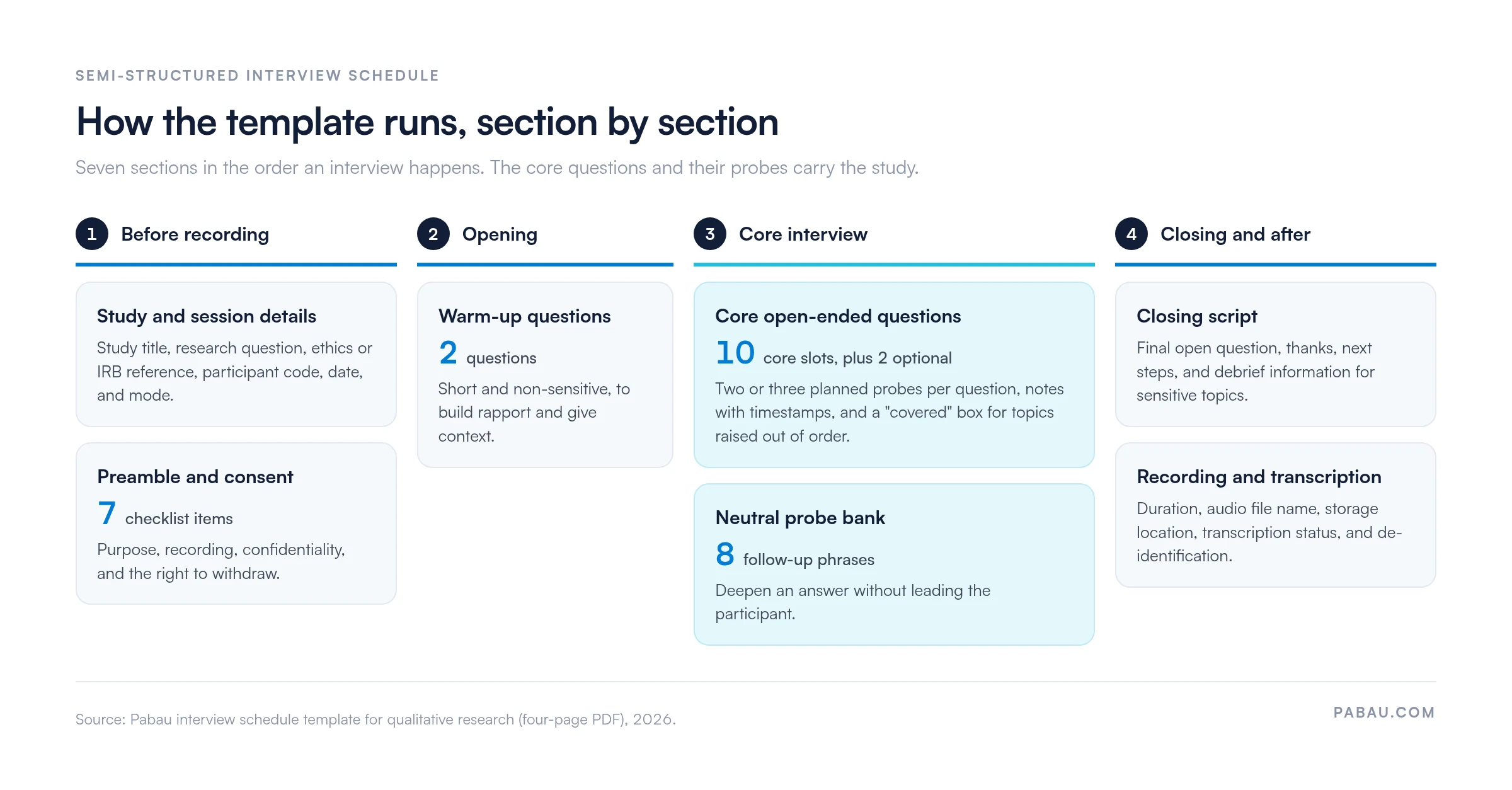
The PDF follows the running order of a semi-structured interview, as the diagram below shows. Gray example wording on each page shows what a finished entry looks like, so you can replace it with your own study’s questions.
Your questions decide the quality of the data. Open-ended questions let participants describe their experience in their own terms instead of choosing from categories you have set in advance.
These five steps take the template from download to analysis.
Below is a filled-in extract for a hypothetical study on how practitioners adopt a structured evaluation template. Each core question is open-ended, the probes are planned in advance, and the consent and closing wording match the sections of the download.
A strong schedule still depends on how the interview is run. These habits help you collect rich, trustworthy data and recognize data saturation, the point at which new interviews stop producing new themes.
Qualitative interviews often draw out sensitive or personal information, so ethical conduct is built into the schedule from the first page. Before any interview, obtain informed consent that states the study’s purpose, how data will be used, the limits of confidentiality, and the right to withdraw.
The preamble should also tell participants how data will be stored and how long it will be kept. Your institution or funder sets the retention period. Say whether quotes will be de-identified in publications, and how participants can ask to see or withdraw their data.
In the US, human-subjects research conducted or funded under the federal Common Rule needs IRB review or an exemption determination before it starts. Research with vulnerable groups, such as children or prisoners, carries extra protections. Check with your IRB or ethics committee before you recruit.
A practice that is a HIPAA covered entity has one more step when a study uses patients’ health information. Each participant usually signs a HIPAA authorization form, unless an IRB or privacy board waives that requirement.
After the interviews, de-identify every transcript by removing names and identifying details, and use participant codes (“P1”, “P2”) in your analysis. Record in your field notes how you handled any disclosure that needed follow-up support, so other researchers can see how the interview was managed.
The same care applies to anyone else who handles the recordings. A professional transcriber, for example, should sign a confidentiality agreement before you share any audio files.
Practices that run patient-experience interviews or service evaluations often keep the paperwork in several places. Signed consent sits in a folder, recording notes live in a spreadsheet, and participant contact details stay in a booking system. Confirming that one participant consented to recording then means checking all three.
Practice management software like Pabau brings that paperwork into one place. Digital forms send the consent form ahead of the session and capture an electronic signature. The signed form is saved to the patient’s record in HIPAA-compliant storage, alongside any documents you attach.
When an ethics committee or auditor asks for the consent trail, you open each participant’s record and show the signed form. Nobody has to dig through folders or cross-check a spreadsheet first.
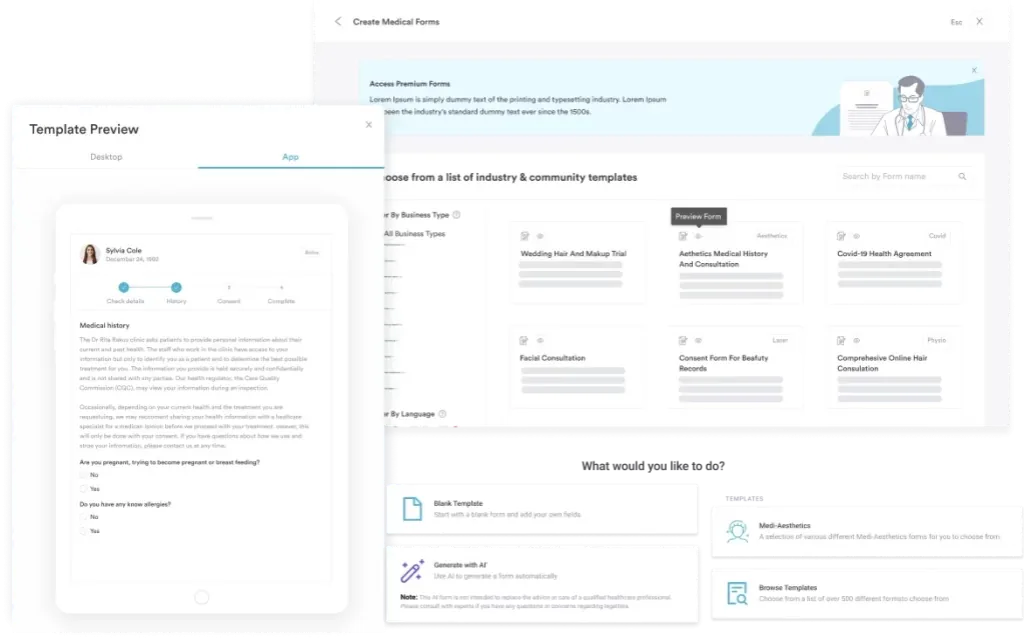

Pabau’s digital forms collect signed consent before each session and save it to the patient’s record. Your consent trail stays complete and easy to check.

An interview schedule earns its value at the analysis stage. When every participant has answered the same core questions, themes can be compared across interviews instead of reconstructed from very different conversations.
Write your questions into the template, pilot it once, and fill in the recording page after every session. The trade-off is flexibility. Hold the core questions steady, but let each participant decide the route between them.
If your practice runs interviews with patients, a clean consent record matters as much as the questions. Book a demo to see how Pabau collects and stores signed consent forms alongside each patient record.

Using patients’ health information in your study? HIPAA authorization form gives you a ready-made form for permission to use and disclose protected health information.
Sharing recordings with a transcriber? Confidentiality agreement puts a third party’s duty to keep your study files private in writing.
Collecting participant background details? Demographic information form lists the fields worth including and comes with a free template.
Want forms completed before the session? Digital patient intake forms explains how to get paperwork signed before anyone walks in.
An interview schedule is a structured guide of predetermined open-ended questions and follow-up probes used by a researcher to conduct qualitative interviews. Unlike a questionnaire, it allows the interviewer to adapt questions and explore unexpected themes while maintaining consistency across participants.
An interview schedule is the more structured of the two, with predetermined questions and probes asked in a planned order. An interview guide is a looser list of topics the interviewer explores conversationally, though many methods texts use the terms interchangeably. Schedules suit semi-structured research, while guides suit exploratory or unstructured research.
Most qualitative research interviews include 8 to 12 core open-ended questions with planned probes. Schedules longer than 15 questions risk participant fatigue and may produce lower-quality data. Depth matters more than breadth in qualitative research.
Yes, with adaptations. A focus group schedule is typically shorter, with six to eight core questions, because group dynamics allow broader coverage through participant discussion. Prepare probes but be ready to let participants build on one another’s comments rather than moving rigidly through the schedule.
Write 8 to 12 open-ended core questions that directly address your research question, using “What” or “How” starters and avoiding jargon or leading language. For each core question, plan two or three follow-up probes that deepen understanding without suggesting answers. Test the schedule with a pilot participant and refine based on feedback.