Psychosis spectrum test: What it screens for and how it works
A psychosis spectrum test is a short clinical screening tool that checks for hal...

Last Updated: Oct 5, 2026

The International Personality Item Pool (IPIP) is a free, public-domain bank of personality items. It measures the Big Five, or OCEAN, traits: Openness, Conscientiousness, Extraversion, Agreeableness, and Neuroticism.
It comes in a 120-item version (IPIP-NEO-120) and a 300-item version (IPIP-NEO-300). Both cover all 30 facets, and both hold up against the licensed NEO PI-R.
Clinicians use the results for formulation, treatment planning, client goal-setting, and tracking change across a course of therapy or coaching.
Practice management software like Pabau can deliver the IPIP as a digital intake form, so scores file straight into the client record.
The IPIP-NEO-120 in print-ready form, with all 120 statements and the five-point accuracy scale. It carries fields for the client’s name, date of birth, and the date taken.
Download templateThe International Personality Item Pool (IPIP) is a public-domain bank of personality items that anyone can use for free. It measures the Big Five traits, and the research puts it level with the proprietary inventories most practices pay to license.
This page covers what the IPIP measures and how its two versions differ. It also walks through scoring, interpretation, and where the results fit in clinical work. The template above gives you the 120-item questionnaire in print-ready form.
The IPIP is a public-domain collection of personality assessment items developed by Lewis Goldberg at the Oregon Research Institute (ORI). It measures the Big Five personality traits, also known as the OCEAN model. Those five are Openness, Conscientiousness, Extraversion, Agreeableness, and Neuroticism.
Unlike commercial personality tests, the IPIP is free to use, copy, and adapt for clinical, educational, or commercial purposes. You need no permission and you pay no fee. That makes it a practical starting point for a practice building its own assessment workflow.
Four things separate the IPIP from the commercial inventories it was written to replace.
The items cost nothing, but the responses are still health data. Store completed assessments where the rest of the client record lives, whether that is your EMR or your psychology practice software. That keeps your HIPAA and GDPR obligations in one system instead of two.
The IPIP measures five broad personality dimensions, each with its own behavioral and emotional pattern. Reading them accurately is what turns a set of scores into a formulation.
Each of these five domains contains six facets that measure a narrower slice of the broader trait. Facet scores show what is driving a client’s domain score. For a shorter instrument covering the same five domains, the Big Five personality test template is the quicker option.
The IPIP comes in two main forms, each built for a different context. Both measure the same five domains and the same 30 facets. They differ in item count, administration burden, and depth of insight.
For most practices, the IPIP-NEO-120 strikes the right balance between coverage and the time a client will actually give you. Reach for the 300-item version when you need facet-level detail or research-grade precision.
The IPIP was written as a public-domain alternative to the proprietary NEO Personality Inventory-Revised (NEO PI-R), developed by Costa and McCrae. The NEO PI-R remains the reference instrument in personality research. The IPIP still carries clear advantages for cost-conscious practices and research teams.
For practices that want a validated measure without a licensing bill, the IPIP-NEO does the job. If your work depends on comparing a client against clinical population norms, the NEO PI-R is still worth its price.
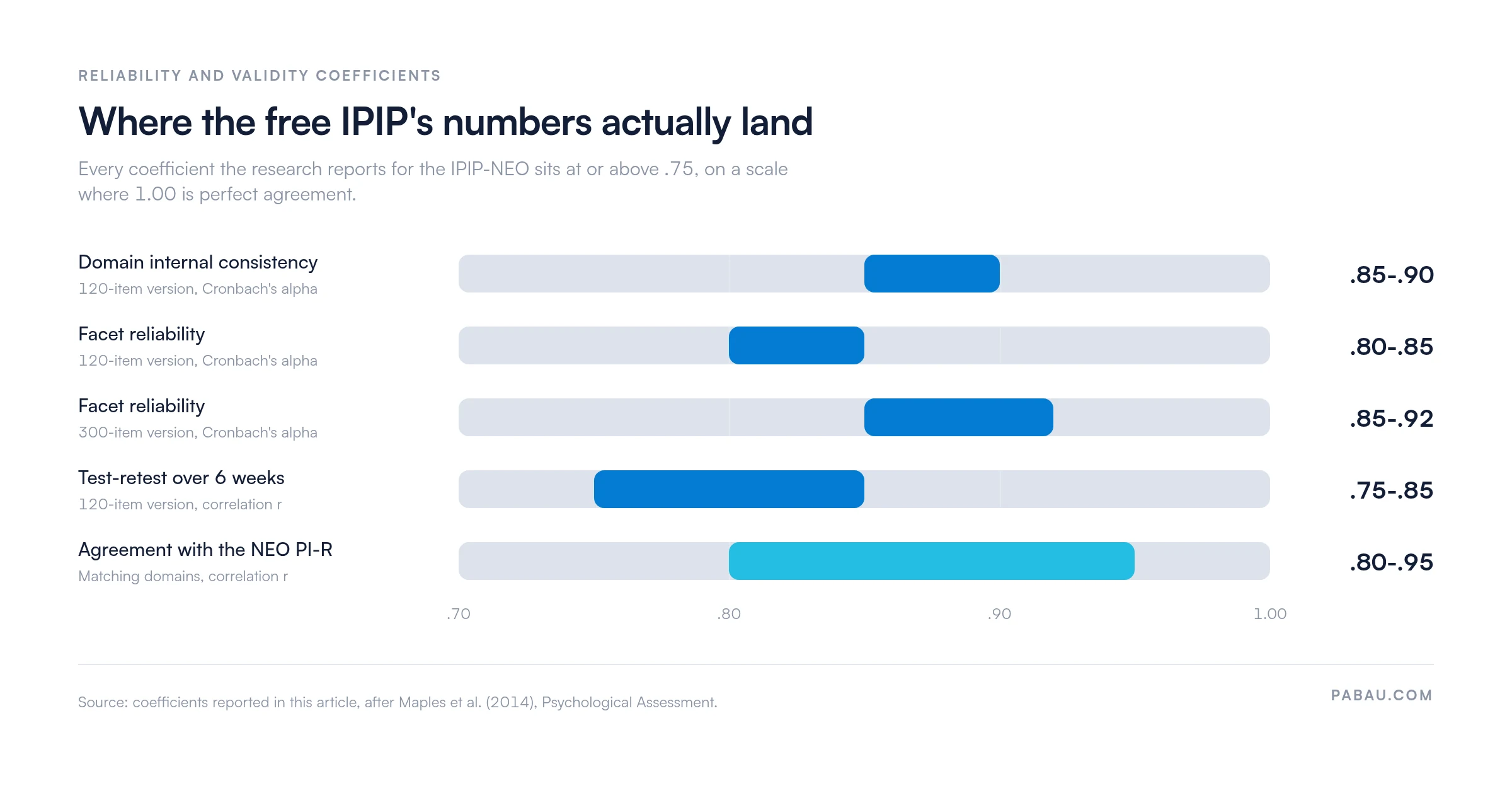
Maples et al. (2014) found strong internal consistency across the five domains (Cronbach’s α = .85-.90) and test-retest reliability over six weeks (r = .75-.85). IPIP domain scores also correlate strongly with the matching NEO PI-R domains (r = .80-.95). The chart below puts all five coefficients on one scale.
Across languages and cultures, the IPIP holds its factor structure and its reliability. That makes it usable in international research and with diverse client groups. One caveat matters clinically. IPIP norms are research-population norms, not clinical ones, so interpretation calls for judgment rather than a straight comparison against clinical cut-offs.
Scoring is straightforward. Reverse-code the negatively worded items, then average the item responses to get domain and facet scores. Responses sit on a five-point scale, from 1 (very inaccurate) to 5 (very accurate).
Digital administration removes the arithmetic. A form that scores itself returns domain and facet totals the moment the client submits, so nobody adds up 120 responses by hand.
Clinicians and coaches use IPIP results at several points in the work. In mental health EMR software, the data supports formulation by clarifying personality-driven patterns in mood, anxiety, and interpersonal behavior. During treatment planning, the profile flags strengths and vulnerabilities worth targeting.
In coaching, the results give a client language for their own patterns. Someone high in Openness but low in Conscientiousness benefits from structure-building work. Someone low in Extraversion and high in Neuroticism may need to address social anxiety or isolation.
Repeat administrations show shifts in emotional stability, social engagement, and openness to change. Comparing scores across a year of sessions depends on finding the earlier results quickly. Most practices keep them inside their therapy practice management system, next to the notes.
Practice management software like Pabau handles the administrative side of the IPIP, from sending the questionnaire to filing the results. Digital intake forms and a secure client portal replace the printing, chasing, and manual data entry that a 120-item assessment usually creates. Here is how the workflow runs.
The outcome is a personality profile that lives where the clinical work happens. Formulation, treatment planning, and progress reviews all draw on the same stored result. The data sits inside a system built for health record security, rather than a spreadsheet or a filing cabinet.
The same forms setup carries the rest of your intake paperwork. The IPIP ends up filed next to the mental health intake form and the client’s consent records.

Pabau’s digital intake forms deliver the IPIP before the appointment and file every response against the client record. Mental health, coaching, and psychology practices use it to keep personality data secure and ready to review.

The choice between the IPIP and a licensed inventory usually comes down to norms. If your work depends on comparing a client against clinical population data, the NEO PI-R is worth paying for. For formulation, goal-setting, and tracking change over a course of therapy, the IPIP does the same job at no cost.
The bigger decision is where the scores end up. A personality profile in a drawer gets read once. One in the client record gets read again at the six-month review, which is when it starts to repay the session time it took.
Ready to run the IPIP digitally? Book a demo to see how Pabau’s intake forms and client records handle assessment delivery and storage.

Want a shorter Big Five instrument? Big five personality test covers the same five domains in a briefer format.
Need detail from a different trait model? 16pf questionnaire walks through scoring and interpretation for Cattell’s 16 factors.
Assessing a client in more depth? In-depth personality test is our template for a fuller personality picture.
Building out your intake pack? Mental health intake covers the history and risk questions that pair with a personality measure.
Curious how type-based tools compare? Jungian personality test shows how type sorting differs from trait measurement.
The IPIP is a free, public-domain collection of personality assessment items measuring the Big Five traits. It was developed by Lewis Goldberg at the Oregon Research Institute. It is available in 120-item (IPIP-NEO-120) and 300-item (IPIP-NEO-300) versions.
Yes. The IPIP is free to use, copy, and adapt for clinical, commercial, or research purposes without permission. Clinicians should still cite the source, the Oregon Research Institute and Lewis Goldberg, and follow the ethical guidelines for administering and interpreting psychological assessments.
The IPIP-NEO-120 has 120 items (4 per facet) and takes 15-20 minutes to complete. The IPIP-NEO-300 has 300 items (10 per facet) and takes 35-50 minutes. The 120-item version suits routine clinical screening. The 300-item version is better for research or detailed personality formulation.
Research by Maples et al. (2014) confirms that IPIP-NEO domain scores correlate strongly with NEO PI-R scores (r = .80-.95) and show comparable reliability. The NEO PI-R does have more extensive normative data for clinical populations, whereas IPIP norms are primarily research-based.
Yes. The IPIP can be administered digitally through online platforms, intake portals, or EMR systems. Practice management software like Pabau lets clinicians build the IPIP into client intake. Responses are stored securely in client records and linked to appointments for progress tracking.
The Big Five are Openness to experience (creativity and curiosity), Conscientiousness (self-discipline and organization), and Extraversion (sociability and energy). The last two are Agreeableness (trust and cooperation) and Neuroticism (emotional reactivity and anxiety). Together they form the OCEAN model of personality.
IPIP-NEO-120 shows strong internal consistency (Cronbach’s α = .85-.90 across domains) and test-retest reliability over six weeks (r = .75-.85). Convergent validity with the NEO PI-R is high (r = .80-.95 for corresponding domains). Reliability is slightly higher for the 300-item version.