Journal prompts for mental health
Journal prompts for mental health are guided questions that help people process ...

2
Last Updated: Oct 13, 2026

An internal family systems workbook guides clinicians and clients through parts work, Self-energy access, and healing, using exercises grounded in Dr. Richard Schwartz’s model.
The worksheets cover protective parts (managers and firefighters), wounded exile parts, and the Self’s compassion, which IFS treats as the core healing resource.
Sequencing is the hard part in practice. Therapists need to know which exercise to use when, and how to pace it without overwhelming the client.
Practice management software like Pabau stores completed worksheets in the client record, so therapists spend less time on admin and more on parts work.
A therapeutic tool for IFS practitioners and their clients. Inside you’ll find parts identification exercises, Self-energy practices, manager, firefighter and exile mapping worksheets, somatic prompts, and session integration guides.
Download templateTherapists working with Internal Family Systems (IFS) need practical tools that guide clients through parts identification, Self-energy access, and the healing work itself. This guide explains how to use an internal family systems workbook in clinical practice. It covers what’s inside, how to sequence the exercises, and how to adapt worksheets for a particular client.
Whether you’re adding IFS to an established therapy practice or specializing in parts work, what follows turns the model into a session-by-session plan.
An internal family systems workbook is a structured therapeutic resource for clinicians and their clients. It works through the internal family systems model developed by Dr. Richard Schwartz. Every person carries multiple parts, both protectors and wounded exiles, plus an undamaged Self at the center.
IFS workbooks provide step-by-step exercises, reflection prompts, and mapping worksheets. They help clients name their inner parts and understand the protective roles those parts play. From there, the client uses the Self’s compassion to reach wounded exile parts.
Therapists use the workbook to structure sessions, cover the essential IFS concepts, and give clients homework for the weeks in between.
Comprehensive IFS workbooks cover the full landscape of parts work. The progression usually follows the client’s journey from awareness to integration.
A foundational tool within most IFS workbooks is the parts map, sometimes called a parts diagram. This visual worksheet helps clients and therapists see the architecture of an internal system at a glance.
A parts map usually includes:
Therapists use the map to build a shared language with clients. Instead of reacting to a triggered part, the client can point at the map and say, “That’s my firefighter trying to distract me.” That move from shame to systems thinking is where IFS starts to work.
Digital forms in therapy practice software let clinicians collect completed parts maps securely, track how they change, and pull them into clinical notes.
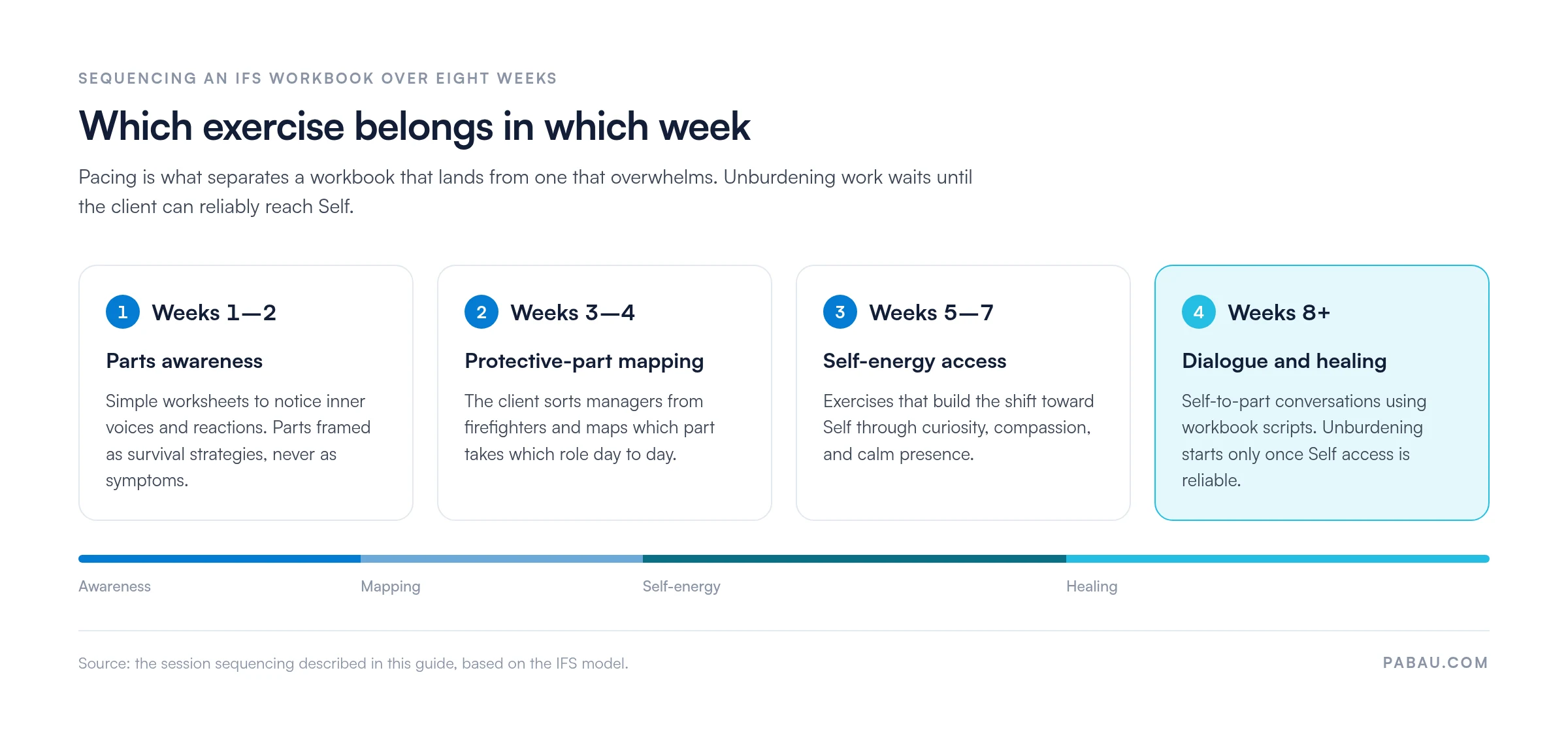
Sequencing and pacing decide whether the workbook helps. Introducing too many concepts at once is one common misstep. Moving into unburdening before the client trusts their Self and their protectors is the other.
The arc below spreads that work over roughly eight weeks.
Assign one worksheet per session so the homework mirrors what happened in the room. The repetition keeps the learning consistent, and it gives the client something of their own to work on.
Attach the completed worksheet to the session note, and the record shows which parts have been mapped and which protectors are still active. If you need a structure for that note, our psychotherapy progress notes template gives you one.
One of IFS’s defining strengths is that clients can continue the work between sessions. A well-designed workbook gives them permission and structure to explore their inner world on their own.
Worksheets for self-directed practice usually include:
Therapists should emphasize that these worksheets are tools, not tests. The client is not “doing IFS wrong” if unburdening doesn’t happen on schedule, or if a protective part resists on paper. The workbook simply creates space for the process to unfold.
A secure client portal lets clients upload completed worksheets between visits. The therapist can read them ahead of the session and respond before the next appointment.
Many modern IFS workbooks add somatic, or body-based, awareness. The premise is that parts hold trauma in the nervous system, so healing needs physical release as well as cognitive work.
Somatic IFS workbook exercises include:
Pairing the workbook with pre-recorded body scans or guided meditations deepens the practice between sessions. It also suits clients who learn better by listening or moving than by writing. Our somatic experiencing exercises work the same way alongside the parts work.
IFS asks a lot of the therapist, and the paperwork piles up alongside it. Practice management software like Pabau takes that admin off your desk. Our therapy practice management system stores forms, notes, and homework in one client record, so you can stay with the parts work.
Pabau supports IFS workflows in four places:
The client portal gives clients a secure place to keep their own parts work going between sessions. They complete worksheets, record insights, and look back at notes from earlier appointments.

From intake to unburdening, Pabau’s documentation, client portal, and AI-assisted notes keep you organized so you focus on parts work.

The workbook is only as good as the pacing behind it. Hand a client every exercise in week one, and you will spend week two repairing the trust a protector lost.
So start narrow. One worksheet per session, in the order above, with the unburdening scripts held back until the client can reach Self without your prompting. The trade-off is that IFS moves slower on paper than it does in a training video, and that is the point.
Keep the completed worksheets somewhere you can find them, and the progression stays visible to both of you. Book a demo to see how Pabau stores IFS worksheets, notes, and client homework in one record.

New to the model itself? The internal family systems model explains parts, Self, and burdens before you hand a client a worksheet.
Working with trauma histories? The trauma timeline worksheet helps a client sequence the events that exile parts still carry.
Need a structure for the session note? Psychotherapy progress notes give you a format that holds up to an audit.
Adding body-based work? Somatic experiencing exercises pair naturally with the body-scan prompts in an IFS workbook.
Comparing software for a therapy practice? Best therapy practice management software weighs the platforms on documentation and client portal depth.
An IFS workbook is a structured guide for identifying inner parts, understanding their protective roles, and accessing the Self’s wisdom to heal wounded parts. Therapists use it to structure sessions. Clients use it for between-session practice.
Yes. The Pabau template library includes a comprehensive internal family systems workbook covering parts identification, protective-part roles, Self-energy access, and unburdening exercises. Download it above and add it to your clinical workflow.
That depends on your client population and your own IFS experience. Beginner-friendly workbooks focus on parts awareness and Self-energy. More advanced ones add unburdening scripts and somatic integration. Match the format to how your clients learn.
A worksheet is a single exercise, such as parts mapping or a Self-access meditation. A workbook is a complete collection of worksheets, sequenced to mirror the IFS journey from awareness to integration.
Start with the Self at the center. Ask the client to notice and name their inner parts, then place each one around the diagram by its role. Therapists often revisit the finished map in later sessions to normalize parts and build self-awareness.
Some clients benefit from self-directed practice, especially after working with a therapist to understand the model. Trauma work and unburdening are safest under clinical guidance. Workbooks work best as a complement to therapy, not a replacement for it.
Yes. Research in the Journal of Marital and Family Therapy and in Psychological Trauma: Theory, Research, Practice, and Policy supports IFS for depression and PTSD. The IFS Institute maintains a registry of peer-reviewed studies on the model.