List of vitamins: All 13 with RDAs and deficiency signs
A list of vitamins names the 13 essential vitamins the body needs from food or s...

1
Last Updated: Oct 8, 2026
An intermittent fasting diet plan sets when a patient eats, not only what, by splitting each day or week into fasting and eating windows. The most common versions are 16:8 (a daily 8-hour eating window), 5:2 (two 500–600 kcal days a week), and alternate-day fasting.
For most healthy beginners, 16:8 is the easiest place to start. This free template turns the plan into a clinical form you complete with the patient. It records their baseline, medical history, agreed fasting schedule, a sample meal plan, and dated progress notes for each follow-up.
A two-page clinical form with fields for patient details, medical history, general guidelines, the fasting schedule, baseline diet, and a sample meal plan. It closes with lifestyle considerations, your recommendations, and a dated progress log for follow-up visits.
Download template
The 16:8 protocol is the easiest starting point, with a 16-hour fast and an 8-hour eating window each day.
The 5:2 protocol keeps five normal eating days and limits two days a week to 500–600 kcal.
Pregnancy, breastfeeding, and a history of eating disorders rule fasting out, and female patients should start with gentler protocols under dietitian guidance.
Preliminary research presented to the American Heart Association in 2024 linked eating windows under 8 hours with higher cardiovascular death risk.
The template records baseline measurements, medical history, the agreed fasting schedule, and dated progress notes, so each follow-up builds on the last.
Intermittent fasting (IF) is an eating pattern that alternates set fasting windows with set eating windows. It changes when patients eat, while food quality still matters. A longer daily fast gives the body time to use up stored glycogen and shift toward burning fat.
Because eating is compressed into fewer hours, patients get fewer chances to overeat. Many find that easier to follow than counting calories at every meal.
IF supports weight loss through four linked mechanisms, and each one is worth explaining to patients at the first consultation.
These mechanisms work together, which is why IF can produce weight loss without the constant willpower drain of traditional calorie restriction.
IF comes in several protocols, each with a different fasting-to-eating ratio and a different adherence challenge. The table compares the four most common ones.
Most patients start with 16:8 because it fits naturally around skipping breakfast. The template’s fasting schedule field works for any of the four, so you record the protocol you agree on with each patient.
The template is a two-page clinical form. Complete it with the patient at the first consultation, then return to it at each follow-up. Its sections run in this order:
The 16:8 protocol compresses eating into an 8-hour window, typically noon to 8pm. Patients skip breakfast and use morning coffee as their fasting anchor. Build the meals in that window around protein, healthy fats, and whole carbs to keep patients full.
Record the agreed calorie target and meal times in the template’s sample meal plan section. A body mass index assessment at the first visit gives you the weight and height baseline the form asks for.
The 5:2 protocol alternates five regular eating days with two 500–600 kcal days, typically spread across the week (for example, Monday and Thursday). It suits patients who find daily fasting hard, because normal eating returns five days a week.
Name the two fast days in the template’s fasting schedule field, so the patient knows what to expect each week. Patients who would rather fast in short, structured blocks every few months may suit a fasting-mimicking diet instead.
IF affects women differently because hormones regulate the menstrual cycle, metabolism, and energy balance. Before a female patient starts, a registered dietitian should check the protocol against her hormonal phase and health history.
Recommendation: Start female patients on the gentler 16:8 or 5:2 protocols, not ADF or OMAD. Monitor cycle regularity, energy, and mood for the first 2-3 months. If amenorrhea, fatigue, or mood disturbance occurs, reduce fasting intensity or pause IF and refer to a registered dietitian.
Food quality in the eating window drives weight loss and metabolic results. A shorter window still needs nutrient-dense meals with balanced macros to keep energy stable.
What can you drink while fasting? Patients can drink water, black coffee, unsweetened tea, and zero-calorie beverages. Any added calories (milk, sugar, honey) break the fast and trigger insulin release, interrupting fat oxidation.
Adherence decides whether IF works. Clear structure cuts daily decision fatigue, so patients keep going long enough to see results, typically 4-8 weeks for meaningful weight loss and metabolic change.
Bring the patient back every few weeks and log each visit in the template’s progress tracking section. Dated remarks show when adherence slipped and what changed, so you can adjust the protocol instead of restarting it.
IF is generally safe for healthy adults. Practitioners still need to screen for specific risks and contraindications before recommending a plan. The chart below shows which starting protocol fits each patient profile.
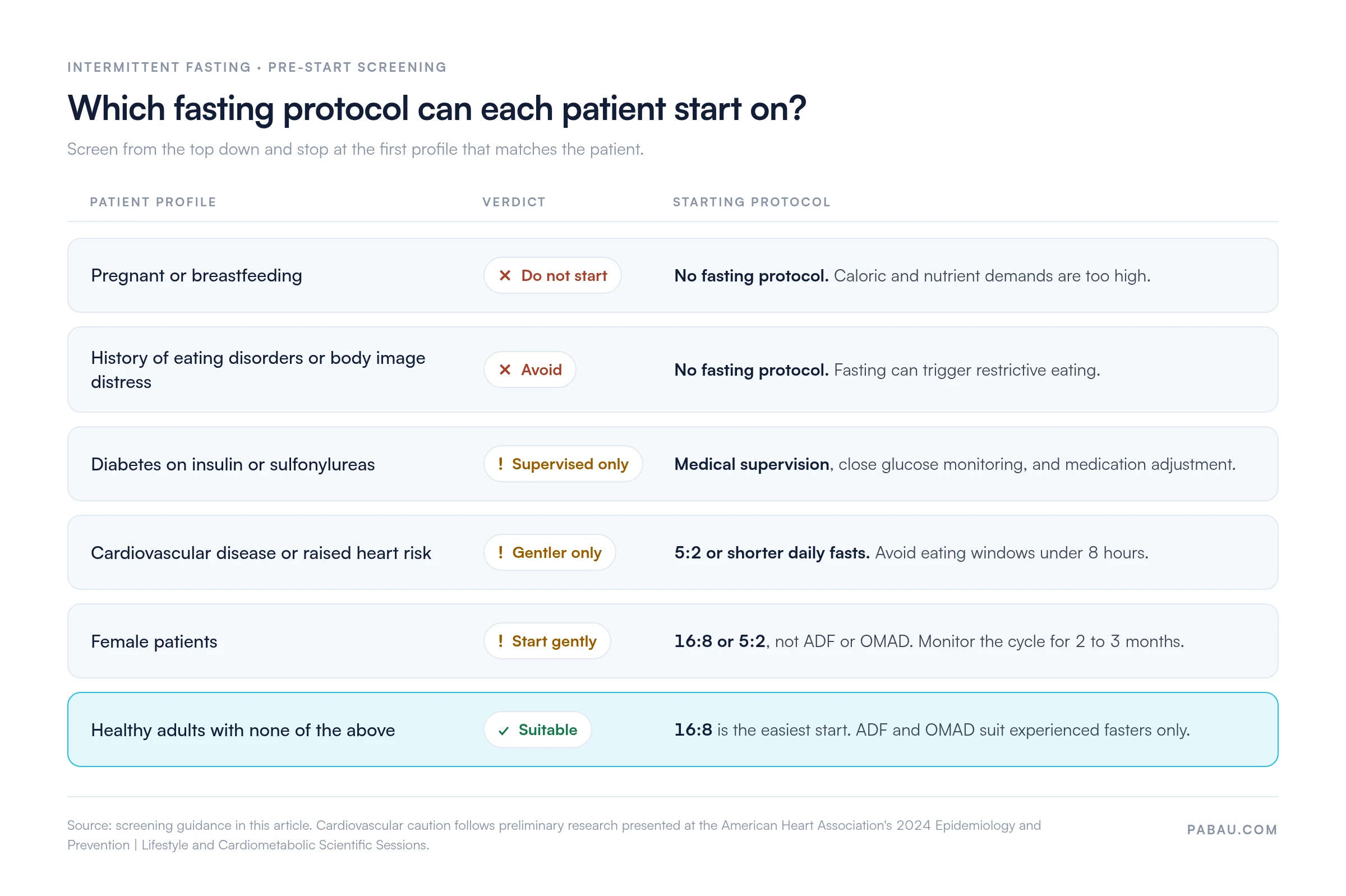
When to see a doctor or registered dietitian: Some patients should consult a healthcare provider before starting IF. That includes anyone with type 1 or type 2 diabetes, cardiovascular disease, or a history of eating disorders, and anyone pregnant or breastfeeding. The Academy of Nutrition and Dietetics recommends professional dietitian review for any patient with metabolic conditions.
Document the screening in the template’s medical history section. Where contraindications exist, have patients sign informed consent acknowledging the risks.
Run on paper, an IF program means a printed form, a spreadsheet of meal plans, and reminder texts sent by hand. Follow-up notes scatter across files, so the next practitioner can’t see what changed since the last visit.
Pabau, the weight loss practice software we build, keeps those steps in one patient record. Patients answer the history and baseline questions as digital intake forms before the first visit.
Automated reminders then go out for eating windows and follow-up bookings, without anyone on your team typing them. Through the Client Portal, patients complete check-in forms and manage appointments from their phone.

Pabau keeps each patient’s intake answers, fasting schedule, reminders, and progress notes in one record. Your team spends less time chasing check-ins and more time adjusting plans.

An intermittent fasting diet plan is only as safe as the screening behind it. Start most healthy adults on 16:8, steer at-risk patients toward 5:2 or shorter fasts, and rule fasting out for pregnancy or an eating disorder history.
The trade-off to remember is that stricter protocols can bring faster results but cost adherence. The 2024 heart research adds a safety question to the shortest eating windows. A patient who sticks with a gentler plan for eight weeks will usually do better than one who quits a strict plan in two.
Download the template, complete it at the first consultation, and review the progress log at every follow-up. Book a demo and see how Pabau tracks patient progress and supports your IF program at scale.

Planning a longer program? 30-day meal plan for weight loss gives patients a month of structured meals once a fasting routine is settled.
Need a calorie-led alternative? 1200 calorie diet plan suits patients who prefer counting calories to fasting windows.
Want a shorter starter plan? The 21-day weight loss plan sets a three-week goal patients can review at their next check-in.
Combining fasting with low-carb eating? 7-day keto meal plan lays out a week of ketogenic meals and recipes.
Running a metabolic health service? Metabolic health EMR shows how Pabau supports weight and metabolic programs from intake to follow-up.
Intermittent fasting is an eating pattern that alternates scheduled eating windows with fasting windows. During a fast of roughly 12 to 16 hours, the body uses up its glycogen stores. It then shifts toward burning fat, and insulin sensitivity improves.
The 16:8 method pairs a 16-hour fast with an 8-hour eating window, such as noon to 8pm. It’s the most popular protocol for beginners because it fits around skipping breakfast and needs no calorie counting.
The 5:2 diet alternates five regular eating days with two restricted-calorie days (500-600 kcal) per week. It appeals to patients who want to avoid daily fasting because normal eating is restored most days.
It can be, but its effects on the menstrual cycle and energy availability need careful monitoring. Women should start with gentler protocols (16:8 or 5:2) and track cycle regularity. They should consult a registered dietitian if amenorrhea or fatigue occurs. Pregnancy and breastfeeding are contraindications.
A 2024 American Heart Association-presented study associated eating windows under 8 hours, meaning daily fasts of 16 hours or more, with higher cardiovascular death risk. Patients with cardiovascular disease, diabetes, or a history of disordered eating should consult a healthcare provider before starting 16-hour fasts. Other common side effects include early fatigue and dizziness, which usually resolve within 1-3 weeks. Patients with diabetes who take insulin also risk hypoglycemia.
Most patients see initial weight loss of 1-2 lbs per week within 2-4 weeks. Metabolic improvements, such as better insulin sensitivity and lower inflammatory markers, become measurable after 4-8 weeks. Results depend on adherence, baseline metabolism, and the protocol chosen.
During the eating window, patients should eat nutrient-dense foods: lean protein, healthy fats, whole grains, and vegetables. During the fasting window, only water, black coffee, unsweetened tea, and zero-calorie drinks are permitted. Any calories trigger insulin and interrupt fat oxidation.