Blood type O food list
A blood type O food list sorts foods into what people with type O should eat, li...

Last Updated: Oct 6, 2026
A fasting mimicking diet meal plan is a 5-day, plant-based, low-calorie protocol that produces fasting-like biological responses without complete food restriction. Dr. Valter Longo developed it at the USC Longevity Institute. The protocol allows roughly 1,100 kcal on day 1 and 750 kcal on days 2 to 5. Fixed macronutrient ratios across all five days are what activate cellular regeneration.
Unlike intermittent fasting, which relies on timed eating windows, this protocol gives patients structured meals with precise nutrient targets. That structure is what makes it usable in a practice. You can monitor compliance, adjust portions for individual metabolic needs, and document how each patient responds.
A printable care plan form for running a 5-day cycle with a patient. It captures the agreed goals, the actions and who owns them, the support arrangements, and a dated review record for each cycle.
Download template
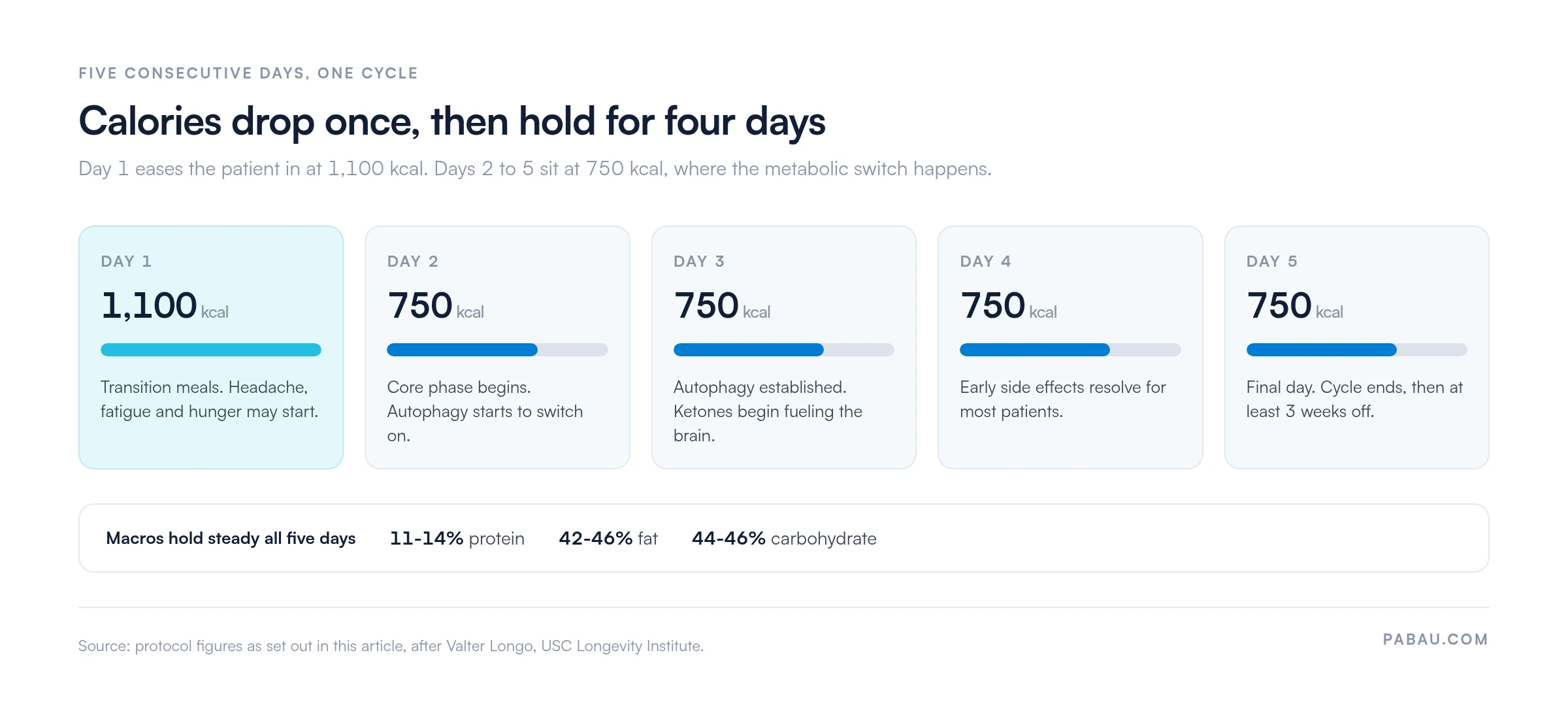
The protocol runs for 5 days, at 1,100 kcal on day 1 and 750 kcal on days 2 to 5.
Macronutrient ratios stay fixed across all five days, at 11-14% protein, 42-46% fat, and 44-46% carbohydrate.
Animal protein, dairy, added sugar, alcohol, and protein supplements are excluded, because they interrupt autophagy.
Contraindications include pregnancy, breastfeeding, a low BMI, a history of eating disorders, and several medication classes.
Practice management software like Pabau records each cycle’s adherence, outcomes, and follow-up in the patient chart.
Three mechanisms work together. Calorie restriction activates autophagy, the process by which the body clears damaged cells and regenerates healthy tissue. The low-protein, high-fat ratio then holds that state open while sparing muscle.
Reduced blood glucose and rising ketones signal metabolic switching. Research links that switch to better insulin sensitivity, lower blood pressure, and calmer inflammatory markers.
A 2025 narrative review in Metabolites gathers the evidence behind those effects. It reports reduced visceral fat, improved metabolic syndrome markers, and increased cellular repair activity in people who complete the protocol.
The ratios matter as much as the calorie count. Fat at 42-46% sustains satiety and keeps ketone production going. Protein at 11-14% keeps mTOR quiet, since that nutrient-sensing pathway would otherwise shut autophagy down.
The 44-46% carbohydrate comes from complex sources and plant fiber, which steadies blood glucose across the day. Miss the ratios and you get a low-calorie week rather than a fasting response.
Calories drop once, between day 1 and day 2, and then hold for the rest of the cycle. The chart below sets each day’s target against what the patient is likely to notice.
Day 1 introduces the protocol gently. Breakfast is a small bowl of oatmeal (35g) with almond milk and blueberries (60g). Lunch is mixed greens with roasted chickpeas (80g), olive oil (1 tbsp), and lemon juice. Dinner is a vegetable soup of butternut squash, carrots, and onion, with whole grain crackers (30g). Ten raw almonds cover mid-afternoon.
Days 2 to 5 hold 750 kcal through smaller portions and tighter meal timing. The day opens with herbal tea and a small smoothie of spinach, flax seeds, and unsweetened coconut milk. Lunch is vegetable broth with roasted zucchini and asparagus. Dinner is a legume dish, such as lentil stew or split-pea soup, with steamed kale. No snacks on these days, and hydration becomes the focus.
The commercial ProLon kit, from L-Nutra, ships pre-packaged meals that guarantee the macronutrient split and take the planning off the patient. Building the protocol from this template costs the patient less, adapts to food preferences, and teaches them how the targets work.
For a practice, the self-built route also produces a record. Patient intake software captures dietary preferences, contraindications, and baseline metabolic markers before day 1. Notes taken during and after the cycle then give you something to compare the next cycle against.

Evidence for the protocol spans metabolic, cellular, and clinical measures. Weight loss over the 5 days averages 4 to 7 lbs (2 to 3 kg), much of it from the visceral fat around the organs.
Glucose control improves too. In a 2017 randomized trial published in Science Translational Medicine, 100 participants ran three monthly cycles of the protocol.
The trial reported lower body weight, less trunk fat, lower blood pressure, and reduced IGF-1. Fasting glucose and several other risk markers improved most in the participants who started out at risk.
Inflammatory markers such as CRP and IL-6 decline, which matters for patients with autoimmune or metabolic conditions. Many patients describe clearer thinking from day 3 onward, as ketones take over as brain fuel. Reports of steadier energy and less bloating are common, and they tend to drive repeat cycles.
Start with a pre-protocol consultation to assess candidacy, screen contraindications, and set expectations. Practices that run these cycles regularly keep the whole sequence in weight loss clinic software, so screening, consent, and follow-up sit in one chart.
An AI medical scribe can turn that consultation into a structured summary and surface the risk flags. Those flags matter here. Pregnancy, a history of eating disorders, and blood-thinning medication all rule the protocol out.

During the 5 days, automated SMS reminders keep adherence up. A day 1 message confirms the transition meals, and a day 3 message prompts the patient on hydration. Book the follow-up for day 14, and use it to repeat biomarkers, weigh the patient, and review adherence.
Record the results in the chart while the detail is fresh. The next cycle then starts with a baseline to beat rather than a blank page.
Mild headache, fatigue, and stronger hunger are common in the first 2 to 3 days. They usually settle by day 4, as the body shifts to ketone metabolism. Water and herbal tea ease the transition.
The protocol is contraindicated in pregnancy and breastfeeding. It is also unsuitable for anyone underweight, meaning a BMI under 18.5. The same applies to a personal or family history of eating disorders, and to advanced kidney or liver disease.
Certain medications rule it out as well, including blood thinners and diabetes drugs that carry hypoglycemia risk. Recommend medical clearance before any patient starts, especially where a chronic condition is involved.
Frequency follows the goal. Patients with insulin resistance, prediabetes, or raised inflammation tend to get cumulative benefit from monthly cycles. Otherwise healthy patients do well on quarterly cycles, and some practitioners run one a year as preventive care.
Never run two cycles back to back. Leave at least 3 weeks of normal eating in between, so adaptive thermogenesis resets. For patients working specifically on insulin sensitivity, an insulin resistance diet plan makes a useful bridge between cycles.
The fasting mimicking diet produces sharper metabolic shifts in a shorter window. Intermittent fasting suits long-term maintenance better, because a patient can keep it up indefinitely. Many practitioners use one cycle as a reset, then move the patient onto a daily eating window.
Setting that window is where most of the coaching happens. Our intermittent fasting by age chart gives you starting windows by age group, which saves guessing at the handover appointment.
Most practices run this protocol on paper. The plan goes home with the patient, the adherence notes land in someone’s inbox, and the day 14 review gets typed up from memory. By the third cycle, nobody can say what changed between them.
Practice management software like Pabau holds the whole cycle in one client record. Intake forms capture the screening answers and the baseline markers. Pabau Scribe, our AI scribe, writes the consultation note straight into that record.
Automated email and SMS send the day 1 and day 3 reminders without anyone remembering to. Every subscription includes all of it, so a solo dietitian gets the same tooling as a multi-site group.
What you end up with is a comparable record per cycle. You can pull up what the patient weighed, what they reported, and what you changed, for every cycle they have run.

Pabau’s digital forms, AI documentation, and automated reminders track adherence and outcomes for each cycle, so your next review starts from a complete record.

The fasting mimicking diet earns its place in a practice when you run it as a protocol. Handing it to the patient as a diet sheet wastes it. Screen properly, set the calorie and macronutrient targets, and book the day 14 review before the patient leaves.
The trade-off worth remembering is preparation. A self-built plan costs the patient less and teaches them more, but it leans on your screening and your follow-up to stay safe. Practices that skip the day 14 review lose the only evidence that the cycle worked.
Download the template above, run one cycle with a patient you have screened, and see what the record tells you. Book a demo to see how Pabau keeps that record complete, from screening through to the day 14 review.

Need a system for dietary interventions? Metabolic health EMR software tracks interventions and outcomes across a patient’s whole care plan.
Want a longer plant-based protocol? The 30-day plant-based diet plan gives patients a maintenance structure once the FMD cycle ends.
Looking at ketone-driven protocols? The ketogenic meal plan sets out a higher-fat structure patients can sustain for longer than five days.
Tracking glucose between cycles? The fasting blood sugar levels chart gives you reference ranges for the day 14 review.
A fasting mimicking diet meal plan is a 5-day, plant-based, calorie-restricted protocol. Day 1 allows 1,100 kcal and days 2 to 5 allow 750 kcal each. It is designed to trigger autophagy and cellular regeneration while the patient still eats food.
Yes. This template carries the calorie and macronutrient targets you need to run the protocol without the kit. Building it yourself usually costs the patient less, although it takes more planning and food preparation.
Yes. Calorie restriction, low protein, and rising ketones activate autophagy by day 2 to 3. The 11-14% protein and 42-46% fat targets keep mTOR quiet, so amino acid sensing does not halt the process.
Average weight loss is 4 to 7 lbs (2 to 3 kg) over the 5 days, much of it from visceral fat. Results vary with starting weight, metabolism, and adherence. Muscle is largely preserved, because protein stays low and ketones spare it.
Avoid it during pregnancy or breastfeeding, and if you are underweight with a BMI under 18.5. It is also unsuitable with a history of eating disorders, on blood thinners or insulin-dependent medication, or with advanced kidney or liver disease. Always consult a healthcare provider first.
Monthly cycles suit patients managing a metabolic condition. Otherwise healthy people do well on quarterly or annual cycles. Leave at least 3 weeks of normal eating between protocols, and never run two back to back.