Cervix length during pregnancy chart
A cervix length during pregnancy chart records cervical length in millimeters ag...

4
Last Updated: Oct 14, 2026
A newborn essentials list is a checklist of the items a family needs in place before a baby comes home. It usually covers feeding, sleep, diapering, bathing, clothing, health and safety, travel gear, and the hospital bag. In practice, obstetric, midwifery, and women’s health practices that hand patients a structured list at the 28-week visit take fewer last-minute calls. Families also reach discharge day with a car seat installed and a safe sleep surface ready.
Put simply, the template below is the blank version of that checklist, not a pre-filled shopping list. It gives you three tick-box sections, a patient details block, an open grid for extra items, and a notes box. Each row arrives with a numbered placeholder label that you replace with your own wording. The category guidance further down this page is where the items and quantities come from.
A blank, printable checklist you complete yourself. It carries numbered placeholder rows under three headings: essentials, documents and paperwork, and useful but optional. Patient name, date of birth and record number fields sit at the top. An open grid for extra items and a notes box close the sheet.
Download template
The downloadable template is a blank checklist with placeholder rows under three headings: essentials, documents and paperwork, and useful but optional.
Use the category table on this page to decide which items and quantities you write into those rows before you hand the list over.
Any sleep product you add must meet the American Academy of Pediatrics standard of back sleeping on a firm, flat surface.
Practice management software like Pabau can send the completed checklist automatically at a set gestational week, so no one hands it out by memory.
A newborn essentials list is a categorized preparation document. It helps expectant parents identify, buy, and organize the items needed to care for a newborn in the first weeks. In a practice setting it does three jobs. Specifically, it educates the patient, sets up the feeding method discussion, and records that safety guidance was given before discharge.
In obstetric and midwifery settings, a checklist like this supports patient compliance without spending clinician time at every visit. As a result, practices using digital intake forms can attach their completed version to a message that goes out automatically at 28 or 32 weeks. Every patient then gets the same guidance, whichever practitioner they see.
The safety context matters when you decide what to write on the list. According to the American Academy of Pediatrics (AAP) 2022 safe sleep guidance, infants should sleep on their backs on a firm, flat surface. Loose bedding, positioners, and inclined sleepers are out. The Safe Sleep for Babies Act of 2022 banned the sale of inclined sleepers and crib bumpers in the US. A practice that hands out recommended items carries some responsibility for keeping them current. That is why this template is worth reviewing and refilling, not printing once.
In short, the template ships blank by design. One file then works for a first-time parent, a twin pregnancy, or a NICU discharge, because you choose the wording on every line. Here is what you get when you open it.
Every row under the three headings carries a placeholder label, such as Essentials item 1. In other words, replace those labels with your own items before you print or send the file. No products, brands, or quantities are pre-printed, so the file cannot go out of date on its own.
This is the part of the page you draw on when you fill the template in. In particular, the table groups the items most newborns need, with quantity guidance and the safety note that belongs with each group. Copy the rows that fit your patient population into the template, then adjust the quantities family by family.
Meanwhile, some patients will be drafting their delivery preferences in the same weeks. Our birth plan template covers that side of the conversation, and both documents end up in the same hospital bag.
The template is built for obstetric, midwifery, and women’s health practices to give to expectant patients. In effect, six steps take it from a blank sheet to part of your antenatal workflow.
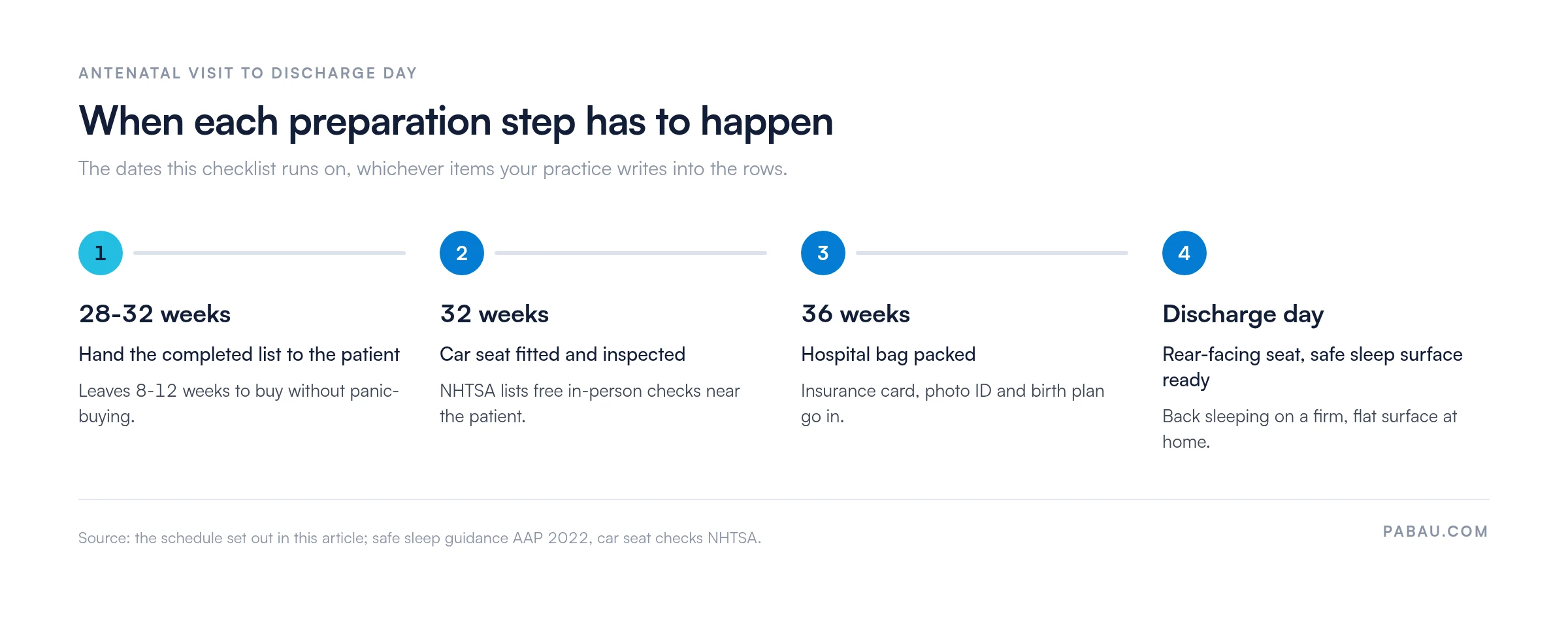
In this way, those six steps land on a fixed calendar, and the dates carry as much weight as the wording on the rows. The timeline below shows when each one falls.
Three types of practice get the most out of this template.
Obstetric and midwifery practices are the primary users. In fact, the checklist fits antenatal care workflows and pulls the guidance patients usually collect from several sources into one shareable document. Practices using OB/GYN practice software can attach the completed PDF to a templated message sent at a set gestational week.
Fertility and women’s health practices supporting patients through IVF or other assisted conception pathways often carry those patients into early pregnancy. Practices running on fertility clinic software keep one record open from transfer through to the antenatal visits. Ultimately, handing over this checklist turns that continuity into a document the patient can act on.
Pediatric practices seeing families for the newborn visit can use a completed checklist as an audit tool. Review what the family has in place, note which sleep items are missing, and document the conversation. Pabau’s pre- and post-care documentation supports structured postnatal follow-up notes.
A structured template does more than save patients time. It standardizes the guidance every patient receives, reduces the calls your front desk fields, and creates a documented touchpoint for antenatal safe sleep education.
Re-read the sleep rows of your completed template at least once a year. The AAP updated its infant safe sleep guidance in 2022. The Safe Sleep for Babies Act banned inclined sleepers and crib bumpers the same year. Any version still naming inclined sleepers, crib bumpers, or positioners should be pulled from distribution the day you find it. Set a recurring annual task in your practice management system so the review lands on someone’s calendar.
A short, accurate list serves patients better than a long one. The items below turn up on registries constantly and rarely earn their place, so keep them out of the rows you fill in. Patients spend less and feel more confident that what they bought will get used.
Handing out a newborn essentials list by hand at each antenatal visit adds admin that compounds across a busy obstetric practice. Someone has to remember the handout, print it, and note that the patient received it.
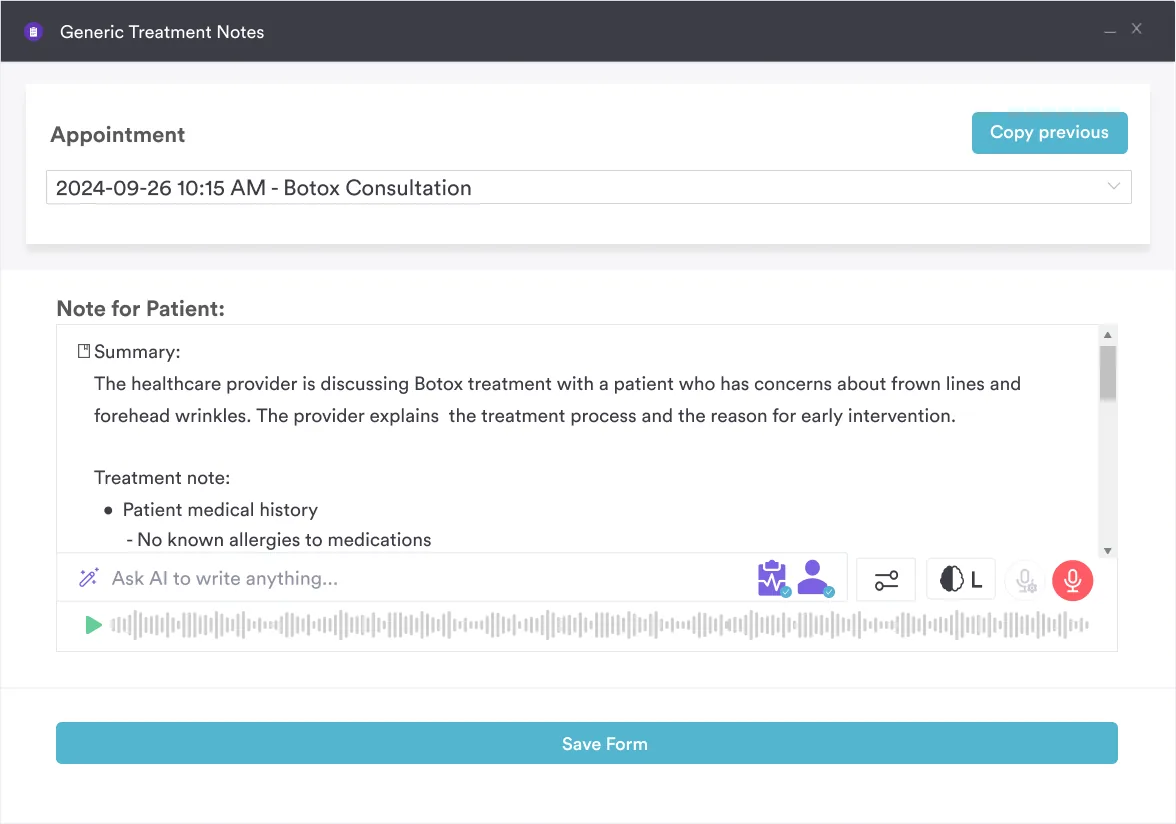
With practice management software like Pabau, the completed checklist sits in your template library. It goes out on a workflow at the gestational week you choose. Pabau Scribe, our AI scribe, captures the consultation note hands-free while you talk the patient through the sleep and car seat rows. Clinicians spend the visit on the conversation rather than on paperwork.
Practices running several locations get the most from a central template library. When the AAP updates its safe sleep guidance, one edit to the master file reaches every site. As a result, no one prints last year’s version from a local folder. Pabau’s compliance tools flag the patient education materials that are due a review.

From checklist delivery at a set gestational week to structured postnatal records, Pabau helps obstetric and women’s health practices keep patient documentation consistent and complete.

A well-built newborn essentials list is a clinical asset as much as a shopping guide. It standardizes safe sleep communication, cuts non-urgent calls, and leaves a record that antenatal education took place. In short, the template on this page gives you the structure. The category table gives you the content to write into it.
The step that slips is delivery. Getting the finished list to every patient in the right week takes a workflow rather than someone’s memory. Pabau’s digital forms and automated workflows handle that part. Book a demo to see how obstetric practices keep antenatal education consistent from 28 weeks to discharge.

Writing the delivery preferences with the same patient? Mama Natural birth plan template gives you a structured sheet for labor preferences that sits alongside this checklist.
Planning the weeks after discharge? Postpartum care plan covers recovery checks, feeding support, and the follow-up appointments that come next.
Documenting the delivery itself? Apgar score template records the newborn’s scores at one and five minutes in a form you can file straight into the chart.
Tracking readings through the pregnancy? Blood pressure pregnancy chart keeps antenatal blood pressure results in one place across visits.
A newborn essentials list is a categorized checklist of the items an expectant parent needs before their baby arrives. It typically covers feeding, sleep, diapering, bathing, clothing, health and safety, travel gear, and hospital bag preparation. Obstetric practices use it as a structured patient education tool in the third trimester.
The template is a blank checklist you complete yourself. It has numbered placeholder rows under three headings: essentials, documents and paperwork, and useful but optional. There are also fields for name, date of birth and record number, an open grid for extra items, and a notes box.
The non-negotiable items are a rear-facing infant car seat, which the hospital requires for discharge, and a firm flat sleep surface meeting AAP guidance. Add feeding supplies, newborn and size 1 diapers, fragrance-free wipes, a rectal thermometer, and a nasal aspirator. Other purchases build on that core set.
Newborns get through roughly 8 to 10 diapers a day in the first month. Buy only a small quantity in newborn size and stock up on size 1 instead. Many babies outgrow newborn size within 2 to 3 weeks, so the larger size is the safer bulk purchase.
Wipe warmers, newborn shoes, dedicated baby laundry machines, and inclined sleepers of any brand are the usual regrets. Inclined sleepers and crib bumpers are banned from sale in the US under the Safe Sleep for Babies Act. Monitors sold as vital-sign trackers add cost without clinical benefit for a healthy newborn.