Despina Petrushevska

DASES: Drug Avoidance Self-Efficacy Scale
DASES at a glance and what it measures DASES stands for Drug Avoidance Self-Effi...

1
Last Updated: Oct 29, 2026
Free PDF 6 pages, print-ready Clinician-reviewed
A gut health quiz is a structured questionnaire that helps practitioners capture how often a patient has digestive symptoms before deciding what to investigate next. This template asks 10 questions, from bloating and bowel regularity to fatigue, skin and mood, each rated from 0 to 4. The ratings add up to a 0-40 total with four interpretation bands. It is a screening and education tool, and diagnosis stays with the treating clinician. Used at intake and repeated at follow-up, it gives every new patient the same starting point.
A ready-to-use 10-question gut health quiz covering bloating, stomach pain, bowel regularity, food intolerance, fatigue, weight change, skin, mood, sugar cravings and immune response. A 0-40 scoring guide closes the form.
Start from scratch, or upload this PDF or any form you already use, and Pabau's AI Form rebuilds it with tick boxes, text fields and a signature. Attach it to the treatment once, and every patient gets it on time.
AI Form rebuilds the consent, history and aftercare forms you already use. You review each one, then publish.
Patients complete forms on their phone before they arrive, so the front desk stops retyping paper.
Every signed form is versioned and attached to the treatment record, ready when you need it.
Set how long a consent stays valid. Returning patients skip forms they have already signed.
Supports HIPAA and GDPR compliance AES-256 encryption 4.8 on G2 4.7 on Capterra Trusted by 4,000+ practices worldwide

A gut health quiz is a screening tool for organizing patient history, not a diagnosis.
Add the 10 item scores into one 0-40 total, then review single items so one severe symptom stays visible.
Use objective follow-up tests only when quiz results and clinical judgment point that way.
Store quiz responses in a system with appropriate access controls, such as Pabau’s digital forms, and follow your HIPAA obligations.
A gut health quiz is a written questionnaire that records how often a patient has digestive and related symptoms. Practitioners use it as a structured intake form, so each new patient answers the same questions in the same order.
The quiz supports, rather than replaces, clinical assessment. Its results give your team a reason to ask follow-up questions or consider further testing.
A useful gut health questionnaire covers several symptom areas rather than a single complaint. Bloating, gas, and abdominal pain are the most common starting points, and bowel habits add the context needed to interpret them.
This template rates 10 symptoms by how often they happened in the last month:
The template covers fatigue, skin, and mood because these often appear alongside digestive complaints. It has no sleep questions, so add them as an optional extra if your intake form doesn’t already ask about sleep.
A gut type is a working label that groups patients by their dominant pattern of symptoms. Some practices sort patients into broad categories like these before building a plan. The labels are heuristic, so treat them as prompts for discussion rather than fixed diagnoses.
The downloadable quiz does not classify gut types. The table below is practitioner guidance for reading the answers, and it is not part of the PDF.
When reactions to certain foods score high, an elimination diet plan gives the patient a structured way to test suspected triggers.
Leaky gut syndrome is not a formally recognized ICD-10 diagnosis in conventional medicine. In clinical contexts, describe it as increased intestinal permeability, and frame quiz questions around symptoms rather than the label.
Gut dysbiosis is associated with increased intestinal permeability in the peer-reviewed literature, although the direction of cause and effect is still debated. Screen for both clusters, but do not presume one causes the other.
The gut-brain axis links digestive function with mood, cognition, and anxiety. This is an established field of research, and it gives practitioners a clinically sound reason to ask about brain fog and mood.
The template’s mood question asks about anxiety and low mood. If brain fog or poor sleep comes up, add two or three questions on concentration and sleep quality. Record the answers alongside bowel history so patterns are easier to see at follow-up.
The downloadable template puts the 10 questions, a scoring guide, and a notes section in one printable PDF. Use it as the starting point for every new patient, then adapt the wording to your own practice.
The diagram below shows how the 10 ratings build the total and where each scoring band starts.
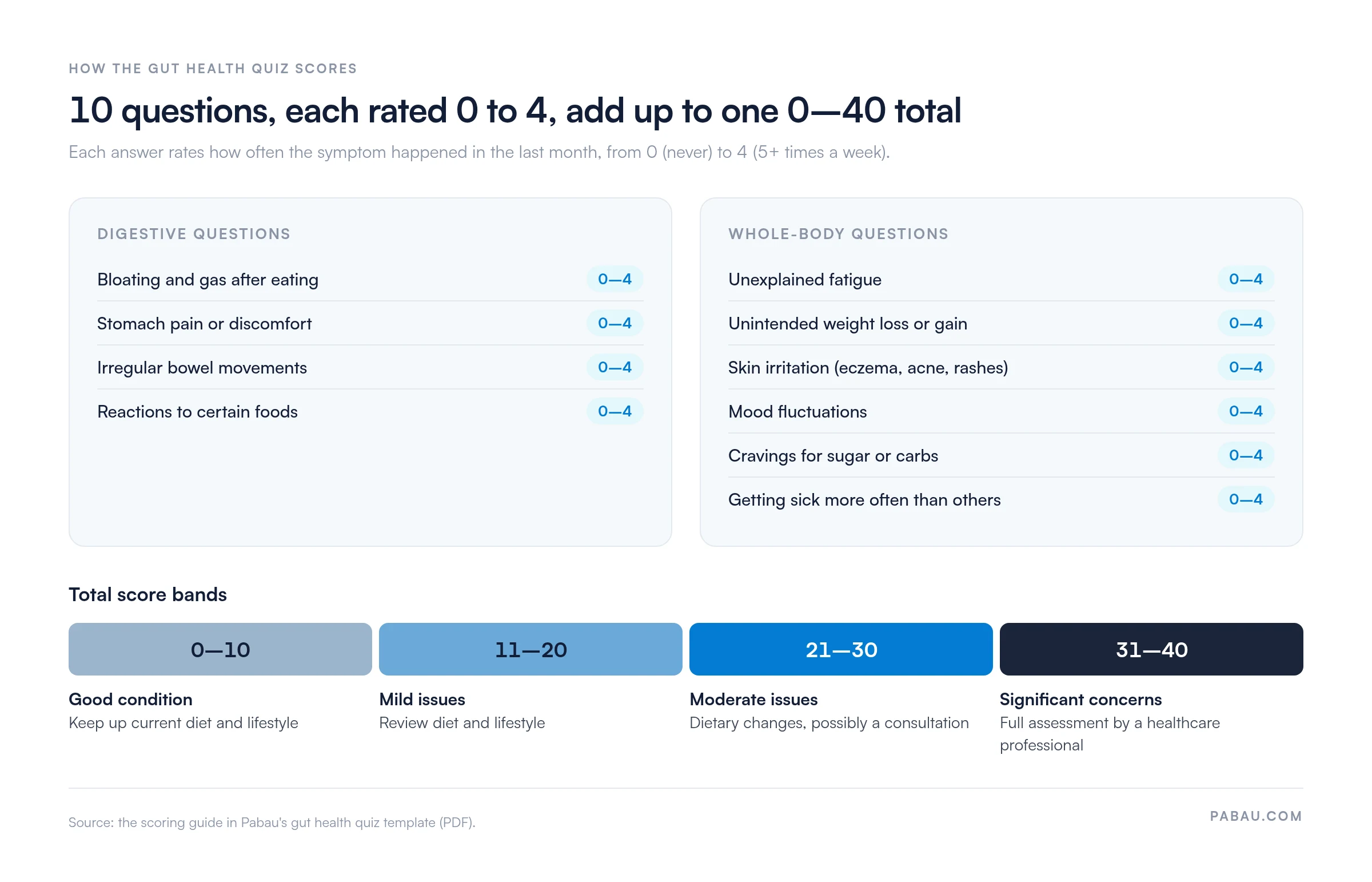
The template scores the quiz as one total. Each of the 10 items scores 0 to 4, so totals run from 0 to 40 and fall into four bands.
Practitioners can also review individual items, because the total can hide one severe symptom. A patient who scores 12 overall might still rate unintended weight change at 4.
Unintended weight loss is a recognized alarm symptom, so it warrants clinical evaluation whatever the total says. The weight question uses a frequency scale, so ask how much weight changed and over what period. Record both in the notes section.
A quiz can suggest that objective testing may be useful, but it cannot confirm a cause. Fecal calprotectin is used to assess gut inflammation and is referenced in AGA guidance, so it is a common choice when inflammation is a concern.
Consumer gut microbiome tests vary widely in clinical validity. Describe them as investigational when discussing them with patients, and avoid presenting results as a diagnosis.
Send the quiz before the first appointment through your digital intake forms, so the practitioner arrives with answers already on file. It pairs well with a functional medicine intake form, which records medical history, medications, and allergies.
Review the results at the start of the consultation and note any items that need follow-up. If you need a signable record of the assessment itself, the gut health checklist covers consent checks, assessment steps, and a sign-off.
Repeat the quiz at set intervals to track change. Store responses in your practice management system with appropriate access controls. Quiz answers are typically protected health information under HIPAA when held by a covered practice.
Many practices still hand patients a printed quiz in the waiting room, add up the scores by hand, and scan the sheet into a file. The answers arrive late, and comparing this month’s total with last quarter’s means digging through paper.
Pabau, the practice management platform we build, turns the quiz into a digital form the patient completes before the visit. Answers save straight to the patient record, so the practitioner reads the history before the consultation starts.
Repeat quizzes sit in the same record, so you can compare answers across visits without a spreadsheet. Functional and integrative practices use Pabau’s longevity clinic software to keep intake, notes, and follow-ups in one place.

Pabau’s digital forms send the gut health quiz ahead of the appointment and save each answer to the patient record. Practitioners review the history before the consultation and compare repeat quizzes at follow-up.

Treat the quiz as a consistent first conversation about gut symptoms. The total shows how much those symptoms weigh on the patient, and individual items show where to look next.
The trade-off is depth. Ten frequency questions won’t capture diet, sleep, or the size of a weight change. Pair the quiz with your own history-taking, and follow up any high single score.
Start with your next new patient and repeat the quiz at each follow-up, because the trend tells you more than any one score. Book a demo to see how Pabau sends the quiz before each visit and keeps every result in the patient record.

Need a signable assessment record? Gut health checklist for patient assessment covers consent checks, the main assessment steps, and a sign-off.
Testing suspected food triggers? Elimination diet reintroduction chart tracks phased food group reintroduction alongside symptoms.
Suspect histamine intolerance? Histamine food list sorts foods by histamine content and DAO-blocking potential.
Planning a gentler diet for GI symptoms? Gastrointestinal soft diet food list shows which foods are usually well tolerated.
Mapping the wider clinical picture? Functional medicine matrix organizes a patient’s story through antecedents, triggers, and mediators.
A gut health quiz is a structured questionnaire that records how often digestive and related symptoms occur. It is a screening and educational tool, not a diagnostic test.
No. The quiz helps identify patterns that may warrant clinical assessment or further testing. Diagnosis remains the responsibility of a qualified clinician.
Repeat the quiz at follow-up visits or at intervals your clinical judgment sets. Repetition shows whether symptoms are changing over time.
No. A quiz and a stool test answer different questions. The quiz organizes history, while a stool test provides objective data that may support the clinical picture.
Each of the 10 questions scores 0 to 4 by frequency, giving a total from 0 to 40. The template groups totals into four bands: 0-10, 11-20, 21-30, and 31-40.