List of vitamins: All 13 with RDAs and deficiency signs
A list of vitamins names the 13 essential vitamins the body needs from food or s...

10
Last Updated: Oct 8, 2026

Gut health describes how balanced and diverse the microbiome is, and that balance shapes digestion, immunity, and mood.
Bloating, irregular bowel movements, food sensitivities, skin flare-ups, and unexplained fatigue are the signs worth screening for.
Fiber, fermented food, hydration, movement, sleep, and stress control do more for the gut than any supplement.
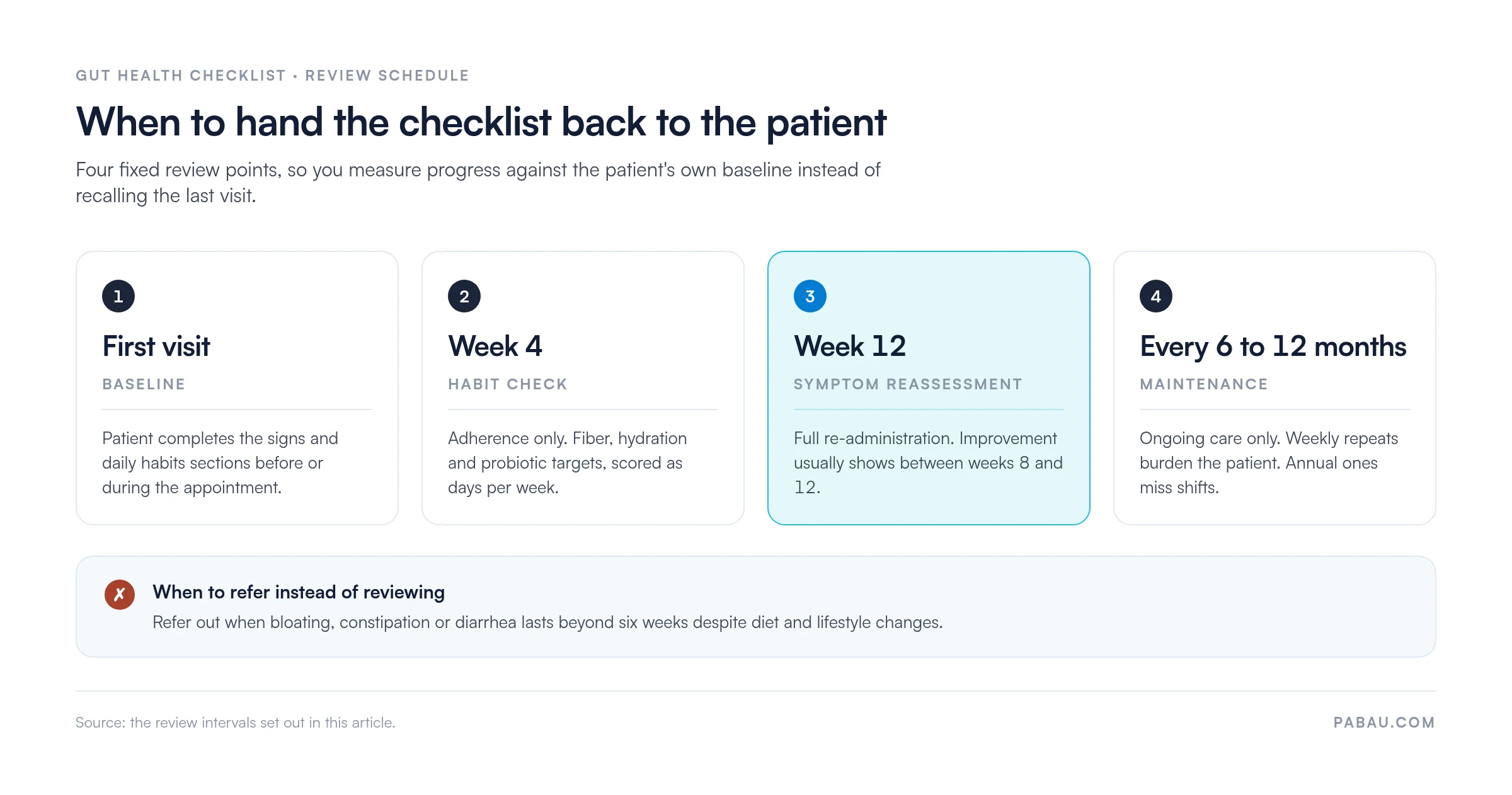
Re-administer the checklist at four weeks and again at 12, and refer out if symptoms outlast six weeks.
Practice management software like Pabau keeps each round of answers in the client record, so progress is easy to compare.
A signable clinical form covering identity and consent checks, the main assessment steps, and a sign-off. It also has space to log every item you could not complete, plus free-text notes.
Download templateA gut health checklist turns a vague complaint about constant bloating into something you can score, file, and measure again a month later. Digestive symptoms rarely arrive on their own. Patients report fatigue, skin flare-ups, and low mood first, then mention the bloating last.
So the checklist earns its place by pulling that pattern into view. It also fixes a baseline, which is the only honest way to show a patient they are improving.
What follows is the screening list, the habits worth tracking, the food swaps, and the point where you refer out.
Gut health describes how well the microbes in a patient’s digestive tract are balanced, and how well that system does its job. Bacteria, fungi, and viruses together make up the microbiome. They break down food, release nutrients, train the immune system, and produce compounds that reach the brain.
When that balance tips, clinicians call it dysbiosis. Digestive complaints follow, and so do symptoms that look nothing like a gut problem.
Dozens of separate digestive conditions open with the same short list of complaints. One screening question will never sort them, which is why a structured checklist beats an ad-hoc conversation.
Patients rarely present with one symptom. Screen against the whole list, because the combination tells you far more than any single item.
Patients tend to dismiss each symptom on its own. Your job is to connect them, then show the patient the connection you have drawn. Adherence climbs once someone sees five complaints resolve into one explanation.
Consistency beats intensity here. Hand patients this list and ask them to score it as days per week, rather than as a pass or a fail.
Do not hand over all seven at once. Pick two or three, get those steady, then add more. A patient-facing healthy habit checklist works well for the tracking, because it keeps the scoring in the patient’s hands between visits.
Diet is the biggest lever you have. Share this table with patients so their daily choices need no interpretation.
Warn patients that the switch can feel worse before it feels better. Moving from processed food to a fiber-rich diet often brings a week or two of extra gas.
Where symptoms track clearly to specific foods, a structured elimination diet plan is the better next step than an ever-longer avoid list.
Supplements sit behind diet and lifestyle, and only some carry decent evidence. Grade them out loud with the patient, so a Tier 3 product never gets discussed like a Tier 1 one.
Your wording matters as much as your choice. The FDA does not review dietary supplements before they go on sale, and no product may claim to cure a disease.
Write the tier into your notes, so the record shows which advice was foundational and which was adjunctive.
A download only pays off once it has a slot in the visit. Five steps put it there:

The order matters more than the paperwork. A patient who leaves with two habits and two dates in the calendar comes back with data. Hand over a seven-item plan and they come back apologetic.
The checklist screens, and it does not diagnose. Refer to a gastroenterologist, a registered dietitian, or a functional medicine specialist when you see any of these:
Write the reasoning down at the moment you make the call. A referral letter that names the pattern, the duration, and what you already tried saves the specialist a visit.
Microbiome sequencing and metabolomic profiling keep advancing, but neither is standard of care and insurance rarely covers either. Say so plainly. A patient who understands why you are not ordering a panel will trust the plan you did order.
Give the plan eight to 12 weeks before you judge it. Re-administer at four weeks to check adherence, then at 12 weeks to reassess symptoms. After that, settle into a maintenance rhythm.
Repeat assessment only works if the record holds more than the last visit. Practices running longevity and functional programs handle this with longevity clinic software that keeps every round of answers on one timeline.
Score five measures at each review:
Name the small wins out loud. A first week without bloating counts. Recording those next to the clinical findings gives the patient a story of progress, and that is what keeps them booking and referring.
Plenty of practices still run this on paper. The form goes home in a folder, and the follow-up gets booked when someone remembers. Whether the week-12 comparison happens at all depends on the filing cabinet.
Pabau moves the same work into the client record. Send the checklist as a digital form before the visit and the answers arrive in the chart, ready to sit beside the last round. Automated reminders handle the four-week and 12-week prompts, so the review schedule holds without anyone working a call list.
It suits functional and nutrition-led practices in particular, because repeat questionnaires are the whole model. If that is your setup, functional medicine software covers the same ground across the rest of your protocols.
Every Pabau subscription includes every feature, so forms, records, reminders, and reporting arrive together.

Pabau sends the checklist as a digital form and files the answers in the client record. Automated reminders prompt the four-week and 12-week reviews, so the comparison is ready when the patient arrives.

What makes this work is the discipline of asking the same questions twice, 12 weeks apart, with both answers in front of you. Any practitioner could write the symptom list from memory. Far fewer can show a patient how their own scores moved.
So decide the review dates before you hand the form over. A checklist with no second date is a leaflet. Weigh that against the pull to fix the whole diet in one visit. The patient who agreed to two habits is the one still trying in week 12.
Download the form above, and set the four-week and 12-week reviews the same day you use it. Book a demo to see how Pabau stores each round of answers in the client record and prompts the reviews for you.

Ready to add foods back in a controlled order? Elimination diet reintroduction chart gives you a sequence and a place to log each reaction.
Working with an autoimmune presentation? AIP diet plan template sets out the elimination and reintroduction phases in one handout.
Need to map causes across body systems? Functional medicine matrix organizes a full history so patterns show up across systems, not just in the gut.
Not sure how far to read into a lab panel? Interpreting biomarkers without overpromising covers how to frame results the evidence does not fully support.
Choosing a system for repeat assessments? Functional medicine EMR compares what to look for when protocols run over months.
Most of the microbiome rebounds within a few weeks. Tracking studies suggest some species take up to six months to return, and a handful never do. Push fermented food and fiber during that window.
Rarely. IgG food sensitivity panels are not validated for diagnosing intolerance, and allergy bodies advise against them. A supervised elimination and reintroduction gives you better information for less money.
Partly. Sleep, movement, stress control, and cutting back on alcohol all shift the microbiome. Diet stays the biggest lever, so treat the rest as support rather than a substitute.
The evidence is early and mixed. Some studies report better microbial diversity, others show no change. Keep it off the first-line list, and avoid it entirely where there is any history of disordered eating.
Check adherence before you change the plan. Most flat results come down to habits that never got established. If adherence held and the scores did not move, that is your referral trigger.
Yes, with two changes. Scale the fiber and hydration targets to age and body size, and involve a parent in the tracking. Skip restrictive elimination diets in growing patients unless a specialist directs it.