OSHA respirator medical evaluation questionnaire
The OSHA respirator medical evaluation questionnaire is the mandatory health for...

3
Last Updated: Oct 15, 2026

Histamine intolerance builds up when the DAO enzyme in the small intestine cannot break down dietary histamine fast enough.
Foods cause symptoms three ways. They carry histamine, they release the histamine a patient already stores, or they block the DAO enzyme.
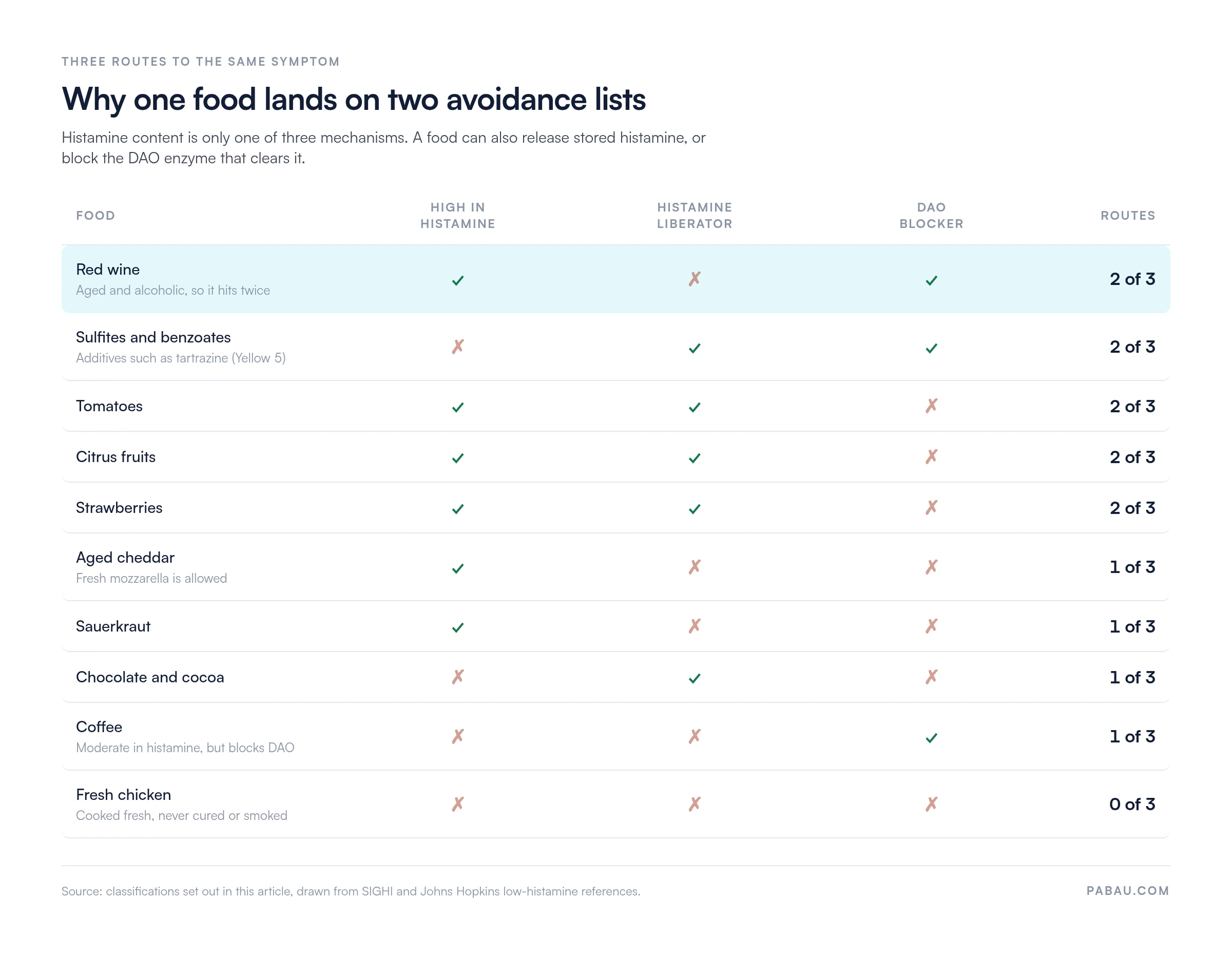
Red wine, tomatoes, citrus and strawberries each trigger symptoms by two of those three routes.
Freshness decides histamine content, so leftovers held more than 24 hours often provoke symptoms the same meal did not.
Most patients avoid strictly for four to six weeks, then reintroduce one food every three to five days.
A clinical reference sorting foods by histamine content, liberator status and DAO-blocking potential. It includes intake patterns, portion guidance and practical substitutions for dietary management.
Download templateHistamine content is only one of three reasons a food ends up on an avoidance list.
Some foods release the histamine a patient already stores. Others block the enzyme that clears it. A list that does not separate the three leaves patients guessing.
This template is built for the practitioner handing the list over. That means functional medicine clinicians, dietitians, naturopaths and primary care providers. It covers the three mechanisms, portion and storage guidance, and a reintroduction sequence you can document per patient.
Histamine is an organic compound the body produces and a wide range of foods naturally contain. Intolerance sets in when a patient cannot break down food histamine fast enough. The cause is an underactive diamine oxidase (DAO) enzyme in the lining of the small intestine. Histamine then accumulates in the bloodstream, and symptoms follow.
Unlike an IgE-mediated food allergy, histamine intolerance sits on a spectrum. It is not formally recognized as a diagnostic ICD code in every territory. Symptoms are still reproducible and often predictable, which is what makes a structured food list useful.
Mast cell activation syndrome (MCAS) is related but distinct. In MCAS, mast cells release histamine excessively, which makes it a systemic disorder rather than a digestive one. MCAS patients often do better on a low-histamine diet, but this list does not replace specialist oversight for them.
Patients arrive with a cluster of non-specific complaints that reads like allergy, hormone imbalance or stress. Recognizing the cluster is what gets them onto the right dietary intervention.
Symptoms usually start 30 minutes to two hours after a high-histamine meal. They can last hours or days, depending on how deep the DAO deficit runs. Logging that timing beside the meal in functional medicine software turns a vague reaction into a trigger you can name.
Histamine climbs with age, fermentation and storage time. Fresh always beats aged or processed. The Johns Hopkins low-histamine diet reference flags these categories as consistently problematic.
Some foods are low in histamine themselves but prompt mast cells to release the histamine a patient already stores. These liberators can set off symptoms in a patient who is following a strict low-histamine diet. The mechanism differs from histamine content, but the symptoms look the same.
Tolerance varies a lot between patients. One tolerates fresh strawberries in small portions. Another reacts hard to the same bowl. Capturing each patient’s baseline triggers in patient intake software means the protocol starts from their history instead of the generic list.

Beyond histamine content, some foods and drinks actively inhibit the DAO enzyme. Small amounts are enough to stop the body clearing the histamine it just took in.
Coffee deserves its own note. Research on coffee as a DAO blocker is thinner than the research on alcohol. It still appears on clinical guidance from SIGHI, the Swiss Interest Group Histamine Intolerance, and many patients report improvement once they drop it. That is the argument for individual trials rather than a fixed rule.
Once all three mechanisms are on the table, the overlap is what patients get wrong. Several everyday foods trigger symptoms by two routes at once, which is why they resist a diet that only counts histamine.
A low-histamine diet is not as narrow as it first sounds. Plenty of everyday foods are naturally low in histamine, as long as they are fresh and unprocessed. Freezing food straight after purchase locks the low level in.
The table below consolidates each food category across the three mechanisms. Print it, laminate it, and hand it over at the consultation.
Two columns can flag the same food, and that is the point. A food in more than one column needs avoiding regardless of how much histamine it holds.
The sequence below is what turns a food list into a protocol you can document. It works across functional medicine, integrative health, naturopathy and primary care settings. A broader elimination diet plan covers the same phases for other trigger foods.
The template carries fields for portion size, symptom onset timing and medication interactions. Those are the inputs that let you refine the protocol instead of repeating it. A reintroduction chart gives the patient somewhere to record each trial between appointments.
Dietary management here is highly individual. Some patients stay sensitive for good. Others regain tolerance once the gut heals. A few principles hold either way.
Patients on multi-modal care plans generate documentation across diet, supplementation and symptom tracking. Keeping it in one record is the difference between a protocol you can adjust and a pile of notes. Purpose-built longevity clinic software holds the dietary protocol next to the labs and the appointment history.
Right now the food list probably goes out as a printout or an email attachment. The patient mislays it, keeps no food diary, and arrives at the next appointment working from memory. You rebuild the timeline in the room.
Practice management software like Pabau replaces that with a digital form the patient completes in the online booking portal. You build the food-trigger questions once, attach the list to the treatment plan, and the responses land in the patient’s record. The front desk has no forms to re-key.
That gives you a dated record of what the patient ate, what they reacted to, and which trials you have already run. Reviewing it before the appointment means the consultation starts at the reintroduction decision instead of the recap. Documentation of the education you delivered sits in the same record.

Pabau’s digital forms and patient portal let you send the histamine food list and collect food and symptom logs. You review them before the next appointment.

A histamine food list earns its keep when the patient understands why each food is on it. Sort by mechanism and the coffee question, the strawberry reaction and the red wine flare stop looking like contradictions.
The trade-off worth remembering is breadth. Strict avoidance buys a clean baseline, and it costs nutrient variety, so treat it as a phase rather than a destination. Reintroduce on a schedule and most patients land on a wider diet than the list suggests.
Download the template, put it into your digital intake flow, and use it at the next consultation. Book a demo to see how Pabau distributes dietary protocols and keeps each patient’s food and symptom log in one record.

Need the intake side of a functional medicine visit? Functional medicine intake form captures diet, symptoms and history in one structured document before the first appointment.
Mapping the drivers behind the symptoms? Functional medicine matrix organizes triggers, mediators and antecedents so the dietary work sits inside a fuller clinical picture.
Does the patient need a stricter starting point? AIP diet plan template lays out an autoimmune protocol elimination phase with the same reintroduction discipline.
Choosing the software behind the protocol? Functional medicine EMR sets out what to look for in a record system built for multi-modal care.
A histamine food list is a clinical reference organizing foods by histamine content. It is for patients with histamine intolerance or MCAS, and the practitioners managing them. Functional medicine doctors, naturopaths, registered dietitians, and integrative health providers use it to guide dietary elimination and reintroduction protocols.
Coffee itself is moderate in histamine, but it actively blocks DAO enzyme function, preventing the body from breaking down dietary histamine. Many patients with histamine intolerance report symptom improvement upon eliminating coffee. Sensitivity varies, and some tolerate small amounts.
The primary approach is avoiding high-histamine foods and DAO blockers, allowing the body’s DAO enzyme to process accumulated histamine. Supplemental DAO enzyme, addressing gut permeability, and managing stress and sleep all support faster histamine clearance. Individual tolerance and gut healing timelines vary.
Low-histamine fruits include apples, pears, bananas, fresh peaches, watermelon, grapes, and cherries. Avoid dried fruits (concentrated histamine), citrus, and berries, which are histamine liberators. Freshness is essential, since overripe fruit has elevated histamine.
The SIGHI (Swiss Interest Group Histamine Intolerance) list is the gold-standard clinical reference classifying foods by histamine content and liberator potential. It is updated regularly and serves as the basis for most modern low-histamine diet guidance in clinical practice.
Yes. Histamine intolerance arises from DAO enzyme insufficiency and food-derived histamine accumulation. MCAS is a systemic disorder where mast cells abnormally release histamine. Both may benefit from a low-histamine diet, but MCAS requires specialist medical oversight and often broader treatment beyond diet.