HIPAA compliant texting: What you can send patients & how to communicate securely
HIPAA compliant texting is possible when a text holds no protected health inform...

Last Updated: Oct 16, 2026
The functional oral intake scale (FOIS) rates what a patient with dysphagia safely eats and drinks by mouth. It runs from Level 1, nothing by mouth, to Level 7, a total oral diet with no restrictions.
Crary, Mann and Groher published the scale in 2005 for adults after stroke. It is now a common outcome measure in swallowing care. The score shapes the diet order, so a wrong level can put a patient on food they can’t manage safely.
The trickiest call sits between Levels 5 and 6, and it turns on one question. Does the diet still need special preparation? Start with the level definitions, then score your next patient on the free template.
A one-page form listing all seven FOIS levels as tick boxes, in the original scale wording. It also has fields for the patient’s name, the assessment date and additional notes.
Download template
The FOIS rates functional oral intake on seven levels, from nothing by mouth (Level 1) to a total oral diet with no restrictions (Level 7).
Levels 1 to 3 cover patients who still depend on a feeding tube, and Levels 4 to 7 cover a total oral diet.
Level 5 needs special preparation or compensations, while Level 6 needs neither but keeps specific food limitations.
Score the highest level the patient manages safely today, and record the foods, liquids and strategies behind it.
The original validation study reported inter-rater kappa statistics of 0.86 to 0.91 in adults after stroke.
The FOIS answers one question: what is the highest level of oral intake this patient manages safely and consistently? The clinician turns observation and chart review into a single score.
That sets it apart from instrumental studies such as the videofluoroscopic swallowing study (VFSS) and fiberoptic endoscopic evaluation of swallowing (FEES). Those show the mechanics of a swallow. The FOIS records the functional result, meaning what the patient eats and drinks day to day.
Crary and colleagues built it for adults recovering from stroke. Teams now apply it in traumatic brain injury, head and neck cancer, neurological conditions and post-surgical dysphagia. A five-level adaptation also exists for young children.
The scale splits into two halves. Levels 1 to 3 describe patients who still depend on a feeding tube. Levels 4 to 7 describe a total oral diet, with fewer conditions at each step up.
Each level works as a ceiling. A patient at Level 3 meets the conditions of Levels 1 to 3 but not yet Level 4. You select the single highest level the patient manages safely and consistently.
In practice, most scoring decisions come down to a short run of yes-or-no questions. The guide below walks through them in order.
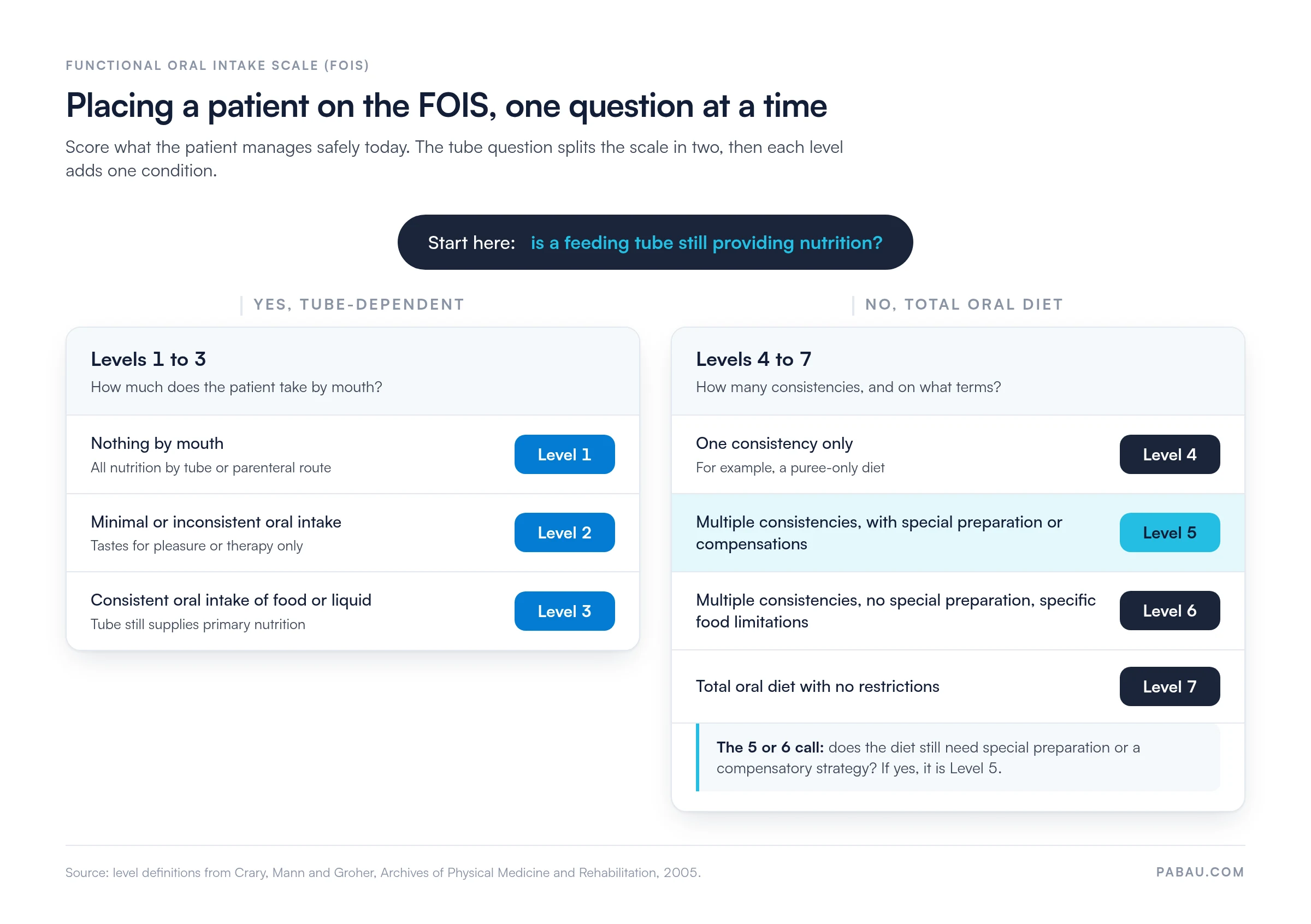
Moving from Level 1 to Level 7 traces the path from full tube dependence to an unrestricted diet. Teams use that path to set functional goals, explain expected diet changes to families and show response to therapy.
Speech-language pathologists usually assign the level, but the whole care team relies on it.
You’ll find the FOIS in acute hospitals, inpatient rehab, skilled nursing facilities, outpatient therapy practices and home health. Outpatient teams often record it in speech therapy practice software next to their session notes.
It is most common in stroke recovery programs, brain injury rehab and head and neck cancer care. Teams also use it with conditions such as Parkinson’s disease, ALS and multiple sclerosis.
Scoring takes a few minutes once you know the patient’s current diet. Work through these steps at every assessment.
Once the level is set, carry it into the patient’s dysphagia care plan. That way the diet goals and the score tell the same story.
Record the FOIS level at every visit, not only at admission and discharge. Over a few weeks, the scores form a progression line from tube dependence toward a full oral diet. That line shows your clinical impact at a glance, and it motivates patients too.
Three dysphagia measures often share a chart: the FOIS, the Dysphagia Outcome and Severity Scale (DOSS) and the Eating Assessment Tool (EAT-10). Each answers a different question, so they work best together.
The FOIS is clinician-observed and tells you which diet is safe. The DOSS rates swallowing severity, and the EAT-10 is a patient self-report screen. Many practices use all three. The EAT-10 screens, the FOIS sets the diet, and the DOSS supports research or insurance documentation.
Yes. The original 2005 validation study by Crary, Mann and Groher reported inter-rater reliability with kappa statistics of 0.86 to 0.91 in adults after stroke. It also showed the scale was sensitive to change in oral intake over time.
For children aged 1 to 7, Yi and Shin adapted the scale into a five-level version. Their 2020 psychometric study found a weighted kappa of 0.985 and 97.4% agreement between raters.
Beyond the validation work, the FOIS is widely used in speech-language pathology research and practice. It appears often in dysphagia outcome studies and quality improvement projects.
Speech-language pathologists, occupational therapists and dietitians use the FOIS in private practice, hospitals, rehab facilities and home health. If you treat dysphagia after stroke, neurological illness, head and neck cancer or surgery, one shared form pays off quickly.
Solo practitioners benefit too, because the form leaves a paper trail for insurance or regulatory review. Print the free template above or fill it in on screen, then file it in the patient chart.
On paper, a FOIS score lives in one chart, and tracking it across visits means flipping pages. In Pabau, the therapy practice management software we build, the score sits with the rest of the patient’s history.
You can rebuild the FOIS as one of your digital patient forms, with the seven levels as a single choice field. Each completed form saves to the patient’s file, dated and ready for the next clinician.

Because every score sits in one medical record, you can see a patient’s progression across weeks of therapy. Plateaus show up early, and you can compare baseline with current status before you adjust the plan.

See how Pabau’s digital forms and Client records help speech-language pathology teams score the FOIS, track diet progression and share results with the wider team.

The FOIS is a widely used, validated outcome measure, and its value depends on how consistently your team applies it. Score current intake, write down what sits behind the number, and settle every Level 5 or 6 question with the special-preparation test.
Do that at every visit and the scores become a progress record you can share with physicians, families and payers. Skip it, and the same patient can read as Level 5 on Monday and Level 6 on Friday.
Book a demo to see how Pabau stores FOIS scores in the patient record and tracks diet progression across visits.

Planning treatment after the score? Dysphagia care plan helps you turn swallowing assessment findings into goals and interventions.
Writing up swallowing sessions? SOAP notes for speech therapy gives you a session-note structure that sits neatly alongside a FOIS score.
Setting measurable therapy targets? Speech therapy goal bank offers goal wording you can adapt for feeding and swallowing work.
Comparing software for your caseload? Best speech therapy practice management software reviews the platforms speech-language pathologists use for notes, scheduling and billing.
Need one home for outcome measures? Speech therapy software shows how Pabau supports speech-language pathology practices from intake to discharge.
Level 1 is nothing by mouth. Levels 2 and 3 are tube dependent, with minimal or consistent oral intake. Level 4 is a total oral diet of one consistency. Level 5 allows multiple consistencies but needs special preparation or compensations. Level 6 needs no special preparation but keeps specific food limitations. Level 7 has no restrictions.
The International Dysphagia Diet Standardisation Initiative (IDDSI) describes food and drink textures on levels 0 to 7. The FOIS records how a patient eats overall. Many teams use both, with IDDSI naming the texture and the FOIS showing functional level.
No. Level 7 means a total oral diet with no restrictions. Thickened liquids count as special preparation, so a patient eating several textures with thickened drinks usually scores Level 5.
Score it at the initial assessment, whenever the diet changes, and at discharge. Recording it at every therapy visit makes progress and plateaus easy to spot.
Yes, in an adapted form. A five-level version for children aged 1 to 7 was validated by Yi and Shin in 2020. They reported a weighted kappa of 0.985 and 97.4% agreement between raters.