Military diet chart: 3-day menu, swaps and safety checks
A military diet chart lays out a three-day, very-low-calorie menu followed by fo...

Last Updated: Oct 23, 2026
A fitness planner turns a vague plan to exercise more into a written week with dates, sessions and targets. This free fitness planner template fits goals, a seven-day workout schedule, meal and sleep targets, and progress tracking onto one printable PDF. For each day, you record the workout, its duration, its intensity and a short note.
Physical therapists, sports medicine teams and personal trainers can hand it out between sessions and review the log at follow-up. Self-guided exercisers can use it the same way. Score intensity on the same simple scale every time, and a month of entries becomes easy to compare.
A two-page planner with start and end dates, a goals box, and a Monday-to-Sunday schedule for workout, duration, intensity and notes. It also covers workout types, meals and snacks, water and sleep targets, and a progress-tracking section.
Download template
A fitness planner puts goals, a seven-day schedule and progress tracking in one document.
Each training day records the workout, duration, intensity and notes, so sessions can be compared.
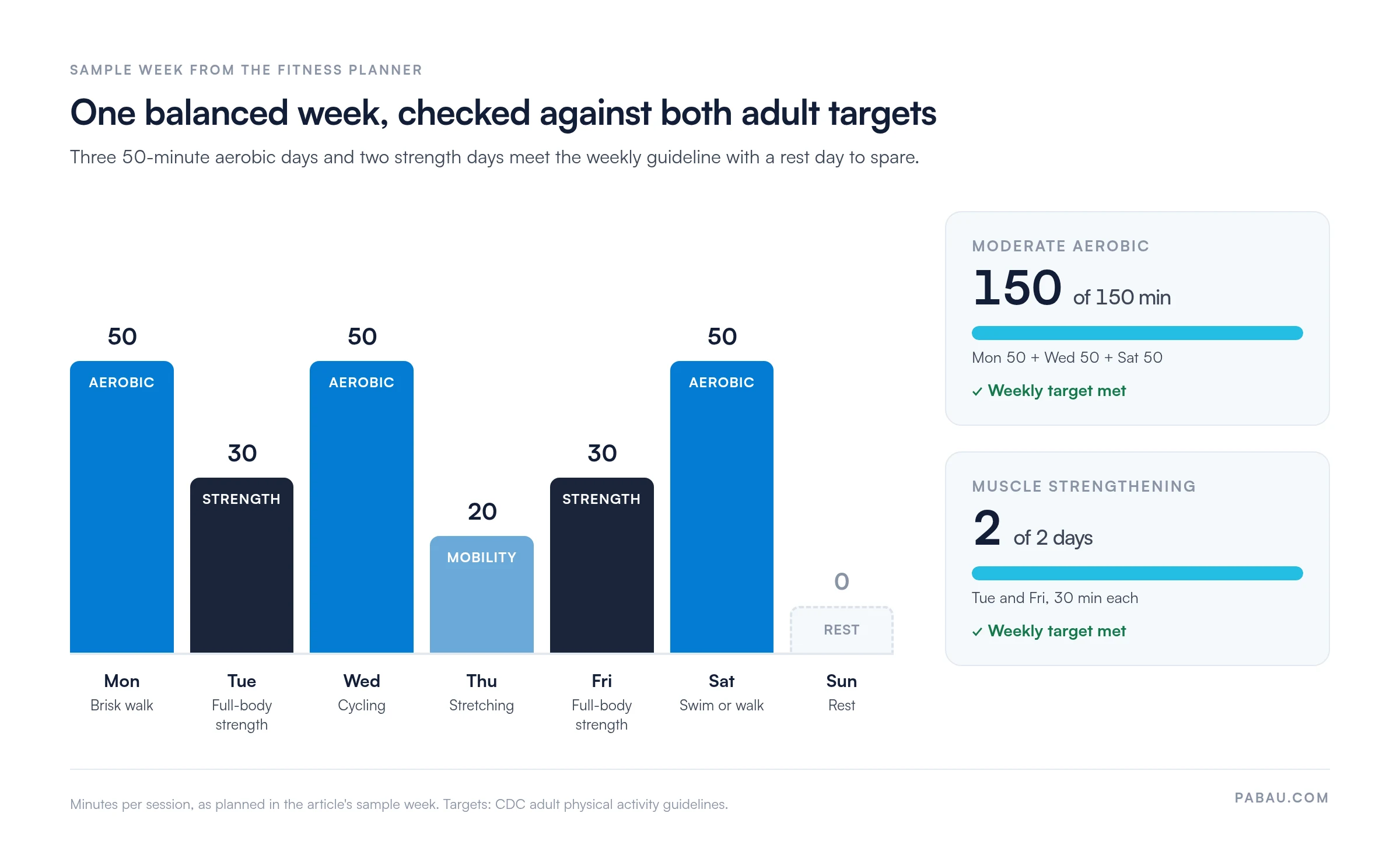
A balanced sample week reaches 150 minutes of moderate aerobic activity plus two strength days.
Rating intensity on one consistent scale makes a month of entries readable at follow-up.
The planner supports, but does not replace, clinical advice when an injury or condition is involved.
A fitness planner is a single document that holds a training week, a set of goals and a running progress record. Its purpose is to make the plan visible, so sessions, rest days and milestones are not left to memory.
Because this template is a printable PDF, you can hand a copy to a patient or keep one on file. It is built around five parts:
For a benchmark, the CDC recommends 150 minutes of moderate aerobic activity a week for adults, plus two days of muscle strengthening. A completed planner shows at a glance whether a week reached that target.
Start with one measurable goal, then block your training days before the week begins. Five steps keep the process simple.
If you work with a patient who has an injury or condition, agree the routine with the treating clinician first. Many practices capture that history through digital intake forms before the first session. For a quick pre-exercise screen, a PAR-Q screening questionnaire flags who needs medical clearance first.
The planner suits independent exercisers, personal trainers and healthcare practitioners who supervise exercise. Each group uses the same sections differently.
If you run a physical therapy practice, keep the planner alongside an EMR for physical therapists, so the log sits next to bookings and notes. Still choosing a system? Our roundup of physical therapy practice software compares the main options.
A structured plan gives both sides one shared record of what was planned and what happened.
Self-monitoring is a common part of behavior change work, although results differ between people. The World Health Organization’s physical activity fact sheet summarizes the global guidance on regular activity.
Review the progress section every Friday rather than at the end of the month. Short review cycles catch missed sessions while they are still easy to fix. They also give patients a reason to keep logging. Keep each entry to one line so the habit stays sustainable, then bring the log to every follow-up appointment.
The weekly section sets out each training day with its workout, duration, intensity and notes. The sample below shows one balanced week for a healthy adult. Adjust it to each person’s goals and capabilities.
The three aerobic days add up to 150 minutes, and Tuesday and Friday cover the two strength days. The chart below checks the week against both targets at a glance.
Use the notes line for anything that changes the next session, such as soreness, poor sleep or a skipped set.
The top of the planner holds the person’s name, a start date, an end date and a goals box. “Walk 50 minutes three times a week by the end date” works better than “get fitter”.
This box lists the forms of exercise the plan draws on. A typical mix covers aerobic work, muscle strengthening, and flexibility or balance.
The planner has slots for breakfast, lunch, dinner and three snacks. It also sets a daily water target in liters and a nightly sleep target in hours. Agree both figures with the person, because needs vary. If a patient needs a specific diet, refer them to a dietitian rather than writing one into the planner.
The final page tracks progress through weight, body measurements or other relevant metrics. Choose two or three measures that match the goal, and record them under the same conditions each time. For a walking goal, minutes completed per week often says more than body weight.
The intensity line is the field people fill in least consistently. One person writes “hard”, another writes “7”, and a month later neither entry means much.
The talk test, which the CDC uses to separate moderate from vigorous effort, gives a simple three-level scale:
Agree the scale at the first appointment and write it at the top of the planner. From then on, a rising number of moderate sessions at the same duration is a clear sign of progress.
In most practices, a paper planner lives in the patient’s bag between visits. Then it gets forgotten, photographed at reception or rewritten from memory during the appointment.
Pabau, the practice management platform we build, keeps the plan with the rest of the patient’s care. Intake forms capture health history and goals before the first session. Client records hold treatment notes and progress entries side by side, and automated reminders bring patients back for each review.
As a result, the clinician opens one record before a follow-up and sees the plan, the history and the last session’s notes.

Pabau brings patient intake, scheduling, reminders and records together, so the plans you build sit beside the rest of each patient’s care. Book a demo to see it in your own workflow.

Start small with the fitness planner. Set one dated goal, fill in next week’s schedule, and agree how intensity will be scored. Then review the log every week rather than once a month.
Done that way, the planner becomes evidence you can act on at each follow-up. The trade-off is a minute of logging after every session, and that minute is what makes the review useful.
Book a demo to see how Pabau keeps exercise plans, intake forms and progress notes together for your practice.

Screening someone before they start? Physical Activity Readiness Questionnaire (PAR-Q) template flags who needs medical clearance before exercise.
Need a starting baseline? Fitness assessment form records the first measurements your progress section builds on.
Want a ready-made routine to plug in? Gym exercise plan for beginners lays out a five-day workout template.
Struggling to measure the goal? Goal attainment scale template scores progress toward each goal on one agreed scale.
Short on time some days? 30-minute exercise plan gives you compact sessions to drop into a busy week.
Yes. The fitness planner PDF is free to download from this page, and you can print as many copies as you need.
Pick your training days, then assign each one a workout, a duration and an intensity. Mix aerobic sessions with two strength days, and leave at least one rest day.
Most adults can reach the CDC’s 150 weekly minutes over three to five days. Add strength training on two of them. A clinician may advise a different plan after an injury.
Yes, in a simple way. It has slots for three meals and three snacks, plus water and sleep targets. A detailed diet plan still belongs with a dietitian.
Track two or three measures tied to your goal, such as weekly minutes, weight or a body measurement. Record them under the same conditions each time.
Both work if the person fills it in after each session. Paper is quick to start, while a digital record is easier to share with a practitioner.