Pediatric teeth chart
A pediatric teeth chart maps the 20 primary (baby) teeth by letter, A to T, with...

1
Last Updated: Oct 15, 2026
An executive dysfunction test is a standardized assessment of how well an adult plans, organizes, holds information in mind, controls impulses, and switches between tasks. Clinicians use two types. Performance tests such as the Stroop and Trail Making Test are timed, while self-report questionnaires such as the Dysexecutive Questionnaire (DEX) capture everyday difficulty.
The free 10-item questionnaire below is a self-report screener for routine intake. A high score tells you which patients need formal neuropsychological testing. It does not confirm a diagnosis on its own.
A 10-item self-report questionnaire rating organization, task initiation, working memory, impulse control, focus, time management, and emotional control on a 1–5 agreement scale. It includes a total score line, a patient reflection space, and a section for clinician notes and recommendations.
Download template
Executive dysfunction is a measurable deficit in planning, working memory, inhibitory control, or cognitive flexibility that disrupts daily functioning.
Performance tests like the Stroop and Trail Making Test measure timed processing, while questionnaires like the DEX capture everyday difficulty.
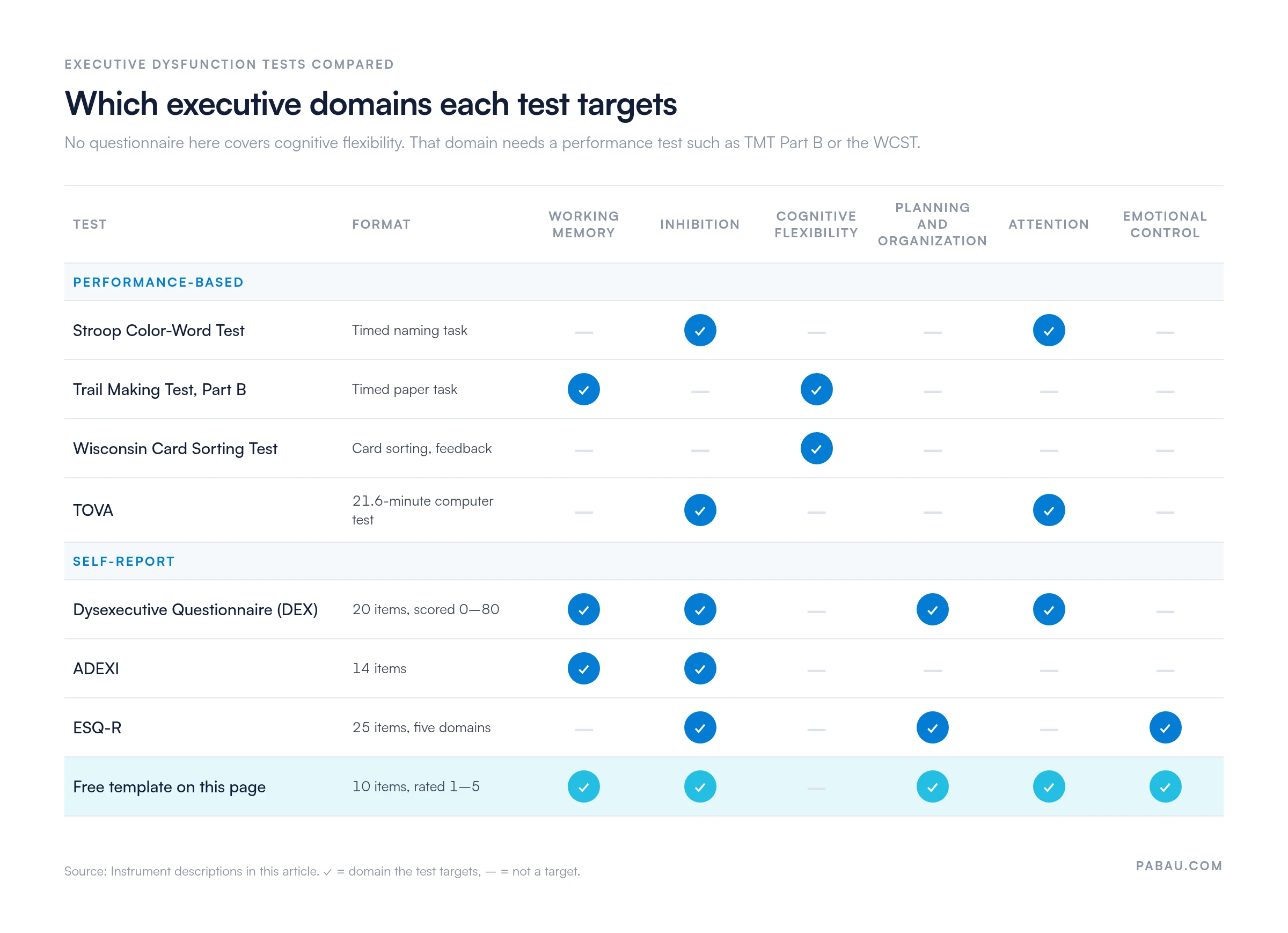
The free 10-item template skips cognitive flexibility, so pair it with Trail Making Test Part B or the WCST when flexibility matters.
Executive dysfunction appears in ADHD, depression, traumatic brain injury, dementia, and autism, so rule out overlapping causes before planning treatment.
Practice management software like Pabau sends the questionnaire before the visit and files the completed form in the patient record.
Executive dysfunction is an impairment in the higher-order cognitive processes that drive goal-directed behavior. Psychologists, psychiatrists, and ADHD specialists screen for it because it shapes how well a patient copes with work, study, and treatment plans. Running the screen inside therapy practice management software keeps the score next to the rest of the intake record.
The four core executive domains are working memory, inhibitory control, cognitive flexibility, and planning and organization. Working memory holds and manipulates information, and inhibitory control suppresses irrelevant responses. Cognitive flexibility lets a person switch between tasks or mental sets, while planning sequences the steps toward a goal. Deficits in any combination disrupt time management, decision-making, and emotional self-control.
A single-domain deficit is less clinically significant than impairment across several domains. The broader pattern is what separates a patient who struggles with one kind of task from one whose whole day is affected.
Executive dysfunction appears across psychiatric, neurological, and developmental disorders. Recognizing the pattern guides diagnosis and treatment prioritization.
Because the pattern crosses so many conditions, screening belongs early in mental health EMR workflows and in ADHD clinic software used for adult assessments. A single test result rarely stands alone. Mood, attention, and developmental history all shape how you interpret it.
Clinicians choose between performance-based and self-report measures depending on the goal of the assessment. Performance-based tests measure cognitive processing under timed conditions. Self-report questionnaires capture how the patient experiences difficulty in everyday life.
These tests require controlled administration and measure specific cognitive processes under standardized conditions.
Self-report tools capture the patient’s lived experience of executive difficulty and are quicker to administer in routine clinical settings.
Mapped side by side, the instruments cover different ground, and none of the questionnaires reaches cognitive flexibility.
The downloadable template takes a patient through 10 statements in a few minutes. Administering, scoring, and following up on it takes five steps.
The template has no item on cognitive flexibility. When rigid thinking or trouble adapting to change is part of the presenting complaint, add Trail Making Test Part B or the WCST.
Critical disclaimer: This screening tool is not diagnostic. Diagnosis requires multi-method, multi-source assessment by a licensed clinician. A high score is a reason to evaluate further, and it does not confirm a disorder by itself.
Privacy and compliance: Store the completed questionnaire in HIPAA-compliant clinical software with access controls. The screening result is part of the medical record and carries the same data protection as other patient health information.
Adult presentations differ from pediatric cases and carry specific diagnostic and treatment implications.
Lifetime onset vs. acquired: Adults with lifelong ADHD often show stable, pervasive executive deficits. When executive dysfunction begins with depression, it may improve with mood treatment. Acquired deficits from TBI, stroke, or degenerative disease follow a different trajectory and may call for neurorehabilitation.
Comorbidity screening: Adults frequently have overlapping conditions. An adult with both depression and ADHD needs a separate assessment of each. Depressive executive slowing and ADHD-related impulsivity present differently and may need different interventions, and executive dysfunction testing helps tell them apart.
Functional impact documentation: Insurance, disability, and workplace accommodations require documented functional limitation. Frame the result in terms of everyday consequences. Examples include “Unable to plan multi-step projects independently” and “Difficulty maintaining an organized workspace.”
Repeat screening: For patients with ADHD, depression, or neurological conditions, the questionnaire can become a standard intake step, as routine as screening for substance use. Some practices pair it with one performance test a year, such as the Stroop or TMT, to track objective cognitive change.
Many practices still hand patients a paper questionnaire in the waiting room. Someone adds up the score by hand, types it into the notes, and scans or files the form.
With practice management software like Pabau, the questionnaire goes out with your digital intake forms before the appointment. The patient completes it at home, and the answers flow into their patient record automatically. Pabau Scribe, our AI scribe, drafts the consultation note while you discuss the result, so you review a note instead of writing one.
The screening result then sits next to the appointment history, treatment notes, and referral letters. When you rescreen after treatment, both scores are in the same file, so progress is easy to show the patient or a payer.

Pabau sends the questionnaire with your intake forms and files the completed answers in the patient record, so appointment time goes on discussing the result.

Start with the free questionnaire at intake. It takes a few minutes and shows you which patients need more than a conversation. Treat the total as a prompt to probe further, never as the diagnosis.
The trade-off is coverage. The template misses cognitive flexibility, so add TMT Part B or the WCST when rigid thinking is part of the complaint. Refer to neuropsychology when several domains score high.
Filing the score against the patient record pays off later, when insurers, employers, or schools ask for evidence of functional limitation. Book a demo to see how Pabau sends, stores, and tracks executive function screening from intake through follow-up.

Screening adults for ADHD? Adult ADHD self-report scale template gives you a ready-to-use screener to run alongside this questionnaire at intake.
Need a broader cognitive screen? Montreal Cognitive Assessment test explains how the MoCA screens for mild cognitive impairment, including its executive function items.
Starting an ADHD workup? ADHD screening test template offers a printable first-pass screener for patients referred with attention concerns.
Want to put test scores in context? Biopsychosocial assessment shows how to weigh screening results against biological, psychological, and social factors.
Executive dysfunction and IQ are separate cognitive domains. A person can have average or high IQ but poor executive function (difficulty organizing, planning, or impulse control despite intact reasoning). Executive tests measure how you use cognition; IQ tests measure raw reasoning capacity. Both matter for diagnosis.
Yes. Depression causes executive slowing, reduced cognitive flexibility, and planning difficulty. These deficits often improve with antidepressant treatment or therapy. ADHD-related executive dysfunction is typically lifelong and stable across mood states. Distinguishing the two guides treatment priorities.
No. Screening questionnaires identify probable dysfunction and guide next steps but are not diagnostic. Diagnosis requires multi-method assessment: Performance-based cognitive testing, clinical interview, collateral history, and ruling out other causes. A psychologist or neuropsychologist typically conducts formal evaluation.
Online tests range from unvalidated games to evidence-based computerized versions of established tests like TOVA. Consumer-facing brain-training apps typically lack clinical validation. Validated computerized batteries with published norms exist, but they require professional administration and interpretation.
Yes. ADHD medication (stimulants, non-stimulants) improves executive function in diagnosed adults. Cognitive behavioral therapy, coaching, and structured environmental supports also build executive capacity. Acquired deficits from TBI respond to neurorehabilitation. Improvement depends on underlying cause and intervention intensity.
The DEX is a 20-item self-report asking about everyday executive problems: Losing things, forgetfulness, difficulty planning, distractibility, impulsivity. It captures the patient’s lived experience of executive dysfunction across multiple domains in one brief questionnaire. Scores guide clinical discussion and referral decisions.