Psychosis spectrum test: What it screens for and how it works
A psychosis spectrum test is a short clinical screening tool that checks for hal...

Last Updated: Oct 5, 2026
Electronic health record systems for mental health are software platforms built around psychotherapy notes, therapy CPT codes, and the way outpatient therapy practices run.
They differ from general medical EHRs in three ways a buyer can check. Psychotherapy notes sit in their own legally protected category, note templates follow therapy modalities, and billing is wired for behavioral health codes.
Choosing one is a multi-year commitment, so the evaluation process matters more than any feature list. This guide covers the six feature areas worth scoring, the three compliance layers a therapy practice carries, and a five-step selection process. The checklist below turns that into a form you can score each vendor against.
A scored checklist covering clinical note templates, therapy CPT billing, HIPAA and 42 CFR Part 2 verification, and telehealth. It also lists the onboarding questions to ask each vendor. Print it, take it into every demo, and compare platforms on the same criteria.
Download template
Mental health EHRs must support HIPAA-protected psychotherapy notes, therapy-specific progress note templates such as SOAP, DAP and BIRP, and treatment plan documentation.
The six areas worth scoring are clinical documentation, therapy CPT billing, HIPAA compliance, telehealth, scheduling with automated reminders, and a client portal.
HIPAA compliance is mandatory, so verify a signed Business Associate Agreement, encryption at rest and in transit, and documented audit trails.
Practices treating substance use disorders carry a second federal rule, 42 CFR Part 2, which is stricter than HIPAA alone.
Pabau offers customizable clinical note templates, multi-practitioner scheduling, online booking, and HIPAA-compliant records for solo and group mental health practices.
A mental health EHR is a clinical records system for therapists, psychiatrists, and counselors. It holds assessments, progress notes, and treatment plans in one secure file, and it sits where clinical workflow meets business operations.
Three differences separate it from a general medical records system:
That last point catches practices out at audit. CPT 90834 covers a 45-minute individual session and 90837 a longer one, so the time recorded in the note has to support the code billed.
Score every system you shortlist against the same six areas, in the same order, so the comparison holds up when you sit down to decide.
A signed Business Associate Agreement and encryption are table stakes, and every vendor on your shortlist should have both. What separates them is how they handle the two regulatory layers that sit on top.
The three layers stack, and each one changes what the software has to do with the record.
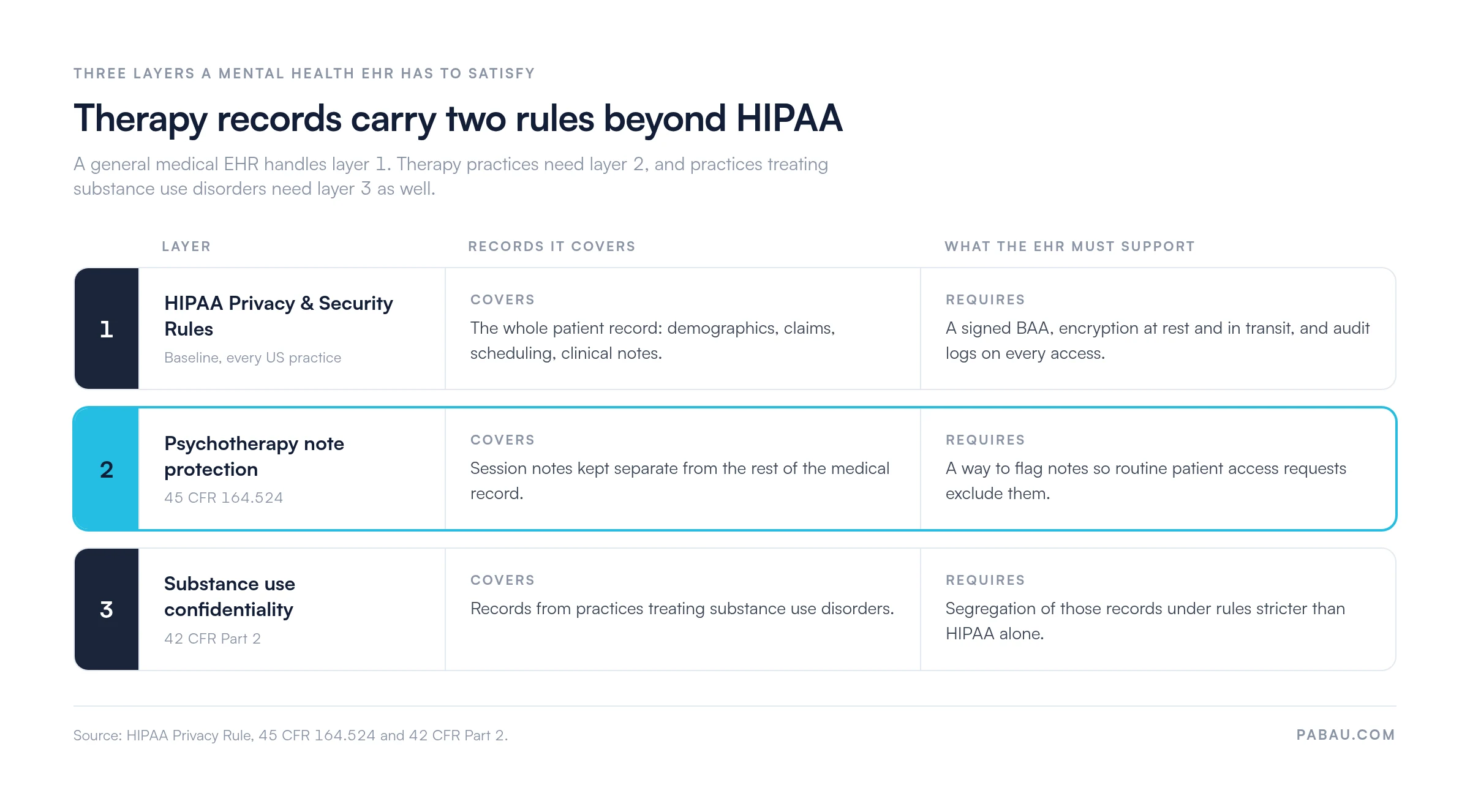
Psychotherapy note protection (45 CFR 164.524): psychotherapy notes carry heightened HIPAA protections and sit apart from the rest of the medical record. The EHR must let you flag a note as a psychotherapy note, so routine patient access requests exclude it.
Substance use records (42 CFR Part 2): a practice treating substance use disorders holds records under federal confidentiality rules stricter than HIPAA alone. Ask each vendor how they segregate those records, and check they can answer without going away to look it up. SAMHSA publishes guidance on what Part 2 compliance requires.
Several established vendors serve this market. Here is how the leading platforms stack up across the dimensions that decide a shortlist.
Use the table to build a shortlist, then go deeper. Our comparison of the best mental health EHR options weighs each platform against practice size and billing needs.
A solo therapist and a ten-clinician group need different architecture. Knowing which model you are buying for stops you overpaying for features you will not use. It also stops you undershooting on the tools you need to run a therapy practice at scale.
Private practice (solo or one to three practitioners): prioritize ease of use, straightforward billing for a small patient panel, and low cost per practitioner. You are probably handling the admin yourself. Look for an intuitive interface, affordable per-clinician pricing, and a client portal strong enough to take bookings and payments without you.
Group practice (four or more practitioners): prioritize multi-provider scheduling, role-based permissions, supervision workflows, shared documentation, and billing that scales. Multi-location support matters as soon as you operate across sites. You also need staff management tools to assign providers, manage coverage, and track individual clinician productivity.
Clients now expect a remote option, so check whether the EHR includes HIPAA-compliant video of its own or leans on an outside platform.
Native telehealth means one login and one interface, with session notes attached to the appointment automatically. Third-party integrations such as Zoom for Healthcare or Doxy.me give you more choice. The trade-off is that someone has to link each video session back to the clinical record by hand.
Pabau, our all-in-one practice management system, runs integrated telehealth from the client record. You start the consultation from the file you are about to write into, so the note and the session never drift apart.
A structured process protects you from vendor overhype and implementation surprises. Five steps cover it.
Once you have chosen, implementation planning matters as much as the product. Most rollouts take four to twelve weeks depending on patient volume and how much historical data moves across. Ask the vendor three questions upfront. Will they migrate the data from your old system, what does that cost, and how long does it take?
Digital intake forms should be configured before launch, so new clients complete questionnaires and consent electronically on day one. Train the team one to two weeks ahead of go-live using test patient accounts. The first week will run slower than your old workflow, so leave room in the diary for it.
Most therapy practices run this across more than one system. Session notes live in one tool, the calendar in another, and invoices in a spreadsheet, so the same client detail gets retyped three times. Every retype is a chance for the record and the claim to disagree.
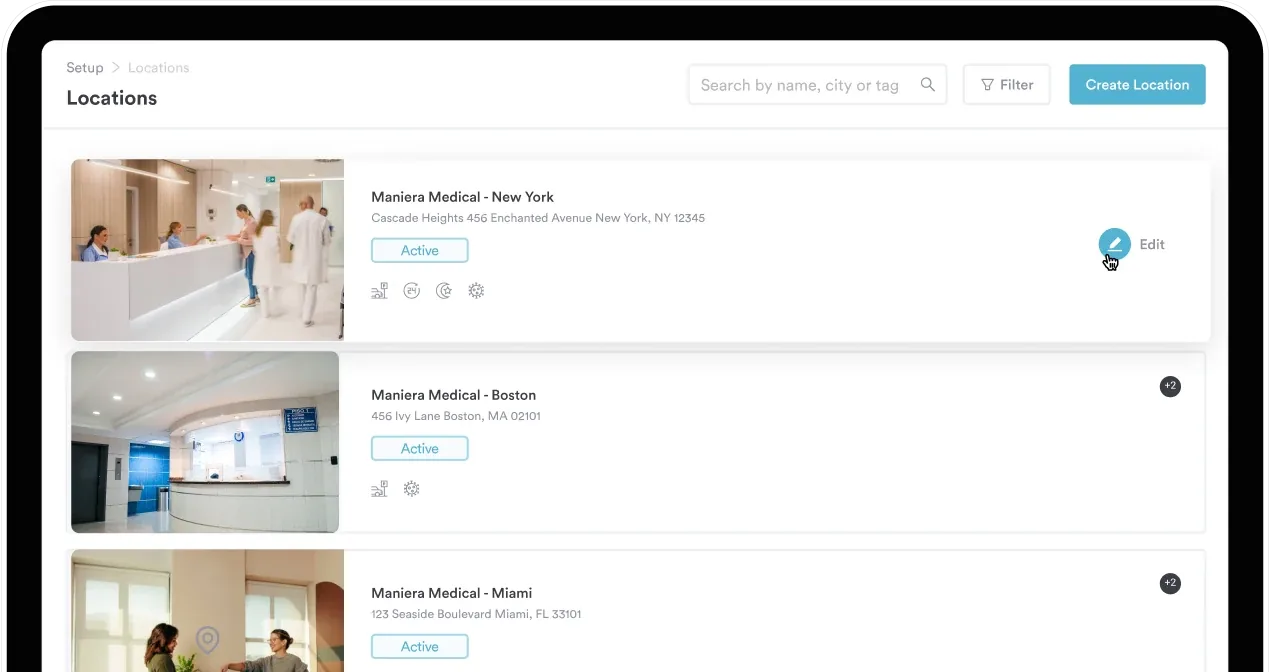
Pabau holds the clinical record, the calendar, and the billing in one place. Note templates are customizable, so a therapist can build SOAP, DAP or BIRP forms that match how they actually write. Multi-practitioner scheduling and online booking sit on the same client file, and every subscription includes every feature.
Instead of a free trial, Pabau runs structured onboarding. A dedicated client coordinator and a documented setup portal walk the practice through data migration and configuration. A therapy EHR only pays off once it matches how the practice works.

Pabau brings clinical notes, multi-practitioner scheduling, online booking and billing into one client record. Your team stops retyping the same detail across separate tools, and claims go out against the note that supports them.

The EHR you pick will shape how your team documents, bills, and schedules for years. That makes it worth running the selection slowly, with the checklist open and the same questions put to every vendor.
The trade-off worth remembering is that a more capable system takes longer to configure. Budget for that setup and the software fades into the background, which is where good infrastructure belongs. Book a demo to see how Pabau handles therapy notes, scheduling, and billing in one client record.

Still building the shortlist? Best EHR software for mental health compares the leading platforms on documentation, billing and price.
Running a behavioral health group? Behavioral health practice management EHR covers the scheduling and supervision workflows a multi-clinician team needs.
Need the paperwork before the first session? Mental health intake form gives you a ready-made intake you can hand to new clients.
Writing progress notes by hand? SOAP note for mental health template shows what each section should contain for a therapy session.
Operating across several sites? EHR for a multi-franchise mental health practice explains how records and permissions work across locations.
There is no single best option. It depends on practice size, specialty, and budget. For solo private practices, SimplePractice and TherapyNotes are strong on ease of use and therapy-specific templates. For group practices, Pabau and TherapyNotes scale better across multiple locations and practitioners. Use the downloadable checklist to score them against your own requirements.
Sessions Health offers a free tier with limited features, and some other platforms run free trials. Pabau does not. We offer demos and structured onboarding instead, because proper setup is what makes the platform deliver. Free tiers usually cap patient count or exclude billing, so they suit very small practices only.
Yes. HIPAA compliance is mandatory for any US mental health practice. Every vendor should offer a signed Business Associate Agreement, encryption at rest and in transit, and audit logs. If a vendor cannot provide these, do not sign.
An EMR (electronic medical record) is a digital copy of a paper chart. An EHR (electronic health record) is broader. It adds scheduling, billing, telehealth, and reporting on top of the records. Mental health practices want an EHR, because clinical work is tightly linked to scheduling and billing.
Yes. Some EHRs include native telehealth, and others integrate with third-party platforms such as Zoom for Healthcare or Doxy.me. Native telehealth is usually the smoother route, while an integration gives you more choice. Either works if the platform is HIPAA-compliant and links video sessions to clinical notes.