Despina Petrushevska
How to start a TRT clinic: A step-by-step guide for 2026
Learning how to start a TRT clinic comes down to nine steps, from choosing a del...

Last Updated: Oct 21, 2026
Free PDF 2 pages, print-ready Clinician-reviewed
Eden’s test is a provocation maneuver used to check whether the costoclavicular space is compressing the nerves and artery that feed the arm. It is one of three standard thoracic outlet syndrome (TOS) tests. This guide covers the procedure, how to read the result, and what the evidence supports. It also shows how the assessment fits into a digital documentation workflow.
Settle one thing up front. This test has no published sensitivity or specificity you can rely on. Pulse changes turn up in most healthy shoulders too. That shapes how much weight the result can carry, and how you word it in the notes.
A printable form for writing up an Eden’s test assessment in the patient’s notes. Open fields cover patient information, clinical notes, a dedicated military brace test box, recommendations, and practitioner sign-off.
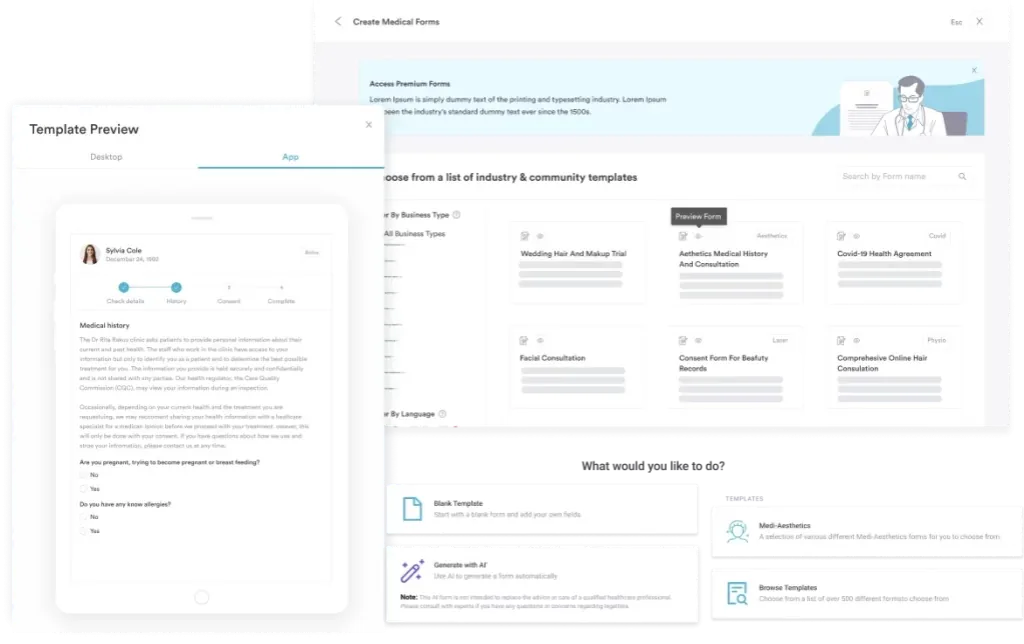
Start from scratch, or upload this PDF or any form you already use, and Pabau's AI Form rebuilds it with tick boxes, text fields and a signature. Attach it to the treatment once, and every patient gets it on time.
AI Form rebuilds the consent, history and aftercare forms you already use. You review each one, then publish.
Patients complete forms on their phone before they arrive, so the front desk stops retyping paper.
Every signed form is versioned and attached to the treatment record, ready when you need it.
Set how long a consent stays valid. Returning patients skip forms they have already signed.
Supports HIPAA and GDPR compliance AES-256 encryption 4.8 on G2 4.7 on Capterra Trusted by 4,000+ practices worldwide

Eden’s test screens for the costoclavicular form of thoracic outlet syndrome using a military brace posture.
A positive test reproduces the patient’s familiar arm symptoms, or diminishes the radial pulse, during the 60-second hold.
No validated sensitivity or specificity figures exist for this test, and pulse changes appear in most people without symptoms.
Treat the result as one input alongside Adson’s test, Wright’s test, the history, and imaging.
Practice management software like Pabau stores each result in the patient record, so repeat tests stay comparable over time.
Eden’s test, also called the costoclavicular or military brace test, compresses the neurovascular bundle between the clavicle and first rib. That channel is the costoclavicular space. Pulling the shoulders down and back narrows it. If compression there is causing the patient’s symptoms, the posture should reproduce them.
The structures at risk are the brachial plexus and the subclavian artery. Compression of either produces arm pain, paresthesia, weakness, or vascular changes such as coolness and swelling. Clinicians pair the test with Adson’s test and Wright’s test to narrow down where the compression sits.
Imaging can show an anatomical variant that never troubles the patient. A provocation test asks something narrower. Does this position bring the symptoms back?
The costoclavicular space is a narrow channel bounded by the clavicle above, the first rib below, and the costoclavicular ligament. Two structures pass through it, and both are vulnerable when the channel narrows.
A military brace posture depresses and retracts both shoulders. That draws the clavicle and first rib closer together, narrowing the space. In a patient with TOS, that narrowing can be enough to reproduce symptoms or change the pulse. That is the response the test is looking for.
Standardized performance is what makes the result comparable between clinicians and between visits. In physical therapy practices where several people run the test, agree on the protocol before anyone documents a finding.
Practices that digitize paper scales with software for capturing forms cut scoring errors and filing time.
A positive Eden’s test points to compression in the costoclavicular space, and nothing more definite than that. It supports a TOS diagnosis when the history and the other provocation tests agree with it. On its own it does not confirm one.
Write down what was reproduced, where, how it felt, and how far into the hold it started. That detail is what makes the patient record useful on the next visit, and what a referral letter needs from you.
No validated sensitivity or specificity figures exist for Eden’s test. A 2018 systematic review found little evidence supporting the validity of clinical tests for TOS. Heterogeneity across the admissible studies also stopped the authors pooling any results. Ranges quoted for this maneuver elsewhere do not trace back to a pooled analysis.
What is documented is how often the test turns positive in people who have no symptoms at all.
Those numbers say a positive pulse sign, on its own, tells you very little. Symptom reproduction is the finding worth acting on, because it links the position to the complaint the patient came in with.
So treat Eden’s test as a screen that tells you where to look next. Some provocation tests do carry published accuracy figures. The lateral pivot shift test is one, and knowing which category a test falls into changes how much weight you give it.
Each of the three standard tests loads a different part of the thoracic outlet. Running all three tells you which compartment is most likely involved.
Positives on more than one test suggest either multifactorial TOS or a shoulder that simply reacts to position. Given how often healthy shoulders test positive, the second possibility deserves as much attention as the first.
Run Eden’s test when a patient reports arm symptoms that come and go with position. Typical triggers are overhead work, carrying, and sleeping with the arm raised. It needs no equipment beyond your hands, so it costs a minute of the visit and nothing else.
Fold it into your standard upper-limb review rather than booking a separate visit. A 60-second hold on each side adds a couple of minutes.
The template gives your team one place to write up a costoclavicular assessment. The sections are open text rather than tick boxes, so you decide how much detail each finding needs. Here is how the form maps onto the test.
Because the fields are open text, agree on house wording for pulse status and symptom reproduction. Pulse diminished at 40 seconds carries information that pulse reduced does not. Settle that once and two clinicians’ entries stay comparable months apart.
Store the completed form in the patient’s record so the next assessment has a baseline to compare against. Let workflow automation handle the follow-up appointment.
Digital clinical documentation removes the step where a completed PDF has to be typed into the record. When assessment templates live inside the practice management system, each result attaches to the patient timeline on save. Referral summaries and outcome tracking then draw on the same entry.
Practices with several practitioners get the most out of a shared assessment library. Positional precision decides the result of this test, so everyone following the same protocol matters more here than for a range-of-motion measurement.
Several conditions reproduce arm symptoms in the military brace position without any costoclavicular compression. Clinical context is what separates them.
Key point: weigh the whole picture before you commit to a TOS diagnosis. Symptom pattern, onset, functional limits, and imaging all count, and a single positive maneuver does not outweigh them.
Most practices run Eden’s test consistently and still end up with notes that do not line up. One clinician writes pulse diminished, the next writes pulse present but weak. Neither entry records how far into the hold the change appeared.
Pabau closes that off with a form the whole team fills in the same way. You build the Eden’s test write-up once as a digital form, with the fields your protocol calls for. Every completed assessment saves straight to the patient record, timestamped and attributed.
The outcome is a set of results you can line up side by side. Repeat the test after six weeks of therapy and the change is visible on the timeline, not buried in free text. Automated follow-up reminders bring the patient back for that second measurement.

Pabau builds your Eden’s test write-up into a digital form that saves straight to the patient record. Follow-up reminders go out automatically, so the repeat measurement does not get missed.

Eden’s test earns its place because it is quick, needs no equipment, and points you toward the right compartment. What it cannot do is confirm TOS on its own. Pulse changes are too common in healthy shoulders for that.
So use it as a screen, run Adson’s and Wright’s alongside it, and let symptom reproduction carry more weight than the pulse. Then write it up in wording your colleagues will read the same way you meant it.
Standardized procedure and consistent documentation are what turn a rough screen into something you can track over time. Book a demo to see how Pabau keeps assessment templates and results together in one patient record.

Need the interscalene equivalent? Adson’s test template covers positioning, pulse monitoring, and how to record the result.
Want a third TOS provocation test? Halstead maneuver explains the technique and what a positive finding suggests.
Suspect a nerve-tension component? Upper limb tension tests sets out each variant and its target nerve.
Checking first-rib mobility? Cervical rotation lateral flexion test shows how to assess the first rib on each side.
Losing revenue to preventable billing errors? This physical therapy billing guide covers CPT codes, billing units, and Medicare rules.
Eden’s test checks whether the costoclavicular space is compressing the brachial plexus or the subclavian artery. A positive result points toward the costoclavicular form of thoracic outlet syndrome (TOS). It is a screening maneuver rather than a diagnostic test.
Hold it for 60 seconds. The patient sits or stands upright and pulls both shoulders backward and downward at the same time. Palpate the radial pulse on the tested side throughout, and ask whether their usual symptoms return.
A positive result means the maneuver reproduced the patient’s familiar arm symptoms, such as pain, tingling, or weakness. A radial pulse that weakens or disappears also counts. Symptom reproduction is the more meaningful of the two findings.
Eden’s test loads the costoclavicular space by depressing and retracting the shoulders. Adson’s test loads the interscalene space by extending and rotating the neck. Both screen for TOS, and running both narrows down where the compression sits.
No validated sensitivity or specificity figures exist for this test. Studies in people without symptoms found pulse changes in roughly 60 to 68 percent of subjects. One found 58 percent positive on at least one thoracic outlet maneuver. Treat it as a screen and combine it with the history, the other provocation tests, and imaging.
Costoclavicular syndrome is the form of thoracic outlet syndrome caused by compression between the clavicle and the first rib. The structures involved are the brachial plexus and the subclavian artery. The military brace position used in Eden’s test reproduces that compression.
Diagnosis starts with the history, especially arm symptoms during overhead activity, tingling, and weakness. Provocation tests follow, usually Eden’s, Adson’s, and Wright’s. Electrophysiology confirms neurogenic TOS, and vascular ultrasound or angiography confirms the vascular form. No single test is diagnostic, so the full clinical picture guides the referral.