Journal prompts for mental health
Journal prompts for mental health are guided questions that help people process ...

2
Last Updated: Oct 13, 2026

The EAT-26 is a 26-item self-report questionnaire that screens for eating disorder symptoms in people aged 14 and older.
Scores run from 0 to 78, and a total of 20 or higher calls for further clinical evaluation.
Three subscales cover dieting, bulimia and food preoccupation, and oral control, so you can see which pattern is driving the score.
Only item 26 is reverse-scored, so check that step before you total the responses.
Practice management software like Pabau can send the questionnaire out, score it automatically, and file the result in the patient record.
The full 26-item questionnaire with its six-point response scale, the scoring key, and the three subscale groupings. Print it for the waiting room or send it out before a first appointment.
Download templateThe EAT-26 is the questionnaire most practices reach for when a patient’s relationship with food starts to look like a clinical concern.
A total score of 20 or higher is the point at which you arrange a full eating disorder assessment.
It takes five to ten minutes to complete. This guide covers what the 26 items measure, how to total and interpret them, and what each score band asks you to do next.
The EAT-26 (Eating Attitudes Test, 26-item version) is the most widely used self-report screen for disordered eating attitudes. Garner and colleagues developed it in 1982, and it is still the standard first-line screen in both practice and research.
The questionnaire flags risk rather than confirming a diagnosis. A score of 20 or higher marks a patient who needs a clinical interview, not a patient who has an eating disorder. It is validated in community samples, clinical populations, and both male and female respondents.
You can hand the questionnaire to a patient on paper, or send it ahead of the visit as one of your digital intake forms. Sending it early means the score is already in the record when the patient sits down.

Each of the 26 questions uses the same six-point response scale: always, usually, often, sometimes, rarely, or never. The full set of items sits in the downloadable template, grouped by subscale. Here is a sample from each group, to show what the instrument covers.
The binge item is the bluntest of the 26. It asks whether the patient has “gone on eating binges where I feel that I may not be able to stop.” The template gives you all 26 items in their published order, so you can run the complete questionnaire at intake or at a review appointment.
Responses are coded numerically: always is 3, usually is 2, often is 1, and sometimes, rarely and never all score 0. One item (item 26) is reverse-scored. Add the 26 item scores together for a total between 0 and 78.
What the table cannot show is where 20 actually sits. The cutoff falls a quarter of the way up a 0 to 78 scale. A fairly modest total already puts a patient in the clinical range.
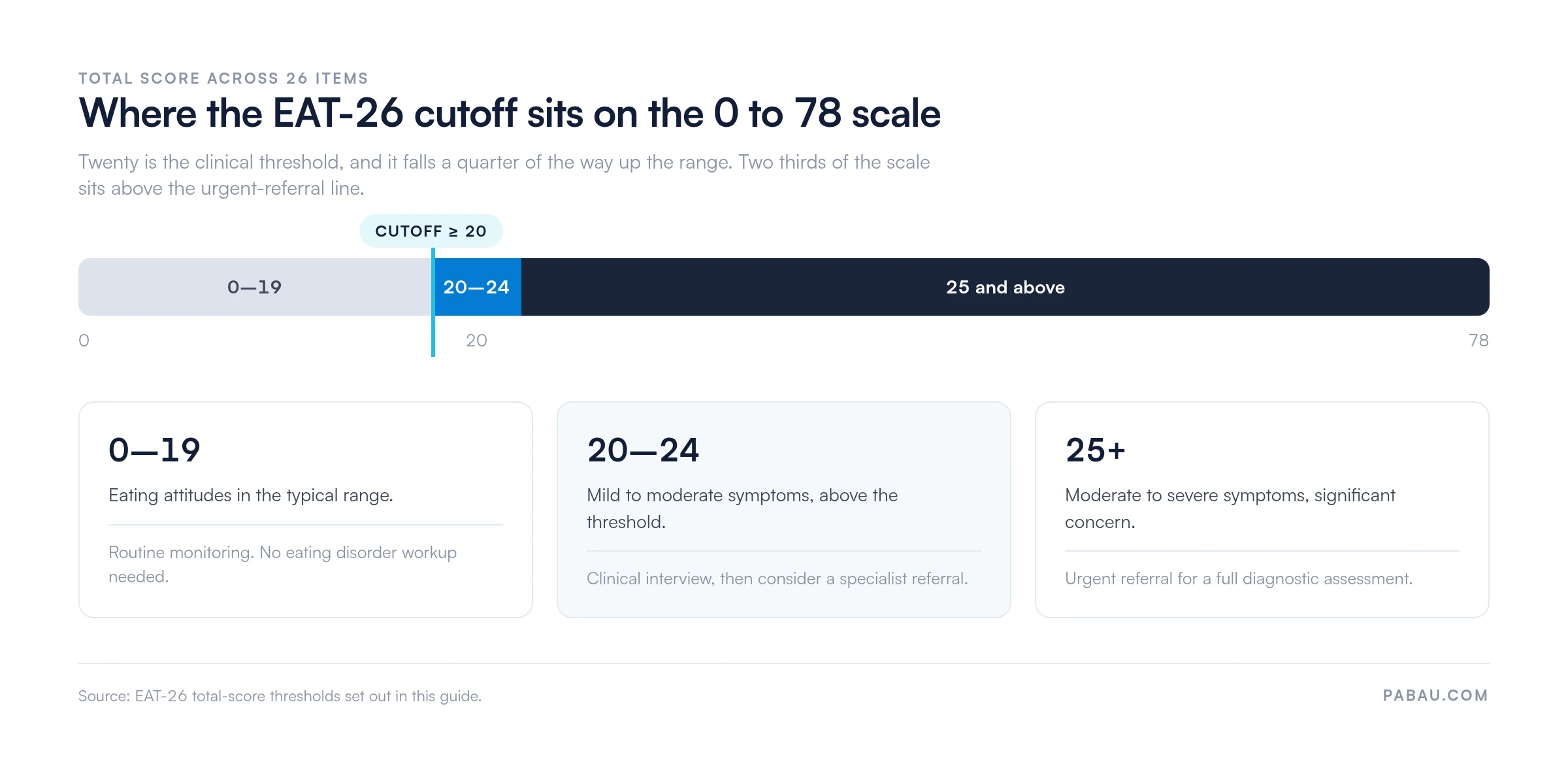
The cutoff of 20 or higher is the standard clinical threshold across published validation studies and professional guidelines. Meeting it means the patient needs further evaluation, not that the patient has an eating disorder.
The EAT-26 yields three subscale scores, and each one points at a different pattern of eating pathology. Reading them separately tells you what to ask about in the interview that follows.
A high dieting score suggests the restrictive pattern typical of anorexia nervosa. Elevation on bulimia and food preoccupation points instead to binge and purge behavior. Low oral control scores often reflect difficulty managing eating impulses.
A score of 20 or higher means an eating disorder may be present and a professional evaluation is warranted. It is a screening threshold, not a diagnosis. False positives happen, particularly in patients with high health anxiety, perfectionism, or subclinical body image concerns.
The reverse also happens. A total below 20 does not clear a patient, because someone who is minimizing or hiding symptoms can score in the typical range. Weigh the number against what you observe in the room.
Important clinical note: the EAT-26 cannot diagnose an eating disorder. Follow a positive screen with a full clinical interview and a medical history review. A psychiatric evaluation template gives you a structure for that conversation, and a specialist referral follows where it is clinically indicated.
Set up a recall in Pabau that prompts any patient scoring 20 or higher to book a follow-up assessment. High-risk patients get chased automatically, and the record shows a reviewer exactly when each one was contacted.
The EAT-26 is validated for adolescents aged 14 and older and for adults of all ages. It has been translated into more than 20 languages and used across a wide range of cultural settings.
Below age 14, a developmentally matched instrument usually fits better. The ChEAT, the children’s version of the test, uses adapted wording and examples. Consider reading level as well as age when you pick a screening tool.
Five steps take the EAT-26 from a PDF in a folder to a documented part of routine care.
Several validated alternatives exist, and the right pick depends on how much time you have and what you need to measure.
The EAT-26 is the most commonly cited of the group and the usual choice for a first screen. It gives you enough detail to guide an interview without taking up a whole appointment slot.
Most practices still run the EAT-26 on paper. Someone prints it and the patient fills it in at reception. A clinician totals the 26 items by hand, and the sheet gets scanned into a folder later. The reverse-scored item is easy to miss, and the number rarely ends up anywhere you can report on.
Digital forms in Pabau handle that whole sequence for you. You send the EAT-26 with the appointment confirmation and the patient completes it on their phone. With the scoring built into the form, the total and the three subscale scores are waiting in the record before the session starts.
The result is also reportable. You can pull every EAT-26 score across your caseload and check how many positive screens actually got a follow-up appointment. As software for therapy practices, Pabau keeps that screening history next to the notes, the consents, and the appointment record.

Send the EAT-26 before the appointment, let Pabau total the score, and keep the result in the patient record. Your clinicians read a number instead of adding one up.

The EAT-26 earns its place because it is short enough to use on every intake and specific enough to act on. A total plus three subscale scores tells you whether to ask more questions, and which questions to ask.
The trade-off is that a number this easy to collect is also easy to over-read. Twenty is the threshold for a conversation, not a diagnosis, and a score below it does not close the question either.
Get the questionnaire into your intake pack this week, and decide in advance what happens when a score comes back at 20. Running it inside a mental health EMR removes the arithmetic and the filing, and keeps the result searchable a year later. Book a demo to see how Pabau delivers and scores the EAT-26 as part of your intake.

Need to keep working with a patient after a positive screen? Eating disorder worksheet gives them structured between-session work while a specialist assessment is arranged.
Want a measure focused on binge eating? Binge eating scale scores severity where the bulimia and food preoccupation subscale is elevated.
Screening a teenager for the first time? Adolescent intake questionnaire collects the history and consent detail an under-18 intake needs.
Need a structure for the interview that follows? Psychiatric evaluation template covers the diagnostic interview and the safety assessment.
Screening for substance use at the same visit? AUDIT alcohol screening test is a 10-item screen you can run alongside the EAT-26.
The EAT-26 (Eating Attitudes Test, 26-item version) is a standardized self-report questionnaire that screens for eating disorder symptoms in adolescents and adults. It gives a total score from 0 to 78 plus three subscale scores covering dieting, bulimia and food preoccupation, and oral control. A total of 20 or higher calls for a professional evaluation.
No. The EAT-26 is a screening tool rather than a diagnostic instrument. A score of 20 or higher means the patient needs further evaluation by a qualified provider. The questionnaire alone cannot diagnose anorexia nervosa, bulimia nervosa, or any other eating disorder.
The EAT-26 is validated for adolescents aged 14 and older and for adults of all ages. For children under 14, the ChEAT is a better fit, with adapted wording and examples.
Responses use a six-point scale, where always scores 3, usually 2, often 1, and sometimes, rarely and never all score 0. Only item 26 is reverse-scored. Add all 26 items for a total between 0 and 78, then work out the three subscale scores using the key in the template.
A score of 20 or higher warrants a full clinical interview and a detailed eating and weight history. Check for medical complications such as amenorrhea, cardiac symptoms, and gastrointestinal problems. Refer to a specialist or an eating disorder program where it is clinically indicated, and do not assume pathology from the score alone.
Yes. Digital forms in Pabau let you send the questionnaire before the appointment, score it automatically, and store the result in the patient record. That removes the paper handling and the manual data entry, and the score stays searchable later.