Physician credentialing checklist
A physician credentialing checklist lists every license, certificate, verificati...

Last Updated: Oct 23, 2026

The clear liquid diet menu plan download is a two-page care plan form, and it contains no food lists.
You fill it in with the patient, and page one covers their details, the background, five goals and seven actions.
Every goal carries a measure of progress and a target date, and every action names who is responsible.
Page two holds the support-in-place checklist, a five-entry review record, and signature lines for both parties.
The fields are general, so the same sheet works for a diet plan, a rehab program or aftercare.
A two-page clinical care plan form. Page one holds the patient’s details, the background to the plan, five goals with target dates and seven actions with owners. Page two holds a support-in-place checklist, a warning-signs box, a five-entry review record and signature lines.
Download templateThe clear liquid diet menu plan you can download above is a two-page care plan form with no menu inside it. There are no food lists, no meal timings and no preparation instructions. What you get is a sheet you fill in with the patient, covering the background, five goals, seven actions and five reviews.
The form suits far more than diets, but two boxes decide whether any plan holds up. One is the measure beside each goal. The other is the review date in the header. Leave either blank and nobody can tell later whether the plan worked.
Below we cover each block, how to word a goal the patient can meet, and what to check before you file.
The form runs to six blocks across two pages. Those are patient identifiers, background, goals, actions, support in place, and a review record. Page two closes with two signature lines. No food list, meal schedule or preparation instruction appears anywhere in it.
Here is what each block asks for, and what belongs in it.
You and the patient complete the form together, in one sitting. The front page says as much. Agree each goal and action between you, then set a review date. It is a shared document, so the patient should be able to read every box back to you.
In practice the sheet gets filled in over four passes, and only two of them need the patient in the room.
The pen changes hands as you work down the sheet, which is easier to see laid out than described.
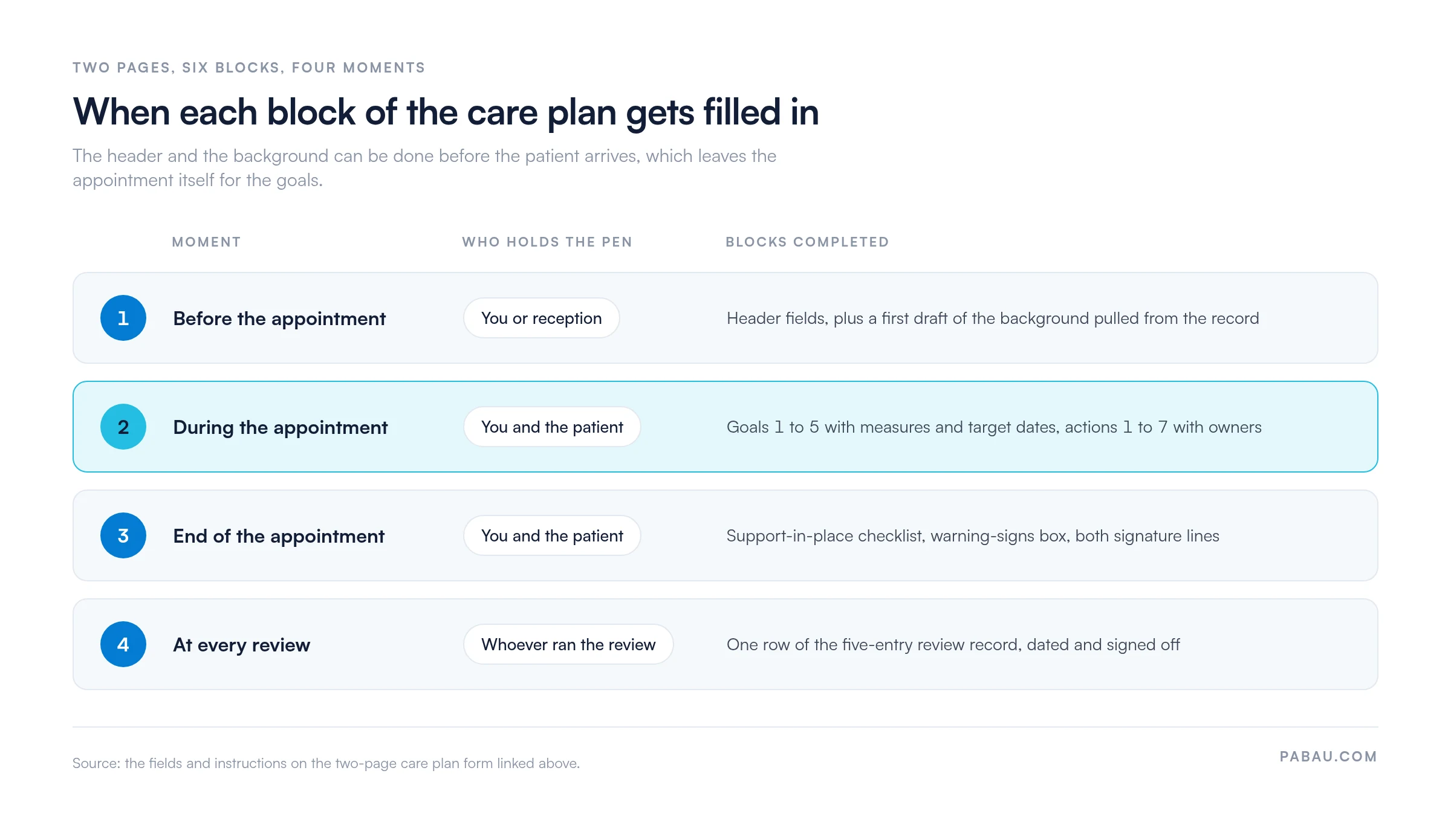
Filling in the header beforehand is worth the two minutes. It keeps the appointment for the conversation that matters, which is the goals. Collect that history through pre-filled intake forms and most of the header is typed for you already.
A goal on this form needs three parts, because the form asks for three. There is the outcome, the measure of progress, and the target date. Drop any one of them and the goal cannot be reviewed.
Take two versions of the same goal. “Improve hydration” carries no measure and no date, so at review you end up arguing about whether it happened. “Drink 2 liters of fluid a day, logged on the sheet, by March 3” can be checked in ten seconds.
Before either of you signs, ask the patient to read each goal back in their own words. A goal they cannot repeat is one you wrote for yourself.
Actions are the steps that deliver the goals, and the form gives you seven rows. Each row carries a field for who is responsible, plus a start date and a review date. That owner field is the one to guard.
Name a person in it, not a role. “Reception” never remembers. “Priya, front desk” does. Here is the hydration goal above, split into three rows.
Three rows, three owners, three date ranges. Notice that the start dates stage the work instead of dumping all seven actions on week one. The goal number also opens each row, so the link survives a photocopy.
Leave the spare rows empty. Padding them out to fill the page hides which actions carry the plan.
Page two opens with five checkboxes that record what the patient left with. Tick them at the end of the appointment, not from memory afterwards. Each line is a small promise, and an unticked box tells you something on its own.
Below the checklist sits a box headed “what to do if things change”, for warning signs and who to contact. Keep it to two or three signs the patient can recognize at home. Then give one route for reaching you.
Where a relative or carer is doing the day-to-day work, the action rows need to say so by name. A caregiver care plan is the better sheet once most of the actions belong to them rather than the patient.
The review record holds five entries. Each one takes a date, the progress, the changes made, and who reviewed it. Write the row at the review itself, while the patient is still in front of you.
Write progress against the measure, so “log shows 1.6 liters a day” rather than “doing well”. Record a decision even where the plan stays the same, because “no change, goals 1 and 2 continue” is worth dating.
Put a name in “reviewed by” too, since the record should show who made the call. After review 5, start a fresh sheet and staple it behind the original.
Before the sheet goes in the file, five checks take about a minute.
A review is also the moment to renegotiate. Where a goal has not moved in two reviews, the goal was probably wrong rather than the patient. Rewriting it in front of them beats repeating it.
A general form wins where your caseload is mixed, because the team learns one layout instead of six. The wording of the goals carries the clinical detail, so the sheet does not need to know the condition.
Two cases make a general form the wrong choice. The first is where a regulator, insurer or commissioner requires their own named document. The second is where the plan needs clinical fields this sheet has no room for, such as dosing schedules or scored assessments.
Every field on the sheet exists because care plans fail in a handful of predictable ways. The blank box is the warning.
A paper care plan works right up to the point where someone needs to find it. The signed copy sits in a folder and the review date sits in somebody’s head. As for the actions, they live in whatever the patient remembers. Practice management software like Pabau closes that loop by keeping the plan on the client record.
You can build the same six blocks as a digital form in Pabau. The goals, actions and support checks get typed once and stored against the client. Your patient signs on screen, and the signed version lands in their record while they are still with you.
Because the plan sits alongside the appointment history, the next review is easy to book and easy to prepare for. You open the client, read the last review row, and write the next one. Pabau GO, our iOS app for practitioners, also carries a care pathway that walks the patient through forms and consents before they arrive.
The result is a plan the next clinician can find without asking, and a review history nobody has to re-type. You can also share the agreed copy through the patient portal, so the patient reads the same wording you do.
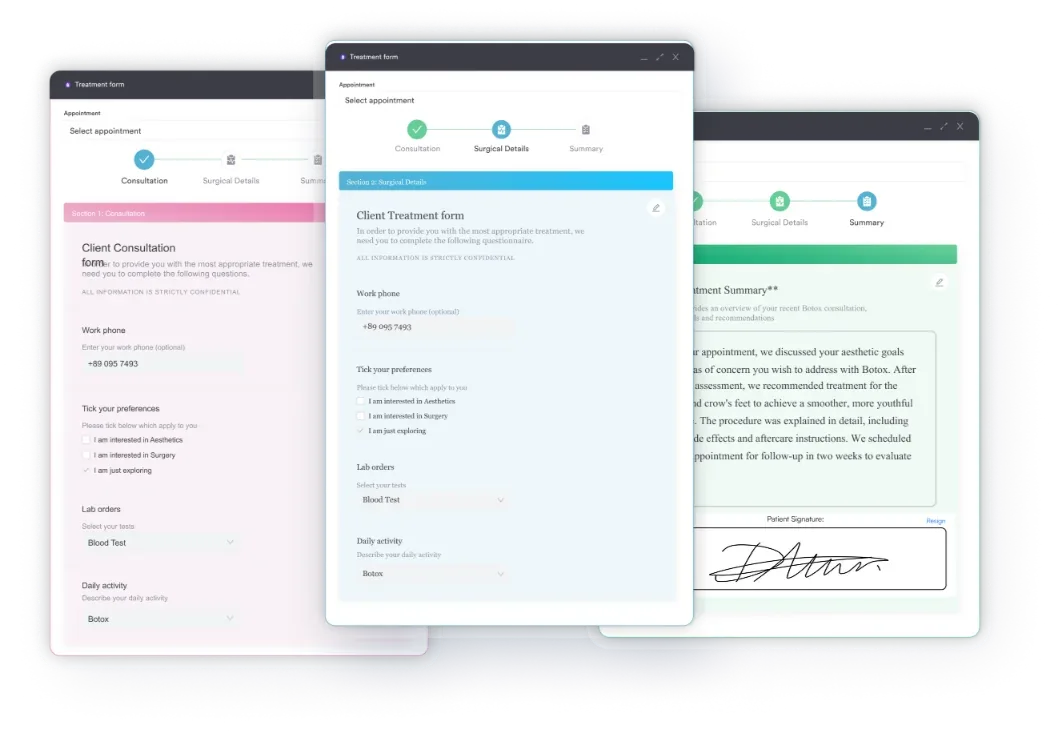

Pabau’s digital forms and client records hold the goals, actions and signatures for each care plan. The next review starts from the signed version, not a paper copy in a folder.

This form earns its place through the boxes it refuses to let you skip. A goal shows its measure. An action shows its owner. A blank review date is visible to whoever picks the sheet up next.
Print it, fill it in with the patient, and set the review date before either of you signs. Where the plan changes at review three, write the change in that row rather than starting a new sheet. The record should show the decisions you made along the way.
If the paper copy is the part that keeps going missing, store the plan where the client record already lives. Book a demo to see how Pabau builds care plans as digital forms and keeps every review against the client.

Need to record what happened in the room, not just what you planned? Treatment notes template gives you the fields a note needs, with a worked example.
Are most of the actions falling to a relative? Caregiver care plan sets out the goals and checks a family carer works from.
Writing the aftercare the patient goes home with? Aftercare guidelines template covers what to include and how to hand it over.
Need a running note for the visits between reviews? Clinical progress notes gives you a structure for each entry.
They overlap, but they answer different questions. A treatment plan sets out the clinical intervention you will deliver. A care plan sets out the goals you and the patient agreed, who owns each action, and when you will check progress.
Give them one. A plan the patient cannot read at home is only half agreed. The first checkbox on page two asks you to record what you handed over, so print or email the copy before they leave.
Note the refusal on the sheet, with the reason and the date. An unsigned form still records what you offered and discussed. Ask which goal they disagree with, reword that box, then offer the signature again at the review.
The form leaves the interval to you and records five reviews. Set the first date when you agree the plan, then set the next one at each review. Bring a review forward whenever the patient’s circumstances change.
Yes, and the owner field is what makes it workable. Each action names the person responsible, so a colleague can pick up their rows without guessing. The reviewed-by field then shows which of you made each call.