Anja Dodevska
Head to toe assessment cheat sheet: Printable nursing guide
A head to toe assessment cheat sheet gives you one fixed order at the bedside, s...

5
Last Updated: Oct 23, 2026
Free PDF 2 pages, print-ready Clinician-reviewed
A breastfeeding weaning plan is a structured way to move your baby from breast milk to other milks and foods. The usual pace is one feed dropped every 3 to 5 days, daytime feeds first and night feeds last.
The American Academy of Pediatrics (AAP) and the World Health Organization (WHO) both support breastfeeding to 2 years or beyond. Each frames it as a choice for mother and child, continued for as long as they mutually want it. There is no deadline, so your plan sets the order you drop feeds in and keeps you both comfortable.
Whether you are a lactation consultant, a midwife, or a parent doing this at home, a written plan removes the guesswork. This guide covers readiness signs, timing by age, gradual and abrupt weaning, engorgement, and the emotional side of stopping.
You can also download a free template to print, customize, and fill in week by week.
A printable plan for midwives, lactation consultants, and parents, with a readiness checklist and a week-by-week reduction schedule. It also carries fields for feeding logs, engorgement symptoms, night weaning progress, and notes on how your baby is coping.
Upload this PDF, or any form you already use, and Pabau's AI Form rebuilds it with tick boxes, text fields and a signature. Attach it to the treatment once, and every patient gets it on time.
AI Form rebuilds the consent, history and aftercare forms you already use. You review each one, then publish.
Patients complete forms on their phone before they arrive, so the front desk stops retyping paper.
Every signed form is versioned and attached to the treatment record, ready when you need it.
Set how long a consent stays valid. Returning patients skip forms they have already signed.
Supports HIPAA and GDPR compliance AES-256 encryption 4.8 on G2 4.7 on Capterra Trusted by 4,000+ practices worldwide

A weaning plan sets out which feeds to drop and when, so the change is gradual rather than sudden.
The AAP and WHO both support breastfeeding to 2 years or beyond, so readiness matters more than the calendar.
Readiness shows up as shorter feeds, distraction at the breast, and eager eating of solids, usually from around 6 months.
Dropping one feed every 3 to 5 days protects you from engorgement and gives your baby time to adjust.
Night feeds go last, and after weaning babies move to formula under 12 months or whole cow’s milk after that.
A weaning plan does two jobs at once. It maps which feeds to drop, in what order, and what to offer in their place. Stopping without a plan tends to bring engorgement, a higher risk of mastitis, and an unsettled baby.
It also keeps both people in view. Your physical comfort and mood matter as much as your baby’s nutrition at each stage of the change.
The CDC recommends gradual weaning because it lets milk supply fall naturally and lowers the risk of engorgement and infection. It also gives both of you time to adjust. If you use a plan with patients, the same template keeps your notes clear and comparable from one family to the next.
Readiness is a mix of developmental cues and parental choice, not a birthday. Common signs include:
These cues usually appear between 6 and 12 months, though nursing can carry on well into toddlerhood. There is no correct age to stop. The AAP updated its guidance in 2022. It now supports breastfeeding to 2 years or beyond, alongside complementary foods, for as long as mother and child want it.
Timing depends on your baby’s age, the readiness signals above, and your own circumstances. This table shows the common milestones and what a plan looks like at each stage:
Key safety note: Whole cow’s milk should not be introduced before 12 months, because it lacks essential nutrients and can stress infant kidneys. Before then, continue breast milk or use infant formula.
Gradual weaning is the method most often recommended. It prevents engorgement, lets milk supply decline naturally, and gives your baby time to adjust. The method is simple: drop one nursing session every 3 to 5 days. Start with daytime feeds, which usually carry less emotional weight than the morning or bedtime feed.
Sample weekly reduction schedule (starting from 6 daytime feeds + 2 night feeds):
Plotted week by week, the same schedule shows why the first month feels like the busy part and the last two weeks do not.
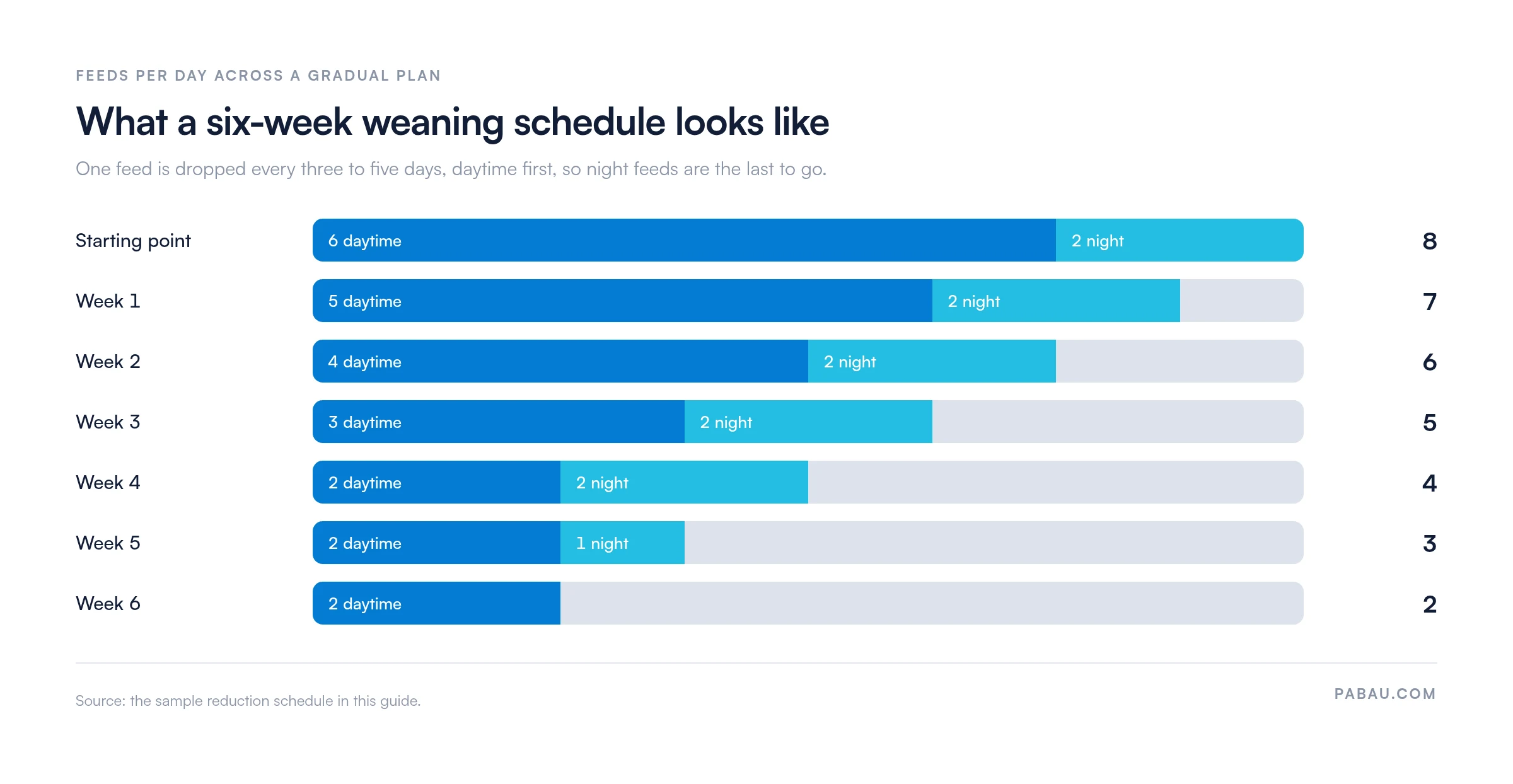
The schedule is flexible. Some families take longer, and some babies adapt faster. Logging which feed you dropped and how your baby responded makes a pattern easier to spot.
Twelve months is a common weaning point because most babies are eating a varied diet by then. You can introduce whole cow’s milk as the main milk source and keep the gradual schedule above. Offer about 3 cups a day, roughly 24 ounces, spread across meals and snacks, alongside solids that provide iron, calcium, and protein.
A typical 12-month schedule drops the morning and midday feeds over 2 to 3 weeks. Keep the afternoon feed a few days longer, then drop the bedtime feed last. Night weaning is optional at this age, and many families carry one or two night feeds through to 18 or 24 months.
Night weaning usually comes last, because nighttime nursing is tied to sleep and carries emotional weight for both of you. Most babies need little nutrition overnight by 9 to 12 months, though plenty still wake for comfort. These approaches help:
Night weaning often takes 1 to 2 weeks longer than daytime weaning, because it means replacing a sleep ritual rather than a meal. Patience and consistency do most of the work.
Sometimes abrupt weaning is medically necessary. Maternal illness that needs medication incompatible with breastfeeding, a hospital admission, or an urgent separation can all force it. Sudden stopping carries a higher risk of severe engorgement, mastitis, and distress, so medical support matters here.
Tell your doctor or lactation consultant if you have to wean abruptly, so someone is watching for complications.
Nutritional needs shift as breast milk is phased out. Here is the breakdown by age:
Introduce a cup during weaning, so your baby is comfortable with one by the time the breast or bottle goes. Start with water, then milk, to build the habit.
As you drop feeds, supply falls, but your breasts may feel uncomfortably full for a day or two after each change. That is most noticeable in the first two weeks. Here is how to manage it:
Most engorgement settles within 3 to 5 days as supply adjusts. If symptoms last more than a week or get worse, see a lactation consultant or your doctor.
Your own nutrition shifts as well, since feeding no longer draws on your calorie stores. A postpartum diet plan is a simple way to keep iron, calcium, and fluids steady while your body settles.
Weaning is an emotional transition as well as a physical one. Hormones shift as supply falls, which can bring mood changes, sadness, or anxiety for some parents. That response is common and usually temporary.
Your baby may respond too, with extra clinginess, disrupted sleep, or changes in behavior. Patience, reassurance, and extra comfort carry them through it.
Your own recovery belongs in the same record. A postpartum care plan keeps mood checks, warning signs, and follow-up appointments together, so nothing is left to memory during a broken-sleep month.
The downloadable template has fields for:
Filling it in weekly keeps you organized and makes patterns easier to see. It also creates a record you can hand to your midwife or obstetric team. Practice management software like Pabau stores it with their other notes, inside the OB-GYN EMR software they already use.

On paper, a weaning plan lives in one place: the kitchen drawer. The practice keeps no copy of what was agreed, and nobody sees how the first two weeks went until the next appointment.
Pabau keeps the plan attached to the patient record instead. You can build the weaning plan as a digital form, send it with the appointment confirmation, and see it come back completed before the follow-up. Pabau is built for women’s health practices, so pregnancy, birth, and postpartum care sit in one record rather than three.
The result is fewer calls asking what the schedule was. The plan, the feeding log, and any note about engorgement or mood stay with the patient’s other notes. Whoever sees that family next has the full picture.

Use Pabau to store, share, and track patient progress on weaning plans and other educational templates. Digital forms cut the paper clutter, so every patient gets the same evidence-based guidance.

Weaning goes well when the pace is slow enough for your body and your baby to keep up. Pick the first feed to drop, hold that change for 3 to 5 days, then drop the next one. Which feed goes first matters less than sticking to the interval.
Expect the emotional side to outlast the physical side. Supply usually settles within a week of the final dropped feed, while a bedtime ritual can take a month to replace with something else.
If a feed will not budge, or you develop a fever or a hard lump, get help early rather than waiting it out. A La Leche League leader, your pediatrician, or your midwife can adjust the plan before it turns into mastitis.
Book a demo to see how Pabau keeps weaning plans, feeding logs, and follow-up notes in one patient record.

Supporting a parent through recovery too? Postpartum care plan covers assessment, warning signs, and discharge planning in one printable form.
Wondering when cycles come back? Period tracker gives patients a simple way to log cycles once feeding winds down.
Booking the parent in for a checkup? Women’s wellness exam sets out what to cover and document at an annual visit.
Yes, stopping at 9 months is fine if your baby is ready and your pediatrician agrees. The AAP now supports breastfeeding to 2 years or beyond, but that is a recommendation rather than a requirement. If you stop before 12 months, keep infant formula as the main milk source until your baby’s first birthday. Cow’s milk is not a substitute at that age.
Gradual weaning usually takes 2 to 6 weeks, depending on how many feeds you drop and how fast your supply adjusts. Dropping one feed every 3 to 5 days is the standard pace. Night weaning often adds another 1 to 2 weeks. Abrupt weaning takes 7 to 10 days physically, though the emotional side can run longer.
Follow your baby’s lead. Drop a feed only where your baby shows less interest, which tends to look like shorter feeds or easy distraction. Hold that change for 3 to 5 days before dropping the next feed, replacing each one with age-appropriate milk and solids. This pace protects you from engorgement and gives your baby time to adjust.
Start by checking readiness: shorter feeds, eating solids well, and an age that suits the change. Then choose your timeline, gradual over 2 to 6 weeks or abrupt if a medical reason forces it. List your baby’s current feeds, pick the mid-day ones to drop first, and plan one drop every 3 to 5 days. Use the free template above to record the plan and track symptoms, then confirm it with your pediatrician or lactation consultant.
The common signs are shorter feeds, distraction at the breast, and eager eating of solid foods, especially from 9 to 12 months. Older babies also start to communicate, pushing away or saying no. These cues usually appear between 6 and 12 months, though babies differ. Your own readiness counts as much as your baby’s.