Trauma response test: Free template for clinicians
A trauma response test is a structured screening questionnaire that helps clinic...

5
Last Updated: Oct 15, 2026
A 504 plan for anxiety is a legally binding document that lists the accommodations a school must provide to a student with anxiety. It applies when the anxiety substantially limits a major life activity, such as learning, concentrating, or interacting with others. Unlike an Individualized Education Program (IEP), a 504 plan provides accommodations rather than special education services. That keeps the student in the general education curriculum on equal footing with their peers. This guide covers eligibility, common accommodations, the difference between a 504 plan and an IEP, and how to request one. It also includes a free downloadable form for recording the plan’s goals, actions, supports, and review dates.
A two-page form for writing up an agreed 504 plan and keeping it under review. It has header fields, a background box, five goals with progress measures, and seven actions with named owners and dates. A supports-in-place checklist, a note on handling changes, and a five-entry review log close the form.
Download template
A 504 plan for anxiety is an accommodation document under Section 504 of the Rehabilitation Act. A diagnosis on its own does not guarantee eligibility.
The legal standard is that anxiety substantially limits a major life activity, such as learning, concentrating, or interacting with others. Schools make that call, not clinicians.
Common accommodations include extended test time, preferential seating, structured breaks, a designated safe space, a modified assignment load, and counselor check-ins.
A 504 plan provides accommodations within general education. An IEP provides special education services for students whose disability affects educational performance.
The free template below is a plain goal-and-action tracker. It records background, goals, actions, supports in place, and review dates, not symptom scores.
Pabau’s digital forms and automated workflows help clinicians document accommodation requests and keep records ready for 504 plan reviews.
Section 504 of the Rehabilitation Act of 1973 requires schools to accommodate disabilities that limit learning. A 504 plan for anxiety records the accommodations a student with anxiety receives. The plan does not provide special education.
It adjusts the learning environment and testing conditions so the student can show what they know without anxiety getting in the way. Clinicians who support students through this process record their findings in a mental health EMR. Those notes are what the school weighs when it decides eligibility.
A diagnosis of anxiety is useful context, but it does not qualify a student on its own. Schools must evaluate whether the anxiety substantially limits one or more major life activities. Those activities include learning, concentrating, reading, thinking, communicating, working, sleeping, performing manual tasks, and interacting with others. The school team makes that determination, not the treating clinician.
A student qualifies when anxiety substantially limits a major life activity, such as learning, concentrating, or attending school. A formal diagnosis helps, but schools assess functional impact directly. The interference has to show up at a level the team can measure.
Notes kept in psychiatry EMR software strengthen the case when they describe specific functional limitations and their severity. Vague wording is what stalls a request.
A 504 plan delivers accommodations only, while an IEP adds special education services on top of them. Which route fits depends on whether the student needs the teaching itself changed, or only the conditions around it. The table below sets the two side by side.
Most effective 504 plans for anxiety mix environmental, testing, instructional, and emotional-support accommodations. Recording which ones match the student’s clinical presentation gives the school team a history to work from, rather than a fresh account at every meeting.
Some accommodations build coping capacity, and others quietly reinforce avoidance. A 504 plan for anxiety should carry both support and a manageable degree of challenge. Accommodations that let the student practice tolerating anxiety with support tend to produce longer-term improvement. Accommodations that remove all anxiety feel safe in the short term and can make the anxiety worse over time. Therapists who record that reasoning in psychology practice software can hand the school team a clear rationale at review meetings.
Five steps take a family from a written request to a signed plan. The documentation you supply at step two decides how quickly the team reaches a decision, so dated assessment notes are worth assembling first.
The downloadable form is deliberately plain, so it suits any 504 plan rather than one district’s house format. Fill it in during the 504 meeting, or straight afterwards, while the agreed wording is still fresh. The two pages run in this order.
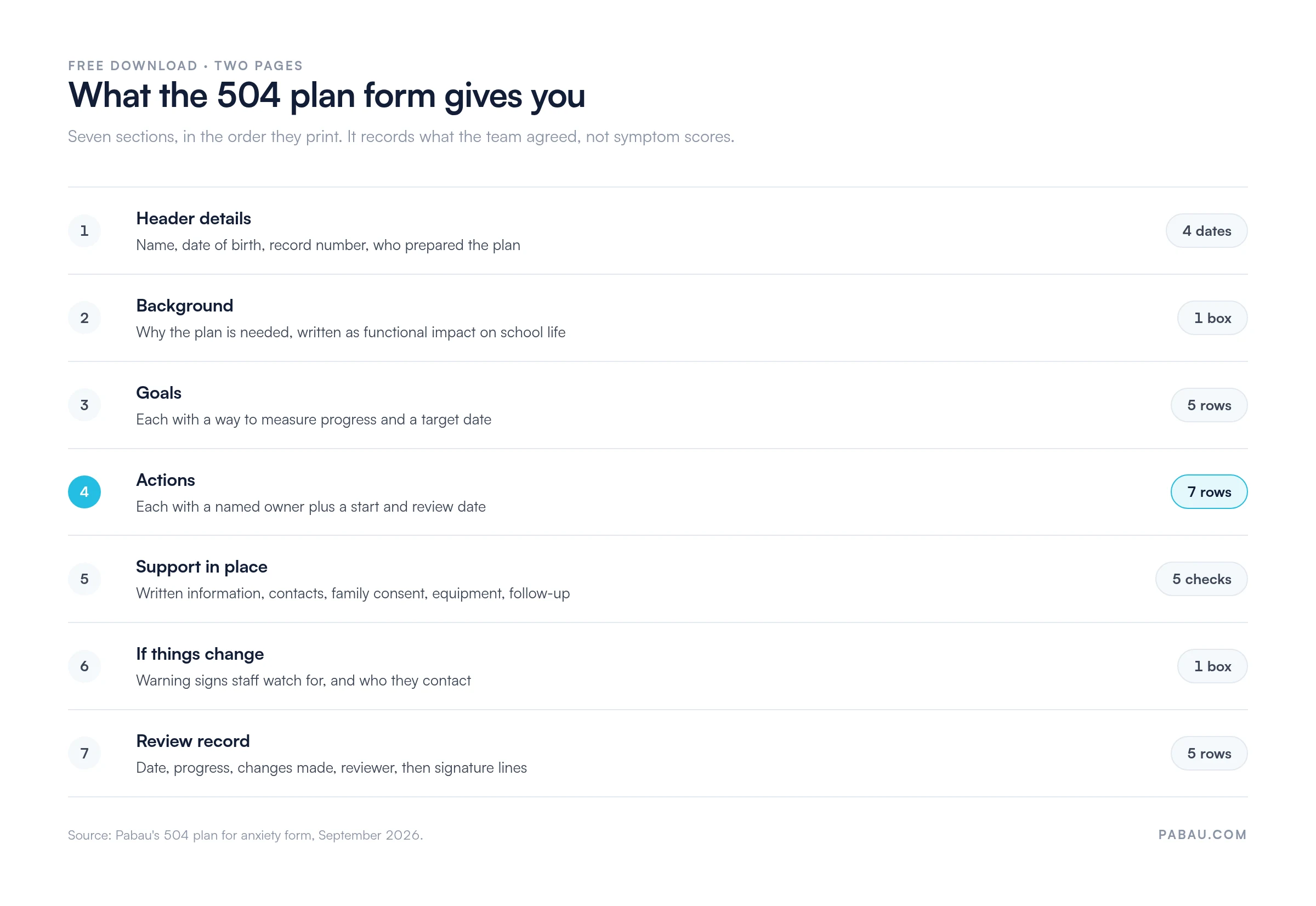
The form does not score symptoms or rate severity, and it holds no assessment section. Keep clinical measures in your own records, and use this document for what the team agreed to do and by when. The printed date fields run in day, month, year order, so write months out in full if your school reads dates the other way round.
Section 504 requires periodic reevaluation rather than a review on a fixed calendar date. Most districts run that review once a year, and the annual cycle has become the working norm.
You can request an amendment sooner when the student’s needs change. New triggers, a medication that improves focus, or coping strategies that are working all justify a revision. Changes are easiest to justify when improvement or new difficulty is documented as it happens.
Request an update if:
A strong 504 plan balances protection and progress. Document functional limitations clearly, propose accommodations that build coping capacity, and schedule reviews so the plan moves as the student improves.
Clinicians working across several school teams often keep those findings and review dates in therapy practice management software. That way the family hears the same reasoning the school does.
Advocate for your child in school meetings, keep copies of all documentation, and stay in touch with both the school team and your clinician. That keeps the plan aligned with what the student needs this term, not last year.
Supporting a 504 request means producing functional detail a school team can act on. That evidence usually sits across session notes, a referral letter, and a parent’s email thread. Pulling it together the week before a meeting takes hours that nobody has.
Practice management software like Pabau keeps the whole history in one patient record. Digital intake forms capture the settings where the student struggles and the triggers they report. Pabau Scribe, our AI scribe, drafts the session note while you talk, so functional detail reaches the record on the day it was observed.
When the school asks for documentation, you pull a dated history from one place instead of five. Annual reviews get easier for the same reason. Progress since the last review is already written down, so you arrive with evidence rather than recollection.

Pabau’s digital forms and AI-assisted notes let mental health clinicians record functional detail as it happens, then pull a dated history for school meetings. Fewer hours spent reassembling evidence before every 504 review.

A 504 plan for anxiety turns a diagnosis into practical access to education. It only works where the documentation shows a substantial limit on learning or another major life activity. Gather that evidence first, submit a written request to the district’s 504 coordinator, and work with the school team on the accommodations themselves.
Aim for a plan that carries support and manageable challenge together. Accommodations that remove every source of anxiety buy a quiet term and usually cost the student later. Write the agreed goals and actions down, name an owner for each one, and set the review date before anyone leaves the room. Book a demo to see how Pabau keeps clinical records organized for 504 meetings and annual reviews.

Need a structured intake before the 504 meeting? Psychiatric evaluation template gives you a framework for documenting presenting concerns and functional limitations.
Want to pin down what sets the anxiety off? Anxiety triggers worksheet helps students and clinicians map situations, thoughts, and physical responses.
Building the crisis element of the plan? Mental health safety plan sets out warning signs, coping steps, and who to contact when distress escalates.
Dealing with anxiety alongside attention difficulties? ADHD treatment plan template covers goal setting and progress review where both conditions are in play.
Yes. If anxiety substantially limits a major life activity such as learning, concentrating, or social interaction, a student can qualify for a 504 plan. A formal diagnosis is helpful but not required; the school conducts its own evaluation of functional impact.
Most effective plans combine four kinds of support. Environmental and testing accommodations cover preferential seating, a separate testing room, extended time, and scheduled breaks. Instructional changes cover advance notice of transitions and a reduced homework load. Emotional supports cover regular counselor access, a safe space, and a written crisis plan.
Submit a written request to your school’s Section 504 coordinator. Include clinical documentation (evaluation reports, clinician letters) describing how anxiety limits learning. Attend the 504 evaluation meeting, collaborate on accommodations, and receive a signed plan document.
Section 504 itself covers programs that receive federal funding, which includes most colleges, so college students can request accommodations. In the workplace the equivalent protection comes from Title I of the Americans with Disabilities Act. Both routes follow the same shape. You supply documentation, the institution reviews it, and accommodations are agreed.
No formal diagnosis is required, though it strengthens your case. The school focuses on functional limitation, not diagnosis. Clinical documentation describing how anxiety interferes with learning, concentration, or attendance is more persuasive than a diagnosis label alone.