CPT code 93503: Swan-Ganz catheter billing and modifiers
CPT code 93503: Official descriptor and procedure overview In the AMA CPT code s...

Last Updated: Oct 23, 2026
V2730 is the HCPCS Level II code for a special base curve, glass or plastic, per lens. A lab grinds the lens on a front curve the prescriber chose, instead of the standard curve for that power. The code is an add-on, so it always travels with a base lens code.
That makes V2730 easy to misbill. Some references treat it as an aphakic lens code, which it is not. Claims also fail when the base lens is missing or noncovered, or when a pair goes on one line. Each of those errors can be caught before the claim leaves the practice.
Let Pabau's smart automation suggest the right codes, reduce claim denials, and keep your practice compliant—effortlessly.
Automate repetitive tasks and focus on what matters most—your patients.
Reduce coding errors and ensure compliance with the latest regulations.
Clean claims, fewer denials, and faster reimbursements.
Powerful insights and reporting to help your practice thrive.
HIPAA compliant SOC 2 certified GDPR-compliant Trusted by 4,000+ clinics worldwide

HCPCS code V2730 bills a special base curve, glass or plastic, with one unit for each lens.
It is an add-on, so it always sits next to a base lens code on the same claim.
V2730 is not an aphakic lens code, and the codes V2731 and V2732 do not exist.
Medicare pays only when the lens itself is covered, such as the pair after cataract surgery with an IOL.
Each lens needs its own claim line with RT or LT and one unit.
HCPCS code V2730 is the Level II code for a special base curve, glass or plastic, per lens. You report it when the prescriber chooses the base curve and the lab grinds the lens to match. Without that order, the lab would use the standard curve for that power.
The code sits in the V2700 to V2799 range of the vision codes, which the Centers for Medicare and Medicaid Services (CMS) maintains. That range holds lens options, such as prisms, tints and oversize blanks. So V2730 never stands alone. It always travels with a separate claim line for the base lens. Our HCPCS code guides cover those base lens codes.
Every spectacle lens has a base curve, the curvature of its front surface. For each power, the lab normally picks a curve from the lens maker’s chart. V2730 applies only when someone overrides that choice.
Common reasons for a specified curve include:
Either way, the paper trail matters more than the reason. The prescription or the lab order should name the curve. If the lab simply used its default curve, V2730 does not apply.
Some references list V2730 as a single-vision aphakic lens. That is wrong. The official descriptor covers the base curve only, and the next code in sequence is V2744. No V2731 or V2732 exists.
Aphakic patients often need very high plus lenses, and labs may build them with a lenticular design. Those lenses take their own lens codes. A lenticular single-vision lens is V2121, a bifocal is V2221, and a trifocal is V2321.
Prism add-ons cause the most mix-ups, because they also change how the lens is ground. If the order calls for a slab-off, use V2710 instead.
Medicare treats refractive lenses as prosthetic devices. They are covered when they restore the vision a natural lens would give. That means the lens was removed in surgery or never formed.
The DME Medicare Administrative Contractors (DME MACs) apply this through the Refractive Lenses LCD, L33793, and its policy article, A52499. The article lists V2730 among the add-on codes billed in addition to the base lens.
Three rules from the policy article decide most V2730 claims:
V2730 has no separate medical-necessity test in the LCD. The KX, GA and GZ rules there apply to tints, coatings, oversize and polycarbonate lenses. Even so, keep the order that names the curve on file.
Medicaid coverage of lens add-ons varies by state. Commercial vision plans set their own lens-option rules, too. Check the plan before the lens is ordered.
Policy article A52499 lists the ICD-10-CM codes that support medical necessity for refractive lenses. The claim must carry one of them. A routine refractive error code will not support the lens or its add-ons.
Medicare prices V2730 on the DMEPOS fee schedule, not the Physician Fee Schedule. DMEPOS stands for durable medical equipment, prosthetics, orthotics and supplies. The HCPCS file gives V2730 pricing indicator 38, which means its fee is subject to national floors and ceilings.
To find your rate, download the current file from the CMS DMEPOS fee schedule page. Then read the V2730 amount for your state. The fee applies per lens, so a pair pays it twice. CMS updates the file during the year, so check it each quarter.
Most of the work happens before the claim leaves the practice. Follow these steps in order:
Steps 3 and 4 produce the layout below, with two lines for each eye.
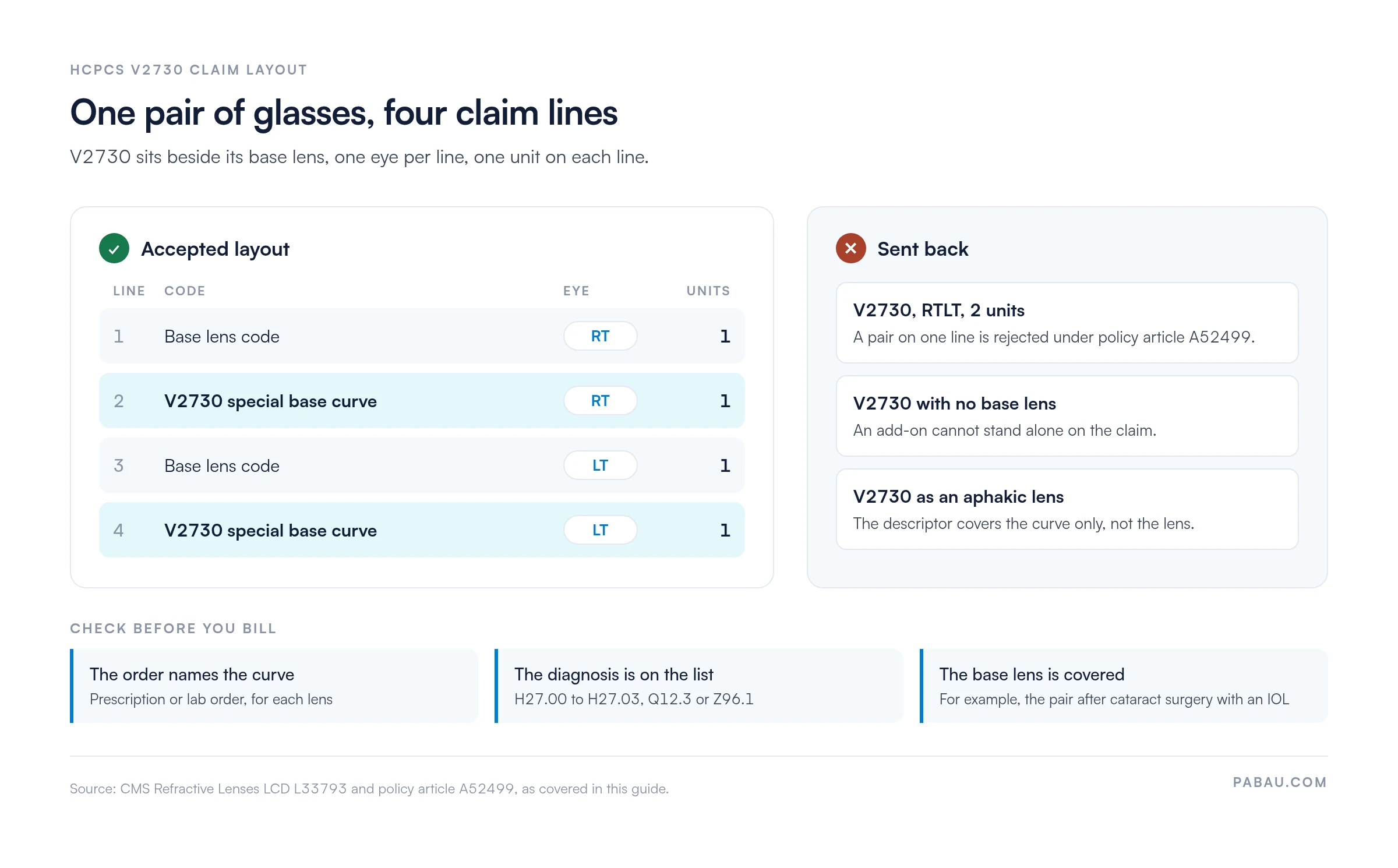
Then check the remittance line by line. If the lens paid but V2730 did not, read the denial reason before you resubmit.
Most V2730 problems trace back to the code’s add-on status. These four show up most often:
The first mistake is the costly one. Correcting the code later also means correcting the base lens line. Related add-ons fail the same way, such as V2780 for oversize lenses and V2744 for photochromatic tints.
Run through this list for every claim that carries a special base curve:
Add-on codes go missing when the lab order lives in email and the claim lives in a separate billing tool. The curve gets ground, but nobody bills it, or it gets billed without a base lens.
Pabau, the practice management platform we build, keeps prescriptions, orders and notes in the patient record. Its claims management software pre-fills the claim from that record and checks required fields before it goes out. In the US, claims go through Claim.MD, with status tracking and remittance posting.


Keep the prescription, lab order and diagnosis in one patient record, then pre-fill the claim from it. Required fields are checked before each claim goes out.

Treat V2730 as a line that depends on another line. Bill it only when the order names the curve, and only beside a covered base lens.
Get that pairing right at dispensing and the claim rarely comes back. Miss it, and you correct two lines instead of one. Book a demo to see how Pabau keeps lens orders and claims together for your optical practice.

Billing a premium lens option instead? HCPCS code V2702 explains the deluxe lens feature code and when the patient pays.
Adding an anti-reflective coating? HCPCS code V2750 covers the coating add-on and its medical-necessity rules.
Is the prism stuck on, not ground in? HCPCS code V2718 walks through the Fresnel press-on prism.
Coding the frame on the same claim? HCPCS code V2020 covers spectacle frames and their coverage limits.
Fighting a denial on a lens claim? Denial codes in medical billing decodes the reason codes payers send back.
It means carrier judgment. No national rule decides V2730 coverage, so the contractor does. For Medicare lenses, that is the DME MAC applying LCD L33793.
No. The Medicare policy article lists V2730 as an add-on billed in addition to the base lens. Put the lens code on the claim for the same eye.
Not under the Medicare refractive lens policy. Its KX rules cover tints, coatings, oversize and polycarbonate lenses. V2730 still needs RT or LT on every line.
Only as part of the one covered pair after each surgery with an IOL. Replacement lenses for those patients are noncovered.
Yes. CMS lists V2730 as active, with an effective date of October 1, 2003. Check each quarterly HCPCS update before you rely on any lens code.