HCPCS code G0257: Unscheduled or emergency dialysis billing guide
HCPCS code G0257: Official descriptor and code overview HCPCS code G0257 is defi...

Last Updated: Oct 27, 2026
T1999 is the HCPCS Level II code for miscellaneous therapeutic items and supplies, retail purchases, not otherwise classified; identify product in "remarks". State Medicaid agencies use it for retail-bought supplies that have no more specific code.
The supplier names the product in the claim remarks, often with the invoice attached, and the payer prices each line individually. Medicare does not recognize T-codes, so T1999 claims go to Medicaid programs and the plans that adopt it.
Let Pabau's smart automation suggest the right codes, reduce claim denials, and keep your practice compliant—effortlessly.
Automate repetitive tasks and focus on what matters most—your patients.
Reduce coding errors and ensure compliance with the latest regulations.
Clean claims, fewer denials, and faster reimbursements.
Powerful insights and reporting to help your practice thrive.
HIPAA compliant SOC 2 certified GDPR-compliant Trusted by 4,000+ clinics worldwide

HCPCS code T1999 covers miscellaneous therapeutic items and supplies bought at retail that have no more specific HCPCS code.
T-codes exist for state Medicaid agencies, and Medicare does not recognize or pay them.
Every T1999 claim must name the product in the claim remarks, usually backed by the purchase invoice.
Payers price T1999 claims one at a time from the invoice, and state rules can cap the dollars billed.
Pabau, the practice management platform we build, submits US claims through Claim.MD and tracks them using data already on the patient record.
HCPCS code T1999 is the Level II code for miscellaneous therapeutic items and supplies, retail purchases, not otherwise classified. Its official descriptor ends with an instruction: identify product in “remarks”. The code took effect on January 1, 2003, and its descriptor has not changed since.
T-codes are national HCPCS codes that CMS maintains for state Medicaid agencies. T1999 is the not otherwise classified (NOC) supply code in that series. A supplier uses it when a Medicaid program covers a retail-bought therapeutic item that no specific code describes.
The table below lists the classification data for this code.
CMS publishes the full Level II code set, T1999 included, in its quarterly HCPCS update files. Medicare does not recognize T-codes, so a T1999 line sent to a Medicare contractor is not paid.
T1999 covers a therapeutic item or supply that a Medicaid program pays for, bought at retail, with no more specific HCPCS code. Check each of these conditions before the code goes on a claim.
Each state decides which provider types may bill the code. North Carolina Medicaid, for example, has let home health agencies bill T1999 for miscellaneous supplies.
T1999 is a fallback for products, so it never replaces a code that already exists. Bill these items and services under their own codes instead.
Payers check for a specific code before they price a NOC line. A T1999 claim for an item that has its own code is likely to be denied or returned for recoding. The decision path below runs the full set of checks, from the item itself to your state’s dollar limits.
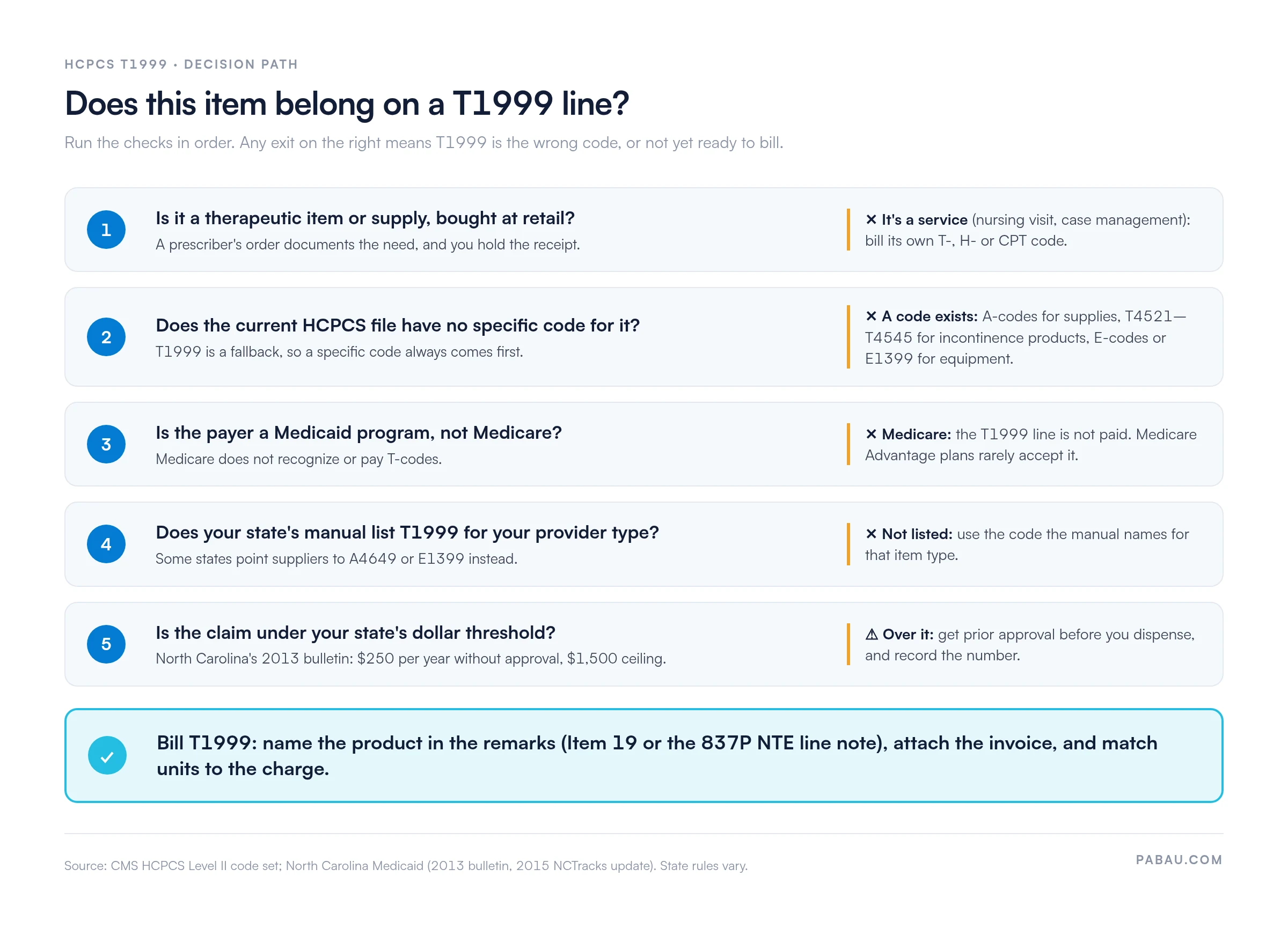
T1999 is one of several NOC codes in HCPCS Level II. The right one depends on the item type and on what the payer accepts.
Some states point suppliers to A4649 or E1399 instead of T1999 for certain items. Use the code your state’s manual names for the item type, because a valid code sent to the wrong payer still fails.
State Medicaid programs are the main payers for T1999, and only where their manuals list it. Medicare does not recognize or pay T-codes, so Medicare fee-for-service will not pay the line.
Many Medicaid programs require prior approval for T1999, either for every claim or above a dollar threshold. North Carolina Medicaid shows how these limits work in practice.
Your state’s limits will differ, so read the current manual before the first claim. Submit any prior approval request before you dispense the item.
A T1999 claim stands on product identification. The descriptor itself tells the supplier to name the product, and a payer cannot price a line it cannot identify. The basics of medical billing still apply, but the paperwork carries more weight here.
On the paper CMS-1500, the narrative usually goes in Item 19. On an electronic 837P claim, it goes in the line note (NTE segment) for the T1999 line. Your state’s companion guide may name a different field, so check it first.
No national fee exists for T1999. Each payer prices the claim individually, usually from the invoice and the product details in the remarks.
State methods differ. Common approaches include paying the invoice cost, adding a set markup, or applying a cap. Your state’s fee schedule or provider manual gives the formula and any limits.
Medicare fee schedules carry no T1999 rate, because Medicare does not use T-codes. Base revenue estimates on your state’s published rules, not on a national lookup tool.
T1999 denials cluster around a short list of avoidable errors. A steady denial management routine catches them before they repeat.
Most T1999 denials come down to missing detail, which a corrected claim can supply. Confirm deadlines against your plan’s provider manual.
Scan the retail receipt into the patient’s record on the day you dispense the item. When a payer asks for the invoice weeks later, your team can send it the same day.
A clean T1999 claim follows the same route every time. Good revenue cycle management treats each step as a checkpoint.
T1999 claims stall on paperwork. The invoice sits in one place and the order in another, and the claim goes out without the product details the payer needs.
Pabau keeps the order, clinical notes, and uploaded documents on one patient record. Its claims management pulls the data already on that record into the claim. In the US, it submits claims through Claim.MD and tracks their status.
Pabau doesn’t choose the code or apply your state’s rules for you. It keeps your team’s records in one place, so the invoice and order are easy to find when a claim needs them.

Pabau keeps orders, notes, and documents on one patient record. It submits US claims through Claim.MD, so your team can follow every T1999 line to payment.

T1999 pays when the payer can see what was bought, why, and for how much. Treat it as the last code you reach for, after a search for a specific one comes up empty.
Before the first claim, read your state’s manual for provider types, dollar limits, and where the product narrative goes. Those three checks head off the denials covered above.
Book a demo to see how Pabau keeps the records behind your Medicaid supply claims together and tracks each claim to payment.

Want fewer rejected supply claims? Denial management in healthcare breaks down common denial causes and the workflows that prevent them.
Need a refresher on the billing cycle? What is medical billing explains the process from coding to remittance.
Sending US claims electronically? Claim.MD clearinghouse covers how claims move from your system to the payer.
Auditing your Medicaid claims? Medical billing compliance covers the rules that keep claims defensible.
HCPCS code T1999 covers miscellaneous therapeutic items and supplies bought at retail that have no more specific HCPCS code. The supplier must identify the product in the claim remarks. State Medicaid agencies use it, and each state decides which provider types may bill it.
Yes, T1999 is an active HCPCS code, in effect since January 1, 2003, but each state Medicaid program decides whether to cover it. Check your state’s provider manual for covered provider types, prior approval rules, and dollar limits before you bill it.
No, Medicare does not recognize or pay T1999 or any other T-code. T-codes exist for state Medicaid agencies, so a Medicare claim needs a code Medicare accepts.
Each payer prices T1999 claims individually, usually from the invoice and the product details in the remarks. There is no national fee. Your state’s manual or fee schedule sets the pricing method and any limits.
You need the product name, manufacturer, model or NDC, the quantity, and a copy of the retail invoice. Keep the prescriber’s order and a medical necessity note with the supporting diagnosis codes. Add the prior approval number where your state requires one.
Most T1999 denials trace to a missing product description, a missing invoice, or an item that has its own specific code. Claims also fail when sent to Medicare or when they pass a state dollar limit without prior approval.