CPT code 40819: Labial and buccal frenectomy billing guide
CPT code 40819 covers lip and cheek frenectomies CPT code 40819 is the procedure...

Last Updated: Oct 8, 2026
S0395 is the HCPCS Level II code for impression casting of a foot performed by a practitioner other than the manufacturer of the orthotic. It covers the casting service itself, not the custom orthotic a lab builds from the impression.
Coverage splits sharply by payer. Most commercial plans reimburse S0395, while traditional Medicare does not recognize it at all, because the S-series is reserved for non-Medicare payers. Submitting it for a Medicare-primary patient is the most common reason an S0395 claim denies.
Let Pabau's smart automation suggest the right codes, reduce claim denials, and keep your practice compliant—effortlessly.
Automate repetitive tasks and focus on what matters most—your patients.
Reduce coding errors and ensure compliance with the latest regulations.
Clean claims, fewer denials, and faster reimbursements.
Powerful insights and reporting to help your practice thrive.
HIPAA compliant SOC 2 certified GDPR-compliant Trusted by 4,000+ clinics worldwide

HCPCS code S0395 is a temporary national code for non-Medicare payers, so traditional Medicare denies it automatically.
S0395 pays for the casting service only, and the orthotic device is billed separately under an L-code.
Bilateral casting is two claim lines, one carrying the LT modifier and one carrying the RT modifier.
Commercial plans pay roughly $20 to $75 per foot once medical necessity is documented in the chart.
Practice management software like Pabau flags a non-covered payer before an S0395 claim leaves your system.
HCPCS Code S0395 is the Healthcare Common Procedure Coding System (HCPCS) Level II code for impression casting of a foot. The casting is performed to produce custom foot orthotics. S0395 belongs to the S-code series, the temporary national codes created for non-Medicare payers.
The S-series was established by the Blue Cross Blue Shield Association and AHIP, formerly the Health Insurance Association of America. Those two bodies still maintain it.
CMS publishes the codes in the national HCPCS file but did not create the series and does not maintain it. Commercial insurers, Medicaid managed care plans, and self-insured employer plans are the payers that use it.
The code draws one line that matters, between the casting service and the orthotic device. S0395 captures the work of taking a physical impression of the foot, by plaster cast, foam box, or digital scan. A lab then uses that impression to build the custom device.
The device itself is billed separately under an L-code. Putting both S0395 and the relevant L-code on the same claim is standard practice. That is the shape of the claim whenever the practitioner casts the foot and the device is delivered later.
HCPCS Code S0395 has no national Medicare fee schedule rate, because traditional Medicare does not reimburse S-codes. Reimbursement is set entirely by individual payer contracts. The CMS Physician Fee Schedule lookup returns no payment data for S0395, which confirms it sits outside the standard Medicare PFS.
Commercial rates for impression casting typically run from roughly $20 to $75 per foot. Payer, plan type, region, and your own contracted rate all move that figure. Verify the current rate with each payer before you submit.
Track reimbursement outcomes for S0395 through the electronic remittance advice (ERA) files each payer returns. ERA data shows allowed amounts, denial reason codes, and contractual adjustments. That is how you find out whether a payer is paying the rate it contracted for.
Traditional Medicare does not cover HCPCS Code S0395. The rule is structural rather than a coverage policy written for this code, and it applies to the whole S-code series.
Run insurance eligibility verification before every orthotic encounter to confirm the primary payer. A patient whose primary payer is traditional Medicare will generate an automatic denial on S0395.
Medicare Advantage plans (Part C) run on private plan rules and may or may not recognize S0395. Some cover impression casting under a broader orthotics benefit. Others require prior authorization, or restrict the service to specific provider types. Check the plan’s own benefits and coding policy before you submit S0395 to anything Medicare-branded.
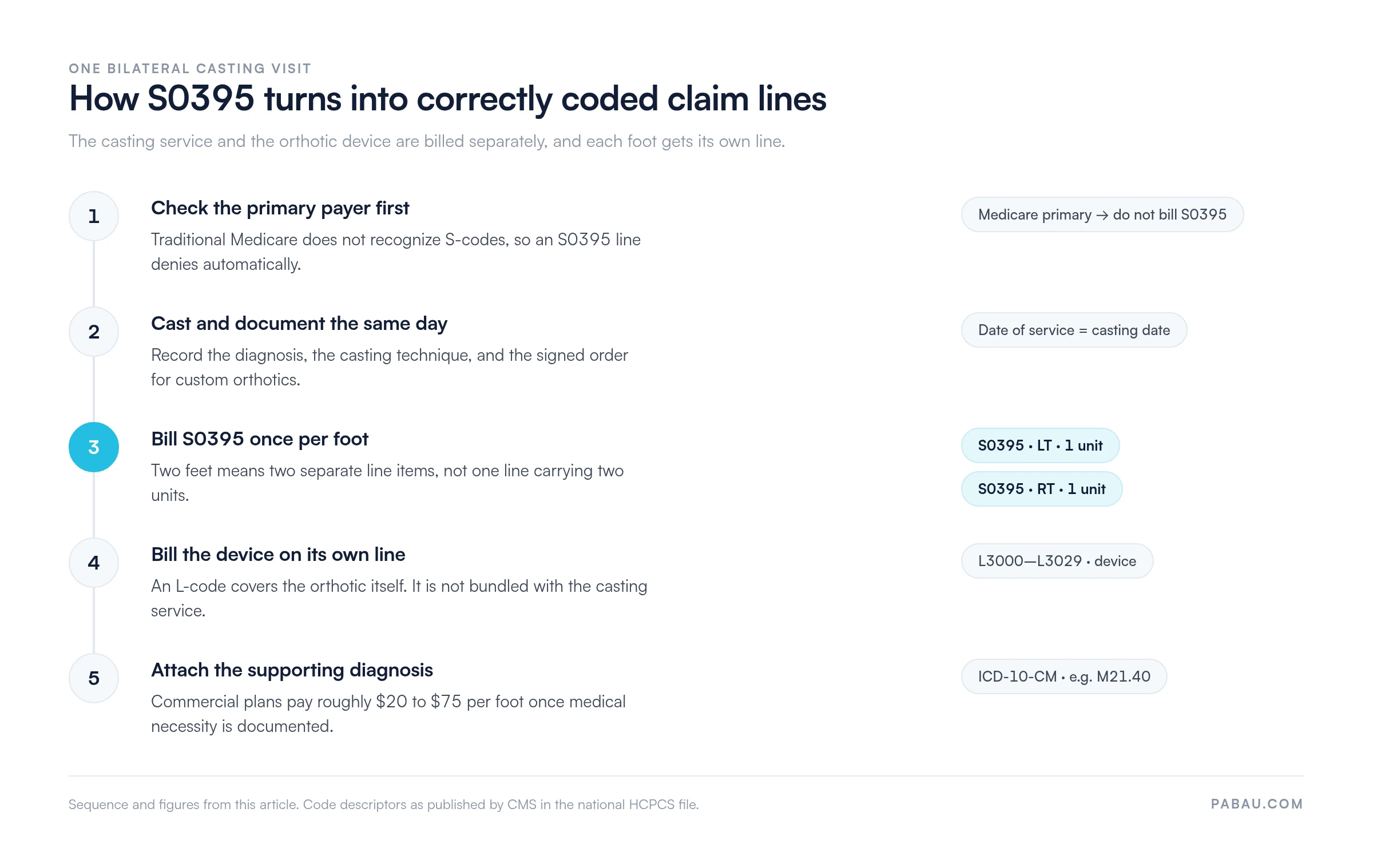
Billing HCPCS Code S0395 correctly comes down to provider type, unit counting, bundling rules, and each payer’s own policy. The casting service and the device it produces sit in different code series, under different coverage rules. The sequence below shows how one bilateral casting visit becomes correctly coded claim lines.
S0395 is billed by the physician or qualified healthcare professional who personally performs the impression casting. Podiatrists, orthopedic physicians, and physical medicine specialists are the most common billers.
Whether a physical or occupational therapist can bill it depends on the payer. Some commercial and Medicaid plans allow allied health providers to bill S0395, while others restrict it to physicians. Practices that offer therapy services should confirm provider eligibility with each payer before billing under a non-physician NPI.
S0395 is billed per foot. A patient needing bilateral custom orthotics generates two units on the same claim, each carrying the right modifier (LT for left, RT for right). Bill the code on the date the casting was performed, not the date the device was delivered.
If you run claims management software, check that it can split a bilateral service into separate LT and RT line items. Two units on one line without modifiers trips clearinghouse edits at most payers.
S0395 and the corresponding L-code (L3000-L3029 for foot orthotics) are not bundled with each other, because they describe distinct services. S0395 is the casting service and the L-code is the device. Both belong on the same claim when the casting and the device are both provided.
Some payers still run bundling edits that deny S0395 alongside specific L-codes. Scrub the claim before it leaves your system, so those edits surface while you can still fix them.
Check the Local Coverage Determination (LCD) for custom foot orthotics before billing S0395. CMS publishes LCD articles for its Medicare contractors, and a number of commercial payers adopt them by reference. They name the diagnoses, provider types, and documentation elements that support coverage. Claims written to match the applicable LCD clear on first pass far more often.
Payers require documentation that establishes medical necessity before paying S0395 claims. Thin or missing chart notes are the second most common denial reason, behind only incorrect payer selection. Build the documentation standards into the clinical workflow, so the chart is complete before the patient leaves the room.
The following elements must appear in the medical record for every S0395 claim:
Keep the superbill for each S0395 claim linked to the patient record. Payers may request records during a post-payment audit, sometimes years after the date of service.
S0395 requires a supporting ICD-10-CM diagnosis code that establishes why custom foot orthotics are medically necessary. The codes below are among the most commonly paired with S0395 claims in podiatry and orthopedic practices. Our ICD-10-CM code index carries the full official descriptors.
Pairing one of them with S0395 does not guarantee approval. Payers decide medical necessity from the complete clinical picture and the applicable Local Coverage Determination.
Understanding where S0395 sits in relation to other orthotic and procedural codes prevents both unbundling errors and missed billing opportunities. The AAPC’s HCPCS code lookup is a useful reference for confirming current code descriptions and status before billing.
S0395 and the L-codes answer different questions. S0395 pays for the casting procedure, while the L-codes pay for the orthotic device as durable medical equipment. A practice that bills only the L-code leaves a reimbursable service unbilled wherever the payer covers impression casting separately.
S0395 denies more often than most HCPCS codes, and the reasons repeat. Six errors account for the bulk of them, and each one can be caught before the claim is submitted. Working out which of the six drives your denials is usually faster than appealing them one at a time.
Before billing S0395 to a new payer, call their provider services line and ask three questions. Do you recognize HCPCS code S0395? Is prior authorization required for impression casting? Which provider types may bill it under your plan? Write the representative’s name and the call date into your billing notes. That 10-minute call saves the 30-day cycle of denial, appeal, and resubmission.
The usual sequence runs backwards. The casting is done, the claim goes out with the rest of the day’s work, and the denial lands three weeks later. By then someone has to rebill the patient or write the charge off.
Pabau is an all-in-one practice management system, so the payer on file, the appointment, the clinical note, and the claim sit in one patient record. A Medicare-primary patient shows up before the casting appointment rather than after the denial.
Bilateral work goes out as separate LT and RT lines instead of one two-unit line, with the device L-code on the same claim. Denials are tracked by payer and by code, so you can see which plans pay S0395 and which never will.

Pabau’s claims management software helps practices track HCPCS claims, apply modifiers automatically, and flag non-covered payer submissions before they reach the clearinghouse. See how it works for your specialty.

S0395 is a simple code with an awkward coverage rule attached, and that rule decides whether it gets paid. Confirm the payer before the encounter, document why custom orthotics are necessary, and keep the casting and the device on separate lines. Do those three things and the code behaves predictably.
Pabau flags a non-covered payer before an S0395 claim leaves your system. It applies LT and RT modifiers and tracks denial patterns by payer. Book a demo to see how that fits a podiatry or orthotic billing workflow.

Want to reduce orthotic claim denials across your practice? Denial management in healthcare covers systematic approaches to tracking, appealing, and preventing the most common claim rejections.
Need to verify eligibility before every orthotic encounter? Insurance eligibility verification walks through how to run real-time eligibility checks and what to look for in benefit responses for DME and orthotic services.
Looking for a structured billing workflow for podiatry and orthopedic practices? What is revenue cycle management explains how to connect patient intake, coding, claim submission, and payment posting into a single trackable workflow.
HCPCS Code S0395 describes impression casting of a foot performed by a practitioner other than the manufacturer of the orthotic. It is a temporary national code in the S-series, used by non-Medicare payers. It covers the casting service only. The orthotic device itself is billed separately under an L-series HCPCS code.
No. Traditional Medicare (Parts A and B) does not recognize S-codes, including S0395. Medicare Advantage (Part C) plans vary, and some cover impression casting for custom orthotics while others do not. Verify coverage with the specific plan before billing S0395 to anything Medicare-branded.
There is no national Medicare fee schedule rate for S0395, because Medicare does not cover S-codes. Commercial rates for impression casting typically run from roughly $20 to $75 per foot. The figure moves with the payer, the region, and your contracted rate. Verify it with each payer, since contracts change annually.
The chart needs a confirmed ICD-10-CM diagnosis supported by objective examination findings. It also needs a medical necessity statement explaining why custom orthotics are required, plus a signed physician order. Record the casting technique used, the billing provider’s NPI and credentials, and the date the casting was performed. Keep the records for post-payment audits.
S0395 covers the casting service, meaning the work of taking a physical foot impression. The L3000-series codes cover the custom orthotic device itself. Both can go on the same claim when the practitioner performs the casting and the device is later fabricated and delivered. They are not bundled with each other.
It depends on the payer. Some commercial plans and Medicaid managed care plans allow physical therapists and occupational therapists to bill S0395. Others restrict the code to physicians and podiatrists. Verify provider eligibility with each payer before submitting a claim from a non-physician NPI.