CPT code 40819: Labial and buccal frenectomy billing guide
CPT code 40819 covers lip and cheek frenectomies CPT code 40819 is the procedure...

Last Updated: Oct 8, 2026
S0195 is the HCPCS Level II code for pneumococcal conjugate vaccine, polyvalent, intramuscular. It covered children from five to nine years of age who had not previously received the vaccine.
The code was deleted effective January 1, 2016, and it is no longer valid with any payer. A claim that still carries S0195 is rejected at the clearinghouse before the payer sees it. Bill the current CPT product code for the vaccine administered instead.
Let Pabau's smart automation suggest the right codes, reduce claim denials, and keep your practice compliant—effortlessly.
Automate repetitive tasks and focus on what matters most—your patients.
Reduce coding errors and ensure compliance with the latest regulations.
Clean claims, fewer denials, and faster reimbursements.
Powerful insights and reporting to help your practice thrive.
HIPAA compliant SOC 2 certified GDPR-compliant Trusted by 4,000+ clinics worldwide

S0195 was the HCPCS Level II code for pneumococcal conjugate vaccine in children aged five to nine.
The code was deleted effective January 1, 2016, so any claim carrying it now rejects at the clearinghouse.
S codes are temporary national codes maintained by the Blue Cross Blue Shield Association, and Medicare never accepted them.
Bill the current CPT product code instead: 90670, 90671, 90677 or 90684, depending on the vaccine given.
A deleted-code rejection never reaches the payer, so it never appears in your denial report.
HCPCS code S0195 was the temporary national code for pneumococcal conjugate vaccine, polyvalent, intramuscular. It applied to children aged five to nine who had not previously received the vaccine. The code was deleted effective January 1, 2016, and it is no longer valid on any claim.
S0195 belonged to the S-series, the block of temporary national codes maintained by the Blue Cross Blue Shield Association rather than by CMS. S codes were never valid for Medicare fee-for-service billing. Their use sat with Medicaid managed care plans and commercial insurers.
If S0195 is still sitting in your fee schedule, inactivate it. Then bill the CPT product code for the vaccine you actually administer. The sections below cover the deletion record, the replacement codes, and the audit that catches the claims already submitted on it.
The table below summarizes the key reference data for S0195. Check anything you plan to put on a claim against the current CMS quarterly release before you submit.
S0195 was retired because pneumococcal conjugate vaccine billing moved to CPT product codes that name the exact formulation given. AAPC’s deleted-code record puts the deletion date at January 1, 2016.
The Blue Cross Blue Shield Association and the HCPCS National Panel review the S-series on an annual and quarterly cycle. A code is retired when any of the following applies:
All three applied to S0195 as new pneumococcal conjugate formulations reached the market and picked up their own CPT codes.
One detail catches billing teams out. An S-code deletion reaches practices through payer and clearinghouse bulletins, not through a CMS notice addressed to you. If nobody on the team reads those bulletins, the code sits in the fee schedule until a rejection surfaces it years later.
Bill the CPT product code for the vaccine you administered. Four pneumococcal conjugate vaccine codes are in use today:
The product on the vial decides the code, not the patient’s age. Vaccine administration is reported separately, and the administration code depends on the patient’s age and on whether counseling was given.
Which of the four you use is a stocking question first and a payer question second. Run this verification once, then keep the result in your code table:
Payer acceptance still varies by state Medicaid plan and by individual commercial insurer. A code one payer takes can draw a denial at another, which is why the mapping is worth documenting rather than remembering.
Practices that billed pneumococcal vaccine on S0195 have three jobs: audit past claims, remap to the current code, and confirm acceptance payer by payer. The table below sets out the billing context for this vaccine category.
Clean claim submission for vaccine codes depends on matching the product administered to the correct CPT descriptor. A claim whose code does not match the product’s National Drug Code (NDC) or the payer’s formulary draws a technical denial. That happens even when the vaccine was given and documented properly.
A written code-transition log earns its keep once you bill several payers. Record the old code, the replacement code, the payer, and the date the change took effect. That log answers a payer query about any claim dated near the switch.
HCPCS S codes are temporary national codes used by non-Medicare payers, including Medicaid managed care organizations and commercial insurers. The Blue Cross Blue Shield Association administers the S-series, while CMS maintains the permanent HCPCS Level II codes. Coders working across both Medicare and commercial payers therefore need two coding paths for the same clinical service.
That structure matters for S0195. A pneumococcal vaccine billed to a Medicare patient on this code was never a valid claim, even in the years the code was active.
If those claims went out without rejection, the payer’s edit logic let them through, and a code-level audit is the right response. Our HCPCS Level II codes hub lists the other letter series your practice is likely to bill.
S0195 sits in the S01xx range of the S-code series. The table below lists neighboring codes for orientation only. Each one runs on its own review cycle, so the deletion of S0195 tells you nothing about the status of the codes around it.
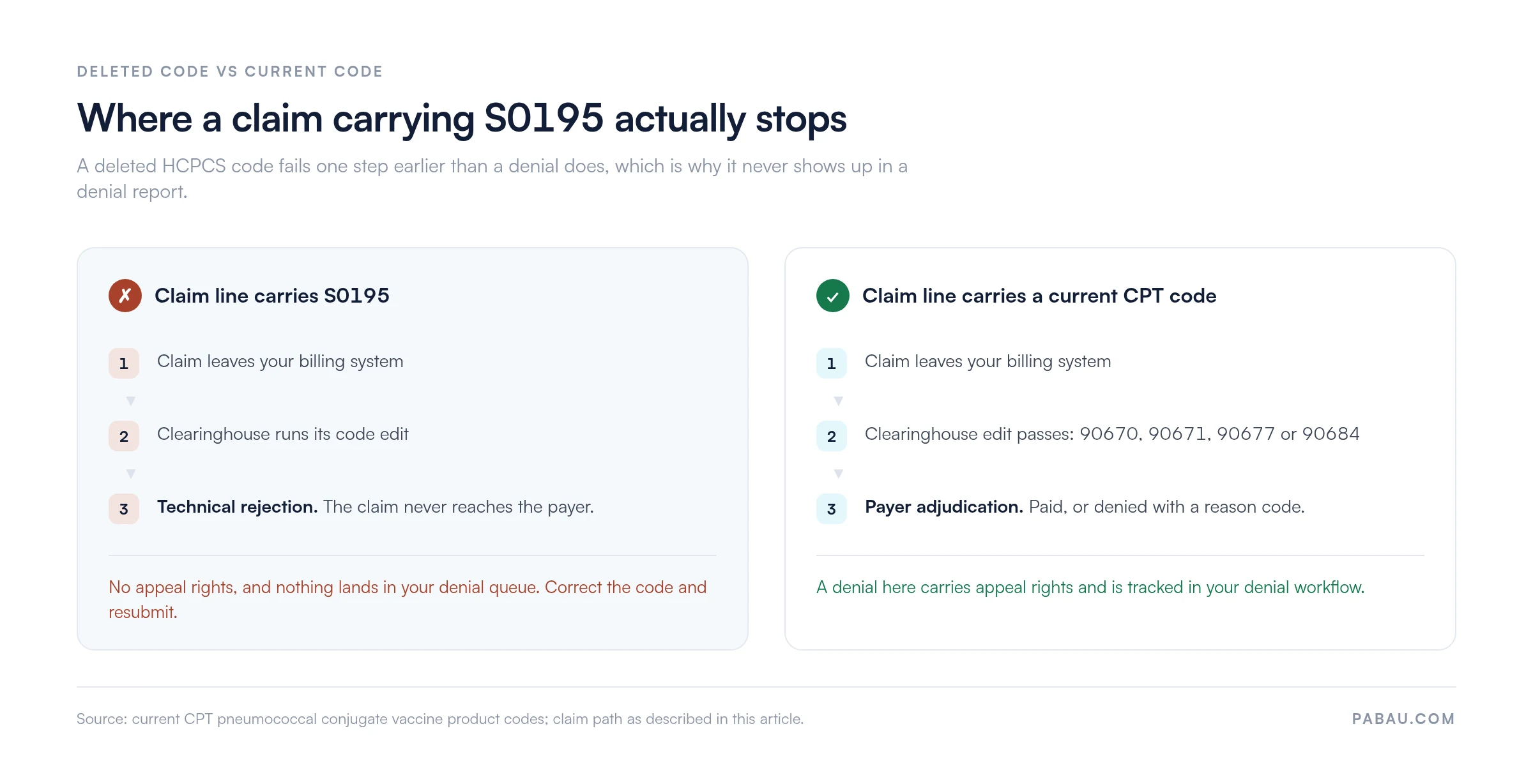
A deleted code fails earlier in the claim path than a denial does. The clearinghouse edit catches it, so the claim never reaches the payer and never lands in your denial report. That is how S0195 can sit in a fee schedule for years without anyone noticing it.
Here is the workflow for retiring a deleted S code from practice management software:
Run a quarterly HCPCS code audit. Download the latest CMS HCPCS file and compare it against every code in your fee schedule. Inactivate the deleted ones before they reach a live claim. Set a calendar reminder for each CMS quarterly release so your team never bills from a stale code table.
A deleted code usually surfaces through a rejection report. Someone traces it back to a fee schedule row and rebuilds that week’s claims by hand. The practice loses a payment cycle to work nobody planned for.
Practice management software like Pabau keeps the billing side in one system, so a code change does not have to be chased across spreadsheets. Pabau’s claims management software tracks claim status at code level. You can see which claims carried S0195, and whether each one settled, rejected, or is still open.
That code-level view is where the back-catalog audit in step five starts. Instead of pulling reports out of three places, you filter the billing queue by code and work the list. Rejections route to the person who owns them, rather than waiting for the monthly reconciliation.

Pabau’s claims management software keeps your code library current, groups claims by code, and routes rejections to the right person. See how it fits your vaccine billing workflow.

S0195 has been invalid since January 1, 2016, so a claim carrying it will not reach a payer. The correction itself is small. Find the code, inactivate it, map your vaccine stock to the right CPT product code, then confirm the choice with each payer.
The part worth remembering is where the failure happens. Clearinghouse rejections sit outside the denial process, so your usual reporting will not show them to you. Reviewing the code table every quarter costs far less than the resubmission work that follows a missed deletion.
Pabau’s claims management software gives billing teams a code-level view of every claim, which makes that audit quick. Book a demo to see how it handles vaccine billing and code changes in your practice.

Need a framework for tracking rejected claims? Denial management in healthcare explains how to catch and resolve rejected claims before they turn into write-offs.
Building a superbill your payers will accept? What is a superbill? covers the codes and fields it has to carry, so a retired code never travels onto a claim.
Evaluating billing software for your practice? Best medical billing software in the US compares the leading platforms on code management, claim tracking, and ERA handling.
S0195 was the HCPCS Level II temporary national code for pneumococcal conjugate vaccine in children aged five to nine who had not been vaccinated before. It was deleted effective January 1, 2016, and any claim carrying it today is rejected.
Pneumococcal conjugate vaccine billing moved to CPT product codes that identify the exact formulation given. Once those codes covered the service, the Blue Cross Blue Shield Association and the HCPCS National Panel retired S0195.
Bill the CPT code for the vaccine product you administered: 90670 for PCV13, 90671 for PCV15, 90677 for PCV20, or 90684 for PCV21. Confirm the code with each payer before you submit.
No. S0195 has been deleted since January 1, 2016 and is not valid with any payer. A claim carrying it is rejected at the clearinghouse before a payer ever sees it.
S codes are temporary national codes that non-Medicare payers use for services with no permanent HCPCS Level II code. The Blue Cross Blue Shield Association maintains them, and Medicare does not accept them for fee-for-service claims.
Commercial insurers and Medicaid managed care plans are the main users, but acceptance varies by plan and by state. Ask each payer which S codes they accept, because some have replaced them on their own code lists.