

HCPCS code E0198: Water pressure pad billing guide
HCPCS code E0198 is a water pad for a standard mattress HCPCS code E0198 is the ...

Last Updated: Oct 13, 2026
S0078 is the HCPCS Level II code for injection, fosphenytoin sodium, 750 mg.
The official descriptor carries no "PE" abbreviation, even though clinicians dose fosphenytoin in phenytoin equivalents. That mismatch between the code and the administration record is where unit counts go wrong. One unit of S0078 covers 750 mg, and the claim also needs a supporting epilepsy or status epilepticus diagnosis.
Let Pabau's smart automation suggest the right codes, reduce claim denials, and keep your practice compliant—effortlessly.
Automate repetitive tasks and focus on what matters most—your patients.
Reduce coding errors and ensure compliance with the latest regulations.
Clean claims, fewer denials, and faster reimbursements.
Powerful insights and reporting to help your practice thrive.
HIPAA compliant SOC 2 certified GDPR-compliant Trusted by 4,000+ clinics worldwide

HCPCS code S0078 describes injection, fosphenytoin sodium, 750 mg, a temporary Level II S-series code for non-Medicare payers
The official descriptor carries no PE abbreviation, unlike Q2009, which reads injection, fosphenytoin, 50 mg phenytoin equivalent
PE means phenytoin equivalents, the clinical dosing convention for fosphenytoin, and it is what the administration record will show
S0078 is not reimbursable under standard Medicare Part B fee-for-service, so it suits Medicaid and commercial payer claims
Claims must link a supported ICD-10 diagnosis, such as epilepsy or status epilepticus, to establish medical necessity
Practice management software like Pabau helps outpatient practices track S-series claim status across Medicaid and commercial payers
The table below summarizes the key attributes of HCPCS code S0078. The code is maintained by the Centers for Medicare and Medicaid Services (CMS) and the Blue Cross Blue Shield Association, which administers S-series codes.
S0078 is active and billable for the payer types listed above. Confirming acceptance with the specific plan before submission is what saves the rework. No federal rule obliges a payer to recognize an S-series code.
The official long descriptor for S0078 is “Injection, fosphenytoin sodium, 750 mg.” The published wording makes no reference to phenytoin equivalents. The short descriptor in the CMS Alpha-Numeric HCPCS file reads “Injection, fosphenytoin sodi,” cut off by the file’s 28-character limit on short descriptors.
Many coding references print the descriptor as “750 mg PE.” That version is a paraphrase rather than the published text. Quoting it in an appeal letter or a payer query weakens your position, because the reviewer compares your wording against the CMS file.
Fosphenytoin is a prodrug of phenytoin. The body converts it to phenytoin after injection, so clinicians and pharmacists express the dose in phenytoin equivalents rather than fosphenytoin milligrams. One mg PE delivers the same phenytoin exposure as one mg of phenytoin.
Vial labels, prescriber orders, and medication administration records all use mg PE for that reason. The convention belongs to clinical dosing, not to the code’s published wording. CMS does spell the unit out when a descriptor genuinely uses it, which is why Q2009 reads “Injection, fosphenytoin, 50 mg phenytoin equivalent.”
In day-to-day billing the practical step is reconciliation. Read the mg PE figure off the administration record, then confirm in the payer’s manual how that payer counts a 750 mg unit of S0078. Doing both keeps your unit count defensible if the claim is reviewed.
Do not confuse S0078 with the phenytoin injection code J1165. Fosphenytoin and phenytoin are distinct drugs with separate billing codes. Submitting a phenytoin code when fosphenytoin was administered creates a drug-versus-record mismatch that invites denial or audit scrutiny.
S-series HCPCS codes are temporary Level II codes designated for use by non-Medicare payers. The BCBSA, not CMS, maintains and updates the S-series. That is why CMS publishes no fee schedule rate for S0078 through its standard Physician Fee Schedule lookup tool.
For practices that bill Medicaid, separating Medicare and Medicaid claim batches cleanly keeps S-series codes out of the wrong file. Good claims management software flags an S-series code automatically and routes it away from Medicare claim files before submission.
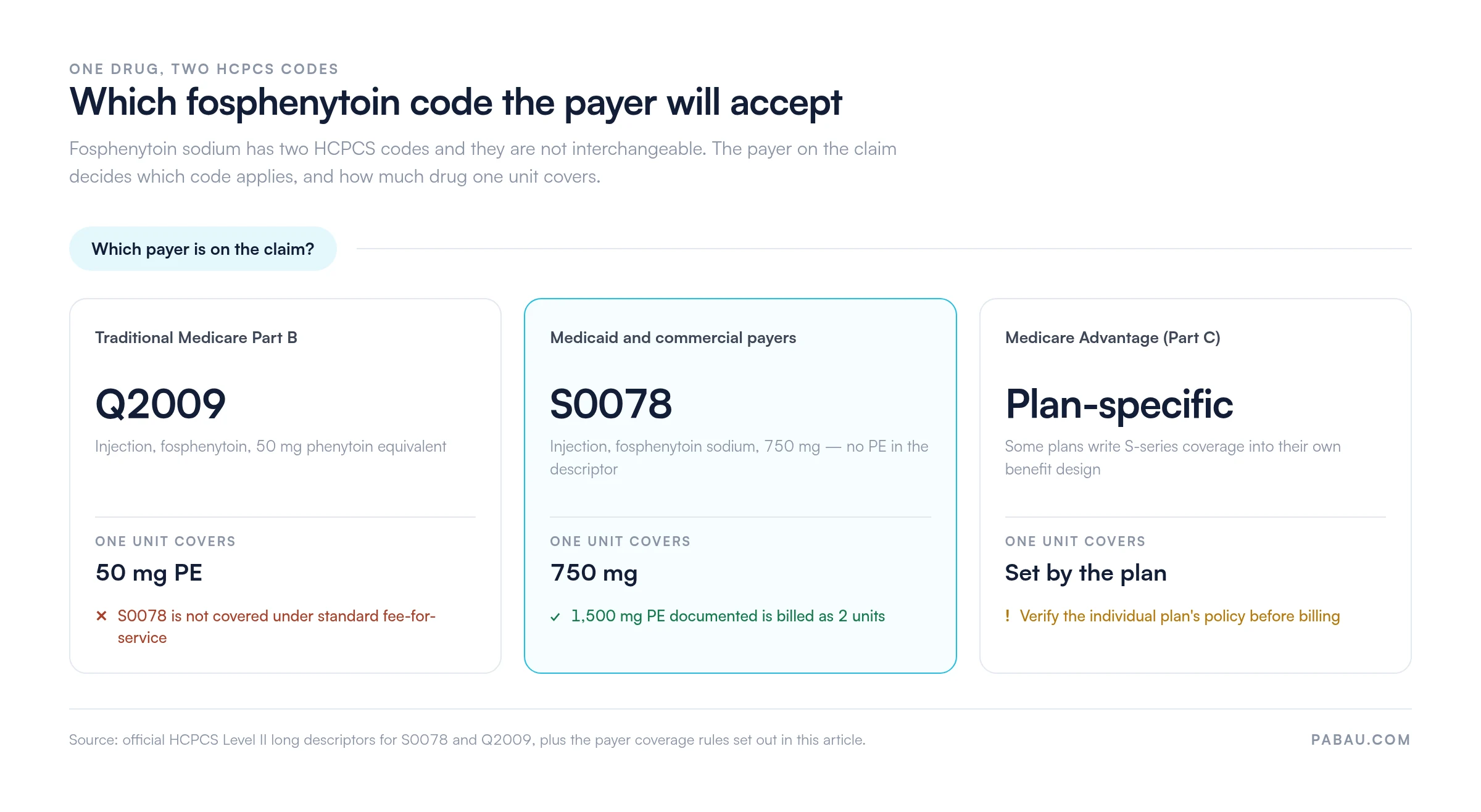
S0078 submitted to traditional Medicare Part B will not be paid. S-series codes are excluded from standard Medicare fee-for-service reimbursement by design. When the payer is traditional Medicare, the fosphenytoin code to look at is Q2009, reported in 50 mg PE increments.
Some Medicare Advantage plans write coverage for S-series codes into their plan-specific benefit designs. Verify the individual plan’s coverage policy rather than assuming that all Medicare products behave the same way. The decision chart below shows which code and unit size each payer type takes.
Running an eligibility check before the encounter keeps S0078 off a Medicare claim that has no path to payment. The response names the plan, which tells the biller whether an S-series code will be accepted before the drug is administered.
Coding fosphenytoin injection correctly means knowing how each payer defines the unit of service for S0078. It also means knowing which modifier rules apply in the outpatient setting. A wrong unit multiplier leads to either underpayment or an overpayment recovery demand.
One unit of S0078 covers 750 mg of fosphenytoin sodium. Because prescribers order and document the drug in mg PE, the administration record is where most teams read the quantity. A documented 1,500 mg PE dose is reported as two units.
Bill only the quantity administered, per the physician order and the administration record. Rounding up to the next 750 mg increment is not appropriate. Confirm in each payer’s provider manual how that payer defines the S0078 unit, since S-series unit rules are set payer by payer.
Modifiers for S0078 depend on the payer’s specific billing guidelines. Common modifiers that may apply include JW, for the amount of drug discarded when part of a single-use vial is wasted. Some state Medicaid programs also require place-of-service modifiers for emergency department versus outpatient infusion settings. Verify modifier requirements with each payer’s provider manual before submitting.
S0078 is most commonly billed for hospital outpatient, emergency department, and outpatient infusion center encounters. Inpatient drug administration is typically bundled into the facility’s DRG payment and not separately billable with an HCPCS Level II code. Confirm the encounter setting before billing separately.
A clean S0078 claim carries four elements. It needs the correct unit count, a linked ICD-10 diagnosis, the rendering provider’s NPI, and the applicable place-of-service code. Checking those four before submission removes most preventable rejections.
Before billing S0078, confirm the patient’s plan is not a standard Medicare fee-for-service product. Pull the payer ID from the eligibility response and cross-reference it against your Medicaid and commercial payer list. An S-series code routed to Medicare will reject at the clearinghouse level rather than at the payer, which can delay rework tracking.
Because S0078 is a non-Medicare code, it does not carry a CMS Ambulatory Payment Classification (APC) assignment or a national Medicare fee schedule rate. Reimbursement is set entirely by each individual payer’s drug fee schedule or the rate negotiated in your provider contract.
Track S0078 reimbursement by payer so you can see which contracts pay less than the drug costs to acquire. Payment-per-unit trends across Medicaid and commercial claims are what surface a contract worth renegotiating.
Every S0078 claim must link a supporting ICD-10-CM diagnosis code that establishes medical necessity for fosphenytoin administration. Fosphenytoin is an antiepileptic drug used to treat seizures and status epilepticus. The applicable diagnoses are therefore drawn from the epilepsy and seizure chapters of ICD-10-CM.
The AAPC HCPCS Level II lookup tool provides crosswalk references for S-series codes alongside their commonly paired diagnoses.
Always use the most specific ICD-10-CM code the clinical documentation supports. Billing R56.9 when the record documents status epilepticus may invite a medical-necessity query from the payer. The more specific epilepsy code is also the one that survives an audit.
Billing teams working in neurology, emergency medicine, or neurocritical care will encounter related codes alongside S0078. Knowing the differences prevents upcoding errors on anticonvulsant drug administration. The wider HCPCS code set holds the permanent J-codes and Q-codes listed below.
Some payers accept neither S0078 nor any other specific HCPCS code for fosphenytoin. J3490 is the fallback in that case, submitted with an invoice and full drug identification. Unclassified drug claims attract higher scrutiny and slower adjudication, so reserve J3490 for payers that ask for it.
Check the NLM HCPCS Level II API for the current status and descriptor of any S-series alternative before billing it.
Supporting documentation is the foundation of a defensible S0078 claim. A payer reviewing an injectable anticonvulsant claim checks three points. The drug must have been medically necessary, ordered by a licensed provider, and administered at the reported dose.
Standardizing the documentation workflow for drug injection claims reduces additional-documentation requests (ADRs) from Medicaid and commercial payers. Track denial reasons for S-series claims as their own group, so a pattern shows up quickly instead of reading as scattered one-off rejections.
Review your state Medicaid provider manual’s drug billing chapter annually. S-series code acceptance, unit definitions, and modifier requirements for injectable anticonvulsants vary by state and update with each annual fee schedule revision. What was accepted last year may require an additional modifier or a different unit structure this year.
In many outpatient billing teams, S-series drug claims are sorted by hand. Someone reads the plan off the eligibility response, remembers that Medicare will not take an S-code, and moves the claim to a different batch. When that person is on leave, the claim goes out to Medicare and rejects at the clearinghouse a week later.
Practice management software like Pabau handles that sorting as part of the claim build. Eligibility results, payer type, and code set sit on the same record. An S-series code on a traditional Medicare plan is flagged before the file goes out. The mg PE figure from the administration record stays attached to the charge, which keeps the unit count auditable.
The outcome is fewer preventable rejections and a shorter route from administration to payment. Your billers spend their time on appeals that are worth fighting, rather than on rework that a routing check would have prevented.

Pabau’s claims management tools route S-series and other HCPCS codes to the right payer. Flag Medicare-incompatible codes before submission and track claim status across every payer from one dashboard.

Two codes cover the same drug, and the descriptor is what tells them apart. Get that right and the appeal writes itself, because the reviewer can match your wording to the CMS file. Get it wrong and you are defending text that was never published.
The same discipline decides the payer lane. A practice that routes S0078 to Medicaid and commercial plans, and Q2009 to traditional Medicare, stops paying for rework it never needed. The trade-off is that S-series rules are set payer by payer, so the unit definition has to be re-checked each year.
Managing injectable drug claims across several payer types is where claim routing, eligibility verification, and denial tracking earn their keep. To see how Pabau keeps S-series and other HCPCS drug codes in the right billing lane, book a demo.

Need to understand how medical billing errors get caught and corrected? Denial management in healthcare covers the systematic approach to identifying, appealing, and preventing claim rejections.
Want a primer on what a clean claim looks like for injectable drugs? Clean claim submission explains the elements every drug injection claim needs to pass initial payer edits without a rejection.
Billing across Medicaid and commercial payers and need to track eligibility? Insurance eligibility verification walks through best practices for confirming payer-specific coverage before administering and billing high-cost injectable drugs.
HCPCS code S0078 is a temporary Level II S-series code with the official descriptor “Injection, fosphenytoin sodium, 750 mg.” It reports antiepileptic drug administration on Medicaid and commercial payer claims.
No. The official long descriptor reads “Injection, fosphenytoin sodium, 750 mg,” with no reference to phenytoin equivalents. Many coding references print it as “750 mg PE,” but that wording is a paraphrase. Quote the published descriptor in appeals and payer correspondence.
PE stands for phenytoin equivalents. Fosphenytoin is a prodrug that the body converts to phenytoin, so clinicians dose it in phenytoin-equivalent units. One mg PE delivers the same phenytoin exposure as one mg of phenytoin. Vial labels, orders, and administration records all use mg PE.
Both codes cover fosphenytoin, but they serve different payers and different units. Q2009 reads “Injection, fosphenytoin, 50 mg phenytoin equivalent” and is recognized by Medicare. S0078 is an S-series code for Medicaid and commercial payers, billed in 750 mg units.
No. S0078 is not covered under standard Medicare Part B fee-for-service. S-series codes are temporary, non-Medicare codes maintained by the Blue Cross Blue Shield Association rather than CMS. Some Medicare Advantage plans include S-series coverage in their benefit designs, so verify each plan individually.
State Medicaid programs and commercial insurers that follow BCBSA coding conventions generally accept S0078. Acceptance varies by state Medicaid program and by individual commercial plan contract. Always verify payer acceptance through an eligibility check or the payer manual before submission.
S0078 is commonly billed with epilepsy and status epilepticus diagnoses. Examples include G40.901 (epilepsy, unspecified, not intractable, with status epilepticus) and G40.911 (epilepsy, unspecified, intractable, with status epilepticus). Use the most specific code the documentation supports.
One unit of S0078 covers 750 mg of fosphenytoin sodium. Because the administration record is written in mg PE, read the documented quantity from there. A documented 1,500 mg PE dose is reported as two units of S0078.
No. Fosphenytoin and phenytoin are distinct drugs with separate HCPCS codes. Fosphenytoin sodium injection is billed with S0078, while phenytoin injection uses J1165. Substituting one for the other creates a drug-versus-record mismatch that can trigger denial or audit review.



