

HCPCS Code G0163: Skilled nursing observation and assessment
What is HCPCS Code G0163? HCPCS Code G0163 is a deleted Level II code for skille...

Last Updated: Oct 15, 2026
Q4176 is the HCPCS Level II code for Neopatch or Therion skin substitute, per square centimeter, reported as an add-on to the primary application procedure. It bills the product only, one unit per square centimeter applied, while CPT 15271-15278 bill the clinician's work.
The unit count matters more than ever. From January 1, 2026, Medicare pays skin substitutes as supplies at one national rate of about $127 per square centimeter. So a miscounted wound is money lost now or clawed back later. Below, you'll find the unit math, companion codes, payer rules, and the denial triggers to check first.
Let Pabau's smart automation suggest the right codes, reduce claim denials, and keep your practice compliant—effortlessly.
Automate repetitive tasks and focus on what matters most—your patients.
Reduce coding errors and ensure compliance with the latest regulations.
Clean claims, fewer denials, and faster reimbursements.
Powerful insights and reporting to help your practice thrive.
HIPAA compliant SOC 2 certified GDPR-compliant Trusted by 4,000+ clinics worldwide

HCPCS code Q4176 bills Neopatch or Therion skin substitute per square centimeter, as an add-on to the application procedure.
Units equal the wound area covered that day, rounded to a whole number under your MAC’s policy.
Every claim pairs Q4176 with a CPT 15271–15278 application code and an ICD-10 diagnosis from the LCD’s covered list.
From January 1, 2026, Medicare pays skin substitutes as incident-to supplies at about $127.28 per square centimeter.
Medicare Advantage and commercial plans often require prior authorization, so confirm it before the first application.
HCPCS code Q4176 is an active HCPCS Level II code for Neopatch or Therion skin substitute, billed per square centimeter. The Centers for Medicare & Medicaid Services (CMS) maintains it. In the 2026 code set, its descriptor also marks it as an add-on, listed separately from the primary application procedure.
Because both products share one code, the claim never has to tell them apart. Still, check Q4176 against the current CMS HCPCS Level II code set before you bill. CMS revises Q-code descriptors and assignments on a regular cycle.
Both are tissue-based skin substitutes used to help chronic or complex wounds close. The clinician places the product over a prepared wound bed, where it works as a temporary cover.
The clinical note should still name the exact product. Auditors compare the chart with the claim, and a note naming Neopatch backs up a Q4176 line. Billing either product under a different Q code is a miscoding error. It usually ends in a denial or a later recoupment.
Q4176 covers the supply of Neopatch or Therion on a wound that meets the payer’s coverage criteria. The application procedure goes on its own CPT line. Here’s a quick way to sort what belongs where.
Covered: The product supply (Neopatch or Therion), billed per square centimeter of wound area treated at the time of application.
Not covered under Q4176:
The diagnosis has to fit as well. It must match a wound type listed in the applicable Local Coverage Determination (LCD). A diagnosis outside that list is one of the leading denial triggers for this code family.
Units for HCPCS code Q4176 equal the wound’s surface area in square centimeters at the time of application. That makes the ruler the most important billing tool in the room. In fact, measurement slips are the most common unit mistake on skin substitute claims.
Work through these five steps at every application visit:
Next, get the numbers into the note. Auditors often request the progress note to check that billed units match the recorded dimensions. A mismatch counts as a billing error, whatever the intent.
Q4176 covers the product supply only. So every valid claim also carries a CPT application code, such as CPT 15271, plus a supported ICD-10 diagnosis. The table shows where each companion code fits.
Treat the ICD-10 codes above as examples. Covered diagnoses vary by contractor, so confirm them against your MAC’s LCD before billing.
Check your MAC’s skin substitute LCD before the first Q4176 application. Save the covered diagnosis list and attach it to your wound care order template. That one step cuts diagnosis-mismatch denials at the point of care.
Take the 3 cm by 4 cm wound from the unit table. Once it’s measured, it turns into three claim lines and one Medicare payment. The flow below follows it from the ruler to the remittance.
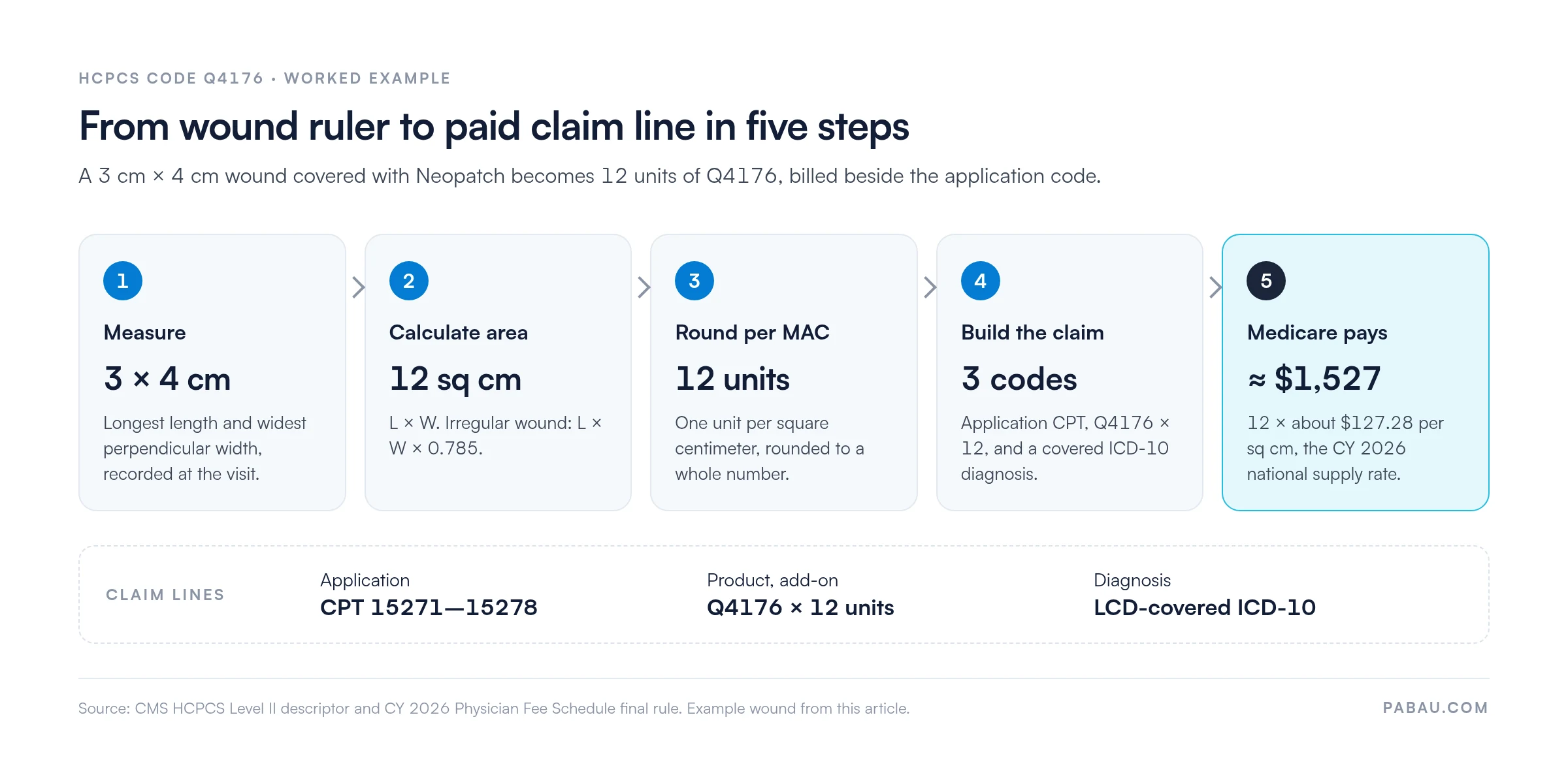
At each handoff, one person owns the check. The clinician owns the measurement and the product name. Then the coder matches the diagnosis to the LCD, and the biller confirms prior authorization before the claim goes out.
Q4175 (Miroderm) is the code billers mix up with Q4176 most often. Both are Q4100-series skin substitutes billed per square centimeter. However, they cover different products, and the wrong one invites recoupment.
So which code do you pick? Read the product label recorded in the chart. If it says Neopatch or Therion, bill Q4176. If it says Miroderm, bill Q4175. No further clinical judgment is needed.
Medicare Part B covers HCPCS code Q4176 when the claim meets the applicable LCD’s coverage criteria. Coverage isn’t automatic, though. Each MAC publishes its own skin substitute LCD, with its own covered indications, diagnosis codes, and frequency limits.
From January 1, 2026, CMS pays skin substitutes as incident-to supplies under the Physician Fee Schedule (PFS). The CY 2026 final rule set a single initial rate of about $127.28 per square centimeter. CMS pays it separately, on top of the application procedure.
As a result, the unit count now drives the whole product payment. A 12 sq cm application pays roughly $1,527, while an 80 sq cm wound pays about $10,182. Check the figure for your year and locality in the CMS Physician Fee Schedule lookup tool.
Before 2026, some MACs priced skin substitutes from the supplier invoice. With one national rate in place, the invoice matters less for payment. Even so, follow your MAC’s current guidance and keep the paperwork for audits.
Traditional Medicare doesn’t require prior authorization (PA) for skin substitutes as a national rule. Individual MACs and Medicare Advantage plans often add their own requirements, though. Confirming eligibility and PA before the first application is the surest way to avoid denials after the fact.
Submit PA requests early, especially to Medicare Advantage plans with multi-day reviews. An application done before a required PA is granted becomes a non-covered service. That denial usually can’t be overturned on medical necessity grounds alone.
Complete records are what separate a payable Q4176 claim from a denial in pre- or post-payment review. Use the list below as a before-you-submit checklist. Each item should be in the chart before the claim leaves the practice.
Skin substitute claims are a frequent target for MAC pre-payment reviews and post-payment audits. Incomplete records count as unsupported claims, even when the product was clinically appropriate.
Build this checklist into your wound care encounter template. Before the clinician closes the visit, confirm four items: measurements, lot number, wound photo, and a covered diagnosis. A 60-second review removes the most common audit weak spots.
Q4176 denials follow predictable patterns, which means you can prevent many of them. Match each denial to its root cause, then build that check into your workflow. That’s far cheaper than working appeals after the payment is held up.
When a remittance comes back, the Claim Adjustment Reason Code (CARC) names the denial category. Our guide to medical billing denial codes explains each one and the fix it points to.
Many wound care teams track Q4176 across a paper measurement sheet, a product invoice, and a separate billing system. Details slip between them, and a claim goes out missing a unit count or an authorization number.
Pabau, the practice management platform we build, keeps those pieces in one patient record. Clinicians capture wound dimensions and product details on digital forms during the visit, so billers aren’t chasing notes.
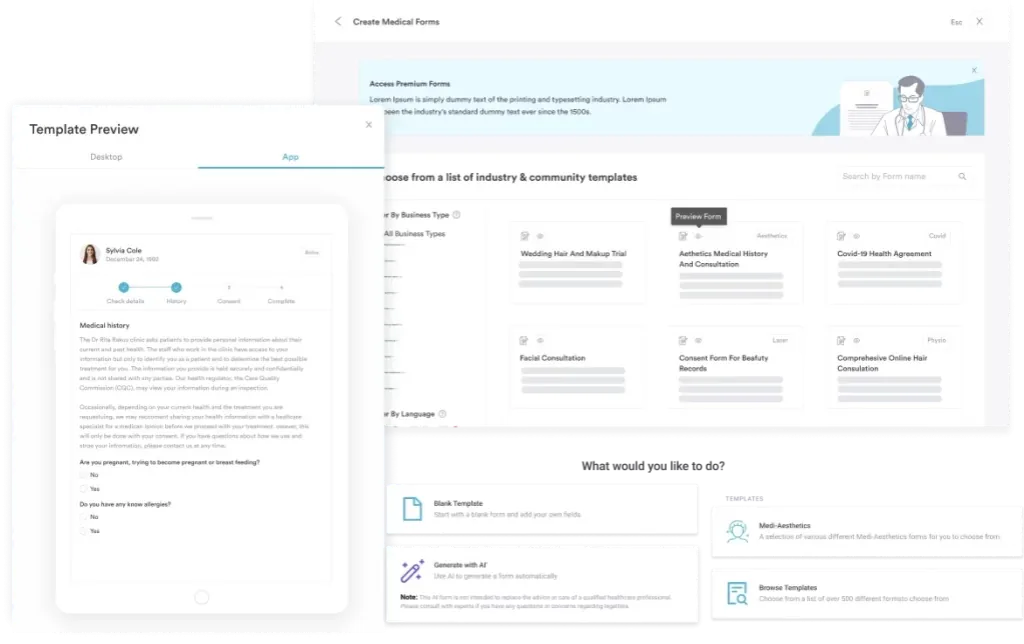
When the claim is built, Pabau’s wound care claims software pre-fills it from the record. You can search HCPCS and ICD-10 code libraries, and required fields such as authorization numbers are checked before submission. US claims then go out through Claim.MD, with eligibility checks and remittance posting built in.
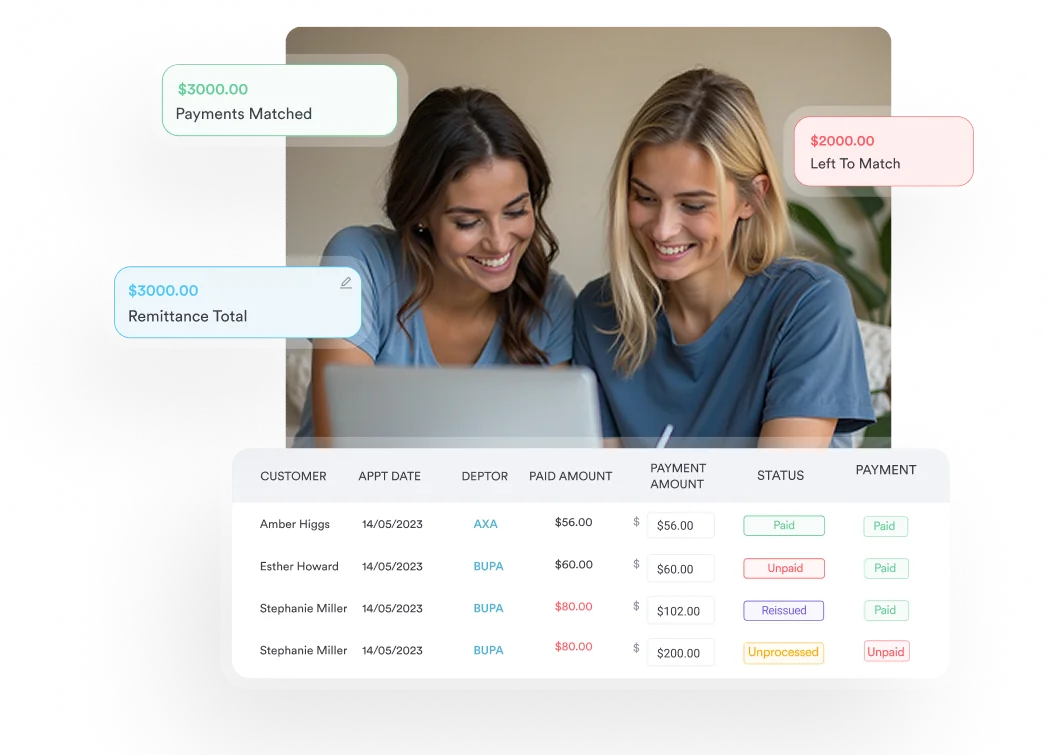
The outcome is fewer claims bounced for missing fields and less time rebuilding a claim from three sources. Pabau won’t choose your diagnosis code for you. Instead, it makes a skipped step easy to spot.

Pabau pre-fills wound care claims from the patient record and checks required fields before submission. Measurement forms sit beside the claim, so billers aren’t chasing notes.

Q4176 rewards practices that treat wound measurement as a billing step as well as a clinical one. With Medicare paying a flat rate per square centimeter in 2026, each unit on the claim now carries a fixed dollar value.
So build the ruler, the product name, and the covered diagnosis into the visit itself. Then the biller’s job becomes a quick check. Leave those details for someone to piece together later, and each audit turns into an argument you’re unlikely to win.
Book a demo to see how Pabau keeps wound measurements, product details, and Q4176 claims in one record for your practice.

Billing the application alongside the product? CPT code 15271 covers the skin substitute graft code that sits on the same claim as Q4176.
Coding a neighboring skin substitute? HCPCS code Q4150 walks through AlloWrap DS billing, the fee schedule, and ICD-10 pairing.
Want prior authorization sorted before the visit? Insurance eligibility verification explains what to confirm with each payer before treatment starts.
Working a pile of skin substitute denials? Denial management in healthcare sets out a workflow for tracking, appealing, and preventing claim rejections.
Preparing for a MAC audit? Medical billing compliance outlines the documentation standards that protect practices during payer reviews.
No. Q4176 bills the Neopatch or Therion product itself, while CPT 15271–15278 bill the clinician’s work applying it. Both go on the same claim. The CPT code you choose depends on the wound’s location and size.
Physician offices bill Q4176 on the CMS-1500 form or its electronic 837P version. Hospital outpatient departments use the UB-04, or 837I, under facility billing rules. In both cases, the units field carries the square centimeters applied.
Yes. Units reflect the area on the day of service, so a healing wound bills fewer units at each visit. Record fresh measurements in every note, because auditors compare each claim line with that day’s dimensions.
Yes. Q4176 is active, and its 2026 descriptor labels it as an add-on to the primary application procedure. CMS updates HCPCS codes every quarter, so check the latest release before you bill a new episode of care.




