CCSD code H4180: Full or partial thickness rectal biopsy
CCSD code H4180: definition and procedure scope The CCSD schedule lists H4180 as...

Last Updated: Oct 22, 2026
M0075 is the HCPCS Level II code for cellular therapy, a service Medicare does not cover under National Coverage Determination (NCD) 30.8.
It sits in the M0075-M0301 range of miscellaneous medical services. Prolotherapy has its own code, M0076, while PRP injections and stem cell transplants are billed with CPT codes. CMS rates cellular therapy as not reasonable and necessary. A Medicare patient must therefore sign an Advance Beneficiary Notice (ABN) before treatment if the practice plans to bill them.
Let Pabau's smart automation suggest the right codes, reduce claim denials, and keep your practice compliant—effortlessly.
Automate repetitive tasks and focus on what matters most—your patients.
Reduce coding errors and ensure compliance with the latest regulations.
Clean claims, fewer denials, and faster reimbursements.
Powerful insights and reporting to help your practice thrive.
HIPAA compliant SOC 2 certified GDPR-compliant Trusted by 4,000+ clinics worldwide

HCPCS code M0075 reports cellular therapy, while prolotherapy uses M0076 and PRP injections and stem cell transplants use their own CPT codes.
Medicare doesn’t cover M0075, because National Coverage Determination (NCD) 30.8 finds cellular therapy not reasonable and necessary.
A Medicare patient must sign an ABN (CMS-R-131) before treatment, or the practice can’t bill them for the denied service.
On Medicare claims, append modifier GA when a signed ABN is on file and GZ when none was issued.
Pabau, our practice management platform, stores each signed ABN on the patient record and checks every claim before it’s submitted.
HCPCS code M0075 is a Level II HCPCS code with the official Centers for Medicare & Medicaid Services (CMS) descriptor Cellular therapy. It sits in the M0075-M0301 range of miscellaneous medical services, alongside M0076 for prolotherapy. Our HCPCS code library lists the neighboring codes in that range.
The code describes administering cell-based treatments meant to repair, replace or regenerate tissue. That includes autologous preparations, made from the patient’s own tissue, and allogeneic preparations from a donor. PRP injections follow their own coding pathway, and prolotherapy is reported with M0076.
According to the CMS HCPCS program overview, CMS maintains and updates the Level II code set, and codes can be revised or deleted. Check M0075 against the current CMS HCPCS release file before each billing year.
The descriptor “cellular therapy” is broad, so coders often stretch it over neighboring regenerative procedures. Check the treatment against both lists below before you choose the code.
Services captured under M0075:
Services excluded from M0075:
If the chart describes a PRP procedure but the claim carries M0075, the payer will deny it because the code and the documentation disagree. An allogeneic stem cell transplant for a blood cancer, for example, is reported with 38240. Compare the clinical note with the code descriptor before every submission.
Complete documentation is the main defense against M0075 denials and audits. Because cellular therapy sits outside standard coding categories, the record has to justify the service, the cell source and the clinical rationale.
The medical record for an M0075 encounter should contain all of the following:
Keep these six records together, because an appeal draws on all of them at once. With error-checking claims management software, the claim, the treatment note and the signed ABN sit on one patient record. An appeal then starts with the evidence already attached.
No. Medicare doesn’t cover HCPCS code M0075, so no Medicare payment is made whatever diagnosis code sits on the claim.
The basis is National Coverage Determination (NCD) 30.8, Cellular Therapy, which applies across every Medicare Administrative Contractor (MAC). It describes cellular therapy as injecting foreign proteins, such as placenta or lung tissue from unborn lambs.
CMS found no scientific evidence that it works and considers it potentially dangerous. The service is therefore not reasonable and necessary under section 1862(a)(1) of the Social Security Act.
That reason shapes the whole billing workflow. A denial for not being reasonable and necessary is exactly the case the ABN exists for, and it decides which modifier goes on the claim. The patient pays the full cost, but only when the practice obtained a signed ABN before treatment.
An Advance Beneficiary Notice is required whenever Medicare is expected to deny a service as not reasonable and necessary. M0075 is one of those services.
Without an ABN signed before the service, the practice can’t bill the patient and absorbs the cost. CMS sets out the rules in its guide to advance written notices.
The ABN process for M0075 follows these steps:
A signed ABN doesn’t guarantee the patient will pay. It’s the legal prerequisite that lets the practice collect at all. Our Medicare waiver template walks through each section of the form.
Commercial insurers and self-pay patients are the main revenue pathway for M0075. Private plans aren’t bound by NCD 30.8, though coverage varies widely from plan to plan. The diagram below maps who pays on each route.
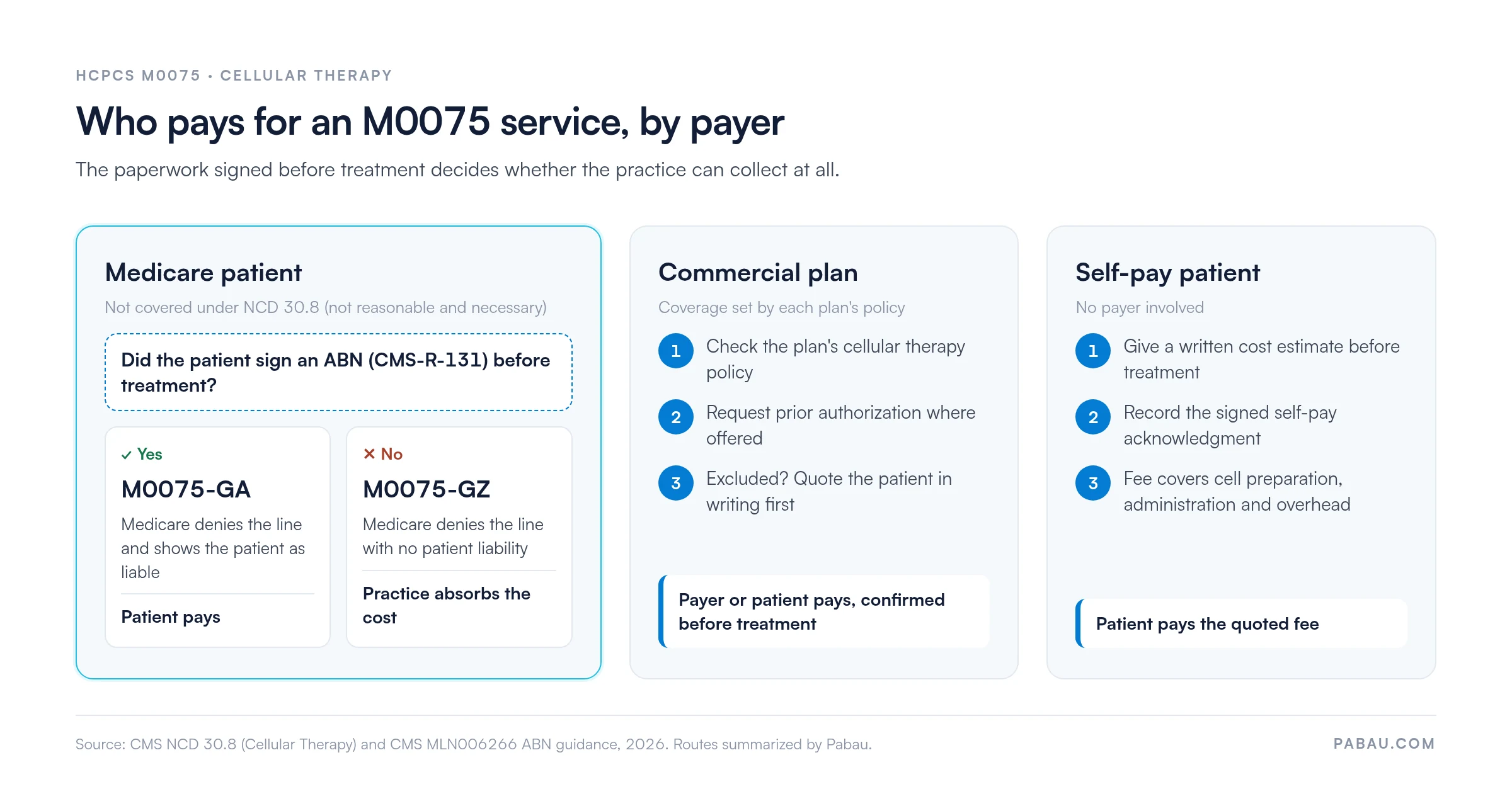
Commercial payer billing: each insurer sets its own cellular therapy policy. Before treatment, run an eligibility check and, where the plan offers one, a prior authorization request. Some plans cover specific cell-based therapies for a covered diagnosis, while others exclude M0075 by contract. Billing without confirming coverage carries the same denial risk as a Medicare claim with no ABN.
Self-pay patients: set a clear fee schedule and give a written cost estimate before treatment. Base the fee on the cell preparation, the administration time, and any facility or supply costs. Record the patient’s written acknowledgment of the self-pay arrangement in the chart.
State law adds another layer. Some states impose extra licensing or oversight requirements on cellular therapy providers, which can affect billing eligibility and the records the practice must keep.
M0075 and M0076 are adjacent HCPCS M-codes that coders often confuse, because both describe non-standard regenerative or injection procedures. Clinically they are distinct, and choosing the wrong one is an easy audit flag. Our guide to M0076 covers prolotherapy billing in full.
The therapeutic agent decides it. If the treatment injects a solution to stimulate connective tissue healing, use M0076. If it delivers live or processed cells as the main therapeutic material, use M0075. When one encounter includes both, document each separately and bill each code with its own clinical rationale.
M0075 may share a claim with other HCPCS or CPT codes when the encounter includes other billable services. Knowing which codes can go together, and which modifiers apply to M0075, prevents bundling errors and avoidable denials.
Three modifiers decide how Medicare processes an M0075 claim, and checking them is a routine audit step.
When the patient picks Option 1 on the ABN, submit M0075 to Medicare with modifier GA, even though you expect a denial. The denial confirms the patient’s liability, so you can bill them for the full service amount. A missing or wrong modifier can make the claim process incorrectly and lead to billing disputes.
Medicare pays nothing for HCPCS code M0075. Because the service isn’t covered, no payment is issued under the Physician Fee Schedule (PFS). The CMS Physician Fee Schedule lookup tool returns no payment amount for M0075, which reflects its non-covered status.
Commercial reimbursement varies by contract and plan. Check each payer’s fee schedule or contracted rate before quoting the patient. For self-pay patients, set the fee from the cell preparation cost, administration time and facility overhead. No Medicare or commercial benchmark exists for this code.
Confirm M0075’s current status on the AAPC HCPCS code lookup at the start of each billing year. CMS releases HCPCS Level II updates through the year, so M-codes can change on a different schedule from CPT codes.
M0075 claims fail in predictable ways, and most trace back to the non-covered status and the paperwork it demands. Knowing the denial reason in advance is the fastest way to prevent it.
Tag each denied M0075 claim by reason and track its appeal deadline, so resubmissions keep their audit trail. Our guide to denial management workflows sets out a process that holds up at high volumes of non-covered claims.
Cellular therapy billing draws more scrutiny than most outpatient services. Non-standard coding, investigational treatments and non-covered claims together create several audit triggers that practices need to manage early.
Regulators already watch this field closely, and the FDA has sent warning letters to clinics marketing unapproved stem cell products. A practice that bills Medicare without valid ABNs or the right modifier invites claim review on top of that. When an auditor opens the file, the medical record and a consistent ABN process separate an honest coding error from a pattern that looks deliberate.
Three habits cut M0075 audit exposure:
For a wider checklist, our medical billing compliance guide covers the policies and audit trail a non-covered billing program needs.
Billing M0075 by hand usually means a paper ABN, a self-pay quote sent by email, and denials tracked in a spreadsheet. Every encounter then depends on someone remembering all three steps.
Pabau keeps them in one place. The ABN goes out as a digital form before the appointment, and the signed copy is stored on the patient record. The claim is raised from the patient’s invoice, and claim validation checks it for missing or invalid details before it reaches your clearinghouse.
If a claim still comes back rejected, Pabau flags it as needing action and shows the reason. Your billing team fixes the modifier or the note and resubmits, so fewer services you’ve already delivered end up written off.

Pabau stores signed ABNs on the patient record and checks every claim before submission. Codes like M0075 go out with the right modifier and the paperwork behind them.

Treat every Medicare M0075 encounter as a planned denial. Payment depends on the ABN signed before treatment, the GA modifier, and a record that explains the cell source and dose.
Get those three right at scheduling, and the patient pays a known price while the claim denies cleanly. Miss one, and the practice absorbs the cost of a service it already delivered. For commercial and self-pay patients, a written estimate before treatment does the same protective job.
If cellular therapy is a growing service line, fold these steps into your revenue cycle management process. Book a demo to see how Pabau tracks ABNs and flags rejected claims for practices billing non-covered services.

Want the bigger Medicare picture? Medicare billing explains how claims, coverage rules and patient liability fit together.
Decoding a denied claim? Denial codes in medical billing lists the common reason codes and what to do about each one.
HCPCS code M0075 covers cellular therapy services, meaning autologous or allogeneic cell-based treatments that no more specific CPT or HCPCS code describes. It does not cover PRP injections, prolotherapy (M0076), or stem cell infusions coded under the CPT 38240 range.
No. Medicare doesn’t cover HCPCS code M0075. National Coverage Determination 30.8 finds cellular therapy not reasonable and necessary, and that applies across every Medicare Administrative Contractor. Practices submit M0075 with modifier GA and a signed ABN on file so they can bill the patient directly.
M0075 is the HCPCS code for cellular therapy, where the primary therapeutic agent is live or processed cells. M0076 is the code for prolotherapy, which injects irritant solutions such as dextrose into ligaments or tendons to stimulate healing. The two codes describe different mechanisms and shouldn’t be swapped, even when the clinical setting is similar.
Yes. An ABN (CMS-R-131) is required before delivering any M0075 cellular therapy service to a Medicare beneficiary. It must carry a cost estimate, be signed by the patient before the service, and be kept in the medical record. Without a valid ABN, the practice can’t collect from the patient for the non-covered service.
On Medicare claims, M0075 takes modifier GA when a signed ABN is on file and GZ when no ABN was issued. Modifier 52 may apply when a reduced service is delivered. Use it only with documentation supporting the reduction, after checking your MAC’s modifier policy.
Medicare’s reimbursement rate for M0075 is zero because the code is non-covered. Commercial payer rates vary by contract, so verify coverage and contracted rates with each payer before billing. For self-pay patients, fees are usually based on cell preparation cost, administration time and overhead.