

CCSD code G5100: Bypass of duodenum billing guide
CCSD code G5100 bills a bypass that leaves the duodenum in place CCSD code G5100...

Last Updated: Oct 16, 2026
K0836 is the HCPCS Level II code for a power wheelchair, group 2 standard, single power option, with a captains chair. The patient weight capacity is up to and including 300 pounds.
Let Pabau's smart automation suggest the right codes, reduce claim denials, and keep your practice compliant—effortlessly.
Automate repetitive tasks and focus on what matters most—your patients.
Reduce coding errors and ensure compliance with the latest regulations.
Clean claims, fewer denials, and faster reimbursements.
Powerful insights and reporting to help your practice thrive.
HIPAA compliant SOC 2 certified GDPR-compliant Trusted by 4,000+ clinics worldwide

HCPCS Code K0836 describes a power wheelchair, group 2 standard, single power option, captains chair under the DMEPOS benefit.
Prior authorization under the CMS PA program is mandatory before delivery, and a claim without an approved PA is denied.
A face-to-face examination within 45 days and a completed CMN are required documentation before billing.
Pabau’s claims management software runs validation checks before a claim is sent, so missing details surface early.
HCPCS Code K0836 is a Level II HCPCS code for a power wheelchair, group 2 standard, single power option, with a captains chair seating system. DME suppliers bill it under the Medicare Part B durable medical equipment benefit.
Claim systems show the short description “Pwc gp2 std sing pow opt cap.” The code sits within the K0813-K0899 power mobility device series, maintained by the Centers for Medicare and Medicaid Services (CMS).
Group 2 power wheelchairs are mid-range powered mobility devices. They suit patients who cannot propel a manual chair but retain the upper extremity function to operate a standard joystick. Within the group 2 classification, codes split by power option count (single vs. multiple) and seating type (captain’s chair vs. rehab seat). K0836 specifically combines a single power option with a captains chair, which is a basic contoured seat without full complex rehab seating. Understanding that distinction is critical: a patient who needs power tilt, recline, or elevating leg rests moves into a higher group and a different K-code.
The “single power option” designation means the chair includes one powered function beyond basic drive. That is typically a power seat or an adjustable footrest, not multiple stacked powered accessories. Billing K0836 for a chair with multiple powered options is a coding error that auditors flag routinely.
Medicare Part B covers K0836 under the DME benefit when the chair is medically necessary for use in the beneficiary’s home. Coverage requires that the patient cannot walk or self-propel a manual wheelchair in the home, and that the home environment can accommodate a power wheelchair. CMS frames this as the “in-the-home” use standard: a chair is covered for home use, not general community mobility.
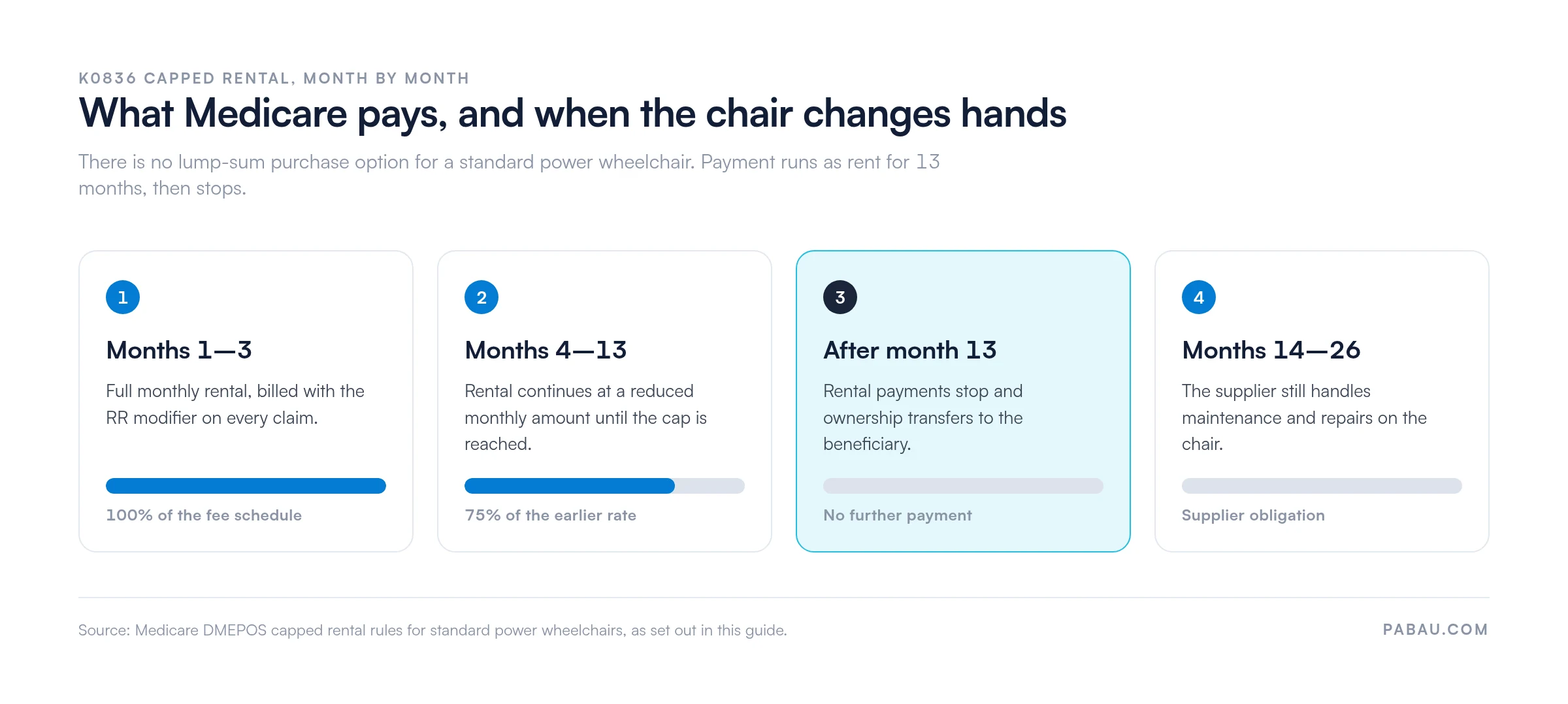
K0836 is billed under the capped rental payment model. Under this model, Medicare makes monthly rental payments for up to 13 months. After month 13, ownership transfers to the beneficiary and no further rental payments are made. The DME supplier remains responsible for maintenance and repairs for the following 13 months after the ownership transfer. Knowing this timeline matters because billing beyond the capped rental period without a legitimate replacement order triggers overpayment flags. The timeline below tracks what Medicare pays across each stretch of the 13-month clock.
Verify the beneficiary’s home address matches the address used for the in-the-home determination before submitting. Claims where the delivery address is a nursing facility or assisted living residence are not covered under the Part B DME benefit for power wheelchairs.
Prior authorization is mandatory for K0836 under the CMS Prior Authorization Program for certain DMEPOS items. Group 2 power wheelchairs are included on the list of items requiring prior approval before delivery. Submitting a claim without an approved PA decision results in an automatic denial with no appeal pathway for the missing PA itself. Confirm PA program applicability with the MAC serving the beneficiary before the order is placed.
Complete documentation must be assembled before delivery, not after. CMS audits regularly cite missing or incomplete documentation as the leading cause of K0836 claim reversals. Store all documentation in a HIPAA-compliant record system with audit timestamps, so records are retrievable on demand. A superbill alone does not satisfy the documentation requirements for power mobility devices.
Medical necessity for K0836 is governed by LCD L33789 (Power Mobility Devices), which applies across all four DMEPOS MAC jurisdictions. The beneficiary must demonstrate three things:
The physician’s CMN attestation must reflect findings from the face-to-face examination, not just a diagnosis code alone.
The following ICD-10 diagnosis codes are commonly paired with K0836 claims under LCD L33789. Note that listed codes may support medical necessity but coverage depends on the full clinical picture and MAC determination. Check the current version of the LCD for the complete covered diagnosis list before billing. Each one belongs to the wider ICD-10-CM code set, where the full descriptor and any sequencing notes live.
Medicare reimburses K0836 under the DMEPOS fee schedule, with rates varying by MAC jurisdiction and urban/rural geographic adjustment. The 2026 fee schedule reflects CMS’s annual update to the DME payment amounts. Because rates differ by region, the figures below are approximate national benchmark ranges. Verify current amounts through the CMS DMEPOS fee schedule or your billing MAC’s published schedule. The beneficiary pays 20% coinsurance after the Part B deductible; Medicare covers the remaining 80%.
Applicable billing modifiers significantly affect claim adjudication. Use the correct modifier on every K0836 claim, or expect a denial.
Selecting the wrong code within the group 2 series is one of the most common billing errors for power wheelchairs. Use the comparison table below to confirm the correct code before billing.
OIG audit reports and MAC post-payment reviews consistently identify the same patterns of K0836 billing errors. Each error below represents a real denial or overpayment finding. Medical billing compliance for power wheelchairs requires active monitoring, not just a checklist at the time of order. Track every outstanding PA decision against its delivery date, so a chair never ships ahead of its approval.
DME billing teams usually work across several systems. The order and the examination notes sit in the patient record. The PA decision sits in a payer portal, and the claim gets keyed somewhere else again. Each re-entry is another chance to drop a detail the payer needs.
Pabau, practice management software for private practices, keeps the patient record and the claim in the same place. Insurer and policy details live on the patient record, so every invoice routes to the correct payer without re-keying.
In the US, Pabau connects to Claim.MD. You can submit electronically, run real-time eligibility checks, track each claim’s status, and post ERA remittances from one claim dashboard. Validation checks run before a claim is sent, and flag missing details such as membership numbers and authorization codes.
For a K0836 rental billed monthly across 13 months, that consistency matters. The same insurer details and the same documentation trail feed every one of those claims, instead of being rebuilt each month.

Pabau runs validation checks before a claim is sent, and connects to Claim.MD for electronic submission, eligibility checks, and status tracking. See how that fits a DME billing workflow.

K0836 denials rarely turn on the code itself. They turn on timing. The prior authorization goes in after delivery, the examination falls outside the 45-day window, or the RR modifier never makes it onto the rental claim.
Work the order sequence backwards from the delivery date and most of that risk disappears. Confirm the PA decision, check the documentation set against LCD L33789, then release the chair. A rental that bills cleanly in month one usually bills cleanly for the next twelve.
The chair itself is the easy part. What decides payment is whether the file behind it was complete on the day it shipped. Book a demo to see how Pabau keeps patient records, documentation, and payer submissions in one workflow.

Need to understand how claim denials are categorised? Denial codes in medical billing covers the most common reason codes DME suppliers encounter after K0836 claim adjudication.
Want a plain-language breakdown of the billing cycle? What is medical billing walks through every stage from order to payment, with DME-specific context.
Submitting electronic claims and unsure about ERA workflows? Electronic remittance advice explains how to read ERA files and reconcile K0836 rental payments against fee schedule amounts.
HCPCS Code K0836 bills a power wheelchair, group 2 standard, single power option, captains chair, under the Medicare Part B DME benefit. DME suppliers use it when delivering this specific power mobility device configuration to a Medicare beneficiary with documented medical necessity for in-home use.
Yes, K0836 requires prior authorization under the CMS Prior Authorization Program for certain DMEPOS items before the wheelchair is delivered. Claims submitted without an approved PA decision are denied without a pathway to appeal the missing authorization.
K0836 is billed under the capped rental payment model. Medicare makes monthly rental payments for up to 13 months, after which ownership transfers to the beneficiary. Verify current rental rules with your billing MAC, as policy details are subject to CMS updates.
K0836 is processed by the four regional DMEPOS MACs (Jurisdictions A, B, C, and D). Each MAC may have jurisdiction-specific fee schedule rates and PA requirements. Confirm applicable rates and policies with the MAC serving the beneficiary’s billing address.



