

CCSD code G5100: Bypass of duodenum billing guide
CCSD code G5100 bills a bypass that leaves the duodenum in place CCSD code G5100...

Last Updated: Oct 16, 2026
K0056 is the HCPCS Level II code for seat height less than 17" or equal to or greater than 21" for a high strength, lightweight, or ultralightweight wheelchair.
Let Pabau's smart automation suggest the right codes, reduce claim denials, and keep your practice compliant—effortlessly.
Automate repetitive tasks and focus on what matters most—your patients.
Reduce coding errors and ensure compliance with the latest regulations.
Clean claims, fewer denials, and faster reimbursements.
Powerful insights and reporting to help your practice thrive.
HIPAA compliant SOC 2 certified GDPR-compliant Trusted by 4,000+ clinics worldwide

HCPCS code K0056 covers seat heights below 17 inches or at or above 21 inches on high strength lightweight, lightweight, or ultralightweight wheelchairs.
A seat height from 17 through 20 inches is standard, so the base wheelchair is billed on its own.
Every K0056 claim needs a physician order, a face-to-face evaluation, and a certificate of medical necessity. Missing any one triggers denial.
Practice management software like Pabau submits CMS-1500 claims, runs real-time eligibility checks, and posts ERA remittances across the K0056 claim cycle.
HCPCS code K0056 describes a seat height that is less than 17 inches, or equal to or greater than 21 inches. Suppliers bill it as an option or accessory for a high strength lightweight or ultralightweight wheelchair. The code belongs to the HCPCS Level II K-series. CMS maintains that coding system for durable medical equipment, prosthetics, orthotics, and supplies. K-series codes specifically cover wheelchairs and related accessories billed outside the standard CPT framework.
The classification sits under wheelchair options and accessories, meaning it is not billed for the wheelchair base itself. K0056 is an add-on billing item that accounts for the additional cost of manufacturing or modifying a chair to accommodate a non-standard seat height. Suppliers bill this alongside the base wheelchair code, not as a standalone item.
The seat height criteria for HCPCS code K0056 are strict. Two distinct thresholds qualify: a seat height strictly below 17 inches, or a seat height at or above 21 inches. Heights from 17 to 20 inches do not fall under this code. Billing K0056 for a chair in that range results in denial. Measure seat height from the floor to the top of the seat cushion, excluding any tilt or recline positioning.
Only the three wheelchair weight classes listed above qualify. Standard wheelchairs (K0001), heavy duty chairs (K0006 and K0007), and power bases do not pair with K0056. Verify the base wheelchair code before billing the accessory, because DME MACs flag mismatched combinations automatically. The chart below puts both tests side by side.
The standard hemi base K0002 is excluded on the same grounds, because a low seat height does not make the chair eligible.
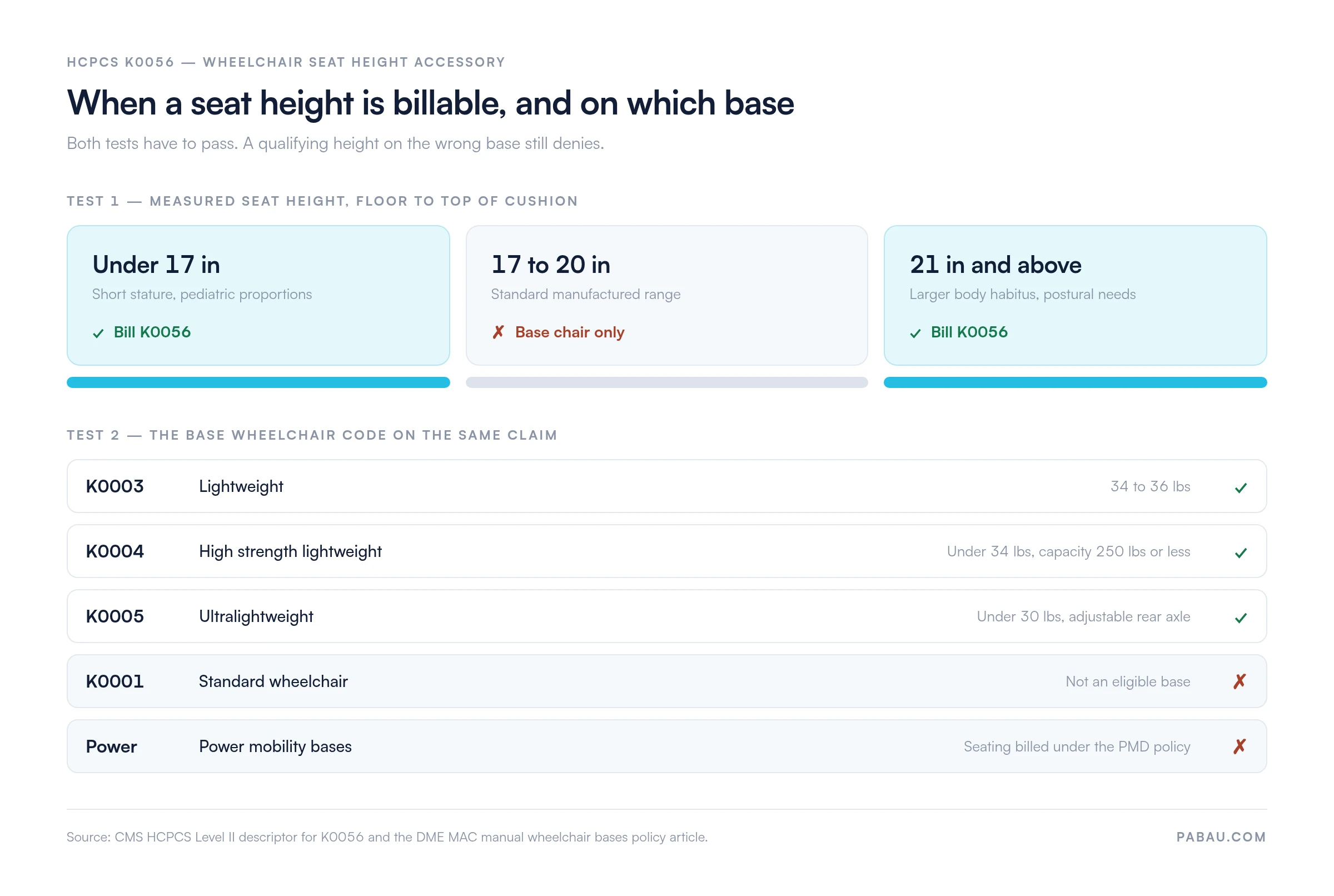
Medicare reimburses HCPCS code K0056 under the DME fee schedule, which the Centers for Medicare and Medicaid Services (CMS) updates annually. The reimbursement amount reflects the additional cost of a non-standard seat height modification rather than a full wheelchair. Rates vary by geographic locality, and the competitive bidding program status of the supplier’s region also affects the allowable amount.
Pull the current K0056 allowable from the CMS DMEPOS fee schedule rather than the Physician Fee Schedule. The Physician Fee Schedule carries no rates for wheelchair accessory codes, and looking there is a common reason suppliers quote the wrong allowable. Payment amounts differ by state and by whether the supplier operates in a competitive bidding area (CBA). Suppliers in CBAs receive the bid-determined rate instead of the standard fee schedule amount.
Billing HCPCS code K0056 under Medicare Part B follows the standard DME claims pathway. The supplier must be enrolled with the DME MAC that serves the patient’s home state. Claims submit on the CMS-1500 form (or 837P electronic transaction) to the appropriate DME MAC jurisdiction.
Track every K0056 claim through to remittance rather than stopping at submission. Payments are then reconciled against the fee schedule allowable for each jurisdiction served. Discrepancies between submitted and paid amounts often trace to incorrect locality codes or competitive bidding area misclassification.
Medicare requires medical necessity documentation for every HCPCS code K0056 claim. The DME MAC reviews documentation before payment and again through post-payment audits. Suppliers must therefore retain the records for a minimum of seven years. Sound medical billing compliance for DME starts with assembling that file before delivery.
Documentation requirements vary by DME MAC jurisdiction. Two contractors now run the four jurisdictions. Noridian runs Jurisdictions A and D, and CGS runs Jurisdictions B and C for the rest of the country. Palmetto GBA and National Government Services no longer hold DME MAC jurisdictions, so any four-contractor reference is out of date.
Each contractor publishes local coverage determinations naming the records that satisfy medical necessity for wheelchair accessories. Check the applicable LCD before you assemble the claim file. The same order can clear in one jurisdiction and fall short in another.
Request and retain the full face-to-face evaluation note, not just the CMN, before delivering the wheelchair. DME MAC post-payment audits increasingly focus on whether the clinical notes independently support the seat height specification without relying solely on the CMN form.
Every HCPCS code K0056 claim must pair with an ICD-10-CM diagnosis code establishing medical necessity for the wheelchair and its non-standard seat height. The diagnosis codes listed below are those most commonly accepted by DME MACs under wheelchair accessory LCDs. Confirm against the specific LCD governing your jurisdiction before billing, as accepted code lists can differ by region and update annually.
Pair the primary mobility-related diagnosis with any secondary condition that directly explains the non-standard seat height requirement. A standalone obesity code without a mobility impairment diagnosis, for example, typically does not independently support medical necessity for the wheelchair itself. Confirm accepted code combinations through the AAPC HCPCS code reference and the applicable DME MAC LCD crosswalk. Correct pairing also keeps a K0056 line away from the denial codes that follow a thin medical necessity file.
HCPCS code K0056 does not stand alone in the wheelchair accessories series. Billers coding wheelchair claims regularly work across multiple K-codes depending on the chair type, accessories ordered, and patient characteristics. The table below maps the most relevant codes adjacent to K0056 for quick cross-reference during claim preparation. Accurate code selection at this stage prevents the rework that mismatched base and accessory codes create downstream.
Watch for K0057 in older crosswalks and vendor code lists. That code described a seat width option for heavy duty chairs, and CMS terminated it on December 31, 2003. It is not a power wheelchair version of K0056, and it should never appear on a current claim. Confirm the base wheelchair code and whether the chair is manual or powered before you bill the seat height accessory at all.
Most HCPCS code K0056 denials trace back to a small set of causes, and each one is visible before the claim goes out. The table below pairs the trigger with the check that prevents it.
Denials in the first two rows are coding decisions, and they can be cleared inside the billing team. The rest depend on documents the prescriber controls, which is why suppliers who chase the order and the evaluation before delivery see fewer K0056 rejections.
A K0056 claim file comes together from several places at once. The physician order, the face-to-face evaluation, the CMN, and the delivery receipt each originate with a different party. Collecting them is still a manual job. Software shortens the stretch on either side of that work. It confirms coverage before delivery, sends the claim, and reads what comes back.
Pabau’s claims management software handles US claims through its Claim.MD integration. Claims are built from the data already on the patient record and submitted as CMS-1500 transactions. Real-time 270/271 eligibility checks confirm Medicare Part B coverage and the remaining deductible before the supplier commits to the order.
ERA remittance files post back into the same record, so denial codes on a K0056 line surface without a separate trip to a payer portal.
Be clear about where that stops. The integration submits and tracks claims. It does not attach the physician order, the evaluation note, or the CMN to the claim. An eligibility response reports the beneficiary’s coverage, not the supplier’s competitive bidding contract status. Those records still have to be gathered and retained on your side for the DME MAC audit that may follow.
Posted remittances are still worth reading as a set. When several K0056 lines come back with the same remittance adjustment reason code, the repeat points to one weak link in the claim file. It is usually the base code pairing, the recorded seat height, or a face-to-face note that never arrived. Each of those has a fix that carries over to the next order.
Run an eligibility check for DMEPOS benefits before ordering the custom chair, not just a general Medicare Part B check. Some beneficiaries have Medicare Advantage plans that process DME differently from traditional Medicare. Discovering that after delivery leaves you with a collection problem.

Pabau’s claims management tools submit CMS-1500 claims, run real-time eligibility checks, and post ERA remittances. Billing teams can see where a K0056 claim stands.

HCPCS code K0056 is a precision billing item. The seat height thresholds are exact, the eligible wheelchair types are specific, and the documentation requirements vary by DME MAC jurisdiction. A single missing document or incorrect base code pairing can trigger denial even when the equipment itself is medically appropriate.
Pabau submits CMS-1500 claims through its Claim.MD integration and checks eligibility in real time before delivery. Posted ERA remittances then put denial codes on a K0056 line in front of the billing team. The clinical file stays your responsibility, but the submission and follow-up stop being manual. To see how the platform handles HCPCS Level II claims end to end, book a demo.

Need to understand how the broader medical billing process works? What is medical billing walks through the end-to-end claims workflow from patient visit through payment posting.
Dealing with rejected K0056 claims? Denial codes in medical billing explains the most common HCPCS remittance adjustment codes and how to resolve them.
Want to strengthen your DMEPOS compliance posture? Medical billing compliance covers the documentation retention, audit response, and supplier enrollment requirements that govern DME claims.
HCPCS code K0056 is the Level II HCPCS code for a wheelchair seat height accessory. It covers seats measuring less than 17 inches, or 21 inches and above, on high strength, lightweight, or ultralightweight manual wheelchairs. It is billed as an add-on to the base wheelchair code when the patient requires a non-standard seat height outside the 17-to-20-inch standard range.
A seat height strictly below 17 inches or at or above 21 inches qualifies for HCPCS code K0056. Seat heights in the 17-to-20-inch range do not qualify under this code and require a different billing approach. Measure from the floor to the top of the seat cushion with the chair in its standard upright position.
HCPCS code K0056 applies to high strength lightweight, lightweight, and ultralightweight manual wheelchairs (base codes K0003, K0004, and K0005). It does not apply to standard wheelchairs (K0001) or power wheelchairs. A power wheelchair claim cannot carry K0056. Check the power mobility device LCD for the seating codes that apply to a power base.
No. HCPCS code K0056 is limited to manual high strength lightweight, lightweight, and ultralightweight bases. A power wheelchair claim carrying this code denies for a code-to-equipment mismatch. Some legacy crosswalks still list K0057 beside K0056 as a power chair equivalent. K0057 actually described a seat width option for heavy duty chairs, and CMS terminated it on December 31, 2003. Bill seating for a power base under the codes named in the power mobility device LCD.
Competitive bidding program status for HCPCS code K0056 can change with each CMS program update. Suppliers should verify current status directly through the CMS DMEPOS competitive bidding program tool for their specific geographic area before billing. In competitive bidding areas, only authorized contract suppliers may bill Medicare for affected product categories.



