

HCPCS code E0198: Water pressure pad billing guide
HCPCS code E0198 is a water pad for a standard mattress HCPCS code E0198 is the ...

Last Updated: Oct 13, 2026
K0010 is the HCPCS Level II code for standard - weight frame motorized/power wheelchair.
The descriptor was never withdrawn, though, so the code still turns up in HCPCS lookups, on the DMEPOS fee schedule, and in billing software drop-downs.
Below is what K0010 covered, what replaced it, why a rental amount is still published, and the one claim where the code still belongs.
Let Pabau's smart automation suggest the right codes, reduce claim denials, and keep your practice compliant—effortlessly.
Automate repetitive tasks and focus on what matters most—your patients.
Reduce coding errors and ensure compliance with the latest regulations.
Clean claims, fewer denials, and faster reimbursements.
Powerful insights and reporting to help your practice thrive.
HIPAA compliant SOC 2 certified GDPR-compliant Trusted by 4,000+ clinics worldwide

HCPCS code K0010 is a legacy code. CMS closed it to new power wheelchair claims for dates of service on or after October 1, 2006.
Transmittal 1037, issued as change request 5255, replaced it with group-based codes. K0800 to K0812 cover power-operated vehicles and K0813 to K0898 cover power wheelchairs.
The January 2026 DMEPOS fee schedule still lists a monthly rental amount for K0010, and no purchase amount at all.
K0010 does not appear in the covered code list of the Power Mobility Devices coverage determination, L33789.
Certificates of medical necessity ended for all DME dates of service on or after January 1, 2023. A face-to-face exam and a standard written order carry the claim instead.
Where the code still shows up legitimately, the claim is a repair on a beneficiary-owned chair that predates the 2006 cut-off.
K0010 is a HCPCS Level II code for a standard weight frame motorized or power wheelchair supplied as durable medical equipment. It was the workhorse code for a basic power base until the end of September 2006.
Since then it has functioned as a historical reference, and as the code attached to chairs dispensed before the cut-off.
The descriptors never changed, and that is part of the trouble. A code lookup returns a plausible power wheelchair description with no sign that the code was closed to new claims two decades ago.
K0010 belongs to the wheelchair and mobility K-codes that begin at K0001 in the HCPCS Level II file. Three of its neighbors closed on the same day, and they were K0011, K0012, and K0014.
The change arrived in a routine quarterly fee schedule update, which is why so few billers noticed it. Transmittal 1037, issued as change request 5255 on August 25, 2006, added the group-based power mobility codes and closed K0010 to new business.
That wording is narrow, and easy to misread. The transmittal named four codes: K0010, K0011, K0012, and K0014. From October 1, 2006 forward, a claim for any of them is rejected if it is for purchase or initial rental.
Rental was the only exception, and only for equipment already out with a beneficiary. A rental that began before October 1, 2006 could keep billing under K0010 until the 13-month capped rental period ran out. That window closed during 2007 and 2008, and no update has reopened it since.
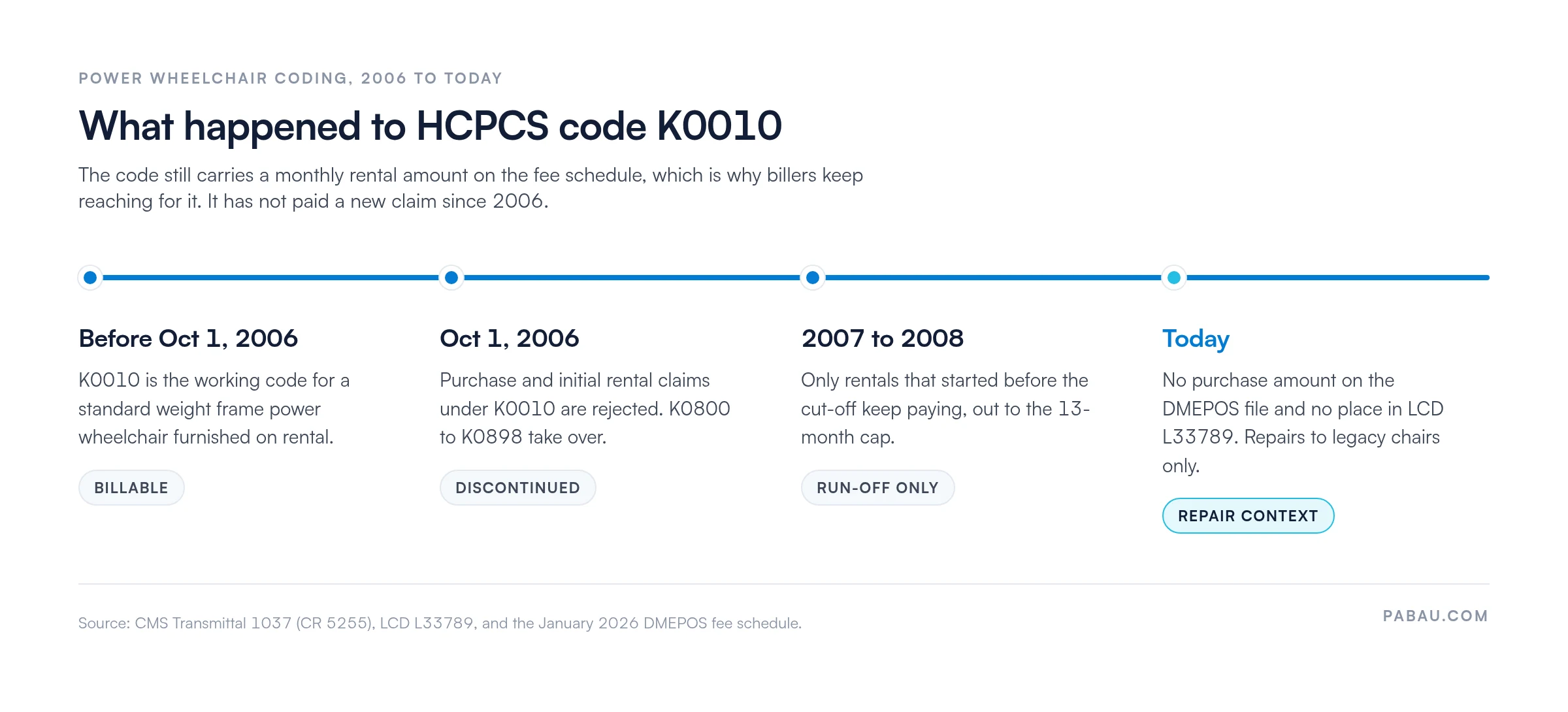
Current coverage policy confirms the position. The Power Mobility Devices coverage determination, L33789, lists the codes a power mobility claim can use. That list runs from K0800 through K0898 and includes K0013 for a custom base. K0010 is absent from it.
So four broad wheelchair codes gave way to roughly 60 specific ones. The replacements sort equipment by device group, weight capacity, seat and back type, and power options. Now the code carries most of the equipment detail that used to sit only in the medical record.
CMS did not publish a one-to-one crosswalk from the old codes. The ranges below are the current structure, so the correct code depends on the chair actually delivered.
Most former K0010 equipment now lands in the Group 1 or Group 2 standard range. Our guide to HCPCS code K0813 walks through the Group 1 standard chair. It covers the capped rental math and the KX modifier that every claim needs.
K0010 has a live line on the DMEPOS fee schedule, and that line is the single biggest reason billers treat the code as current. A published amount is a pricing record, not a coverage decision.
The January 2026 DMEPOS fee schedule file lists K0010 exactly once, carrying modifier RR in the capped rental payment category. Monthly amounts range from $516.03 to $1,144.42 depending on the state. There is no NU or UE row anywhere in the file for the code.
The K0013 blank is worth reading correctly. That code is still active and still in the covered list. CMS prices a custom power wheelchair base case by case, rather than from a published amount. A missing fee row means individual pricing there, and a retired code here.
No documentation package makes a new K0010 claim payable. K0010 is not in the covered list, so no clinical record can qualify equipment under it.
The rules below decide a current claim instead, whether it covers a new chair or a repair.
A power mobility device base needs a standard written order, and the supplier must have it before the chair is delivered. Per the CMS standard documentation requirements, the order has to carry every element below.
A face-to-face examination by the treating practitioner supports that order. The resulting record has to establish the mobility limitation and show why a cane, a walker, or a manual chair will not resolve it.
Records created by other clinicians count as part of the medical record here, so a therapist’s mobility assessment carries weight.
Delete the certificate of medical necessity step from any wheelchair checklist that still carries it. CMS discontinued certificates of medical necessity and DME information forms for all claims with dates of service on or after January 1, 2023.
Attaching one now works against you. A claim submitted with either form after that date is rejected in full. CMS retired them because they duplicated information already sitting in the claim and the medical record.
One related error circulates widely enough to name. CMS form 484.03 is the oxygen certificate of medical necessity, not a wheelchair form, and it was never the paperwork for a power mobility claim. Any checklist that cites it for a wheelchair is wrong twice over.
Asking a DME MAC to authorize K0010 is a dead end. The code cannot be used for a purchase or an initial rental, so there is no dispensing to authorize.
CMS builds its required prior authorization list from active codes only. Group 3 complex rehab codes such as K0856 sit on it, and an affirmation has to be in hand before that chair is delivered.
K0010 is not part of that program at all. CMS lists prior authorization and a written order prior to delivery as not required for the code.
So treat a prior authorization instruction for K0010 as a sign the code is wrong. Work out which chair is going out the door, find its current K08xx code, then check that code against the required list.
There is a single situation where the code appears on a current claim legitimately. A beneficiary still owns a power wheelchair that was dispensed under K0010 before October 2006, and that chair needs work.
Ownership is what makes this possible. The 13-month capped rental period transferred title to the beneficiary years ago. Repairs to equipment a beneficiary owns are covered when they are needed to make the item serviceable. Routine periodic maintenance, meaning testing, cleaning, regulating, and checking, is not covered.
The repair does not bill through the base code’s rental fee. Labor goes on K0739 in 15-minute units, and each replacement component with its own HCPCS code goes on its own line with modifier RB.
Picture an hour of work replacing both drive motors on a 2005 chair. The labor goes out as four units of K0739. Each motor then sits on its own line with modifier RB, and the practitioner’s continued-need note stays in the record behind the claim.
Two records carry a repair claim, and neither of them is a new order. The treating practitioner documents that the chair itself is still reasonable and necessary. Either the practitioner or the supplier documents that the repair is reasonable and necessary.
Beyond that, the supplier keeps detailed records of the work. Those records name what failed, why each part was replaced, and the labor time needed to restore the chair.
Where the original qualifying paperwork is more than seven years old, proof of continued need can stand in its place. On a chair this age, that clause matters.
Medicare pays nothing extra for five categories of repair. A K0010 chair clears them all, because its rental period ended long ago.
If the chair is beyond repair, the conversation changes entirely. Any chair dispensed under K0010 is at least 20 years old, so its reasonable useful lifetime has long passed. The replacement is a new dispensing under a current code, with the full order, examination, and authorization workflow attached.
Search your item master for K0010, K0011, K0012, and K0014 before the next billing cycle. These codes usually survive because someone imported an old HCPCS file years ago and never retired the rows. Deactivating them at the source stops the rejection from recurring, which biller training on its own will not do.
Nearly every K0010 rejection traces to one root cause. Someone picked the code from a stale list instead of from the equipment in front of them. So map the symptom to that cause first, because it beats working a remittance line by line.
The appeal route itself has not changed. Redetermination goes to the DME MAC, reconsideration goes to a qualified independent contractor, and a hearing before an administrative law judge follows. Mapping each denial reason code back to its cause is what shortens that path.
Do not appeal a stale-code rejection, though. A rejected claim was never processed, so there is no determination to dispute. Correct the code and resubmit, and watch the filing limit, because the clock started at the date of service.
Rejections that stop at the clearinghouse are the ones that go missing, so pull that report before you close the month. HCPCS code S0104 often rejects at that stage when an S code reaches a Medicare claim file, since Medicare does not accept S codes.
Five quick reads catch almost every power mobility rejection in this family:
Retired codes rarely survive because a biller does not know the rule. They survive in the systems around the biller. The culprit is usually an item master imported years ago, a saved claim template, or an unpruned favorites list.
Practice management software like Pabau keeps the code set and the claim in one place. Pabau’s claims management software builds each claim from the patient record, so the code attached to the item delivered lands on the charge line. Searchable HCPCS and ICD-10 libraries sit inside the claim form, refreshed with each official code release.
Required fields also have to be complete before a claim will send, and submissions route to US, UK, and Australian payers from the same screen. Remittance data lands next to the original claim rather than in a separate pile. Rejections group by reason, so a run of stale-code returns reads as one fixable pattern.
For a supplier handling new dispensings alongside repairs on older equipment, that matters twice over. The written order, the labor units, the part lines, and the continued-need note all sit against the same patient record. An audit request becomes a lookup rather than a search.

Pabau builds each DME claim from the patient record, with current HCPCS and ICD-10 libraries a click away. It also tracks every rejection back to its cause, so a retired code like K0010 never reaches a payer twice.

K0010 is a reference code now, not a billing code. Every claim for a new chair belongs on a current K08xx code, and no documentation package changes that. Treat the rental amount still sitting on the fee schedule as a leftover from 2006.
Most of the useful work happens upstream of the claim. Retire the code inside your own systems, and bill the chair that was delivered. Treat any surviving K0010 chair as a repair question rather than a dispensing one.
Book a demo to see how Pabau builds a DME claim from the patient record and tracks every rejection back to its cause.

Need to understand how claims clearinghouses process DME submissions? Medical claims clearinghouse guide explains how electronic claim routing works between suppliers and payers.
Want to reduce claim rejections before they happen? Best medical billing software for US practices covers the platforms that support DME and specialty billing workflows.
Looking for guidance on handling 837P file structure? 837P electronic claim file guide walks through the transaction set required for electronic DME claim submission.
Check that state’s current fee schedule before you send anything. Programs update on their own cycles, and a few still carry retired HCPCS codes in their files. A listing is not a promise of payment. Where a state does recognize K0010, it is almost always for repair work on equipment the beneficiary already owns.
Most follow the current HCPCS file, so a group-based K08xx code is the safer submission. Some plans keep their own code lists, though, and a few lag behind CMS by a quarter or more. Ask the payer for its published list rather than testing it with a claim.
No. Modifiers describe how equipment was supplied, so none of them can revive a code that is closed to new business. RR points at a rental that ended years ago, and no purchase amount exists for NU or UE. Choose the code that matches the chair first.
Medicare allows one calendar year from the date of service, and a rejected claim does not pause that clock. So correct the code in the same week the rejection lands. On an older date of service, check the deadline before you rework the line, because a late claim fails on timing alone.



