HCPCS Code G0147: Screening cytopathology smear billing guide
HCPCS code G0147: Definition and key details HCPCS code G0147 is the laboratory ...

Last Updated: Oct 16, 2026
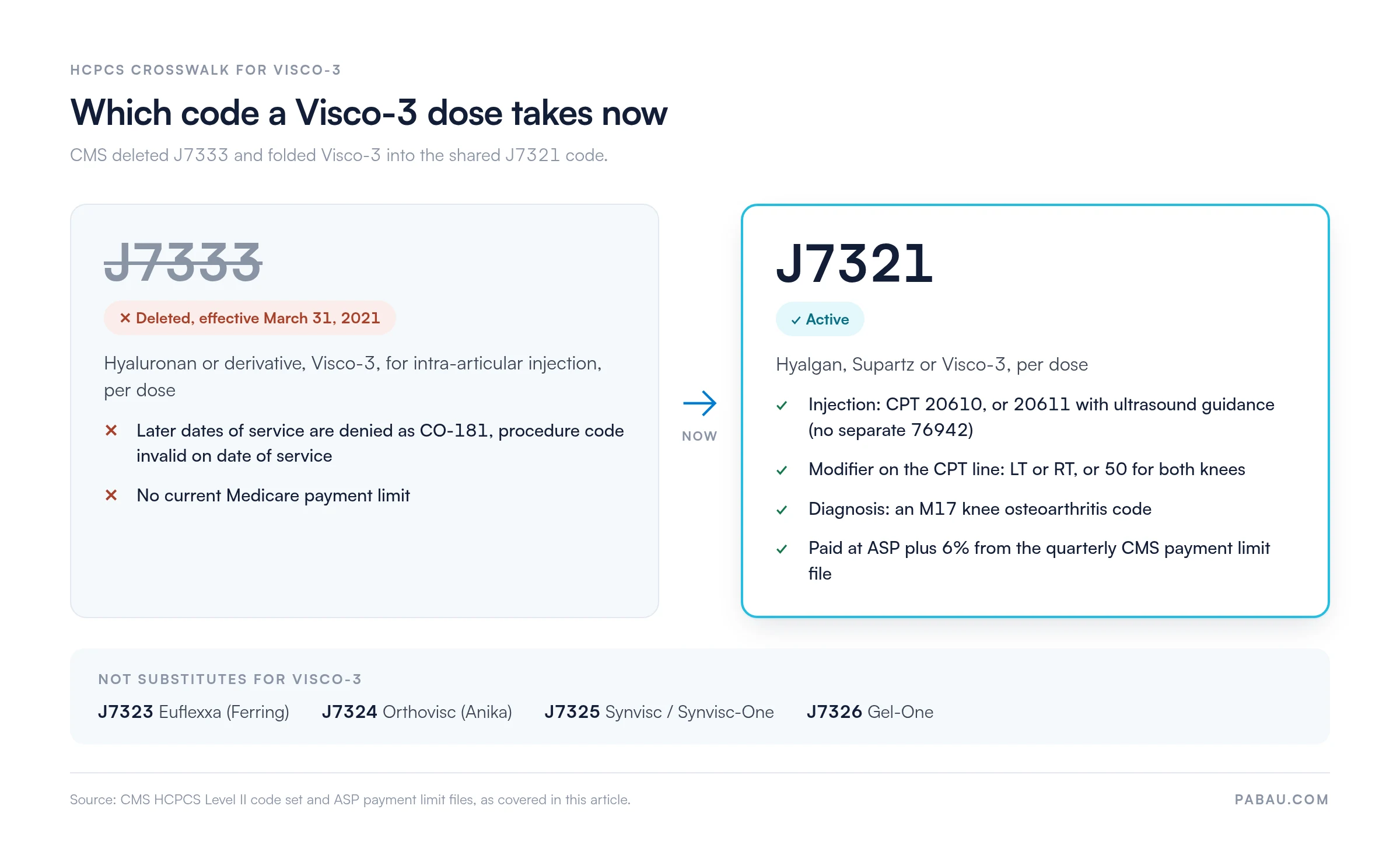
J7333 was the HCPCS Level II code for hyaluronan or derivative, Visco-3, for intra-articular injection, per dose. CMS deleted it effective March 31, 2021, so it is not valid for later dates of service.
Visco-3 is now billed under J7321, the shared code for Hyalgan, Supartz or Visco-3, per dose. Report it with CPT 20610 for the injection, or CPT 20611 when ultrasound guidance is used, plus an M17 knee osteoarthritis code.
Let Pabau's smart automation suggest the right codes, reduce claim denials, and keep your practice compliant—effortlessly.
Automate repetitive tasks and focus on what matters most—your patients.
Reduce coding errors and ensure compliance with the latest regulations.
Clean claims, fewer denials, and faster reimbursements.
Powerful insights and reporting to help your practice thrive.
HIPAA compliant SOC 2 certified GDPR-compliant Trusted by 4,000+ clinics worldwide

HCPCS Code J7333 was the per-dose code for Visco-3 hyaluronan injection, and CMS deleted it effective March 31, 2021.
Visco-3 is now billed under J7321, the shared code for Hyalgan, Supartz or Visco-3, per dose.
A claim that still carries J7333 for a later date of service is denied as CO-181 and must be corrected and resubmitted.
Report the injection with CPT 20610, or CPT 20611 when ultrasound guidance is used, plus LT or RT for a single knee.
Medicare coverage comes from each MAC’s local coverage determination rather than a national policy, so frequency limits vary by jurisdiction.
HCPCS Code J7333 is the deleted Level II drug code for hyaluronan or derivative, Visco-3, given by intra-articular injection and billed per dose. CMS retired it effective March 31, 2021, and Visco-3 doses are now billed under J7321.
J7333 sat at the end of the hyaluronan J-code family, which gives each viscosupplement brand, or group of brands, its own code. Visco-3 is a three-injection sodium hyaluronate series for knee osteoarthritis, made by Seikagaku and marketed by Dr. Reddy’s.
CMS deleted J7333 effective March 31, 2021, and folded Visco-3 into J7321. That code covers Hyalgan, Supartz or Visco-3, per dose, so one HCPCS number now spans three products. A claim that still carries J7333 for a later date of service fails the code-validity edit. Payers return it as CO-181, procedure code invalid on date of service.
What this means for charge masters: any system that stored J7333 as the Visco-3 billing code needs J7321 in its place. A charge master carrying a deleted code keeps producing invalid claims until someone corrects it. The deletion is recorded in the CMS HCPCS code files.
The date of service decides which code a Visco-3 dose takes, and the crosswalk below sets out what each code pairs with.
Viscosupplementation is the injection of hyaluronic acid, or a hyaluronan derivative, into a joint, most commonly the knee. It supplements the synovial fluid that osteoarthritis depletes. The rationale is mechanical: degraded synovial fluid loses its lubricating and shock-absorbing properties, and injected hyaluronan temporarily restores joint viscosity. Visco-3 was a three-injection series, with each dose administered weekly.
For coders, the clinical detail matters because payer policies tie coverage to the clinical scenario. Orthopedic and physical therapy practices billing viscosupplementation must document confirmed knee osteoarthritis and failed conservative treatment. The chart must also name the product injected. J7321 covers three brands, so the product name is what shows the code matches the dose.
The hyaluronan J-code family assigns each brand, or group of brands, its own HCPCS number. Billing the wrong code for the product administered is a common coding error in this category. Every code in the table below is active except J7333. Recheck the AAPC HCPCS code lookup after each quarterly CMS update, because new viscosupplement codes are added over time.
J7333 vs J7323 (Euflexxa): both describe three-injection series, which is why coders mix them up. Euflexxa is a Ferring product with its own active code, J7323. Visco-3 is an unrelated product, made by Seikagaku and marketed by Dr. Reddy’s, and it now bills under J7321. Submitting J7323 for a Visco-3 dose, or J7321 for Euflexxa, is a coding error.
J7321, the code that replaced J7333, covers the drug only. The injection is reported separately with CPT 20610 when no imaging guidance is used. For knee viscosupplementation, 20610 is the standard administration code.
Ultrasound-guided injections take CPT 20611 instead. Ultrasound guidance is built into that code, so 76942 is not billed separately with it. Laterality modifiers are required for unilateral knee injections, and omitting LT or RT on the CPT line is a common edit trigger. When both knees are injected on the same date, modifier 50 applies.
Bill one unit of J7321 per dose, per knee, per injection date, not one unit for the whole series.
Viscosupplementation claims must be supported by an ICD-10-CM diagnosis code that confirms knee osteoarthritis. The M17 category, osteoarthritis of knee, is the standard medical-necessity anchor. Payers cross-reference the diagnosis code against LCD criteria, so a non-specific or incorrect diagnosis code will trigger denial even when the procedure was clinically appropriate.
Confirm which M17 sub-codes are accepted under your MAC’s LCD before billing. Some MACs exclude secondary osteoarthritis codes or require primary osteoarthritis specifically. The diagnosis must appear in the medical record with supporting imaging (X-ray or MRI confirming joint space narrowing or cartilage loss).
Run an insurance eligibility verification before each injection in the series, not just before the first dose. Payer benefit limits for viscosupplementation often reset by calendar year. A patient who was covered in January may have used up the allowed series by the time the third injection is due. Catching a coverage lapse before the injection is far simpler than appealing a denial after the fact.
Medicare coverage for intra-articular hyaluronan injections is not governed by a national coverage determination (NCD). Instead, each Medicare Administrative Contractor (MAC) publishes its own Local Coverage Determination (LCD). This means coverage varies by geography. A practice billing in a Noridian MAC jurisdiction may face different frequency limits and documentation requirements than one billing under Novitas or CGS.
Confirm active LCD status and coverage criteria in the Medicare Coverage Database and on your MAC’s own website before billing. The insurance eligibility verification step must confirm both the patient’s active Part B enrollment and whether viscosupplementation is covered under the applicable LCD.
Medicare fee-for-service generally does not require prior authorization for viscosupplementation, but Medicare Advantage plans and most commercial payers do. Their criteria are broadly the same. Plans look for knee osteoarthritis confirmed on imaging and at least one failed conservative treatment, such as NSAIDs, physical therapy or a corticosteroid injection. They also need a physician attestation of medical necessity.
Each viscosupplementation chart note must support its claim on its own, without the reviewer pulling records from earlier visits. Good superbill documentation captures the elements below at the point of service.
Keep prior authorization records attached to the encounter as well. If a payer audits the claim months after service, the authorization number and approval must be retrievable at once.
Viscosupplementation denials fall into seven recurring patterns, listed below with their usual adjustment codes. The code on the remittance decides whether you correct and resubmit or file an appeal, which is the starting point for denial management.
For adjustment codes outside this table, the guide to medical billing denial codes covers the 20 most common CARCs and how to fix each one.
Medicare Part B pays for hyaluronan J-codes at average sales price (ASP) plus 6%, the standard rate for physician-administered drugs. CMS updates the ASP file quarterly, so the J7321 allowable can change four times a year. Practices billing viscosupplementation should refresh contracted and allowable rates each quarter rather than once a year.
J7333 has no current rate, because a deleted code carries no payment limit. Visco-3 is now paid at the J7321 rate. J7321 is a payment-limit-file code, so its Medicare allowable comes from the quarterly ASP pricing files rather than the physician fee schedule. Commercial rates are negotiated separately and usually differ from Medicare’s, so check the practice’s payer contracts.
Check the CMS ASP drug pricing file at the start of each quarter (January, April, July, October). A fee schedule updated once a year falls behind whenever ASP rises, and the shortfall repeats on every dose billed that quarter.
In many orthopedic and sports medicine practices, a viscosupplementation series runs on a charge master plus a spreadsheet of dose dates. A deleted code like J7333 can sit in that setup unnoticed, and each dose is another chance for a wrong code or a lapsed authorization.
Pabau, the practice management platform we build, raises each claim from the patient’s invoice. Its claims management software validates the claim before it goes to the clearinghouse. Prior authorization codes follow the appointment, so the second and third doses carry the same approval as the first.
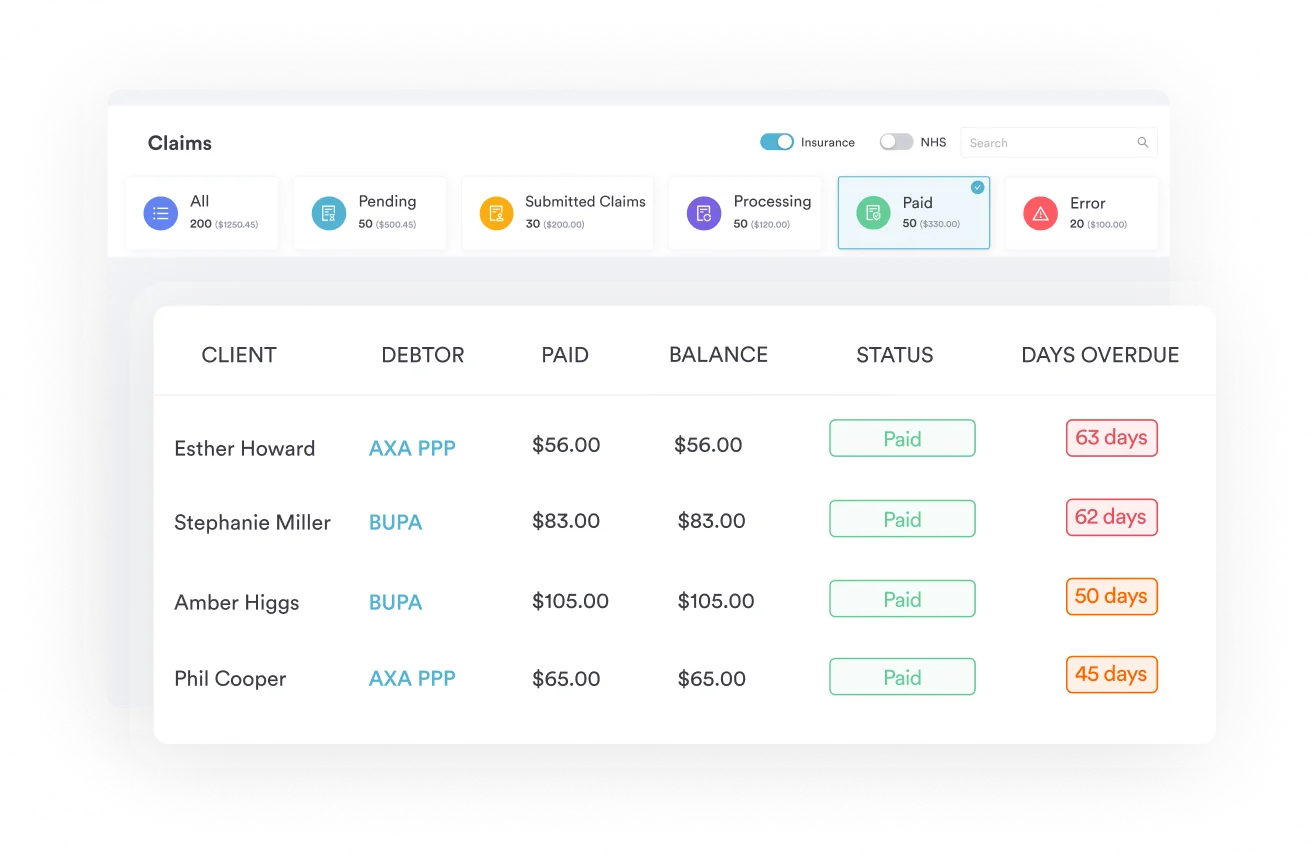
Eligibility checks run before the visit, and the claims dashboard shows each claim’s status and days overdue. The series gets billed under J7321 from the first dose, with the authorization and chart note stored in the same patient record.

Pabau’s claims management software validates each viscosupplementation claim before submission and keeps prior authorization codes with the appointment. Every dose in a series is billed against the same approval.

If your charge master, order sets or superbill templates still list J7333, replace it with J7321 now. Each Visco-3 claim sent under the deleted code comes back as a CO-181 denial and costs a full resubmission cycle.
The larger risk sits in the series rather than the code. Coverage, authorization and frequency limits apply dose by dose, so verify eligibility before each injection and record which dose each claim covers. A practice that does this collects on the third dose as reliably as on the first.
Book a demo to see how Pabau tracks a viscosupplementation series from authorization to the final paid dose.

Billing Orthovisc instead of Visco-3? HCPCS code J7324 covers Orthovisc billing, units and reimbursement.
Treating a patient with Euflexxa? HCPCS code J7323 explains Euflexxa billing, coverage and modifiers.
Injecting both knees on the same day? ICD-10 code M17.0 covers bilateral primary osteoarthritis of knee.
Getting frequent claim rejections across your injection billing? Denial codes in medical billing maps the top 20 CARC codes to the errors that trigger them, with a fix for each.
Need prior authorization for a UnitedHealthcare patient? UnitedHealthcare prior authorization form walks providers through completing and submitting the request.
HCPCS Code J7333 was the code for hyaluronan or derivative, Visco-3, for intra-articular injection, per dose. It reported Visco-3 viscosupplementation for knee osteoarthritis. CMS deleted it effective March 31, 2021, and Visco-3 is now billed under J7321.
Yes. CMS deleted J7333 effective March 31, 2021. A claim that uses J7333 for a later date of service is denied as CO-181, procedure code invalid on date of service.
J7321 replaced J7333 for Visco-3. J7321 covers Hyalgan, Supartz or Visco-3, per dose, so bill one unit per dose with CPT 20610, or CPT 20611 when ultrasound guidance is used.
Medicare coverage for viscosupplementation is MAC-specific, governed by Local Coverage Determinations rather than a national NCD. Some MACs cover viscosupplementation with restrictions, while others do not. Check the active LCD for your Medicare Administrative Contractor jurisdiction before billing to confirm coverage, frequency limits, and documentation requirements.
Medicare fee-for-service generally does not require prior authorization for viscosupplementation, but Medicare Advantage plans and most commercial payers do. Prior auth criteria typically include confirmed knee OA on imaging and documented failure of conservative treatments (NSAIDs, physical therapy, or corticosteroids). Confirm requirements with each specific payer before scheduling the injection series.
CPT 20610 (arthrocentesis, aspiration and/or injection of a major joint or bursa) is the standard administration code for knee viscosupplementation. Use CPT 20611 instead when ultrasound guidance is used, and do not add 76942. LT or RT is required for unilateral injections, and modifier 50 applies when both knees are injected on the same date.