

CCSD code G5100: Bypass of duodenum billing guide
CCSD code G5100 bills a bypass that leaves the duodenum in place CCSD code G5100...

Last Updated: Oct 16, 2026
J7322 is the HCPCS Level II code for hyaluronan or derivative, hymovis or hymovis one, for intra-articular injection, 1 mg.
Under Medicare Part B, the code pays per 1 mg of hyaluronan. A 24 mg Hymovis syringe bills 24 units, and the two-injection course bills 48. A 32 mg Hymovis One syringe bills 32 units in one injection.
The two products share one code but not one dose, so the unit count follows the syringe you used. Coverage also turns on a documented failure of conservative therapy, recorded before the first injection.
Let Pabau's smart automation suggest the right codes, reduce claim denials, and keep your practice compliant—effortlessly.
Automate repetitive tasks and focus on what matters most—your patients.
Reduce coding errors and ensure compliance with the latest regulations.
Clean claims, fewer denials, and faster reimbursements.
Powerful insights and reporting to help your practice thrive.
HIPAA compliant SOC 2 certified GDPR-compliant Trusted by 4,000+ clinics worldwide

HCPCS code J7322 covers both Hymovis and Hymovis One for intra-articular injection, billed per 1 mg under Medicare Part B.
Each 24 mg Hymovis syringe bills 24 units, so the 2-injection course totals 48 units across two dates of service.
Hymovis One is a 32 mg/4 mL syringe given as one injection, so a complete course bills 32 units on a single date.
Medicare coverage requires a confirmed osteoarthritis of the knee diagnosis and documented failure of conservative therapy per LCD A52420/A56157.
Pabau tracks injectable drug inventory, auto-populates J-codes, and streamlines CMS-1500 claim submission for in-office buy-and-bill programs.
HCPCS code J7322 is a Level II code maintained by the Centers for Medicare and Medicaid Services (CMS). It describes a single drug unit within the broader J-code category for drugs and biologicals administered in a clinical setting.
J7322 falls under the AAPC HCPCS Level II J-code series alongside related hyaluronan codes (J7320 through J7325). The code stays specific to the Hymovis products, so it is not interchangeable with codes for other hyaluronic acid brands.
CMS revised the J7322 descriptor effective January 1, 2026 to name both Hymovis and Hymovis One. The short descriptor now reads “Hyaluronan, hymo or hymo one”. Older references that name only Hymovis predate that change.
Hymovis is a hyaluronan-based viscosupplement made by Fidia Farmaceutici and distributed in the United States by Fidia Pharma USA. It is indicated for the treatment of osteoarthritis of the knee in patients who have not responded to conservative non-pharmacologic therapy and simple analgesics.
Hymovis One is the same 8 mg/mL formulation in a larger syringe, approved by the FDA on April 9, 2025 under PMA P150010/S005. It delivers the full course in one injection rather than two, and it has no separate HCPCS code. Claims for it crosswalk to J7322.
Because J7322 is billed per 1 mg, the milligrams in the syringe set the units. A Hymovis injection generates 24 billing units, and the 2-injection course totals 48 across two dates of service. A Hymovis One injection generates 32 units on one date.
Payer policy caps a Hymovis course at 48 units per knee, so anything above that figure gets cut back or denied. Confirm the cap the payer applies to Hymovis One before you bill it, since many policies still name the 2-injection product.
Unit miscalculation is the most common billing error on J7322 claims. The code is structured per 1 mg, so the administered dose in milligrams converts directly to the number of units on the claim.
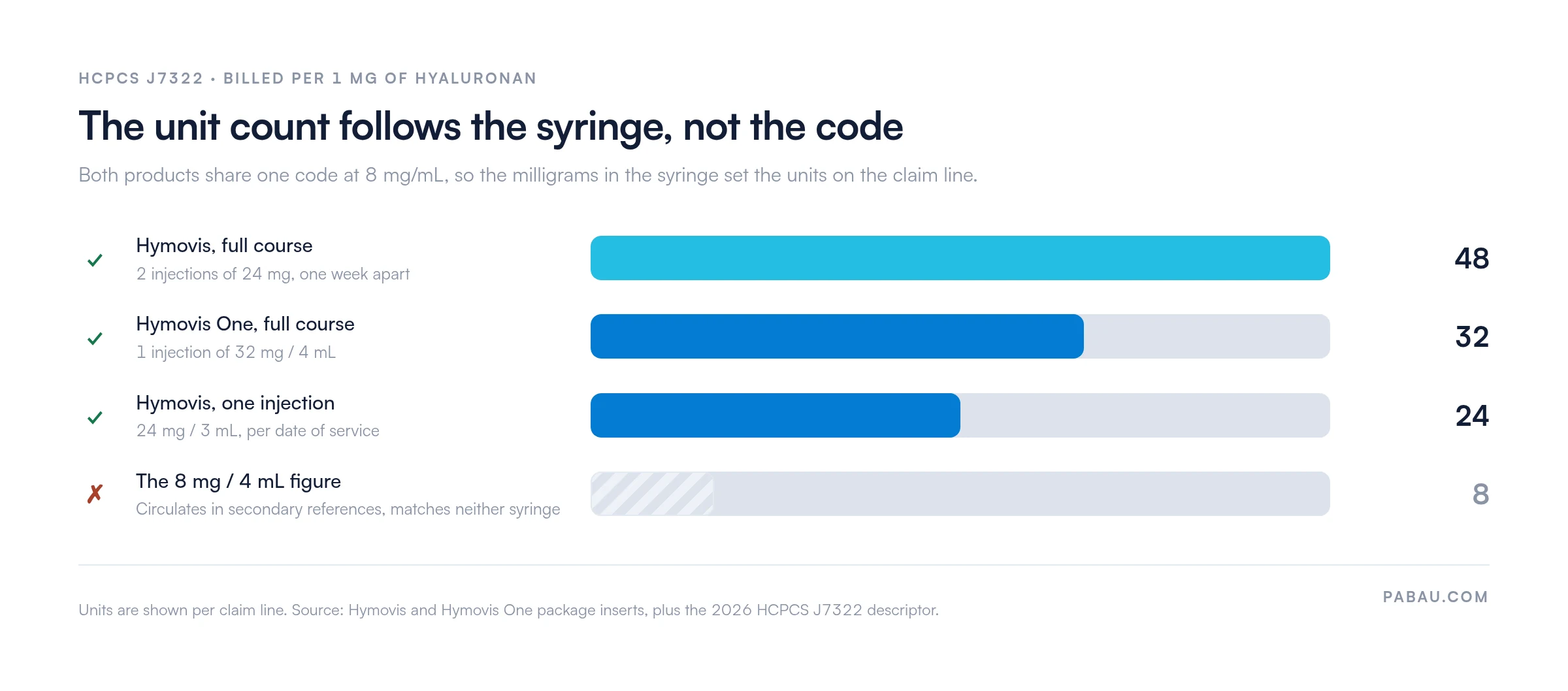
One Hymovis syringe delivers 24 mg, which means 24 units. A Hymovis One syringe delivers 32 mg, which means 32 units. The chart below sets those counts against the 8-unit figure that circulates in secondary coding references.
NDC reporting on Medicare Part B drug claims is required by CMS for separately payable drugs. Verify current CMS transmittals with your Medicare Administrative Contractor (MAC) to confirm the NDC field requirements in your jurisdiction. Guidance can change through a Change Request.
Medicare covers J7322 for knee osteoarthritis, but coverage is conditional. Two Local Coverage Determinations govern eligibility: LCD A52420 and LCD A56157, depending on the MAC jurisdiction. Both share the same core criteria.
Every J7322 claim must carry a covered ICD-10 diagnosis code. The M17 series covers primary and other osteoarthritis of the knee. Use the most specific laterality available.
Always verify covered diagnosis codes against the current LCD in effect for your MAC. The list above reflects commonly accepted codes; individual LCD versions may specify inclusions or exclusions that differ by jurisdiction. Confirm the beneficiary’s active coverage before you administer the injection.
Medicare pays J7322 as a Part B physician-administered drug, using the Average Sales Price (ASP) plus a 6% statutory add-on. CMS updates ASP-based rates quarterly.
Because ASP changes every quarter, always pull the current CMS ASP payment file before setting your charge master or estimating reimbursement for a treatment cycle. Rates cited in older billing guides may already be out of date.
Medicaid coverage for viscosupplementation is set state by state. Some programs cover Hymovis with prior authorization and step-therapy conditions. Others limit coverage to one preferred hyaluronic acid product, and a few exclude the class outright. Check the patient’s own state program before you order the syringes.
Commercial plans and Medicare Advantage plans apply their own medical policy. Expect a prior authorization requirement, documented failure of conservative care, and a unit cap set at one full course.
Many plans also name a preferred hyaluronan, so a clinically appropriate J7322 claim can still be denied as non-preferred.
That kind of denial needs a formulary exception or a switch to the covered product, not a medical-necessity appeal. Plans also differ on how soon a second course can be billed.
Record each answer in a payer checklist your schedulers can see, so the requirement gets checked before the appointment.
J7322 covers only the drug. The injection procedure is billed separately with an administration code on the same claim. For a knee joint injection, two CPT codes commonly apply.
Confirm your 20610 or 20611 choice against current AMA CPT codebook guidance and your payer’s policy before billing. Some commercial payers and Medicare Advantage plans add documentation requirements for ultrasound-guided injections.
Place of service affects payment too. POS 11 (office) and POS 22 (outpatient hospital) both apply, depending on the setting. Check that the claimed POS matches where the injection was given.
Hymovis is acquired and billed under the physician buy-and-bill model. The practice purchases the drug, administers it, and then bills the payer for both the drug and the administration service.
Getting the workflow right at each step prevents denials and protects cash flow. A charge-capture check that confirms every required field before submission is the most effective safeguard.
Medicare Fee-for-Service generally does not require prior authorization for J7322 under traditional Medicare. However, Medicare Advantage (Part C) plans operate under their own PA rules.
Most commercial payers require PA for viscosupplementation. Key documentation for a PA request includes:
Inadequate documentation is the leading cause of post-payment audits on viscosupplementation claims.
Compliant billing for J7322 requires the medical record to support every coverage criterion in the applicable LCD. The goal is a claim that pays the first time, without a request for records.
Retain all documentation for the standard Medicare audit retention period (currently 7 years). Payers conducting post-payment audits typically request the complete medical record, not just the claim face sheet.
J7322 is one of several HCPCS codes covering viscosupplementation products, and coders confuse them with each other often. Each code is product-specific and not interchangeable.
The table below covers the full J7320-J7325 series.
Each code is tied to specific products, so clinical similarity is never a reason to substitute one for another. J7322 covers two, and both are Fidia’s Hymovis formulations. Billing J7321 when Hymovis was administered is a coding error, even though both products are hyaluronic acid.
Two other single-injection products sit just outside this range. Gel-One is J7326 and Monovisc is J7327, so neither belongs on a J7320-J7325 crosswalk. Bill the code that matches the NDC on the syringe you used.
Five errors account for most J7322 denials and underpayments. Each one is preventable at the charge-capture step, before the claim leaves the practice.
An 8 mg/4 mL figure circulates in secondary coding references, and it matches neither product. Hymovis comes as a 3 mL syringe at 8 mg/mL, so one injection delivers 24 mg and bills 24 units. Hymovis One comes as a 4 mL syringe at the same concentration, so it delivers 32 mg and bills 32 units.
A line submitted at 8 units still pays, which is why the shortfall rarely shows up as a denial. A full Hymovis course is 48 units across two dates. Read the dose off the syringe label and the package insert, not a secondary coding summary.
One J7322 line carries two different quantities. The HCPCS unit count is 24, because the code pays per milligram. The NDC quantity is 3 with the ML qualifier, because that is the volume in the syringe. Copying either figure into the other field produces a unit-mismatch rejection.
The neighboring hyaluronan codes do not share one billing unit. J7320 and J7325 bill per 1 mg like J7322, while J7321, J7323 and J7324 bill per dose. A mis-keyed code therefore carries the wrong unit count as well as the wrong product. Match the code to the NDC on the syringe you used.
Traditional Medicare does not require prior authorization, which makes it tempting to treat every plan the same way. Medicare Advantage and most commercial plans do require it.
Injecting first turns a covered course into an uncompensated one, because retroactive authorization is rarely granted. Confirm the requirement and the conservative-therapy record at scheduling.
ASP changes every quarter, so a charge master built on last year’s file is already wrong. Across a 24-unit line and a 48-unit course, a small per-milligram change adds up quickly. Pull the current CMS ASP file each quarter and update the drug’s cost and charge together.
Scan both syringe labels at the two injection visits and store them with the encounter, not in a separate drug log. A post-payment audit will ask how 48 units were supported across two dates of service. With the labels in the chart, the lot numbers, the NDC and the 24 mg dose are already in front of the reviewer.
The code itself is the simple part. Errors accumulate in the steps around it. Billers copy J-code details from a paper drug log into the claim. NDC numbers get transcribed by hand, and the inventory record sits outside the billing system.
Practice management software like Pabau keeps that trail in one place. Pabau’s claims management software connects the dispensing record to the claim.
When a clinician administers either product, the drug record updates and J7322 reaches the claim with the stored dose for that syringe. The NDC captured at dispensing carries through to the CMS-1500.
Practices running denial management workflows across several in-office drug programs feel this most. Centralizing inventory, administration records and claim preparation in one platform closes the most common error pathways.

Pabau tracks injectable inventory, auto-populates HCPCS J-codes, and prepares CMS-1500 claims for buy-and-bill programs. See how practices billing viscosupplementation use Pabau to reduce claim errors and speed up reimbursement.

Billing HCPCS code J7322 correctly comes down to three details. The unit count follows the syringe, 24 units for Hymovis and 32 for Hymovis One.
The diagnosis pairing comes from the M17 series with laterality. The documentation trail has to show conservative therapy failure before the first injection. Miss any one of them and you are looking at a denial or a post-payment audit.
Pabau’s inventory and claims management tools connect dispensing records to claim preparation. J7322 units, NDC numbers and diagnosis codes move from the clinical record to the CMS-1500 without manual re-entry.
To see how practices running in-office viscosupplementation programs handle a J7322 course end to end, book a demo.

Need to understand the full claim submission process? What is medical billing covers the end-to-end claim lifecycle for physician-administered drugs and services.
Getting ERA remittances back with denial codes on J7322? Denial management in healthcare explains how to read remark codes and build an appeals workflow.
Want to understand how your revenue cycle connects to ASP-based reimbursement? What is revenue cycle management maps the full cycle from charge capture to payment posting.
HCPCS code J7322 bills for Hymovis and Hymovis One (hyaluronan or derivative), viscosupplements given by intra-articular injection. They treat osteoarthritis of the knee, and Medicare Part B pays per 1 mg of hyaluronan administered.
Bill 24 units for a Hymovis injection and 32 units for a Hymovis One injection. J7322 pays per 1 mg, and the two syringes hold 24 mg and 32 mg. A full Hymovis course is 2 injections, so it totals 48 units across two dates of service. Hymovis One is given once, so its course is 32 units.
Traditional Medicare Fee-for-Service generally does not require prior authorization for J7322, but Medicare Advantage plans and most commercial payers do. Always verify PA requirements with the specific payer before administering the injection. Required documentation typically includes proof of OA diagnosis and documented failure of conservative therapy.
J7322 pairs with the M17 series. The usual choices are M17.11 (primary OA, right knee), M17.12 (primary OA, left knee) and M17.0 (bilateral primary OA). Always verify covered diagnosis codes against the current LCD for your MAC jurisdiction.
The NDC varies by lot and packaging configuration, so take the 11-digit NDC from the product label at the time of dispensing. NDC reporting is required on Medicare Part B drug claims for separately payable drugs. Report it in Box 24D of the CMS-1500 with qualifier N4. The volume administered is 3 mL per Hymovis syringe and 4 mL per Hymovis One syringe.
J7321 covers Hyalgan and Supartz (sodium hyaluronate products), while J7322 covers Hymovis and Hymovis One. The two codes represent different hyaluronic acid formulations and are not interchangeable. Always bill the code that matches the drug actually administered, confirmed by the NDC on the package label.
CPT 20610 is billed for a knee injection without ultrasound guidance; CPT 20611 applies when ultrasound guidance is used with permanent image recording and reporting. Both are billed on the same claim as J7322. Verify selection with current AMA CPT codebook guidance and your payer’s billing policies.



