CCSD code F5010: Parotid duct transposition billing guide
CCSD code F5010 covers parotid duct transposition, one side or both CCSD code F5...

Last Updated: Oct 9, 2026
J1890 is the HCPCS Level II code for injection, cephalothin sodium, up to 1 gram. CMS terminated it with effect from 31 March 2025, so it is no longer valid for claims after that date.
Like all J-codes, J1890 was specific to one drug and one maximum dosage unit. Here that unit was one gram of cephalothin sodium per billing unit. HCPCS J-code numbers are assigned as codes are created rather than grouped by drug class, so a neighboring code often covers an unrelated drug.
Let Pabau's smart automation suggest the right codes, reduce claim denials, and keep your practice compliant—effortlessly.
Automate repetitive tasks and focus on what matters most—your patients.
Reduce coding errors and ensure compliance with the latest regulations.
Clean claims, fewer denials, and faster reimbursements.
Powerful insights and reporting to help your practice thrive.
HIPAA compliant SOC 2 certified GDPR-compliant Trusted by 4,000+ clinics worldwide

HCPCS code J1890 covered injection of cephalothin sodium, up to 1 gram, a first-generation cephalosporin antibiotic.
J1890 is a deleted code, so submitting it on a Medicare or Medicaid claim today triggers an automatic denial. Verify code status before you bill.
CMS published no crosswalk replacement for J1890. Practices billing an injectable with no specific code may use J3490 or J3590, subject to payer policy.
Practice management software like Pabau flags outdated HCPCS codes before submission, which cuts denials from deleted codes.
The table below summarizes the key reference data for HCPCS code J1890.
HCPCS code J1890 is not active. CMS deleted it from the HCPCS Level II code set, so it cannot be used on current Medicare or Medicaid claims. Submitting J1890 on a claim today triggers an automatic denial from the Medicare Administrative Contractor (MAC) processing the claim.
CMS updates HCPCS Level II codes quarterly, adding new codes, revising descriptors, and deleting others. A code is deleted when the drug is no longer commercially available, no longer separately reimbursable, or reclassified under a different framework. Cephalothin sodium was withdrawn from the US market, which removed the clinical and billing basis for a drug-specific J-code.
Key implications of J1890’s deleted status:
Cephalothin sodium is a first-generation cephalosporin antibiotic in the beta-lactam class. Clinicians used it to treat:
When it was administered by injection in a practice setting, it was billed under HCPCS code J1890 for Medicare and Medicaid reimbursement.
The drug was sold under the brand name Keflin and was one of the earliest cephalosporins introduced to clinical practice. Its market withdrawal was driven by newer cephalosporins with broader spectra and better tolerability. For historical claim reviews, the record should show the drug name, dose administered, route, and the NDC (National Drug Code) where applicable.
J-codes are not mapped to diagnosis codes by CMS in the same way CPT codes are. The clinical indication for the antibiotic injection still belongs in the patient record. An appropriate ICD-10-CM diagnosis code on the claim establishes medical necessity.
When J1890 was active, it was submitted on CMS-1500 claim forms by physician offices and outpatient providers. Hospital outpatient departments reported it on the UB-04 claim form instead. The code went in the procedure code field, alongside the units administered and the administering provider’s NPI. A supporting ICD-10-CM diagnosis code established medical necessity.
Billing J1890 required providers to document the drug name, dose administered, and route of administration in the clinical record. Providers were also expected to note the NDC number on the claim when billing Medicare Part B for separately payable drugs. Medicare requires the NDC on drug claims for certain categories of injectables.
Accurate unit documentation matters most for practices billing across multiple drug codes. Billing more units than administered is a common audit trigger. J-codes for injectable drugs also fall under CMS Correct Coding Initiative (CCI) edits.
CMS has not published an official crosswalk assigning a specific replacement code for J1890. Because cephalothin sodium is no longer commercially available in the United States, no currently marketed drug maps to the old descriptor.
Practices that administered a cephalosporin antibiotic without a specific J-code historically used unclassified drug codes. Those codes remain the right mechanism when an injectable drug lacks its own HCPCS code. Which route applies depends on the drug in the syringe, not on J1890’s old descriptor.
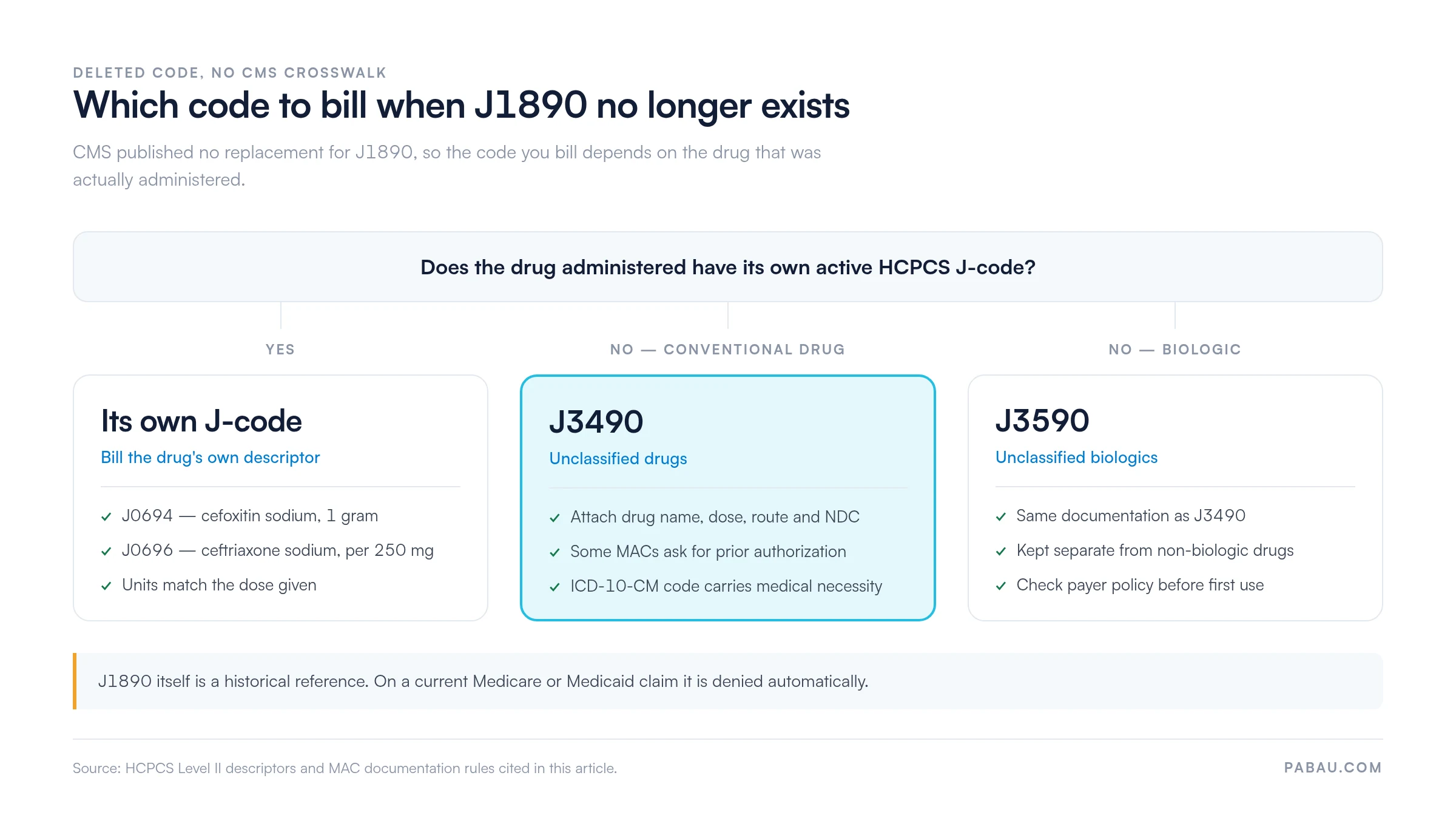
The table below outlines the most relevant related codes for reference. These apply to drug injection billing broadly, and each should be verified against current payer policy before use. Check the active HCPCS codes for the drug you administered before you fall back on an unclassified code.
When using J3490 for an unclassified drug injection, payers typically require a written description of the drug, its dose and route. The NDC number goes on the claim as well. Some Medicare Administrative Contractors require prior authorization or a letter of medical necessity for unclassified drug claims. Always verify MAC-specific requirements before submission by checking your MAC’s local coverage determinations.
When billing an unclassified code like J3490, attach a cover letter to the claim. Document the drug name, brand, dose, route of administration, and NDC. Missing documentation is the leading reason unclassified drug claims are denied on first submission.
A deleted HCPCS code on a live claim is a preventable denial. The process below applies whenever a J-code or other HCPCS Level II code your practice uses leaves the active code set.
CMS publishes HCPCS Level II updates quarterly. Checking the CMS Physician Fee Schedule lookup and the HCPCS release notes each quarter catches deletions early. Practices that build this check into the billing calendar find the problem before claims go out.
Billing errors tied to deleted or inactive HCPCS codes are largely a systems problem. When a practice management platform does not flag an outdated code at the point of claim creation, the error travels through to submission. Pabau’s claims management software gives billing teams visibility over the claim lifecycle, from code entry through submission and payment posting.
For practices managing drug administration billing across several providers or locations, the operational challenge is consistency. Every claim needs a current, payer-accepted code rather than a deleted one from a prior year. Pabau’s billing workflows centralize claim creation and give practice managers one point of review before claims go out.
Revenue cycle performance depends on catching code-level errors early. A denial for a deleted HCPCS code sends the billing team back to find the correct replacement. They then update the claim and resubmit inside the timely filing window, which adds time and cost. Pabau’s reporting tools surface patterns in denial reasons, so practices can fix root causes instead of working denials one claim at a time.

Pabau’s claims management software helps your team flag deleted and inactive HCPCS codes before a claim goes out. Fewer denials, less rework, faster reimbursement.

Treat J1890 as a record rather than a code. It belongs in historical claim documentation and nowhere on a current claim form. The decision that matters now is which code fits the drug you actually gave. That answer sits with the drug’s own descriptor and your payer’s policy.
The wider point is maintenance. Any practice that has not checked its HCPCS library against the current quarterly update carries the same denial risk on other codes. A quarterly review takes an hour. Reworking a quarter of denied drug claims takes far longer.
Pabau supports the billing workflows that keep a code library current and denials rare. Book a demo to see how a deleted HCPCS code gets flagged before the claim leaves your practice.

Need to understand how medical billing works end to end? What is medical billing covers the full claim lifecycle from documentation through reimbursement.
Want a framework for managing claim denials systematically? Denial management in healthcare outlines the key steps practices use to reduce and resolve denied claims.
Exploring how RCM strategy connects to billing accuracy? Revenue cycle management fundamentals explains how billing, coding, and payment posting work together.
HCPCS code J1890 is a deleted HCPCS Level II J-code that previously described the injection of cephalothin sodium, up to 1 gram. It was used to bill Medicare and Medicaid for the administration of this first-generation cephalosporin antibiotic in outpatient clinical settings. The code is no longer active and cannot be submitted on current claims.
No. HCPCS code J1890 is a deleted code. Submitting it on a Medicare or Medicaid claim today will result in an automatic denial. Providers should verify code status before billing using CMS quarterly update files or a verified HCPCS lookup tool.
CMS has not published an official crosswalk replacement for J1890. Because cephalothin sodium is no longer commercially available in the US, there is no direct successor code. Practices billing an injectable drug with no specific HCPCS code should consider J3490, unclassified drugs. Attach supporting drug documentation to the claim, subject to MAC and payer policy.
Claims submitted with a deleted HCPCS code are automatically denied by Medicare and most Medicaid programs. Practices must identify the deletion, determine the appropriate replacement or unclassified code, update their practice management system, and resubmit within the timely filing window. CMS publishes HCPCS code deletions quarterly.
J-codes are a subset of HCPCS Level II used to bill Medicare and Medicaid for injectable drugs administered in clinical settings. Each J-code corresponds to a specific drug and dosage unit. Providers report the code on a CMS-1500 or UB-04 claim form, alongside the applicable ICD-10-CM diagnosis code. For Medicare Part B, the drug’s National Drug Code (NDC) goes on the claim too.
HCPCS Level I codes are CPT codes maintained by the AMA, covering physician services and outpatient procedures. HCPCS Level II codes are maintained by CMS and cover drugs, supplies, equipment, and other items not in the CPT set. J-codes, including J1890, are HCPCS Level II codes. Both levels are used on Medicare and Medicaid claims.