CCSD Code H3334: Low anterior resection billing guide
CCSD Code H3334: Definition and clinical scope CCSD Code H3334 covers an open an...

Last Updated: Oct 16, 2026
J1610 is the HCPCS Level II code for injection, glucagon hydrochloride, per 1 mg. Clinicians give it to reverse severe hypoglycemia and to relax the gut during GI radiology.
One billing unit equals 1 mg, so a standard 1 mg glucagon kit is billed as 1 unit. A dose under 1 mg still bills as 1 unit. Two common errors on this code are confusing it with J1612, a different glucagon product, and miscounting units.
Let Pabau's smart automation suggest the right codes, reduce claim denials, and keep your practice compliant—effortlessly.
Automate repetitive tasks and focus on what matters most—your patients.
Reduce coding errors and ensure compliance with the latest regulations.
Clean claims, fewer denials, and faster reimbursements.
Powerful insights and reporting to help your practice thrive.
HIPAA compliant SOC 2 certified GDPR-compliant Trusted by 4,000+ clinics worldwide

HCPCS Code J1610 covers glucagon hydrochloride injection only, billed per 1 mg, so a standard 1 mg dose is 1 unit.
Medicare Part B reimburses J1610 at ASP + 6% under the buy-and-bill model, and rates update quarterly in the CMS ASP pricing files.
Since July 1, 2023, CMS has required JW or JZ on separately payable drugs from single-dose containers. A J1610 line with no billable waste takes JZ.
Billing J1612 instead of J1610, and reporting the wrong units, are two common causes of glucagon claim denials.
NDC reporting is required by Medicaid and many commercial payers, while Medicare generally does not require it.
HCPCS Code J1610 is defined by the Centers for Medicare and Medicaid Services (CMS) as “injection, glucagon hydrochloride, per 1 mg.” It belongs to the J-code category of HCPCS Level II, which CMS titles “drugs administered other than oral method.” A clinician typically injects it in an outpatient or physician-office setting.
Glucagon hydrochloride is a hormone used primarily to reverse severe hypoglycemia when oral glucose is not possible. It stimulates the liver to release stored glycogen, raising blood glucose rapidly. Clinicians also use it in smaller doses during gastrointestinal radiological procedures to induce smooth muscle relaxation.
J1610 covers only glucagon hydrochloride. J1612 describes a different product, glucagon (Gvoke), billed per 0.01 mg and effective October 1, 2025. Billing J1612 instead of J1610 is a wrong-code denial risk on glucagon claims. J1600 covers gold sodium thiomalate, a rheumatology drug that shares only the number range.
Critical distinction: Gvoke is billed under J1612, not J1610. Nasal Baqsimi is a self-administered product and is not billed under J1610. Selecting J1610 for Gvoke leads to a denial, because the NDC on the line won’t match the code.
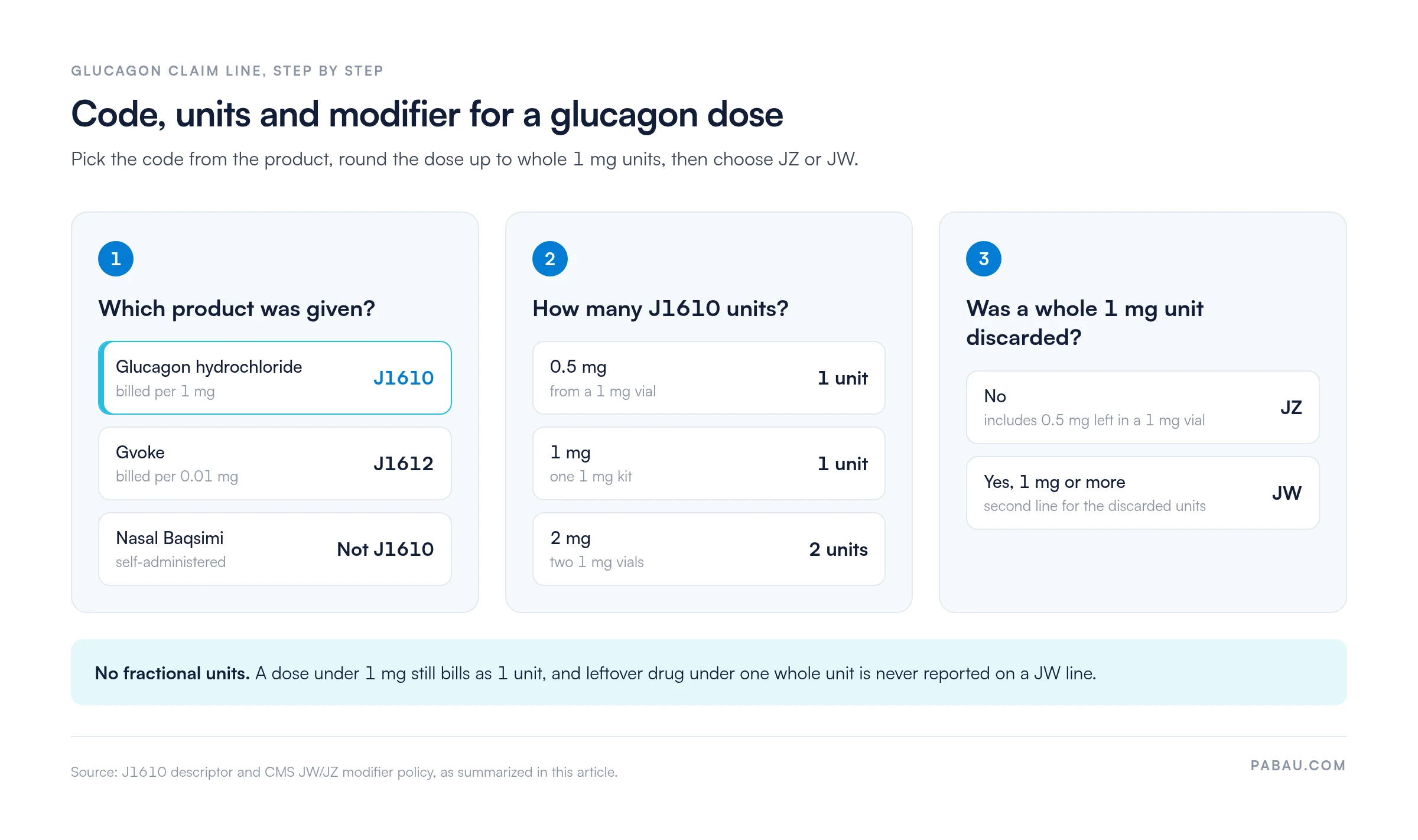
J1610 is billed per 1 mg, so the units field on the claim counts milligrams administered, not vials used. Most standard glucagon emergency kits contain 1 mg, and a full 1 mg kit equals 1 unit of J1610. CMS does not use fractional billing units, so a dose below 1 mg is still billed as 1 unit.
Enter the calculated unit count in field 24G on the CMS-1500 form (or the appropriate UB-04 field for institutional claims). Do not bill by vial count. When 0.5 mg is given from a 1 mg single-dose vial and the rest is discarded, bill 1 unit with the JZ modifier. CMS does not use fractional billing units, so the leftover 0.5 mg is not reported on a JW line. JW applies only when at least one whole 1 mg unit is discarded. The chart below runs the whole decision, from product to modifier.
NDC reporting is required by Medicaid, for dual-eligible patients and by many commercial payers. Medicare generally does not require it, so check your MAC. The NDC identifies the exact glucagon product given, so the payer can match the claim to the drug purchased.
When the payer requires it, three elements go on the J1610 claim line alongside the HCPCS code:
Locate the NDC from the original vial label or the dispensing pharmacy’s invoice, not from memory or a code crosswalk table. NDC numbers differ between manufacturers and between vial sizes. On a claim that requires an NDC, a wrong or missing one can get the line denied. Medicare Administrative Contractors (MACs) set their own NDC rules, so check yours.
Medicare Part B reimburses J1610 at ASP + 6% under the physician-administered drug benefit. ASP is the Average Sales Price that manufacturers report to CMS each quarter. The J1610 rate changes quarterly. Find the current figure in the CMS ASP pricing files.
Under the buy-and-bill model, the practice purchases glucagon hydrochloride directly, administers it, and then bills Medicare for the drug. Reimbursement covers both the drug cost (J1610) and the administration. The injection itself is usually billed as CPT 96372 on the same claim as J1610. That pairing fits a physician-office setting. For institutional outpatient claims, check your MAC’s rules.
Setting-specific notes: hospital outpatient departments (HOPDs) and critical access hospitals (CAHs) follow different reimbursement methodologies. Inpatient hospital administration of glucagon is bundled under Medicare Part A and is not separately payable with J1610. J1610 most often generates separate Part B reimbursement in physician offices (POS 11).
The correct modifier on a J1610 claim depends on whether any drug was wasted after the dose was drawn. From July 1, 2023, CMS requires JW or JZ on separately payable drugs from single-dose containers or single-use packages (CR 13056). A J1610 line from a single-dose vial that carries neither modifier can be returned or denied.
JW billing mechanics: when JW applies, bill J1610 on two claim lines. The first line carries the units administered with no modifier, and the second carries the discarded units with JW. Medicare processes both lines for payment, up to the amount on the vial label.
Every J1610 claim must be supported by an ICD-10-CM diagnosis code that establishes medical necessity for glucagon administration. The diagnosis must be documented in the medical record on the date of service, not inferred or carried forward from a prior encounter.
Beyond the ICD-10 code, billing compliance requirements for J1610 demand a complete documentation record for each encounter. The medical record must contain:
Missing any of these elements raises audit and denial risk.
Most J1610 denials trace back to one of the six errors below, each with a recognizable code on your remittance advice (ERA or EOB). Match the codes on the denial to this table, and to our list of common denial codes, before you file a corrected claim.
Effective denial management on J1610 starts before submission. A pre-claim check of the NDC, the unit math and the modifier catches these errors before the MAC sees the claim.
Run a monthly audit of every J1610 claim billed in the prior 90 days, sorted by denial code. If CO-4 shows up more than three times for the same reason, fix the step where that detail is captured. Correcting each claim by hand won’t stop the next denial.
Most denials in the table above start with one missing or mismatched detail on the claim line. It might be the code, the units, the NDC or the modifier. Today that detail is usually spotted after the payer rejects the claim, days after the visit.
Pabau, the practice management platform we build, includes claims management software that checks each claim before it goes out. Its claim validation scrubs every claim for missing or invalid details, so you can fix a J1610 line while the encounter is still fresh.
Validation works best when the claim starts complete. A structured superbill with a drug administration section prompts for the dose, units and NDC at the time of service. That habit sits at the core of submitting clean claims on drug codes like J1610.

Pabau’s claim validation flags missing or invalid details before a claim leaves your practice. Claim tracking then shows which glucagon claims need action, from Pending to Paid.

Get the product right first, then the units. Glucagon hydrochloride goes on J1610 at one unit per milligram, and Gvoke goes on J1612. A sub-1 mg dose from a 1 mg vial still bills as one unit with JZ.
The rest depends on the payer. Confirm whether it wants an NDC, and record the dose, route and response on the date of service. With those habits in place, a J1610 denial points to one step you can fix.
Pabau’s claim validation flags missing or invalid details before submission, and claim tracking shows which claims need action. Book a demo to see how Pabau checks injectable drug claims like J1610 before they reach the payer.

Need help understanding denial codes on J1610 claims? Denial management in healthcare walks through how to read remittance advice and build a systematic appeals workflow.
Want a structured approach to claim accuracy before submission? Submitting clean claims covers the pre-submission checks that reduce first-pass denial rates across drug codes.
Looking for the full picture on medical billing compliance? Billing compliance requirements maps the OIG’s seven compliance elements to a small practice and shows which documentation habits prevent audits.
HCPCS Code J1610 covers the injection of glucagon hydrochloride, billed per 1 mg. It applies to physician-administered glucagon HCl in outpatient and office settings, for indications such as severe hypoglycemia and gastrointestinal radiology. It does not cover Gvoke, which is billed under J1612, or nasal glucagon.
The unit of service for J1610 is per 1 mg administered. A 1 mg dose equals 1 unit, and a 2 mg dose equals 2 units. CMS does not use fractional billing units, so a 0.5 mg dose from a 1 mg vial is billed as 1 unit. Enter the unit count in field 24G of the CMS-1500.
Medicare Part B does not require prior authorization for J1610 when glucagon is used for emergency hypoglycemia management. Commercial payers and Medicaid managed care plans may require it for non-emergency uses. Check each payer’s policy before administration when time permits.
J1610 covers glucagon hydrochloride injection, billed per 1 mg. J1612 covers glucagon (Gvoke), a distinct FDA-approved product billed per 0.01 mg. The two are not interchangeable. Billing one code for the other product leads to a denial, because the NDC won’t match the code.
Use JZ when no whole 1 mg unit is discarded, including a 0.5 mg dose from a 1 mg vial. Use JW on a second line when at least one whole unit is discarded. Since July 1, 2023, CMS has required one of the two on separately payable drugs from single-dose containers or single-use packages.
Yes, J1610 is covered under Medicare Part B as a physician-administered drug when medical necessity is established. It is most often paid separately in a physician office (POS 11). Inpatient hospital administration is bundled under Part A and is not separately billable.
Required documentation starts with a signed physician order and the drug name, dose in mg, route and site of administration. The record also needs the date and time given, the patient’s response, the vial NDC number and the administering clinician’s signature. Missing any of these elements raises audit and denial risk.
Common J1610 denial causes are a wrong code (J1612 instead of J1610), an incorrect unit count and a missing JW or JZ modifier. A missing NDC or qualifier also causes denials when the payer requires it. Each is a pre-submission data error, so a pre-claim check catches it before the payer does.