

HCPCS code E0198: Water pressure pad billing guide
HCPCS code E0198 is a water pad for a standard mattress HCPCS code E0198 is the ...

Last Updated: Oct 13, 2026
J0745 is the HCPCS Level II code for injection, codeine phosphate, per 30 mg.
Let Pabau's smart automation suggest the right codes, reduce claim denials, and keep your practice compliant—effortlessly.
Automate repetitive tasks and focus on what matters most—your patients.
Reduce coding errors and ensure compliance with the latest regulations.
Clean claims, fewer denials, and faster reimbursements.
Powerful insights and reporting to help your practice thrive.
HIPAA compliant SOC 2 certified GDPR-compliant Trusted by 4,000+ clinics worldwide

HCPCS code J0745 describes an injection of codeine phosphate, per 30 mg, and is used to bill Medicare and other payers for administered doses.
Units are calculated based on the total milligrams administered: a 60 mg dose equals 2 units of J0745.
NDC number reporting is mandatory when billing J0745 to Medicare and Medicaid, and omitting it is a common cause of claim denial.
Pabau’s claims management software helps practices track J-code units, NDC entries, and drug administration billing in one workflow.
The unit definition in HCPCS Code J0745 is per 30 mg, meaning one unit equals 30 milligrams of codeine phosphate administered. This is where most billing errors occur. A prescriber administers 60 mg: the biller must submit 2 units. A 90 mg dose requires 3 units. Billing only 1 unit for a 60 mg dose results in underpayment; billing 2 units for a 30 mg dose risks a False Claims Act audit.
Unit calculation formula: Divide the total milligrams administered by 30. Round to the nearest whole unit per CMS drug billing guidance. Never round up to inflate units, and document the administered dose in the patient chart to support the unit count on the claim.
Medicare reimburses HCPCS code J0745 under the drug fee schedule as a separately payable drug under Medicare Part B when administered in an eligible outpatient setting. The payment rate is adjusted by the Geographic Practice Cost Index (GPCI), so what a clinic in rural Mississippi receives per unit differs from a clinic in urban California. Rates are updated annually on January 1 and should always be verified through the CMS Physician Fee Schedule lookup tool for your specific locality before making reimbursement projections. Diagnosis pointers on the claim form link each service line to the diagnosis that justifies it.
J0745 reimbursement also differs by place of service. Facility rates (hospitals, ambulatory surgical centers) are typically lower than non-facility rates (physician offices, clinics) because facility overhead is separately reimbursed to the institution. Coders must submit the correct Place of Service code to ensure the right rate applies. Mismatching the POS code with the actual setting is a frequent audit trigger.
Verify J0745 reimbursement rates quarterly using the CMS Medicare Physician Fee Schedule Search Tool. Filter by your MAC region and locality code to get the actual rate applicable to your clinic, not a national average.
Medicare Part B covers J0745 when codeine phosphate is administered by a provider in an outpatient clinical setting and a covered diagnosis supports medical necessity. Part D (the prescription drug benefit) generally covers oral formulations dispensed at a pharmacy, not injected drugs administered in a clinic. The distinction matters: billing Part D for an in-office injection will result in a coverage mismatch denial.
Medicaid coverage for J0745 varies by state. Most state Medicaid programs follow CMS guidance for J-series injectable drugs, but formulary restrictions and prior authorization requirements differ. Commercial payers handle codeine phosphate injections inconsistently. Many require prior authorization, especially given the controlled substance classification. Meeting med spa compliance requirements around controlled substance documentation helps support PA requests when needed.
Weight loss programs built on injectables run smoother in weight loss clinic software that tracks doses week by week.
Medical necessity is the core documentation requirement for J0745 claims. The ICD-10 diagnosis code on the claim must directly support the use of an injectable opioid analgesic. Payers cross-reference the submitted diagnosis against their coverage policies and Local Coverage Determinations (LCDs). Maintaining thorough patient compliance documentation in the chart reduces the risk of a medical necessity denial on audit.
Always confirm the specific ICD-10 codes accepted by your payer’s LCD before submitting. The table above represents commonly used diagnoses, not a comprehensive payer-approved list. Specificity matters: submitting G89.18 (Other acute postprocedural pain) rather than a generic pain code gives the claim more clinical context and reduces denial risk.
Correct claim submission for J0745 requires attention to several fields beyond the code and unit count. The Place of Service code, modifier selection, NDC number, and supporting diagnosis all need to be correct simultaneously. A single error in any one field can result in a denial even when the clinical documentation is complete. Practices that manage HIPAA requirements for med spas and outpatient clinics should build drug administration checklists into their billing workflows.
Modifier use with J0745 is payer-specific and setting-dependent. The table below covers the most commonly applied modifiers, but always verify with your specific payer’s drug billing policy before adding a modifier to a J-code claim.
NDC reporting is not optional for J0745. CMS requires NDC submission for all separately payable drugs billed under Medicare Part B and Medicaid. The NDC identifies the exact manufacturer, product, and package size of the codeine phosphate vial used, which supports drug rebate reconciliation and fraud detection. Omitting the NDC or submitting an incorrect one results in an automatic claim denial from most MACs.
The NDC must be the actual lot-traceable NDC from the vial administered, not the packaged kit NDC or a generic lookup value. Keep the drug packaging or pharmacy receipt on file to match the submitted NDC. Using prescription management software that captures NDC numbers at the point of administration reduces this risk significantly. For digital documentation workflows.
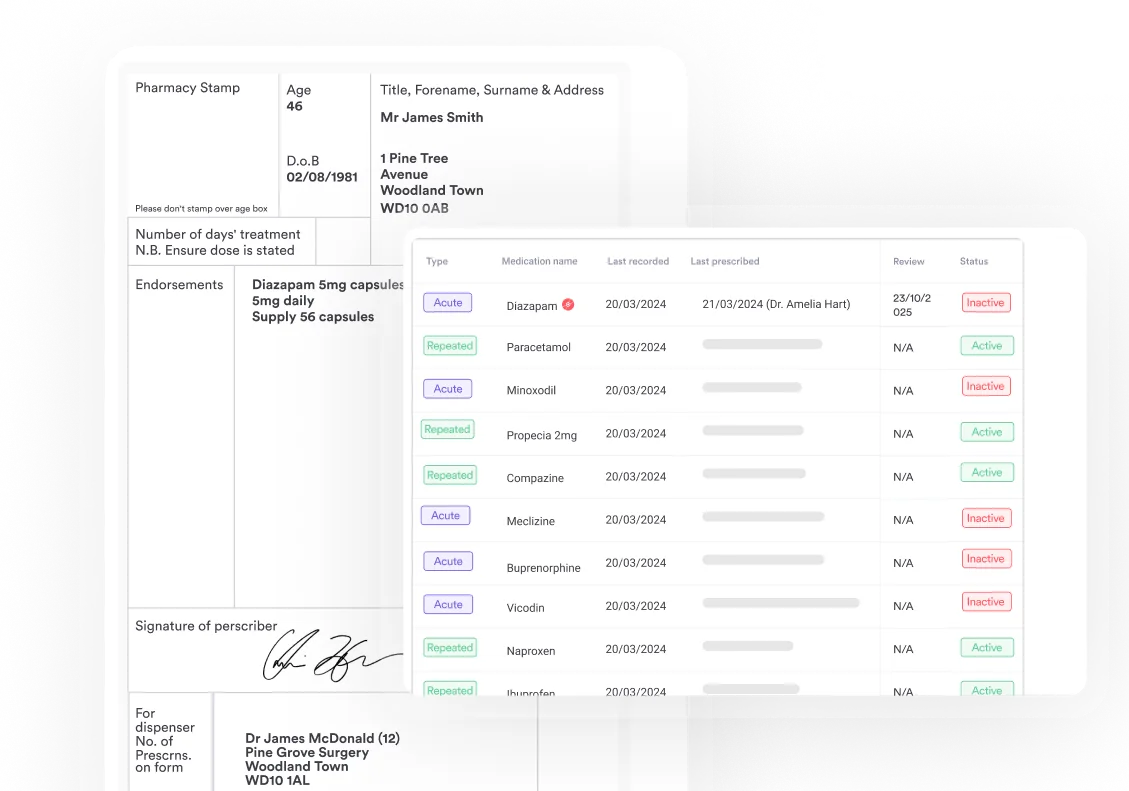
NDC format on claims: enter as 11 digits in 5-4-2 format (xxxxx-xxxx-xx) with the qualifier N4 in the appropriate field. Include the unit of measure and quantity administered. Reference HIPAA compliance standards for medical offices to ensure your drug administration documentation meets both CMS and security requirements.

Pabau’s claims management tools help practices track J-code units, capture NDC numbers at the point of service, and submit cleaner claims. See how it works for drug administration billing workflows.

When codeine phosphate injection is not the right choice, or when a payer’s formulary or LCD requires a different drug, coders need to know the related J-codes for injectable opioids and analgesics. Selecting the wrong J-code for the drug actually administered is a billing compliance violation. Practices managing IV therapy EMR software workflows often need to navigate multiple injectable drug codes simultaneously. See also the broader category of injectable drug billing codes for procedure-level context.
J3490 (Unclassified drugs) is a billing option of last resort. Use it only when no specific J-code exists for the drug administered. Claims submitted under J3490 require an invoice and clinical justification attachment and are subject to greater payer scrutiny than claims under specific J-codes like J0745. Verify J-code accuracy using the AAPC HCPCS Level II code reference or PGM Billing’s HCPCS lookup tool.
When administering multiple opioid or analgesic injections in a single encounter, bill each drug under its own J-code with the correct unit count. Never combine two drugs into a single J-code line. Each has its own reimbursement rate and NDC number.
Billing errors on J0745 are rarely complex, but they are consistent: wrong unit counts, missing NDC numbers, and diagnosis codes that do not clearly support medical necessity. These are the three fields that need to be right every time, for every claim.
Pabau’s claims management software helps practices that administer injectable drugs capture NDC numbers at the point of service, track administered units against prescribed doses, and submit cleaner claims without the manual lookups. To see how it handles drug administration billing workflows, book a demo.

Coding endocarditis as a manifestation code? ICD-10 code I39 covers heart valve disorders that must follow the underlying disease on the claim.
Coding cardiomyopathy from another disease? ICD-10 code I43 covers the Code First rule for cardiomyopathy caused by conditions like amyloidosis.
Coding a nonspecific conduction disorder? ICD-10 code I45.4 covers intraventricular block coding when no named bundle-branch pattern applies.
HCPCS code J0745 is a billing code used to report the administration of an injection of codeine phosphate at a rate of per 30 mg. It is submitted to Medicare, Medicaid, and commercial payers when codeine phosphate is administered by injection in a physician office, outpatient hospital, or other eligible clinical setting. It does not cover oral formulations or pharmacy-dispensed products.
Units for J0745 are calculated by dividing the total milligrams administered by 30. A 60 mg dose equals 2 units; a 90 mg dose equals 3 units. Always document the administered dose in the patient chart to support the unit count on the claim.
Yes. CMS requires NDC number reporting for all separately payable drugs billed to Medicare Part B and Medicaid, including J0745. Submit the NDC in 5-4-2 format with the N4 qualifier on the CMS-1500 or the EDI 837P loop 2410. Omitting the NDC results in an automatic claim denial from most Medicare Administrative Contractors.
Common ICD-10 codes paired with J0745 include G89.18 (other acute postprocedural pain), G89.11 (acute pain due to trauma), G89.29 (other chronic pain), and G89.3 (neoplasm related pain). Always confirm which diagnosis codes your specific payer accepts under their Local Coverage Determination before submitting.
J0745 is specific to codeine phosphate at the per-30-mg unit rate. Other opioid J-codes cover different drugs with different unit definitions: J2270 covers morphine sulfate per 10 mg, J1170 covers hydromorphone up to 4 mg, and J3010 covers fentanyl citrate per 0.1 mg. Using the wrong J-code for the drug actually administered is a billing compliance violation, not just a denial risk.
Modifier JA indicates intravenous administration; modifier JB indicates subcutaneous administration. Modifier 59 may be required when J0745 is billed alongside another service on the same date. Modifier GY is used when billing a non-covered indication to document denial for secondary payer purposes. Modifier requirements vary by payer, so confirm with your MAC or commercial payer’s drug billing policy before applying.



