

CCSD code G5100: Bypass of duodenum billing guide
CCSD code G5100 bills a bypass that leaves the duodenum in place CCSD code G5100...

Last Updated: Oct 16, 2026
J0610 is the HCPCS Level II code for injection, calcium gluconate (fresenius kabi), per 10 ml. CMS terminated it with effect from 31 March 2023, so it is no longer valid for claims after that date.
HCPCS Code J0610 was a HCPCS Level II J-code for an injection of calcium gluconate (Fresenius Kabi brand), billed per 10 ml. CMS deleted it effective April 1, 2023, and claims that still show J0610 are rejected automatically. The bigger risk is the successor code, J0612, which bills by milligram instead of milliliter.
Clinical documentation tools like Pabau capture the administered volume and clinical indication in the patient record, giving billers the data to convert to units correctly.
Let Pabau's smart automation suggest the right codes, reduce claim denials, and keep your practice compliant—effortlessly.
Automate repetitive tasks and focus on what matters most—your patients.
Reduce coding errors and ensure compliance with the latest regulations.
Clean claims, fewer denials, and faster reimbursements.
Powerful insights and reporting to help your practice thrive.
HIPAA compliant SOC 2 certified GDPR-compliant Trusted by 4,000+ clinics worldwide

HCPCS Code J0610 described injection of calcium gluconate (Fresenius Kabi brand), per 10 ml, and was deleted effective April 1, 2023.
The successor code is J0612 (injection, calcium gluconate, not otherwise specified, 10 mg). Claims submitted with J0610 after April 1, 2023 are automatically rejected.
J0612 bills per 10 mg, not per 10 mL. A standard 10 mL vial of 10% calcium gluconate holds 1,000 mg, or 100 units.
Practice management software like Pabau captures administered volume and clinical indication in the patient record, giving billers the data to calculate correct J0612 units.
HCPCS Code J0610 was a HCPCS Level II J-code describing an injection of calcium gluconate manufactured by Fresenius Kabi, billed per 10 ml. J-codes are used under Medicare Part B and Medicaid to bill for drugs administered in outpatient, physician office, and ambulatory surgical center (ASC) settings.
The code was brand-specific from its inception. That specificity matters: J0610 applied only to the Fresenius Kabi formulation of calcium gluconate injection. Providers administering a different manufacturer’s product were already expected to use an alternate code, most commonly J0612 or J3490 (unclassified drug).
HCPCS Code J0610 was deleted effective April 1, 2023, as part of the CMS quarterly HCPCS update. Claims submitted with J0610 for dates of service on or after April 1, 2023 are rejected by Medicare and most Medicaid programs.
The table below summarises the key code attributes for HCPCS Code J0610 as it existed before deletion.
Note: the successor code J0612 does not carry over this per 10 mL billing unit. J0612 bills by weight instead, so the conversion below is essential before you submit a claim.
No. HCPCS Code J0610 is not active. The Centers for Medicare and Medicaid Services (CMS) deleted the code effective April 1, 2023, as part of the quarterly HCPCS Level II update cycle.
The CGS Medicare Administrative Contractor (Jurisdiction C) published explicit billing instructions on the change. Claims submitted with J0610 for service dates on or after that date will be rejected.
Why was J0610 deleted? CMS periodically rationalises brand-specific J-codes when a drug becomes widely available across multiple manufacturers. Tying reimbursement to a single brand’s code creates administrative complexity without clinical benefit. The April 2023 update consolidated calcium gluconate billing under the non-brand-specific successor J0612.
Atropine sulfate shows the same manufacturer-driven pattern. CMS keeps product-specific codes such as J0463 for Fresenius products alongside HCPCS Code J0461, so the NDC crosswalk decides which one to bill.
Audit your charge description master (CDM) and billing software templates as soon as any HCPCS code is deleted. A single uncorrected line item in a CDM can generate hundreds of rejected claims before anyone catches it. Set a calendar reminder each October, January, April, and July to review new CMS quarterly HCPCS updates.
The crosswalk from J0610 to J0612 is not a straight one-to-one swap. J0612 is also non-brand-specific. But its billing unit changed from volume to weight, and getting that difference wrong is the single most consequential mistake in this crosswalk.
The billing unit is not identical, and this is the detail every biller must get right. J0610 billed per 10 mL of solution. J0612 bills per 10 mg of calcium gluconate. That is a mass-based unit, not a volume-based one.
Converting between the two means multiplying volume by concentration, not carrying the old unit count forward. A standard 10% calcium gluconate solution contains 100 mg per mL. A 10 mL single-dose vial therefore holds 1,000 mg, or 100 units of J0612. That same vial was 1 unit under J0610.
Apply that conversion consistently. A 20 mL dose is 2,000 mg, or 200 units, not 2. A 30 mL infusion is 3,000 mg, or 300 units, not 3. Reading J0612 as a per-10-mL code, the way J0610 worked, underbills a claim by a factor of 100.
That miscount changes what the claim pays. At the ASP payment limit, 100 units of J0612 price out to roughly $2.80 per vial, compared with $0.028 under the mistaken 1-unit reading. CMS also flags J0612 as a single-dose container, so unused drug from a partial vial needs a JW or JZ wastage modifier.
Understanding why calcium gluconate is administered helps billers confirm medical necessity and select the correct supporting ICD-10 diagnosis code. Practices running IV therapy programs or infusion centers encounter these clinical scenarios most frequently.
Pairing the drug code with the correct ICD-10 diagnosis is what establishes medical necessity for the claim. The CMS Physician Fee Schedule and MAC local coverage determinations require that the submitted diagnosis code supports the clinical rationale for IV calcium gluconate administration.
Note: ICD-10 code E83.51 (hypocalcemia) is more specific than the older E83.5 grouping referenced in some older resources. Use the most specific code supported by your clinical documentation. Guides on IV therapy complications consistently emphasize documenting the specific calcium deficiency type rather than defaulting to unspecified codes.
Medicare reimburses J-code drug injections under the Average Sales Price (ASP) methodology. The payment rate for J0612 (and formerly J0610) is calculated as ASP plus 6% for physician office and outpatient settings, updated quarterly by CMS.
ASP pricing changes every quarter. Never cite a specific dollar amount for J0612 reimbursement without referencing the current HCPCS fee schedule data for that quarter.
Setting matters significantly for reimbursement. IV vitamin therapy administration and calcium gluconate infusions may occur across several care settings, each with different payment rules:
Medical necessity documentation is not optional. CMS requires it for claim acceptance on J-code drug injections, and auditors specifically look for it during post-payment reviews. Digital intake and clinical forms make it easier to capture the required elements at the point of care. That beats reconstructing them from memory during an audit.
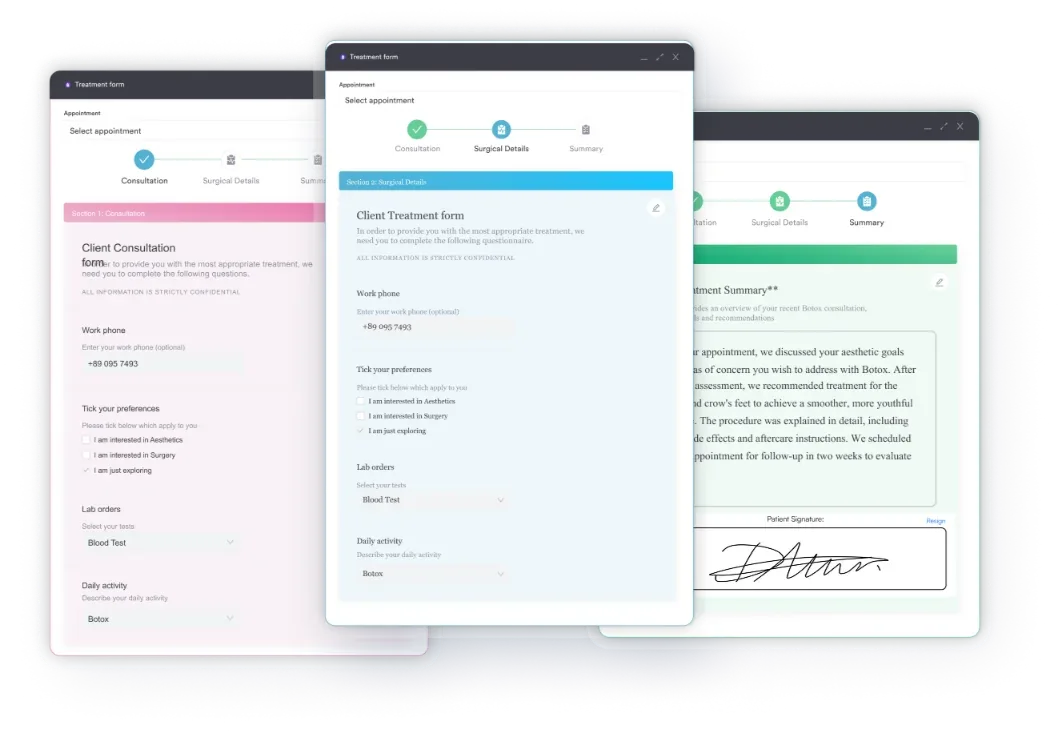
Required documentation elements for calcium gluconate injection billing:
This is where J0610 claims most often go wrong. These error patterns are the most common audit triggers for calcium gluconate injection billing. The same housekeeping applies beyond calcium gluconate. A charge master line still pointing at HCPCS Code J2180 draws a denial, because Medicare allows zero payable units for it.
Review your payer’s local coverage determination (LCD) for infusion therapy before submitting calcium gluconate claims. Some MACs and Medicare Advantage plans have specific coverage criteria for outpatient IV calcium gluconate that differ from standard Medicare Part B. Check the AAPC HCPCS code lookup for any bundling edits or NCCI pair conflicts with the drug administration CPT codes you are billing alongside J0612.
Many infusion practices document the administered drug and volume on paper or in a separate note. That information then gets re-entered into the billing system when the claim goes out. Details can drift between the clinical note and the claim in that step. That is where mismatches between the diagnosis code, the drug volume, and the HCPCS units start.
Practice management software like Pabau keeps the clinical note and the patient record in the same system. The drug name, volume, route, and clinical indication get captured once, at the point of care. Digital forms and treatment notes record the administered dose alongside the diagnosis, giving billers one auditable source to calculate J0612 units correctly.
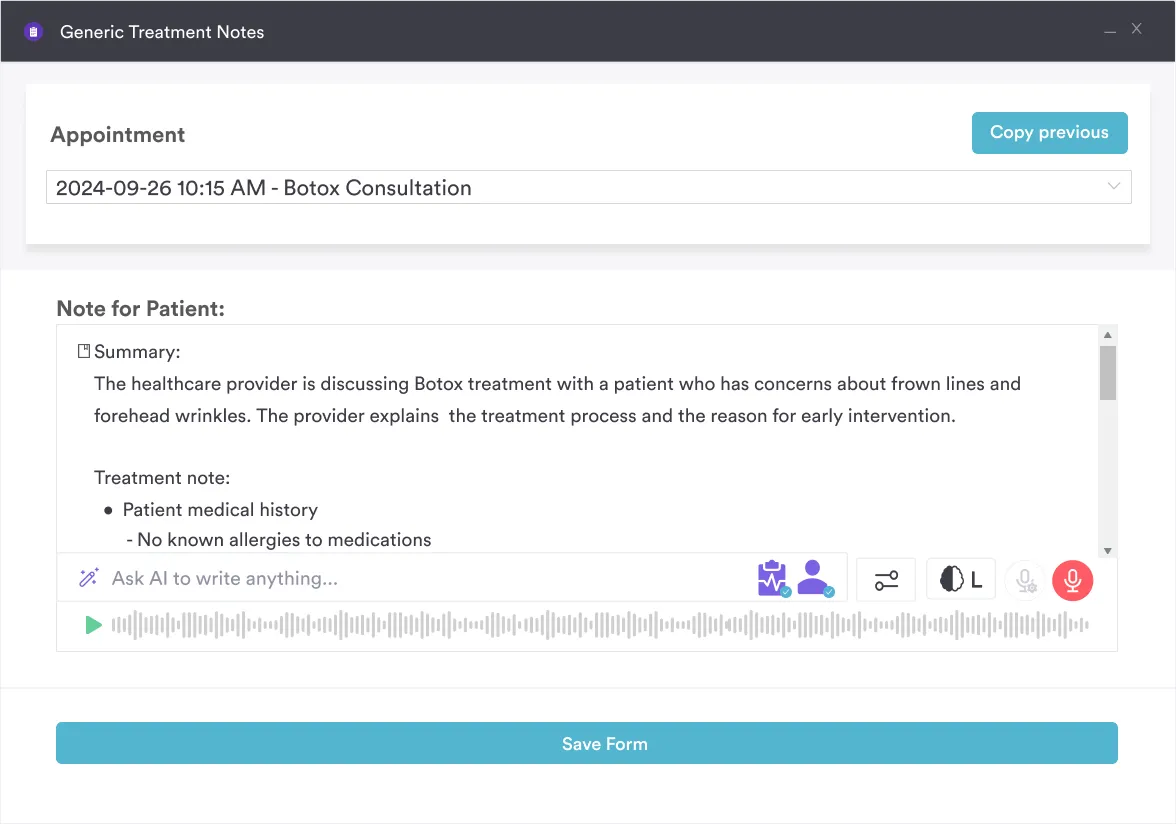
Key documentation capabilities that support accurate HCPCS J-code billing:
For clinics exploring IV therapy intake form best practices, Pabau’s digital forms can be configured to collect the data elements billers need. That supports accurate J0612 coding. Read more about IV hydration business requirements to understand the broader regulatory context for infusion clinics.

Pabau’s digital forms and treatment notes capture the administered volume, route, and clinical indication at the point of care. That gives billers the documentation to support accurate coding.

Getting this crosswalk wrong costs more than a single rejected claim. A biller who miscounts J0612 units by treating it like the old per-10-mL code underbills every calcium gluconate claim by a factor of 100. The fix is procedural, not clinical. Update the charge description master, confirm the ICD-10 pairing, and convert volume to milligrams before the claim goes out. A paper claim is scanned before it is read, so alignment and legibility affect whether it processes.
Practice management software like Pabau keeps the drug name, volume, route, and diagnosis together in one record. That lets billers convert units correctly the first time instead of reconstructing the claim from memory. Book a demo to see how Pabau supports clean clinical documentation for infusion practices.

Billing for an infusion catheter alongside the drug code? C1751 covers the catheter billing, the modifiers payers expect, and the documentation that supports the claim.
Running home infusion services instead of an office visit? S9379 covers billing for home infusion therapy, including per diem rates and required documentation.
Coding bilateral otitis media as a secondary diagnosis? ICD-10 code H67.3 covers bilateral otitis media documented as a manifestation of another disease.
HCPCS Code J0610 is a deleted HCPCS Level II J-code that described an injection of calcium gluconate (Fresenius Kabi brand), per 10 ml. It was used to bill Medicare and Medicaid for IV calcium gluconate administration in outpatient and physician office settings. The code was deleted effective April 1, 2023, and replaced by J0612.
Yes. HCPCS Code J0610 was deleted effective April 1, 2023, as part of the CMS quarterly HCPCS update. Claims submitted with J0610 for service dates on or after that date are rejected. The CGS Medicare Administrative Contractor (Jurisdiction C) confirmed this in its April 2023 billing instructions.
J0612 replaced J0610 and describes injection, calcium gluconate, not otherwise specified, 10 mg. Unlike J0610, it is not brand-specific and covers calcium gluconate from any manufacturer. Its billing unit also changed. J0612 bills per 10 mg, not per 10 mL like its predecessor.
Bill J0612 for the drug, with units calculated at 1 unit per 10 mg of calcium gluconate administered, converted from volume using the product’s concentration. Pair it with a supporting ICD-10 diagnosis code, most commonly E83.51 for hypocalcemia. Bill the appropriate infusion CPT code, such as 96365, separately for the drug administration service. Documentation must include the drug name, volume, route, clinical indication, and ordering clinician.
J0610 was brand-specific to the Fresenius Kabi formulation of calcium gluconate. J0612 is the non-brand-specific successor that covers calcium gluconate from any manufacturer. J0610 is deleted; J0612 is the currently active code. The billing unit also changed. J0610 was per 10 mL. J0612 bills per 10 mg instead, a mass-based unit that does not carry over one-for-one from the old volume-based count.
No, for dates of service on or after April 1, 2023. Medicare and most Medicaid programs reject claims submitted with the deleted J0610 code after the termination date. For corrected claims with original service dates before April 1, 2023, J0610 may still apply depending on your MAC’s instructions for retrospective claim corrections.



