CPT code 41115: Lingual frenectomy billing and denial guide
CPT code 41115 covers removal of the lingual frenum CPT code 41115 is the Americ...

Last Updated: Oct 20, 2026
H0017 is the HCPCS Level II code for behavioral health; residential (hospital residential treatment program), without room and board, per diem.
It bills one unit per day of residential treatment in a hospital residential treatment program. Non-hospital programs use H0018 for short-term stays or H0019 for long-term stays, so the setting decides the code. Medicare does not pay H-series codes, so Medicaid and Medicaid managed care plans are the main payers. Most of them require prior authorization before admission.
Let Pabau's smart automation suggest the right codes, reduce claim denials, and keep your practice compliant—effortlessly.
Automate repetitive tasks and focus on what matters most—your patients.
Reduce coding errors and ensure compliance with the latest regulations.
Clean claims, fewer denials, and faster reimbursements.
Powerful insights and reporting to help your practice thrive.
HIPAA compliant SOC 2 certified GDPR-compliant Trusted by 4,000+ clinics worldwide

HCPCS Code H0017 covers treatment in a hospital residential treatment program, billed as one unit per day without room and board.
Non-hospital residential programs bill H0018 or H0019, so confirm the program’s setting before you choose the code.
When H0017 is billed for SUD treatment, payers expect a primary ICD-10 diagnosis from F10.x through F19.x.
Prior authorization from the Medicaid managed care organization is required before admission in nearly all states.
Pabau, the practice management platform we build, keeps intake forms, daily notes and claim tracking together for facilities billing H0017.
HCPCS Code H0017 describes “behavioral health; residential (hospital residential treatment program), without room and board, per diem.” The setting is the defining feature: H0017 is for a residential program run as a hospital program. Non-hospital residential programs bill H0018 (short-term) or H0019 (long-term) instead.
The phrase “without room and board” means the per diem is meant to pay for the treatment component of the day. Some state Medicaid programs and MCOs fold room and board into one contracted daily rate. Others pay it separately or not at all. Do not assume either reading. Verify how your contracting MCO handles room and board before you set up the charge.
The table below summarizes the key billing parameters for H0017. All values reflect standard Medicaid billing conventions; individual state Medicaid plans and MCO contracts may vary.
Facilities billing on the UB-04 (institutional claim) pair H0017 with the appropriate revenue code rather than submitting on the CMS-1500. Confirm the correct claim form and revenue code pairing with your state Medicaid provider manual before submitting.
H0017 covers each day of 24-hour residential treatment delivered in a hospital residential treatment program. The per diem pays for the structured programming and clinical oversight the program provides, not for room and board. Services typically bundled into the per diem rate include:
Several services sit outside the H0017 per diem and are billed, or excluded, on their own terms:
When H0017 is billed for residential SUD treatment, payers expect a primary ICD-10-CM diagnosis from the F10 through F19 substance use disorder range. An SUD claim that leads with a mental health diagnosis is a common rejection, so the SUD diagnosis should come first.
Co-occurring mental health diagnoses (such as F32.x depression or F41.x anxiety) may be listed as secondary diagnoses but cannot substitute for a primary SUD code. Severity specifiers matter. Mild alcohol use disorder is F10.10, while moderate or severe disorder is F10.20. Severity shapes the clinical justification and, in some states, the ASAM levels of care Medicaid will authorize.
H0017 sits beside three codes that are easy to confuse: the intensive outpatient code H0015 and the non-hospital residential codes H0018 and H0019. The residential codes split on two axes: hospital versus non-hospital setting, and short-term versus long-term stay. Billing H0017 for a non-hospital program misstates the setting on the claim. The CMS HCPCS quarterly update page publishes the official code set and descriptors.
Start with the setting, as the decision path below shows. A hospital residential treatment program bills H0017, and a community or freestanding residential program does not, however intensive its care. For non-hospital programs, the expected length of stay separates H0018 from H0019. Only the H0019 descriptor mentions 30 days, and it says stays are typically longer than that, not that they must be.
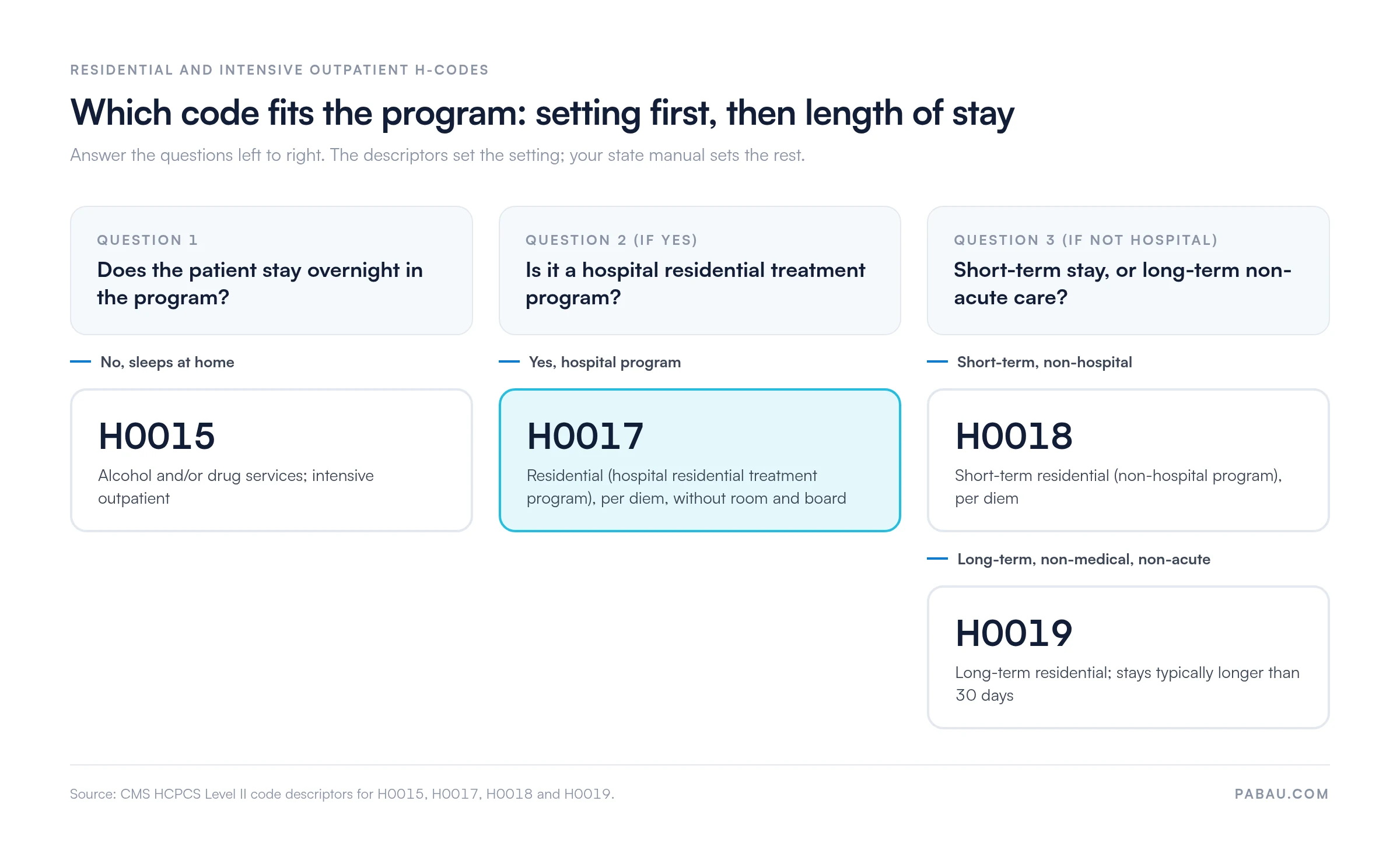
The HCPCS descriptors do not tie any of these codes to an ASAM level of care. Some state Medicaid manuals do map ASAM levels to H0017, H0018, or H0019, but that mapping is payer-specific. Check your state manual before you treat an ASAM level as the deciding factor.
H0017 bills one unit per day of residential service. Admission day and discharge day rules vary by payer, so always check the specific MCO provider manual. Common conventions include:
A 28-day residential stay typically generates 27 or 28 billable H0017 units. The difference is whether the MCO contract lets you bill the discharge date. Facilities that consistently bill 28 units for 28-day programs without checking the discharge-day rule are a predictable audit target.
Prior authorization is required before admission for H0017 in nearly all Medicaid managed care plans. A claim submitted without an active, matching authorization number is denied on the first pass and is rarely recoverable without a concurrent review appeal. The authorization process typically requires:
Concurrent review is the follow-on authorization required every 7 to 14 days during an extended residential stay. The MCO reviewer evaluates whether the patient still meets medical necessity criteria for continued residential care. Missing a concurrent review deadline can result in claim denials for the entire period between the lapsed authorization and the next approved review.
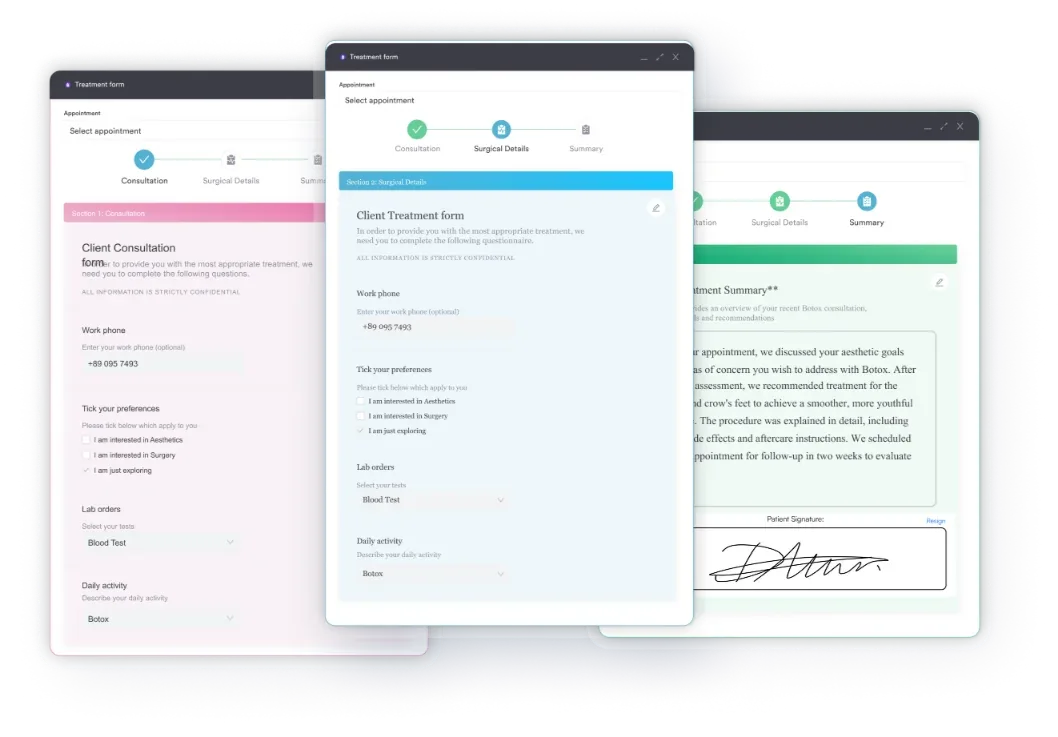
Each H0017 claim day needs daily progress notes or activity logs. They confirm the patient was present and actively engaged in the residential program. Missing a single day’s note when a payer requests records is often treated as a missing day of service and triggers a recoupment demand. Digital intake forms and a daily note template flag an undocumented day while the patient is still in the program.
Build a concurrent review calendar at admission. Log every auth expiry date and assign a staff member to submit the next review request at least 72 hours before the current authorization expires. A single missed concurrent review can result in denial of the full period between reviews, not just the missed day.
H0017 denials cluster around a predictable set of billing and documentation failures. Most are preventable before the claim leaves the facility. Effective denial management in healthcare starts with understanding which of the following patterns your facility triggers most often.
When an H0017 claim does come back denied, the CARC and RARC on the remittance name the reason. Our guide to medical billing denial codes explains the common ones and how to respond to each.
H0017 is a Medicaid-dominant code, and most commercial payers do not recognize HCPCS H-series codes. Commercial plans that cover residential SUD treatment often route claims through a third-party behavioral health administrator with its own coding rules.
A commercial plan may deny H0017 because it does not recognize the code. The Mental Health Parity and Addiction Equity Act (MHPAEA) may support an appeal. That applies when the plan covers comparable medical or surgical inpatient benefits under another code set.
Medicaid per diem rates for H0017 vary significantly by state. Rates are published in each state Medicaid fee schedule and adjusted annually. Look up the current rate through your state Medicaid agency portal. Medicaid managed care organizations negotiate separate contracted rates with facilities that may differ from the published fee-for-service rate.
Medicare generally does not cover HCPCS Code H0017. H-series codes are not on the Medicare Physician Fee Schedule. Medicare Advantage and dual-eligible special needs plans may cover Medicaid-funded benefits under plan-specific terms. Verify coverage with the plan before admitting a dual-eligible beneficiary under H0017.
Run an annual fee schedule audit across every Medicaid MCO you bill. State Medicaid rates and MCO contracted rates for H0017 are updated each fiscal year, often with little notice to providers. A rate that was accurate in January may be underpaid by July if your billing system still carries the prior year’s figure.
Hospital residential programs billing H0017 juggle prior authorizations, daily notes, concurrent review deadlines and per diem claims that run across multi-week stays. When those sit in separate spreadsheets and billing tools, a missed note or lapsed review often surfaces only when the denial arrives.
Pabau’s claims management software pulls the details already on the patient record into a pre-filled claim, then tracks its status after submission. Intake forms and daily notes live in the same record, so the billing team can confirm a day is documented before billing it.
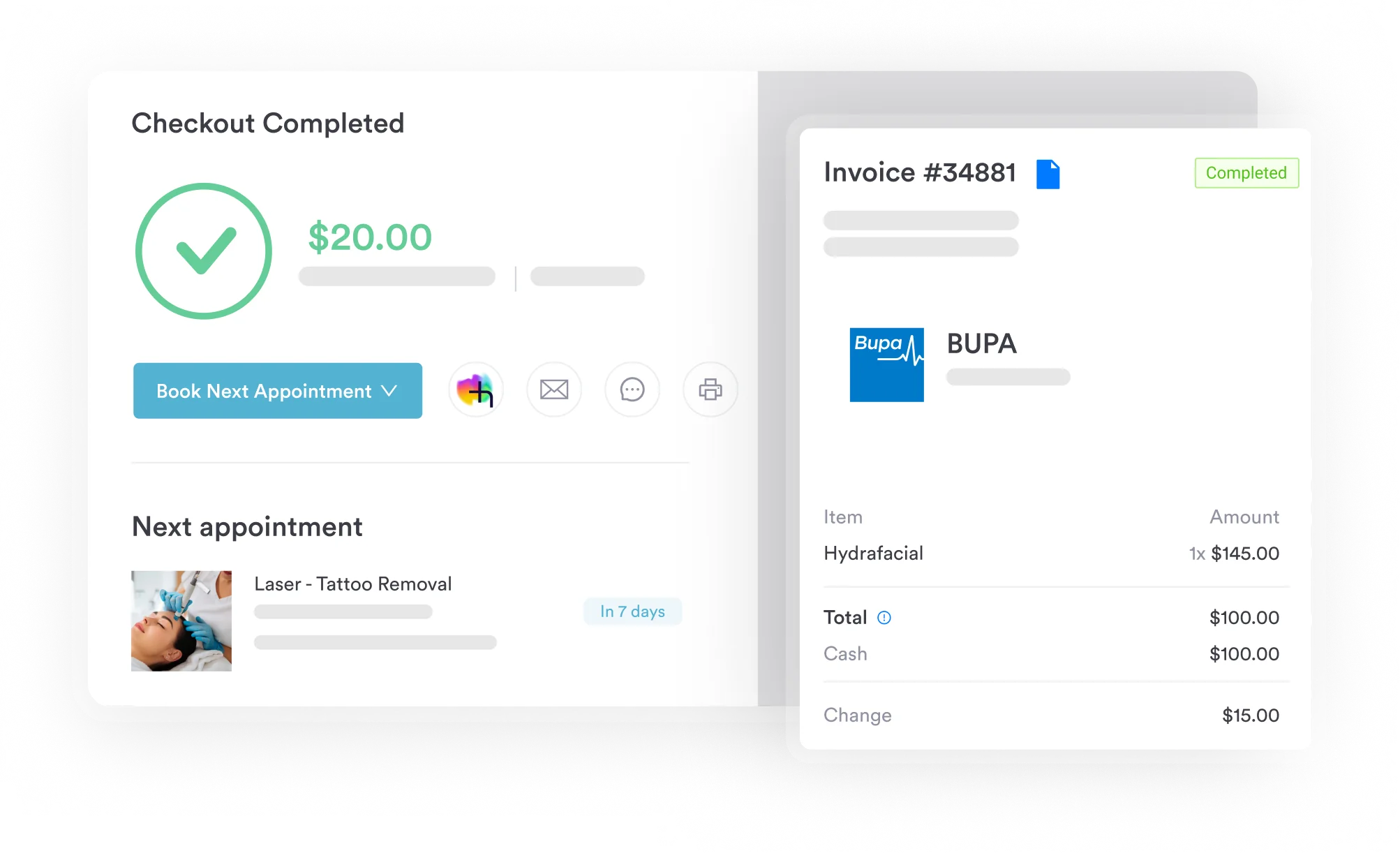
Pabau’s reporting and denial tracking show claim status and denial patterns across payers. The team sees which H0017 days are paid, pending or denied, and can chase each one inside the concurrent review cycle. That link between the clinical record and the claim is what sound revenue cycle management depends on.

Pabau keeps intake forms, daily notes and per diem claims in one patient record, so each H0017 day is documented before the claim goes out.

Confirm the program’s licensed setting before anything else. If it is not a hospital residential treatment program, H0017 is the wrong code however intensive the care, and H0018 or H0019 applies.
For a hospital program, revenue then depends on process. Build the authorization calendar at admission, write a note for every billed day, and recheck each MCO’s discharge-day and POS rules every year. A facility that holds those three habits turns most H0017 denials into rare exceptions.
To see how Pabau keeps daily notes and per diem claims in one record for a residential program, book a demo.

Need a starting point for behavioral health revenue cycle? Revenue cycle management explained covers the end-to-end billing process from eligibility through payment posting.
Dealing with frequent claim rejections? Denial codes in medical billing breaks down the most common CARC and RARC codes and how to respond to each.
Want to understand credentialing requirements for Medicaid billing? How to get credentialed with insurance companies walks through the provider enrollment process step by step.
HCPCS Code H0017 is the HCPCS Level II code for residential behavioral health treatment in a hospital residential treatment program. It is billed per diem, without room and board. Facilities use it to bill Medicaid and Medicaid managed care organizations for each day of hospital-based residential care. Non-hospital residential programs bill H0018 or H0019 instead.
Yes. Prior authorization is required before admission in nearly all Medicaid managed care plans that cover H0017. Claims submitted without an active, matching authorization number are denied on first pass. Extended stays also require concurrent review authorization, typically every 7 to 14 days.
For SUD treatment, H0017 needs a primary ICD-10-CM diagnosis from the F10.x through F19.x range. That range covers alcohol (F10), opioid (F11), cannabis (F12), sedative (F13), cocaine and stimulant (F14/F15), and polysubstance use (F19). On an SUD claim, a mental health diagnosis in the primary position is a common cause of denial.
One unit per day. H0017 is a per diem code and is never billed in hourly or fractional increments. Whether the admission date, discharge date, or both are billable depends on each Medicaid MCO’s policy. Verify it in the payer’s provider manual.
No. H-series HCPCS codes are not on the Medicare fee schedule, and Medicare does not cover H0017. Medicare Advantage and dual-eligible special needs plans may cover Medicaid-funded benefits under plan-specific terms. Verify coverage with the plan before admitting a dual-eligible beneficiary under this code.