HCPCS Code A4627: Spacer and valved holding chamber
HCPCS Code A4627: official descriptor and code definition HCPCS Code A4627 is th...

Last Updated: Oct 21, 2026
H2013 is the HCPCS Level II code for psychiatric health facility service, per diem. It reports one day of care in a facility that a state Medicaid program recognizes. California psychiatric health facilities, which provide 24-hour inpatient psychiatric care, are one example.
Medicare does not pay H2013, so state Medicaid agencies set its rate, units and modifiers. Most denials trace back to missing authorization, a missing modifier, or daily notes that do not support 24-hour care.
Let Pabau's smart automation suggest the right codes, reduce claim denials, and keep your practice compliant—effortlessly.
Automate repetitive tasks and focus on what matters most—your patients.
Reduce coding errors and ensure compliance with the latest regulations.
Clean claims, fewer denials, and faster reimbursements.
Powerful insights and reporting to help your practice thrive.
HIPAA compliant SOC 2 certified GDPR-compliant Trusted by 4,000+ clinics worldwide

H2013 reports one day of psychiatric health facility service, so each covered day is billed as one unit.
Medicare does not pay H2013 (coverage code I), so state Medicaid programs set its rates, rules and modifiers.
California Medi-Cal pairs H2013 with the HE modifier for services in a licensed psychiatric health facility.
Partial hospitalization belongs on H0035 and day treatment on H2012, so neither program should be billed as H2013.
Pabau, the practice software we build, keeps authorizations, treatment plans and daily notes on one patient record, so each billed day is easier to defend.
HCPCS code H2013 is the Level II code for psychiatric health facility service, per diem. The Centers for Medicare and Medicaid Services (CMS) added it on April 1, 2003. It belongs to the H-code series of HCPCS codes, which state Medicaid agencies use for behavioral health services.
The code describes a facility day rather than a single session. One unit equals one day of care, and the facility bills that day instead of each service delivered inside it.
A psychiatric health facility is a setting each state defines in its own licensing law. In California, it is a facility licensed by the Department of Health Care Services that provides 24-hour inpatient care for people with mental health disorders. Its required services include psychiatry, psychiatric nursing and social work.
H2013 is not a partial hospitalization code. Partial hospitalization is H0035, and behavioral health day treatment is H2012, billed per hour. Mixing these codes up is the most damaging error on an H2013 claim, because the whole claim then describes the wrong service.
As a per diem code, H2013 pays for the facility’s day of care. Which professional services that daily rate includes is a state decision. Check your state manual before adding a second claim line for the same date.
These services have their own codes and are not billed as H2013:
Acute hospital inpatient psychiatric stays follow the payer’s hospital billing rules. Those rules differ from the per diem rules for a psychiatric health facility day.
Before the first claim, find H2013 in your state Medicaid behavioral health fee schedule. Confirm the required modifier, the claim form, and whether the payer counts the discharge day as a billable unit.
Only a facility that the state licenses or certifies for this level of care can bill H2013. The facility must also be enrolled with the Medicaid program or managed care plan that pays the claim.
H2013 carries no national place-of-service rule. Your state manual sets the claim form, the place-of-service or revenue code, and the facility type the payer expects. Build those settings into the H2013 charge once, so staff never choose them claim by claim.
Modifiers tell the payer which program delivered the day. State Medicaid manuals decide which ones are required, so treat the table below as a starting point.
Attach the required modifiers to the H2013 charge template. A modifier added by hand on each claim is the one most likely to be left off.
Several H-codes describe behavioral health programs, and they differ mainly in setting and unit. The table below compares H2013 with the codes it is most often confused with.
H2013 and H2014 sit next to each other in the code set but have little in common. H2013 is a whole facility day, while H2014 is a timed skills session. Whether a payer pays both on one date depends on whether its per diem already includes skills work.
Before you pick a code, two questions settle most cases. The first is the setting, and the second is the program and its billing unit.
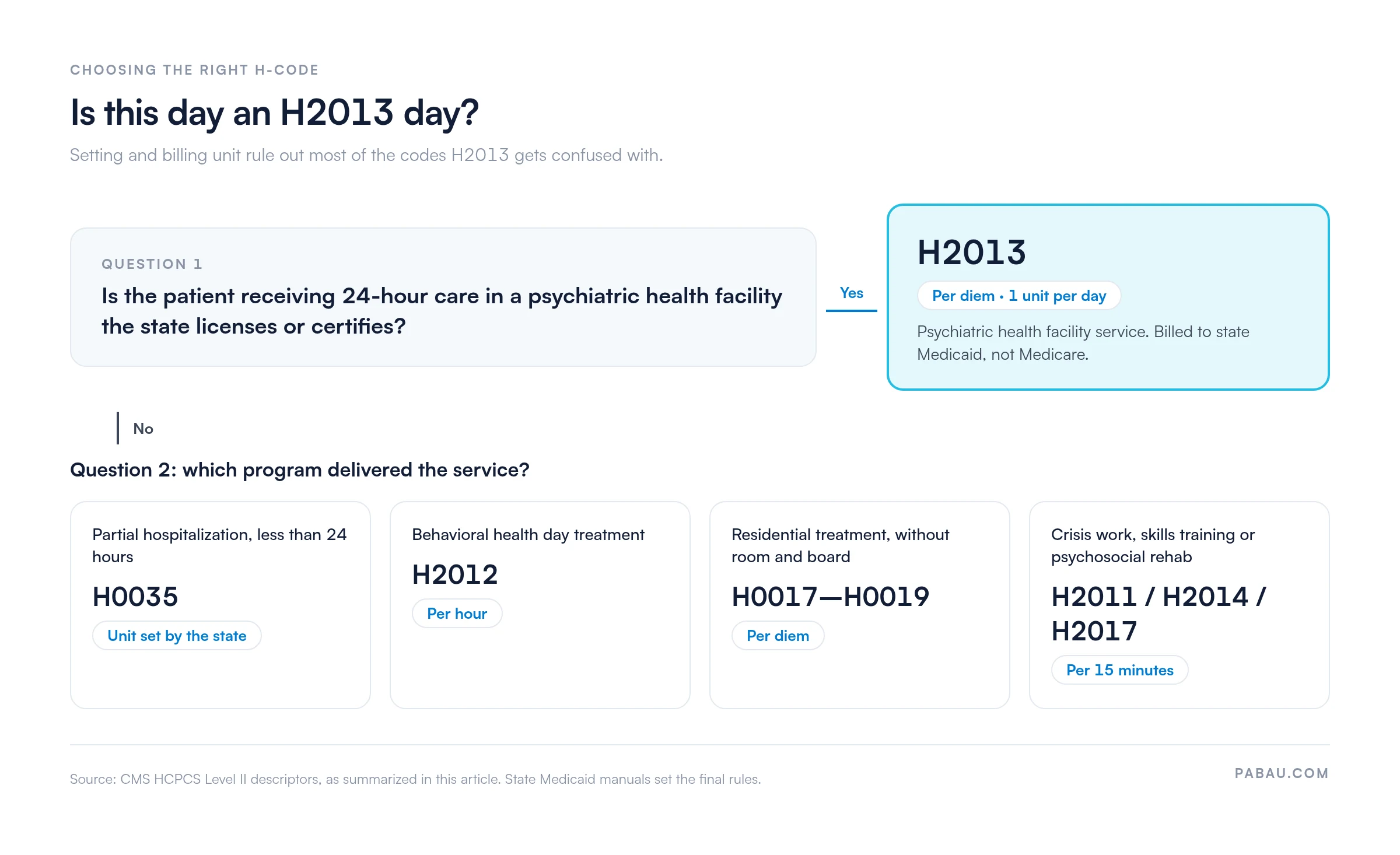
Every billed day needs its own record. An auditor should be able to match each unit to an admission, a current treatment plan and a note for that date.
The minimum record for each H2013 day, in line with standard billing compliance requirements, includes:
Leave the GAF score out of new documentation. DSM-5 dropped it in 2013, so payers now look for LOCUS, CALOCUS or another standardized functional-impairment measure.
Authorization rules for H2013 vary by state and by plan. Many payers approve the admission and then review the stay at set points. Managed care rules often differ from the state’s fee-for-service program, so confirm the timeline with each plan.
A typical request includes the diagnosis, a risk assessment, a LOCUS or CALOCUS score where accepted, prior treatment, and the expected length of stay. An authorization checklist completed at admission prevents the most common H2013 denial.
State Medicaid agencies set the H2013 rate. CMS publishes no national rate, because Medicare does not pay H-codes. Rates also differ between fee-for-service Medicaid and the managed care plans in the same state.
Search for your state Medicaid behavioral health fee schedule on the state agency website to find the current H2013 per diem rate. Cross-check it with your managed care contracts, because those rates are negotiated separately.
Most H2013 denials come from a short list of avoidable errors. Denial management strategies work best when they address each one at admission, not after the first remittance.
A clean H2013 claim depends on each of these steps happening before the claim reaches the payer. Claims management software should enforce them at charge capture, not at remittance review.
Psychiatric health facility billing breaks down when the authorization sits in one system, the census in another and the notes in a third. Pabau keeps those records on one patient file.
Treatment plans, daily notes and consent forms are stored against each patient with a dated audit trail. Your team can record the authorization number and its dates on the same file, so each billed day can be checked against them.
When a claim is ready, Pabau’s claims management pulls the data already on the record into the claim, then submits and tracks it. Your billing team checks dates and modifiers instead of retyping them.
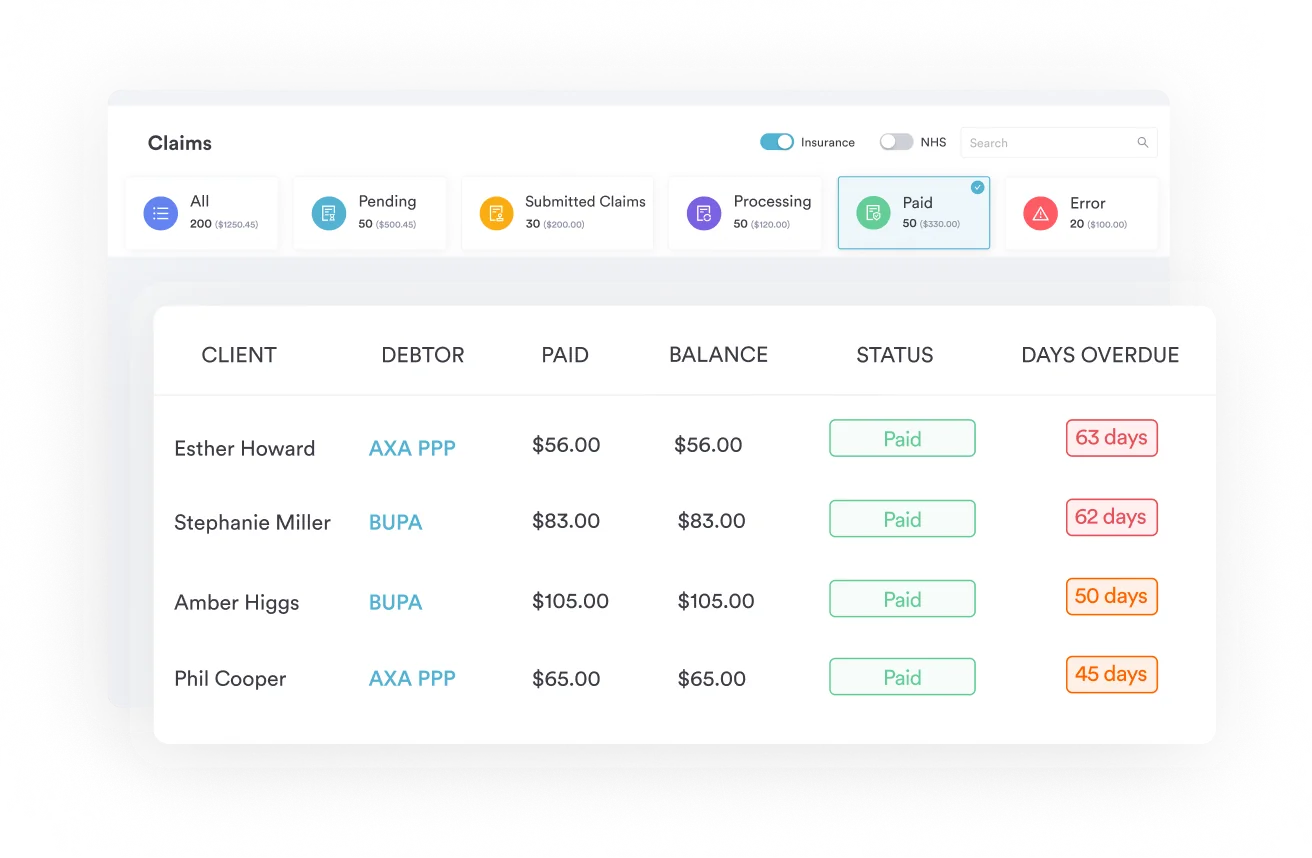

Pabau keeps authorizations, treatment plans and daily notes on one patient record, then pulls that data into each claim. Billed days match the chart.

H2013 pays for a day of psychiatric health facility care, and only where the state Medicaid program recognizes that facility type. Confirm your facility holds the license the code assumes before you bill it. A partial hospitalization or day treatment program belongs on H0035 or H2012 instead.
Once the code is right, the claim rises or falls on the record. Each unit should match an authorized date, a census entry and a note showing why 24-hour care was needed. Setting modifiers and units in the charge template removes the errors that cause most rework.
Book a demo to see how Pabau keeps authorizations, notes and claims for each facility day in one place.

Building a billing compliance program for a small facility? Medical billing compliance maps the laws and common violations to a printable checklist built on the OIG’s seven compliance elements.
Requesting authorization for an H2013 admission? The prior authorization process lays out a five-step workflow, with a request checklist and a log sheet for open requests.
Seeing the same H2013 denial more than once? Denial management in healthcare explains how to investigate, appeal and prevent denied claims when your billing team is small.
HCPCS code H2013 is the Level II code for psychiatric health facility service, per diem. It reports one day of care in a state-recognized psychiatric health facility and is billed to Medicaid, not Medicare.
No. H2013 carries Medicare coverage code I, which means Medicare does not pay it. State Medicaid programs and their managed care plans set its coverage, rates and billing rules.
One unit per day. H2013 is a per diem code, so each unit equals one day of facility care. Your payer decides how admission and discharge days are counted.
No. Partial hospitalization is H0035, mental health partial hospitalization, treatment, less than 24 hours. H2013 describes a day in a psychiatric health facility, and day treatment billed per hour is H2012.
H2013 is a per diem day in a psychiatric health facility. H2014 is skills training and development, billed per 15 minutes. One covers a whole day of care, and the other covers a timed session.
It depends on the state. California Medi-Cal pairs H2013 with modifier HE, mental health program, for psychiatric health facility services. Other states may require HA, HH or a U modifier.
Often, yes. Medicaid programs and managed care plans set their own authorization rules, review points and clinical criteria. Confirm them with the payer at admission, and record the authorization number for the claim.