CPT Code 49450: Gastrostomy tube replacement
CPT Code 49450: official descriptor and procedure overview CPT Code 49450 covers...

Last Updated: Oct 22, 2026
G0260 is the HCPCS Level II code for injection procedure for sacroiliac joint; provision of anesthetic, steroid and/or other therapeutic agent, with or without arthrography.
Hospital outpatient departments and ambulatory surgery centers report G0260, with image guidance packaged into it. Physicians bill the same injection with CPT 27096. G0259 covers SI joint arthrography alone, and neither code involves joint manipulation.
Let Pabau's smart automation suggest the right codes, reduce claim denials, and keep your practice compliant—effortlessly.
Automate repetitive tasks and focus on what matters most—your patients.
Reduce coding errors and ensure compliance with the latest regulations.
Clean claims, fewer denials, and faster reimbursements.
Powerful insights and reporting to help your practice thrive.
HIPAA compliant SOC 2 certified GDPR-compliant Trusted by 4,000+ clinics worldwide

HCPCS code G0260 reports a sacroiliac joint injection of anesthetic, steroid or another therapeutic agent, with or without arthrography.
G0259 reports SI joint arthrography alone, and neither code involves joint manipulation.
Hospital outpatient departments and ASCs bill G0260, while the physician bills the same injection with CPT 27096.
Medicare’s SI joint LCDs allow up to four therapeutic sessions per rolling 12 months, each under CT or fluoroscopic guidance.
Pabau’s claims management software submits G0260 claims and tracks their status for pain management and orthopedic practices.
HCPCS code G0260 is maintained by the Centers for Medicare and Medicaid Services (CMS) as part of the HCPCS Level II code set. Specifically, its official descriptor reads: “Injection procedure for sacroiliac joint; provision of anesthetic, steroid and/or other therapeutic agent, with or without arthrography.”
G0260 is a facility code. Accordingly, hospital outpatient departments report it under the Outpatient Prospective Payment System (OPPS), and ambulatory surgery centers (ASCs) report it on their facility claims. The physician who performs the injection bills CPT 27096 on the professional claim instead.
However, the descriptor says nothing about joint manipulation. G0260 needs an injected agent, and Medicare also needs proof in the record that CT or fluoroscopic guidance was used.
G0260 and G0259 share a site but describe different services. G0260 reports the injection of an anesthetic, steroid or other therapeutic agent. In contrast, G0259 reports sacroiliac joint arthrography, the contrast injection that images the joint.
When the physician injects contrast to confirm placement and then delivers a steroid, the facility reports G0260 alone. The descriptor already covers arthrography, so adding G0259 for the same joint duplicates the service. Instead, G0259 is kept for a session where only arthrography is performed.
The status indicators above come from the CY 2013 OPPS rule, which gave CPT 27096 status indicator B (not paid under OPPS). Indicators can change each year, so confirm the current assignment in OPPS Addendum B.
One SI joint injection usually produces two claims. The physician bills CPT 27096 under the Medicare Physician Fee Schedule, while the hospital or ASC bills G0260 for the facility side.
CPT 27096 has included imaging guidance since 2012, so the physician does not add a separate guidance code. On the facility side, however, CPT 27096 is not recognized under OPPS and is not covered on ASC facility claims.
Critical access hospitals, however, follow a different rule. Noridian’s billing and coding guidance, for instance, tells them to report CPT 27096, plus CPT 64451 for a sacral nerve block, on type of bill 85X.
The decision path below also adds the arthrography-only case and the bilateral rule for each claim type.
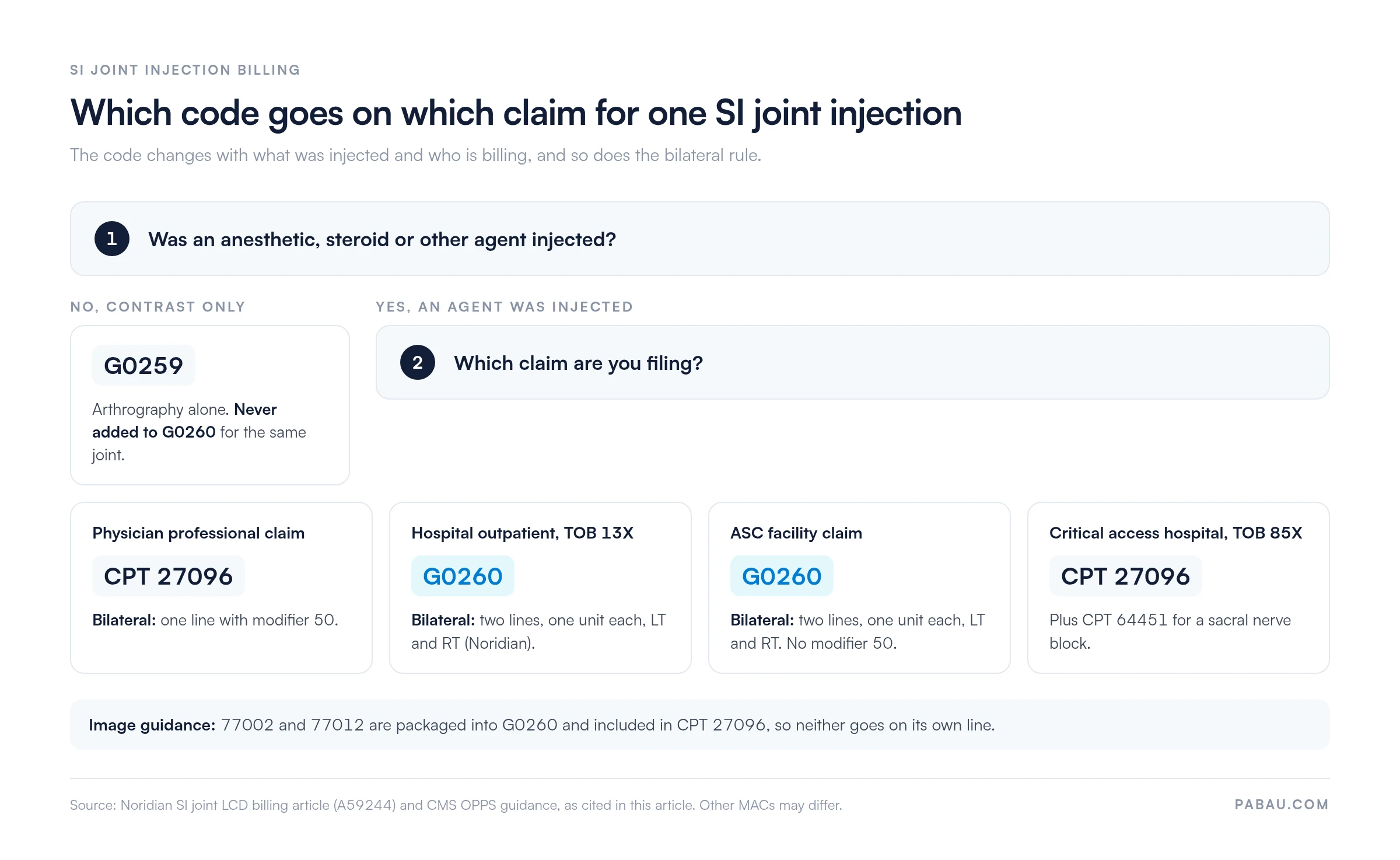
A G0260 procedure follows a defined sequence. Knowing it therefore helps billing staff check that the procedure note supports the code before the claim goes out.
Image guidance does not go on the claim as a separate line. Instead, for hospitals and ASCs, it is packaged into G0260, so guidance codes such as CPT 77002 and 77012 earn no separate payment. Likewise, for physicians, CPT 27096 already includes the guidance.
Every G0260 claim needs a supporting ICD-10-CM code, because it establishes medical necessity. Noridian’s billing article for the SI joint LCD lists four covered diagnoses for CPT 27096, 64451 and G0260. The list therefore applies only to practices billing Medicare in Noridian’s jurisdictions.
Of the four, M46.1 fits documented sacroiliitis most directly. M53.3, however, needs a note that ties the pain to the SI joint rather than the coccyx.
Nonspecific low back pain codes, such as M54.50 or M54.59, do not qualify. This is because the LCD treats SI joint injections for nonspecific low back pain, or for pain mainly above L5, as investigational. Sciatica codes also clash with its rule that pain sits below L5 without radiculopathy.
Other Medicare Administrative Contractors (MACs) publish their own billing articles, so confirm the covered-diagnosis list for your jurisdiction before submission.
Five of the seven A/B MACs adopted an LCD titled Sacroiliac Joint Injections and Procedures, effective March 19, 2023. They are CGS (L39383), Palmetto GBA (L39402), NGS (L39455), Noridian (L39462) and WPS (L39475).
Older guidance cites LCD L34443, which predates this policy family, so check the LCD your MAC publishes today before relying on any coverage rule.
Criteria every SI joint injection must meet:
Diagnostic and therapeutic injections: A diagnostic injection must produce at least 75% pain relief, measured on the same scale as the baseline. Additionally, a therapeutic injection is covered only after a qualifying diagnostic block. In addition, each repeat therapeutic injection needs at least 50% relief, or 50% better function, lasting three months or more.
Frequency limits: The LCD allows no more than two diagnostic sessions, and no more than four therapeutic sessions per rolling 12 months. A session counts once, regardless of whether one side or both sides are injected. Treatment beyond 12 months may also trigger medical review.
Limitations: Specifically, the LCD does not cover injections without radiographic guidance, biologics such as platelet-rich plasma, or radiofrequency denervation of the SI joint. Moderate or deep sedation and monitored anesthesia care are usually not reasonable and necessary.
Traditional Medicare does not require prior authorization for SI joint injections. Instead, coverage is reviewed against the LCD criteria after the service. However, the hospital outpatient prior authorization program covers facet joint interventions, which are a separate procedure family.
Medicare Advantage and commercial plans set their own rules, and those rules change often. Therefore, run insurance eligibility verification before scheduling. Also, record any authorization number on both the facility and the professional claim.
Correct G0260 billing depends on three variables: the claim type, the modifiers, and whether one or both joints were injected. Getting any one of these wrong therefore produces a preventable denial. Pabau, the practice management platform we build, lets billing teams submit claims and track their status.
G0260 is paid under OPPS in hospital outpatient departments, while ambulatory surgery centers are paid under the ASC payment system. Neither rate comes from the physician fee schedule. Instead, look up the current-quarter figure in OPPS Addendum B or ASC Addendum AA.
The physician’s payment for CPT 27096, however, does come from the CMS Medicare Physician Fee Schedule, and it varies by geographic locality.
Reviewers check G0260 claims against three records: the pre-procedure note, the procedure note, and the post-procedure record. Moreover, each one has to support the LCD criteria on its own.
Audit your SI joint procedure note template once a quarter. Reviewers check three items first: the imaging modality, the two saved views, and the pain scores before and after the injection. A note missing any of them can sink the facility claim and the physician claim together.
Most G0260 denials can be fixed, but each needs its own correction before resubmission. Structured denial management strategies help practices fix a root cause once instead of chasing each claim.
G0260 is rarely billed in isolation. For this reason, knowing which codes are separately reportable, and which are packaged, prevents both under-billing and edit denials.
Commercial payers and Medicaid programs set their own rules for SI joint injection codes. Many still follow Medicare’s split, with G0260 on the facility claim and CPT 27096 on the professional claim.
For example, Priority Health’s SI joint billing policy directs facilities to report G0260 and states that CPT 27096 is not recognized under OPPS. Other payers may handle facility claims differently, so check each contract.
Use the AAPC HCPCS code reference to cross-reference G0260 descriptors before submitting to unfamiliar payers.
SI joint injections generate two claims for one procedure, and the code differs on each. For instance, a biller who copies the physician’s 27096 onto the ASC claim creates a denial that can take weeks to surface.
For example, in Pabau, you set up each service with the billing codes your practice uses. The facility service can carry G0260 while the physician service carries CPT 27096, so neither code is retyped from memory.
Claims then go out through the integrated clearinghouse, and faster claim status tracking shows a CO-4 or CO-119 denial when it comes back. As a result, your team can spot a repeat pattern, such as a missing KX modifier, and fix the service setup once.

Pabau’s claims management tools show pain management and orthopedic practices each claim submission and its status. Your billing team can act on a G0260 denial before it becomes a write-off.

G0260 is a facility code for an SI joint injection of a therapeutic agent, while manipulation plays no part in it. Overall, the billing questions that matter are which claim carries which code, and whether the note proves image guidance.
Build the split into your workflow: G0260 for the hospital or ASC, CPT 27096 for the physician, and G0259 only for arthrography alone. Then check the session count and the covered diagnosis before scheduling, because those denials are the hardest to reverse.
Pabau helps pain management and orthopedic practices submit claims and track their status in one place. To see how it handles claims for intervention-heavy practices, book a demo.

Need a structured approach to claim denials? Denial management in healthcare covers how to build a denial-tracking workflow that prevents recurring G0260 claim errors.
Want to understand clean claim requirements? Submitting a clean claim explains the elements every claim must include before it reaches the payer.
Managing billing for a pain management or orthopedic practice? Claims management workflows in Pabau show your team claim submissions and their status.
Billing the physician side of the injection? CPT code 27096: Sacroiliac joint injection covers the professional claim, modifier 50 and the guidance rules.
Coding the diagnosis behind the injection? ICD-10 code M46.1: Sacroiliitis explains when the code applies and what the note must show.
HCPCS code G0260 covers a sacroiliac joint injection of an anesthetic, steroid or other therapeutic agent, with or without arthrography. Hospital outpatient departments and ASCs report it on facility claims. Medicare requires documented CT or fluoroscopic guidance, which is packaged into the code.
G0259 reports sacroiliac joint arthrography alone, while G0260 reports the injection of a therapeutic agent. Neither code involves joint manipulation. G0260 already includes arthrography when performed, so the facility does not add G0259 for the same joint.
Yes. ASC facility claims report a bilateral G0260 on two lines, one unit each, with LT and RT, and no modifier 50. Noridian applies the same two-line LT and RT rule to hospital outpatient claims, though other MACs may differ. The physician reports CPT 27096 with modifier 50.
Noridian’s billing article lists M43.28, M46.1, M47.818 and M53.3 as covered diagnoses for G0260. Nonspecific low back pain codes do not qualify. Other MACs publish their own lists, so confirm yours before submission.
Not on a Medicare professional claim. Physicians report the SI joint injection with CPT 27096, which includes image guidance. G0260 belongs on the hospital outpatient or ASC facility claim.