

HCPCS code E0198: Water pressure pad billing guide
HCPCS code E0198 is a water pad for a standard mattress HCPCS code E0198 is the ...

Last Updated: Oct 13, 2026
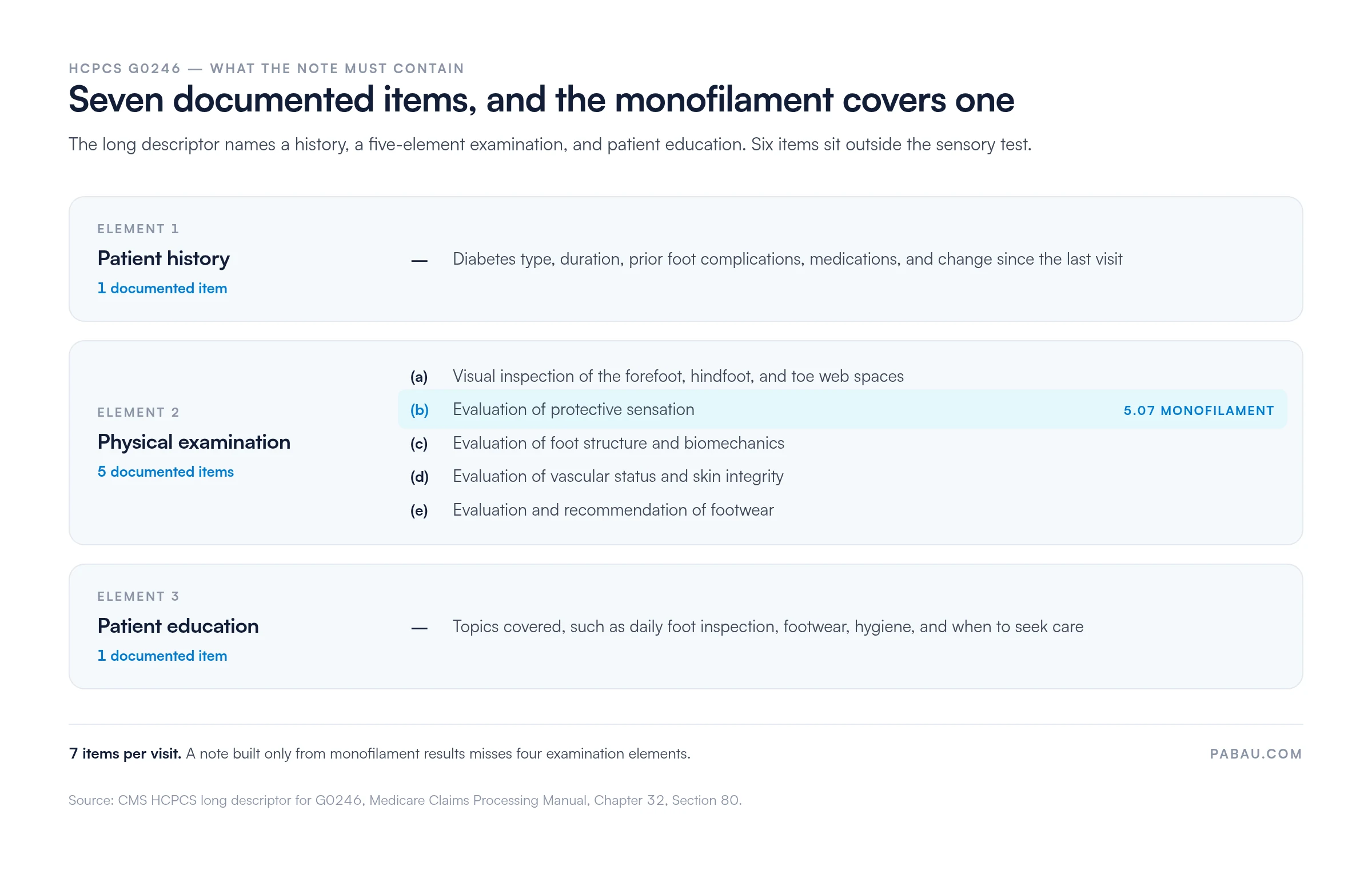
G0246 is the HCPCS Level II code for follow-up physician evaluation and management of a diabetic patient with diabetic sensory neuropathy resulting in a loss of protective sensation (lops) to include at least the following: (1) a patient history, (2) a physical examination that includes: (a) visual inspection of the forefoot, hindfoot and toe web spaces, (b) evaluation of protective sensation, (c) evaluation of foot structure and biomechanics, (d) evaluation of vascular status and skin integrity, and (e) evaluation and recommendation of footwear, and (3) patient education.
The official descriptor asks for more than a sensory test. In fact, it names a five-element physical examination, and a note built only from monofilament results falls short of the coverage criteria.
Let Pabau's smart automation suggest the right codes, reduce claim denials, and keep your practice compliant—effortlessly.
Automate repetitive tasks and focus on what matters most—your patients.
Reduce coding errors and ensure compliance with the latest regulations.
Clean claims, fewer denials, and faster reimbursements.
Powerful insights and reporting to help your practice thrive.
HIPAA compliant SOC 2 certified GDPR-compliant Trusted by 4,000+ clinics worldwide

HCPCS Code G0246 is a follow-up physician evaluation and management service for a diabetic patient with sensory neuropathy causing loss of protective sensation (LOPS).
The code requires a patient history, a five-element physical examination, and patient education. A monofilament test on its own does not satisfy it.
The five exam elements cover visual inspection, protective sensation, foot structure and biomechanics, vascular status and skin integrity, and footwear. All five belong in the note.
Medicare pays G0245 or G0246 no more often than every six months per beneficiary, whoever furnished the earlier service.
Routine foot care is G0247, a separate code that pays only when it is billed on the same date of service as G0245 or G0246.
Practice management software like Pabau structures the G0246 note so every required element is captured at the point of care, which reduces LOPS denials.
G0246 covers follow-up physician evaluation and management of a diabetic patient with sensory neuropathy resulting in loss of protective sensation (LOPS). That definition comes from the Centers for Medicare & Medicaid Services (CMS) HCPCS Level II code set. The official long descriptor requires at least three things. Specifically, those are a patient history, a physical examination with five named elements, and patient education.
CMS published these descriptors in Program Memorandum AB-02-096 and later carried them into the Medicare Claims Processing Manual, Chapter 32, Section 80. That memorandum revised G0245 and G0246 to describe them as evaluation and management codes. It also confirmed that G0246 and G0247 are physician services.
The scope of the code follows from that wording. G0246 describes a physician evaluation, so it does not cover a therapy service, and it does not cover nail or callus care.
The descriptor spells out what the physical examination has to contain. Therefore, each element below has to appear in the note for the visit to meet coverage criteria.
The history and the education sit outside that list. Altogether, the descriptor asks for seven documented items per visit.
Loss of protective sensation is a complication of diabetic sensory neuropathy, and it qualifies a patient for a specific Part B foot benefit. CMS created three HCPCS codes for distinct episodes of care inside that benefit. As a result, picking the wrong one is a common source of avoidable LOPS denials.
Key sequencing rule: G0245 carries the diagnosis of LOPS, so it comes first for a patient new to the practice. Each provider or provider group may be paid once for G0245 per beneficiary. A new provider may also be paid once for the same patient.
G0247 never stands alone. Medicare denies it when G0245 or G0246 is missing from the claim for that date of service. In turn, the denial returns claim adjustment reason code 107.
Medicare covers the LOPS evaluation as a physician service, and the national rule has three parts. First, the patient needs a documented diagnosis of diabetic sensory neuropathy with LOPS. Second, the evaluation is payable no more often than every six months. Third, coverage depends on the patient not having seen a foot care specialist for another reason in the interim.
Routine foot care is normally excluded from Medicare coverage altogether. However, peripheral neuropathy with LOPS counts as a localized illness of the feet, which falls inside the exception at 42 CFR 411.15(l)(1)(i). That regulation is what makes this G code series payable in the first place.
LOPS is diagnosed by sensory testing with the 5.07 Semmes-Weinstein monofilament. Five sites are tested on the plantar surface of each foot, following National Institute of Diabetes and Digestive and Kidney Diseases guidance. Sites are tested in random order, because sensation loss can be patchy and a rhythmic sequence gives the patient clues. In addition, heavily callused areas are avoided.
The threshold CMS cites comes from the American Podiatric Medical Association. Specifically, an absence of sensation at two or more of the five tested sites on either foot must be present and documented.
That test maps to one element of the G0246 examination, the evaluation of protective sensation. However, the other four elements still have to be documented in their own right.
CMS treats the LOPS evaluation as a physician service. Carrier guidance says these services may be furnished and billed by any Medicare provider licensed to provide them. As a result, billing under an ineligible provider type is hard to appeal without credential documentation.
Institutional claims for the LOPS codes come from a defined set of providers. The Medicare Claims Processing Manual names the following.
Verify the applicable Local Coverage Determination and MAC guidance for your jurisdiction before billing G0246 under a non-physician practitioner.
Every G0246 claim needs a diagnosis code that establishes medical necessity. CMS built the original payment edit around the ICD-9 codes 250.60 through 250.63 and 357.2. Specifically, those map to the ICD-10 diabetes-with-neuropathy codes below, and the pairing has to match the diagnosis recorded in the chart.
The polyneuropathy codes matter here, because ICD-9 357.2 covered polyneuropathy in diabetes and sat in the original CMS list. For instance, where the record documents neuropathy without further specificity, E11.40 is the usual pairing for a type 2 patient. Treat the table as a starting point rather than a final answer. Individual MACs publish their own covered diagnosis lists, so verify yours before billing. You can cross-reference pairings with the AAPC Codify HCPCS lookup tool.
The G0246 descriptor names exactly what the visit must contain, which makes the documentation test unusually literal. Seven items have to appear in the note. A chart that records the history, the sensory test, and the education still fails, because four examination elements are missing.
Practices working from paper forms or free-text notes miss elements regularly. Instead, structured digital forms built around the seven items reduce that risk at the point of care.
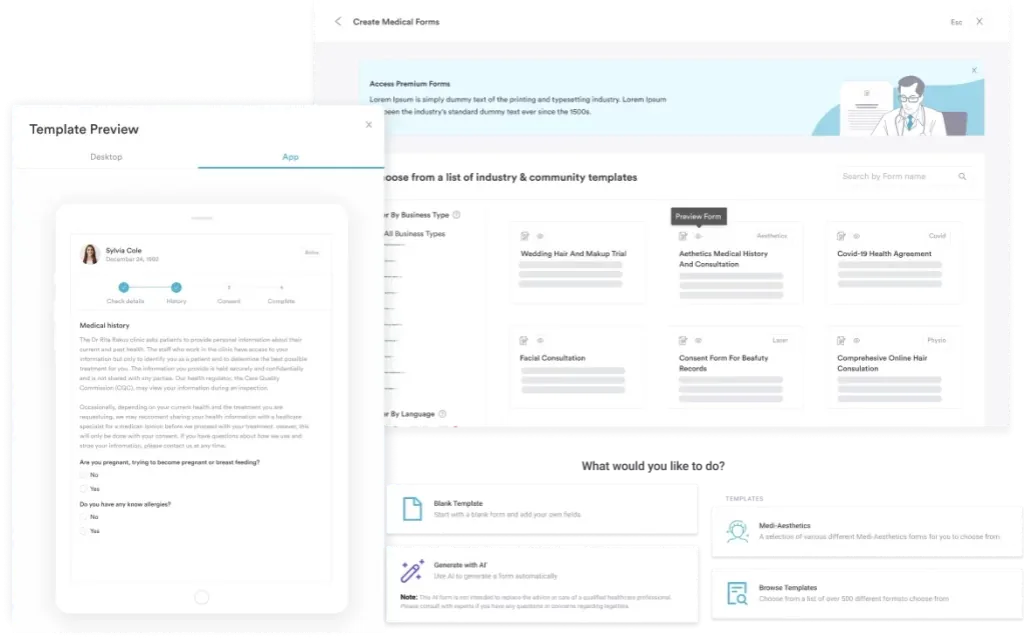
Consistent structured documentation also reduces audit exposure. Store the notes in a system that timestamps entries and blocks after-the-fact edits.
Build a G0246 visit template with seven required fields. That means the history, each of the five examination elements, and the education. Block the signature while any field is empty. That single workflow change removes the most common G0246 documentation denial.
Medicare pays G0246 under Part B through the Medicare Physician Fee Schedule (MPFS). Rates vary by geographic locality and change annually. Facility and non-facility rates differ, because the non-facility rate carries a practice expense component. In addition, G0245 and G0246 have no technical or professional component split.
Payment method depends on where the service is furnished, and CMS sets it out by setting rather than by rate.
Deductible and coinsurance apply. Medicare pays 80 percent of the lesser of the fee schedule amount or the submitted charge, and the patient covers the remainder. A rural health clinic or FQHC claim also needs a visit revenue code alongside revenue code 940. Use 520 or 521; otherwise, the line does not pay.
Not every G-code in the temporary range carries an allowance like this. HCPCS code G9920 posts at $0.00 on the claim as a quality-data line, feeding a MIPS measure instead of payment.
Always pull current rates from the CMS MPFS look-up tool for your specific locality before quoting reimbursement. Rates published in third-party coding references can lag behind the annual fee schedule update. Overall, a charge-capture process that records G0246 alongside the correct ICD-10 pairing speeds the adjudication cycle.
The place-of-service (POS) code on the claim has to match where the service was delivered. A POS mismatch is an audit red flag, and it changes the payment rate, since facility and non-facility rates differ on the MPFS.
If a podiatrist delivers the G0246 service in a hospital outpatient department, the facility rate applies even when they practice mainly in an office. Therefore, confirm the POS designation with your billing team before submitting.
The frequency rule for G0246 is national, and the Common Working File enforces it rather than leaving it to each MAC. G0245 and G0246 share one six-month clock.
The denial messages are specific enough to diagnose from the remittance. For example, a six-month edit returns reason code 96 with remark code M86. Likewise, a G0247 line missing its companion evaluation returns reason code 107.
Modifier use on G0246 is narrow. One requirement comes straight from CMS, and the rest depend on the coverage scenario in front of you.
Modifier choice follows the clinical and coverage scenario. Check your MAC’s guidance instead of appending a modifier by default.
G0246 denials cluster around a small number of repeatable errors. Fixing the error type before submission beats appealing it afterward. Specifically, the table below maps each trigger to its root cause and the prevention step.
Reviewing denial codes alongside your remittance advice shows which error type keeps recurring at your practice. Repeated denials in one category point to a workflow problem rather than a one-off mistake. As a result, getting the claim right the first time cuts rework, speeds the revenue cycle, and lowers recoupment risk.
Run a monthly audit of your G0246 denial remittances by reason code. If more than two claims per month carry the same claim adjustment reason code, the issue is systemic. Fix the workflow before resubmitting corrected claims one at a time.
A code reference tells billers what G0246 requires. In turn, practice management software like Pabau helps the documentation match that requirement at every visit, which is where LOPS denials start.
Pabau builds toward cleaner claims management by connecting clinical documentation directly to the billing workflow. When a provider finishes a G0246 note in a structured template, the billing team sees a complete dated record before the claim is generated. Pre-submission checks can flag an incomplete note, so it never reaches the payer with an examination element missing.
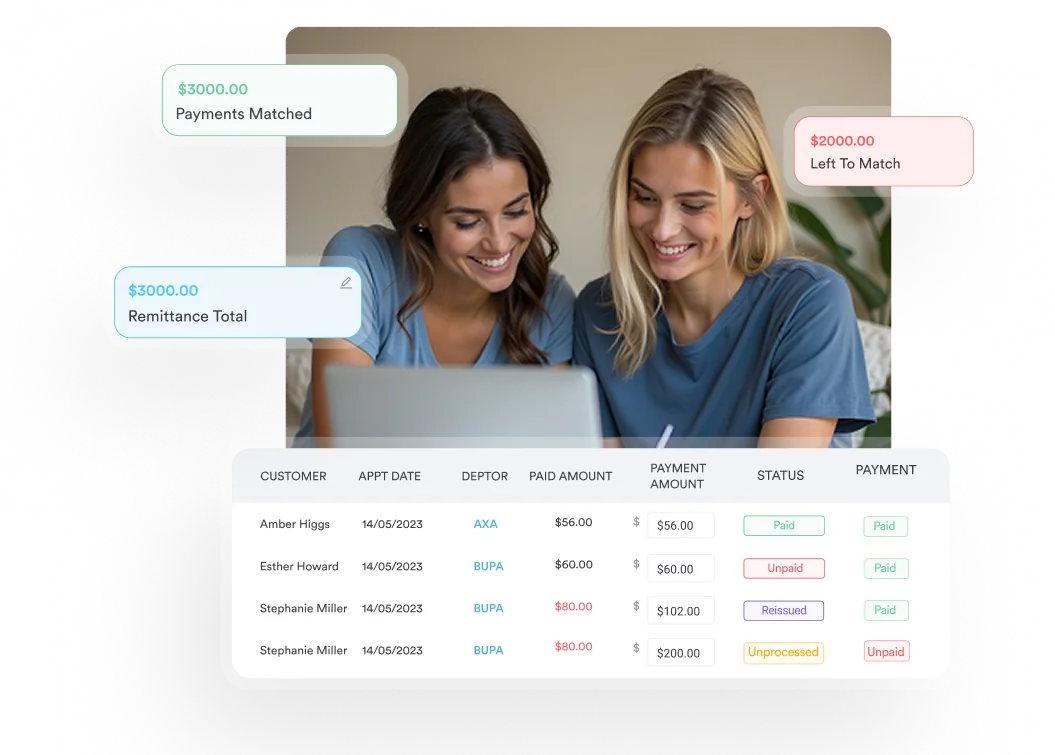
The ICD-10 pairing problem is also solvable at the workflow level. When the platform surfaces accepted diagnosis codes next to G0246, providers pick from a covered list instead of recalling codes from memory. That embedded crosswalk removes the manual lookup step where pairing mistakes creep in.
Digital medical forms at the point of care also land the education element in a structured field rather than a free-text note. For a fuller financial picture, Pabau’s reporting gives revenue cycle visibility across submitted claims, including the LOPS series.

Pabau captures the full G0246 note at the point of care and flags missing fields before submission. It connects to your billing workflow to reduce rework and speed reimbursement.

G0246 denials are largely preventable. The code sets a fixed list of requirements. Specifically, those are seven documented items, a diabetes-with-neuropathy diagnosis, a six-month interval since the last LOPS evaluation, and a place-of-service code that matches the visit. Miss one and the claim fails on an automated edit.
The examination is the part that trips practices up. In fact, five named elements sit inside it, and a monofilament result covers only one of them. Pabau’s structured note templates and claims management tools capture all seven items at the point of care, before a biller touches the claim. See how that works by booking a demo.

Need to understand how denials are tracked and resolved? Denial management in healthcare covers the full workflow from CARC code identification to corrected claim submission.
Looking for a billing compliance reference for your practice? Medical billing compliance outlines the documentation standards and audit risks practices need to manage.
Want to understand the broader revenue cycle behind HCPCS claims? Revenue cycle management explains how each stage from coding to payment affects practice cash flow.
Billing routine foot care at the same visit? HCPCS Code G0247 sets out the same-date requirement and how the two codes pay together.
HCPCS Code G0246 is the Medicare code for a follow-up physician evaluation and management visit. The patient is a diabetic with sensory neuropathy causing loss of protective sensation (LOPS). Specifically, the visit must include a patient history, a physical examination with five named elements, and patient education. Routine foot care is a different code, G0247.
No. The 5.07 monofilament test documents one of the five required examination elements, the evaluation of protective sensation. The other four cover visual inspection of the forefoot, hindfoot and toe web spaces, foot structure and biomechanics, vascular status, skin integrity, and footwear. A note that records only monofilament results does not meet the coverage criteria.
G0246 is most commonly billed under POS 11 (office) at the non-facility rate. In contrast, POS 22 and POS 19 (outpatient hospital) pay the lower facility rate. The POS code on the claim must match where the service was provided. A mismatch changes the payment rate and can trigger denial.
No modifier is needed for a standard covered G0246 claim submitted to the carrier. However, modifier 25 is required on G0245 or G0246 when it is billed with G0247 on an institutional claim. Modifiers GA, GY, and GZ apply only in Advance Beneficiary Notice and non-coverage scenarios. Verify requirements with your MAC.



