

HCPCS code E0198: Water pressure pad billing guide
HCPCS code E0198 is a water pad for a standard mattress HCPCS code E0198 is the ...

Last Updated: Oct 13, 2026
G0177 is the HCPCS Level II code for training and educational services related to the care and treatment of patient's disabling mental health problems per session (45 minutes or more).
Most denials trace to three details. The session ran under 45 minutes. The individualized treatment plan was out of date. Or the note never named the credentials of the professional who delivered the service.
Let Pabau's smart automation suggest the right codes, reduce claim denials, and keep your practice compliant—effortlessly.
Automate repetitive tasks and focus on what matters most—your patients.
Reduce coding errors and ensure compliance with the latest regulations.
Clean claims, fewer denials, and faster reimbursements.
Powerful insights and reporting to help your practice thrive.
HIPAA compliant SOC 2 certified GDPR-compliant Trusted by 4,000+ clinics worldwide

HCPCS Code G0177 covers training and educational services for patients with disabling mental health problems, billed per session of 45 minutes or more
G0177 is used in partial hospitalization programs (PHP) and intensive outpatient programs (IOP) billed under Medicare’s Outpatient Prospective Payment System (OPPS)
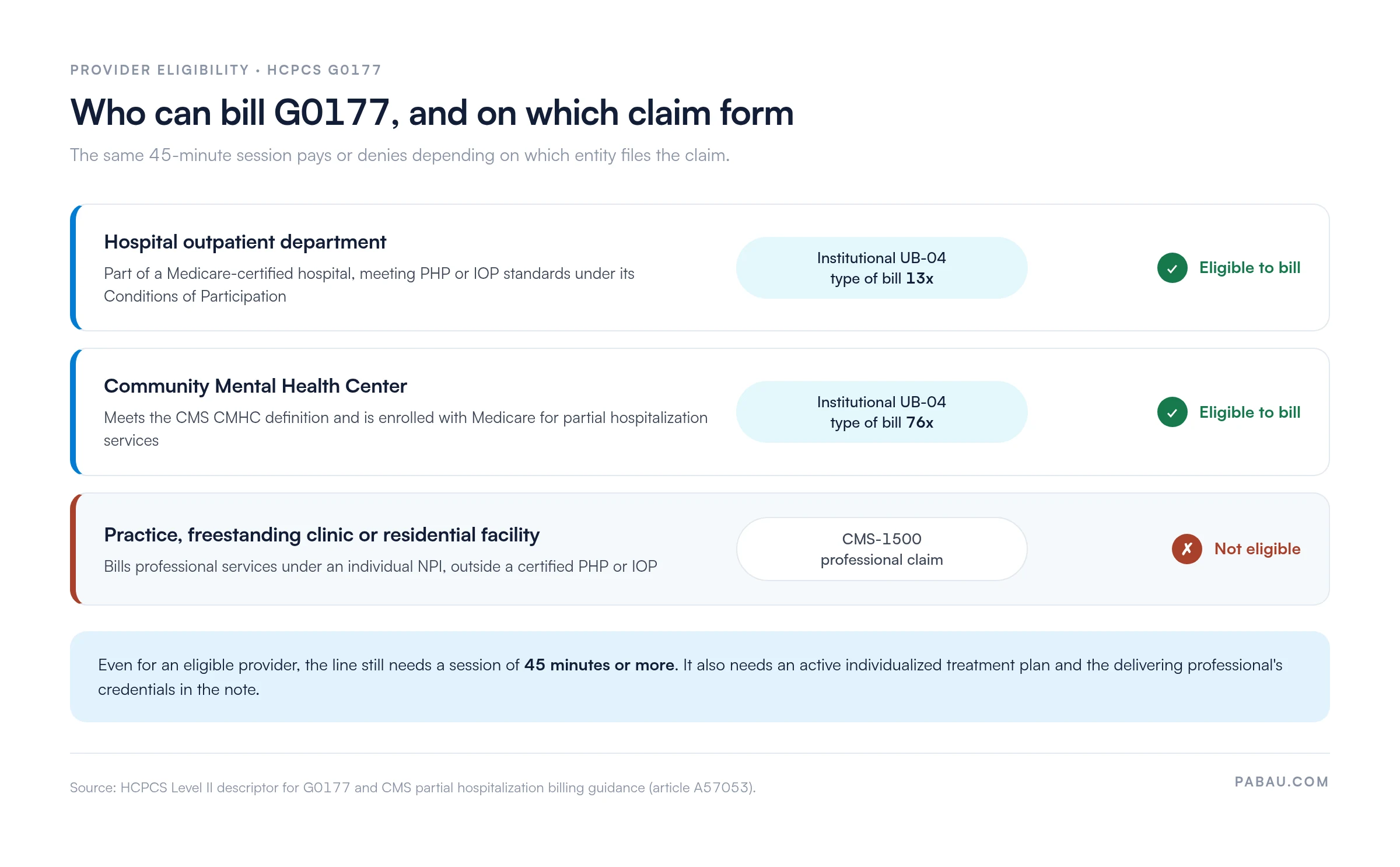
Only hospital outpatient departments and Community Mental Health Centers (CMHCs) meeting CMS Conditions of Participation can bill G0177
The facility files G0177 on an institutional UB-04 claim, so the line never appears on a CMS-1500 professional claim under an individual NPI
Most denials trace back to documentation, usually a session logged under 45 minutes, a stale treatment plan, or missing provider credentials
HCPCS Code G0177 is a Level II G-code for training and educational services for patients with disabling mental health problems. The descriptor sets the billing unit at one session of 45 minutes or more. The Centers for Medicare and Medicaid Services (CMS) maintains the code as part of the annual HCPCS Level II code release.
G0177 sits within Medicare’s psychiatric benefits and is paid under the Outpatient Prospective Payment System (OPPS). OPPS assigns payment through an Ambulatory Payment Classification (APC). The code descriptor embeds the 45-minute minimum directly, so it is a hard billing requirement rather than a clinical guideline.
Two entity types can bill G0177: hospital outpatient departments and Community Mental Health Centers (CMHCs). Both must meet CMS Conditions of Participation for their program type before Medicare will process any G0177 claim.
Individual practitioners billing under their own NPI, freestanding group practices, and residential facilities do not qualify. A Medicare-certified PHP or IOP operating under a qualified hospital or CMHC must furnish the service.
That eligibility rule also decides the paperwork. The facility bills G0177 on an institutional UB-04 claim, or its 837I electronic equivalent, under its own provider number. The line has no home on the CMS-1500 professional claim an individual clinician files. Entity type and claim type move together.
PHP is the primary setting for HCPCS Code G0177. According to the CMS Medicare Coverage Database article A57053, partial hospitalization programs provide intensive, short-term psychiatric services as a medically necessary alternative to inpatient hospitalization. G0177 covers the training and educational component of a PHP service day.
A PHP service day typically bundles multiple covered services billed under different G-codes. G0177 is one line item within that broader claim, covering the structured educational session that teaches patients skills for managing their condition. Medical necessity must be documented for each PHP day as a whole, not just for individual codes billed within it.
Medicare expanded IOP coverage as a distinct benefit category, and G0177 applies in IOP settings as well as PHP. IOP provides structured psychiatric services at a lower intensity than PHP. The Medicare IOP benefit took effect on January 1, 2024, under the Consolidated Appropriations Act of 2023. That law created a dedicated Medicare Part B IOP benefit with its own covered HCPCS code set, which includes G0177.
The key billing difference between PHP and IOP is service intensity. IOP claims carry different minimum service hours per week and may sit in different APC assignments under OPPS. Billing teams should verify current guidance from their own MAC. Local coverage determinations from contractors like Novitas Solutions may set additional conditions for IOP G0177 claims. Verify those payer rules again before each plan year.
OPPS pays G0177 using the Ambulatory Payment Classification (APC) methodology. CMS assigns an APC grouping to G0177 and sets a national payment rate. Geographic wage indices then adjust that rate for each Medicare Administrative Contractor (MAC) jurisdiction. Rates change annually with each CMS OPPS final rule, typically effective January 1.
Payment varies by locality and updates annually. Billing teams should not rely on a fixed dollar figure without verifying the current rate for their MAC jurisdiction. The rate lives in OPPS Addendum B, which CMS publishes with each hospital outpatient final rule. The wage index for your locality then adjusts it. Note that the physician fee schedule lookup does not price this code, since G0177 is paid to the facility rather than to a practitioner.
Insufficient documentation is the single most common reason G0177 claims are denied on audit. Every session billed under G0177 needs a record that satisfies the code’s session-duration requirement. It must also meet the medical necessity standard for the PHP or IOP program.
A standard session note for each session type reduces documentation errors and creates a consistent audit trail. Capture start and stop times, the patient’s response to the session, and the credentials of the professional who delivered it. Programs then meet every required element without rebuilding the note from scratch each time.
Set an automatic alert in your scheduling system to flag any G0177 session clocked at fewer than 45 minutes before the note is signed. Catching a 44-minute session at sign-off is far easier than fighting a denial 90 days later.
PHP and IOP programs rarely bill G0177 in isolation. A typical service day includes a bundle of G-codes, each covering a different modality. Understanding which codes co-exist with G0177, and which ones cannot be billed on the same day, is essential for avoiding unbundling denials. Consult the AAPC HCPCS code reference for current code descriptors and coverage notes.
G0176 is the code most frequently confused with G0177. Both codes require 45-minute minimum sessions and are used in PHP and IOP settings. The distinction is the service type: G0177 covers training and educational services, while G0176 covers activity therapy (art, music, dance, play therapies). Both can appear on the same service-day claim when a patient receives both session types.
Other G-codes serve reporting rather than payment. HCPCS code G9903 records a tobacco screening result under MIPS quality measure 226, and carriers often return it at zero dollars.
G0177 denials cluster around a small set of recurring errors. Addressing them systematically, rather than case by case after denials land, is the faster path to clean claims. The remittance advice names the reason, and the common denial codes tell you which requirement the payer thinks was missed.
Building a pre-submission checklist that flags missing elements before the claim leaves the billing office is one practical way to catch these issues. A clean claim submission process verifies session times, type of bill, provider credentials, and treatment plan currency at the same time.
Run a quarterly internal audit of your G0177 claims. Pull a sample of 20 to 30 sessions and check each one for documented start/stop times, an active treatment plan reference, and a credentialed provider. Catching a thin record before a MAC audit saves significant recovery effort.
G0177 belongs to the facility, and so does the software that bills it. A hospital outpatient department or CMHC files the code from its institutional billing system, on a UB-04 claim. Practice management software like Pabau serves private outpatient practices and files professional claims, so it does not produce that institutional claim. If you run a PHP or an IOP, the G0177 line stays with your facility billing platform.
The outpatient practices on either side of the program are a different matter. Patients usually reach a PHP or IOP through a referral from a therapist or psychiatrist, and most return to that same practice on step-down. That practice carries its own record-keeping load: intake paperwork, session notes, treatment plan updates, and the professional claims it bills under its own NPI.
Pabau keeps that side of the pathway in one patient record. Digital intake forms, structured session notes, and appointment history sit together. A clinician can see what happened before the referral and what came back afterward. Its claims management software submits the professional claims the practice files under its own NPI. Referral and step-down care then stay documented in one system.

Practice management software like Pabau gives therapy and psychiatry practices digital intake forms, structured session notes, and professional claim submission in one patient record. Referrals into a program and step-down care stay documented.

Most G0177 claims fail on detail rather than coverage. Session length, treatment plan currency, the credentials on the note, and the claim type decide whether the line pays. Fixing those at the point of service costs far less than recovering a denial 90 days later.
Eligibility is the check worth running first. Is your program inside a Medicare-certified PHP or IOP at a hospital outpatient department or CMHC? If not, G0177 is closed to you, and a different code set applies.
Outpatient therapy and psychiatry practices sit at both ends of that pathway. They send patients into a program and pick them back up afterward. Book a demo to see how Pabau keeps their intake forms, session notes, and professional claims in one record.

Billing the activity therapy code in the same program? HCPCS Code G0176 covers art, music, dance and play therapy sessions in PHP and IOP, with the same 45-minute minimum.
Billing a PHP day to a commercial payer? HCPCS Code S0201 covers partial hospitalization services as a per diem rather than a line for each session.
Want to reduce claim denials across your behavioral health program? Denial management in healthcare covers systematic approaches to identifying, tracking, and resolving recurring claim denial patterns.
HCPCS Code G0177 is a Medicare billing code for training and educational services for patients with disabling mental health problems. Each session must run 45 minutes or more. It is used primarily in partial hospitalization programs (PHP) and intensive outpatient programs (IOP) billed to Medicare under the Outpatient Prospective Payment System (OPPS).
The minimum session duration for G0177 is 45 minutes. This requirement is embedded in the official code descriptor and is a hard billing rule, not a clinical guideline. Sessions documented at fewer than 45 minutes cannot be billed under G0177 and will be denied on audit.
G0177 goes out on an institutional claim, never a professional one. A hospital outpatient department bills it under type of bill 13x, and a CMHC bills it under type of bill 76x. Both use the UB-04 form or its 837I electronic equivalent. A line submitted on a CMS-1500 professional claim under an individual NPI is rejected.
Yes, G0177 applies in intensive outpatient program (IOP) settings. Medicare expanded IOP coverage as a distinct benefit category under the Consolidated Appropriations Act of 2023, effective January 1, 2024. The 45-minute session minimum and provider eligibility requirements are the same as in PHP settings. Verify current MAC guidance for jurisdiction-specific IOP billing rules.



