HCPCS Code G0163: Skilled nursing observation and assessment
What is HCPCS Code G0163? HCPCS Code G0163 is a deleted Level II code for skille...

Last Updated: Oct 15, 2026
E0221 is the HCPCS Level II code for infrared heating pad system.
That makes E0221 a patient-liability code rather than a reimbursement code. The work shifts away from proving medical necessity. It moves to getting an Advance Beneficiary Notice, or ABN, signed before delivery. Then you bill so the denial lands on the patient rather than on your practice.
Two items decide who pays for the device. The signed notice makes the charge collectible from the patient, and modifier GA tells Medicare that the notice exists. The rest of the claim only identifies the item.
Let Pabau's smart automation suggest the right codes, reduce claim denials, and keep your practice compliant—effortlessly.
Automate repetitive tasks and focus on what matters most—your patients.
Reduce coding errors and ensure compliance with the latest regulations.
Clean claims, fewer denials, and faster reimbursements.
Powerful insights and reporting to help your practice thrive.
HIPAA compliant SOC 2 certified GDPR-compliant Trusted by 4,000+ clinics worldwide

HCPCS Code E0221 is a valid, active Level II code for an infrared heating pad system billed as durable medical equipment.
Traditional Medicare never pays E0221, because National Coverage Determination 270.6 non-covers infrared therapy devices nationwide.
No diagnosis code unlocks payment, since LCD L33825 and Policy Article A52477 both list their ICD-10-CM tables as N/A.
Bill E0221 with modifier GA once the patient signs an Advance Beneficiary Notice, or GZ when no notice was obtained.
Practice management software like Pabau validates claim data before submission, then tracks claim status and reconciles payments in one place.
HCPCS Code E0221 is the Level II code assigned to an infrared heating pad system. The device is a pad, or a set of pads, holding diodes that emit infrared or near-infrared light, plus a power source. The HCPCS system, run by the Centers for Medicare and Medicaid Services (CMS), classifies it as durable medical equipment within the E0200-E0239 range.
Unlike a standard electric heating pad, an infrared pad emits wavelengths intended to penetrate tissue more deeply. That claim is exactly what Medicare examined and rejected. The code exists so the item can be identified on a claim, not because the claim will be paid. That distinction is where billing this code starts.
Traditional Medicare Part B does not cover HCPCS Code E0221 anywhere in the country. National Coverage Determination 270.6, Infrared Therapy Devices, took effect on October 24, 2006 and non-covers these devices nationally.
The reasoning is blunt. CMS found no indications for which infrared therapy devices have been shown to have any therapeutic effect. The device and its related accessories are therefore denied as not medically reasonable and necessary, under section 1862(a)(1)(A) of the Social Security Act.
No review has reopened that decision since 2006. The record shows only ICD-10 conversion and routine maintenance revisions, and those revisions state that they do not alter coverage policy. Reading a recent revision date as a softening of the rule is a costly mistake.
Local coverage policy follows the national decision rather than qualifying it. LCD L33825, Infrared Heating Pad Systems, applies across all four DME MAC jurisdictions and mirrors the NCD. Policy Article A52477 confirms that E0221 sits inside the scope of that NCD. Neither document leaves a covered pathway open, which is why compliance work on this code centers on patient notice rather than medical necessity.
There is no list of diagnosis codes that supports medical necessity for E0221. Medicare recognizes no medically necessary use of the device, so no diagnosis can establish coverage.
LCD L33825 carries the two ICD-10-CM headings that DME local coverage determinations normally use. Both are marked N/A. Policy Article A52477 does the same for its own supporting-diagnosis section. Both lists are empty by design, rather than out of date or awaiting an update.
A claim carrying M54.50, M79.7, or G89.29 gets the same result as a claim carrying none of them. So does a site-specific joint pain code from the M25.5- range. Diagnosis specificity still matters for the medical record. It does not change the payment.
Read those two policy documents yourself before you trust any vendor’s E0221 diagnosis crosswalk. Several published lists of approved diagnoses for this code are circulating, and none of them trace back to LCD L33825. A crosswalk you cannot source to the policy is a liability, not a shortcut.
Traditional Medicare pays nothing for E0221, so the DMEPOS fee schedule is not the figure that decides what your practice collects. The patient pays, and the amount is whatever you charge and they agree to in advance.
That moves the price conversation into the delivery appointment. Set the charge, write it on the Advance Beneficiary Notice as your estimate, and get the signature before the device leaves your hands. There is no deductible or coinsurance calculation to run, because there is no allowed amount to apply them to.
Tracking these lines separately also keeps them out of your denial metrics. An expected denial on a non-covered item is not a revenue cycle failure, and mixing the two hides the denials worth investigating.
Do not build an E0221 workflow around a fee schedule lookup. Build it around the Advance Beneficiary Notice. The signature you collect before delivery is the only thing standing between an expected denial and a write-off.
National non-coverage binds traditional Medicare, not every payer. Some Medicare Advantage plans and state Medicaid programs take their own position, and a few commercial policies do too. Verify in writing before the device is supplied, because a verbal confirmation will not survive a dispute.
Documentation for E0221 protects your right to bill the patient. It will not produce a payment from traditional Medicare. Treat the file as a liability record rather than a medical necessity file, and it becomes much shorter.
PDAC coding verification does not belong on that list. Verification is a product-level decision about which HCPCS code a device fits, issued once to the manufacturer rather than per claim. It confirms the code, and it never creates coverage.
Holding these records together is simpler with claims management software that validates claim data before submission and tracks each claim after it goes out. Storing the notice, the order, and the delivery receipt on the patient record turns an audit response into a lookup. Those records also have to stay secure and retrievable, because a payer request can arrive years after delivery.
A superbill that records the E0221 line, the GA modifier, the signature date, and the delivery confirmation gives you one document to hand a reviewer. It also keeps the patient invoice consistent with the remittance, which is the practical test on a non-covered item.
This is a non-covered DME workflow, not a medical necessity workflow. Every step exists to move liability to the patient cleanly and to close the claim quickly.
If no notice was obtained, submit with GZ instead of GA. GZ tells Medicare you expected the denial and did not notify the patient. That makes the amount your write-off, so the notice is worth chasing before the device leaves the building.
Modifier selection on E0221 decides who absorbs the cost. It does not decide whether Medicare pays, because that answer is already fixed by the national determination. The choice turns on one document, and it has two outcomes.
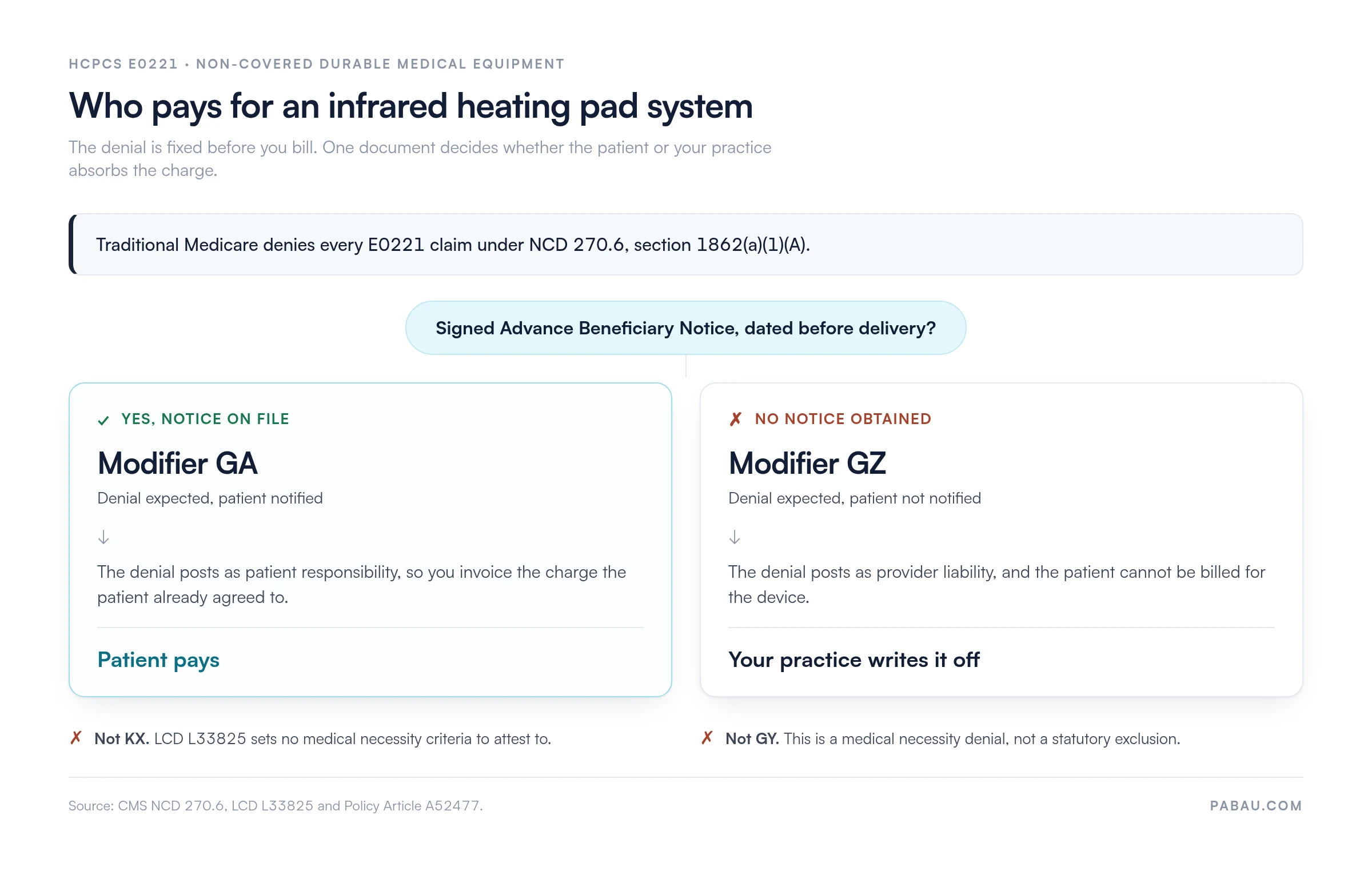
The KX row is where E0221 claims go wrong most often. Suppliers copy a workflow from a covered heat therapy code, attach KX, and attest to criteria that do not exist. That attestation is a False Claims Act exposure on a claim that was never going to be paid.
Neighboring codes in the E0200-E0239 range describe genuinely different devices, and some of them are covered. Picking the wrong one misdescribes the item on the claim. The AAPC HCPCS code range lookup is a useful reference for the full grouping.
Do not reach for E1399 to sidestep the non-coverage. Billing miscellaneous DME for a device that meets the E0221 descriptor misdescribes the item. The claim still fails once a reviewer identifies what was supplied.
The denial itself is the expected outcome on this code, so it is not the error. The errors that cost money are the ones that leave your practice holding the bill. Sound denial handling on this code happens before delivery, not after the remittance arrives.
Reading the reason codes still matters, even when the denial is expected. A GA line that posts as provider liability rather than patient responsibility points to a modifier or notice problem worth fixing that week. Matching the denial codes on the remittance against NCD 270.6 tells you which of the two went wrong.
Run a three-item check on every E0221 line before it goes out. A signed notice dated before delivery, modifier GA on the claim, and no KX anywhere on it. Those three items decide whether the patient or your practice pays for the device.
A non-covered code like E0221 usually lives in three places at once. The signed notice sits in a paper file, the practitioner’s order sits in the chart, and the claim sits in a clearinghouse portal. When a patient queries the invoice six weeks later, someone has to reassemble all three.
Practice management software like Pabau keeps them in one record. The patient file holds the signed notice, the order, and the delivery confirmation. The evidence behind a patient charge becomes one lookup rather than a search across systems.
Pabau’s claims management also validates claim data before submission, tracks each claim’s status afterward, and reconciles payments as they post. On an E0221 line that means you watch the expected denial land, confirm it posted as patient responsibility, and raise the invoice the same day.

Pabau validates claim data before submission and tracks every claim’s status. Payment reconciliation then shows you when a non-covered line like E0221 is ready to invoice the patient.

E0221 is a code you will bill and never get paid for by traditional Medicare. Once you accept that, the workflow gets simpler rather than harder. The Advance Beneficiary Notice replaces the medical necessity file, GA replaces KX, and the patient replaces the payer.
The risk on this code is an unsigned notice, a KX attestation that cannot be true, or a fabricated diagnosis crosswalk. Each of those turns a routine expected denial into a write-off or a compliance problem.
Teams handling E0221 alongside a wider claims portfolio need one view of both. Pabau’s claims management validates claims before submission, tracks their status, and reconciles payments as they post. Book a demo to see how Pabau keeps a non-covered DME line and its patient invoice in step.

Need to understand how clean claims reduce denials? Clean claim submission guide walks through what makes a claim clean and why it matters for first-pass acceptance rates.
Want to track and resolve DME claim denials systematically? Denial management in healthcare covers root-cause analysis, appeal workflows, and tracking denial patterns by code.
Looking for a framework to verify eligibility before every claim? Insurance eligibility verification explains the process, timing, and documentation needed before DME items are dispensed.
HCPCS Code E0221 is the Level II durable medical equipment code for an infrared heating pad system. The device uses diodes that emit infrared or near-infrared light. The code is active and billable, but traditional Medicare does not pay for it.
No. Traditional Medicare Part B non-covers E0221 nationwide under National Coverage Determination 270.6, effective October 24, 2006. CMS found no indication for which infrared therapy devices have a demonstrated therapeutic effect, so claims are denied as not reasonable and necessary. Some Medicare Advantage plans take a different position, so verify with the plan.
None. LCD L33825 lists both its supporting and non-supporting ICD-10-CM tables as N/A, and Policy Article A52477 does the same. No diagnosis code makes E0221 payable under traditional Medicare. Published crosswalks naming codes such as M54.50 or M79.7 for this code do not match the policy.
Keep a signed Advance Beneficiary Notice dated before delivery, plus a Standard Written Order from the treating practitioner. You also need supporting medical records, proof of delivery, and the price the patient agreed to. Certificates of Medical Necessity no longer apply, since CMS discontinued CMNs for durable medical equipment on January 1, 2023.
Issue an Advance Beneficiary Notice before delivery. Then bill E0221 with modifier GA on an 837P or CMS-1500 claim, using place of service 12 for the home. Use GZ instead if no notice was obtained. Never use KX, because LCD L33825 sets no medical necessity criteria to attest to.
E0221 is the specific code for an infrared heating pad system. E1399 is the miscellaneous durable medical equipment code, for items with no specific code. Billing E1399 for a device that fits the E0221 descriptor misdescribes the item. It also does not create coverage, because the device itself is what NCD 270.6 non-covers.