

CCSD code G5100: Bypass of duodenum billing guide
CCSD code G5100 bills a bypass that leaves the duodenum in place CCSD code G5100...

Last Updated: Oct 16, 2026
E0190 is the HCPCS Level II code for positioning cushion/pillow/wedge, any shape or size, includes all components and accessories.
Let Pabau's smart automation suggest the right codes, reduce claim denials, and keep your practice compliant—effortlessly.
Automate repetitive tasks and focus on what matters most—your patients.
Reduce coding errors and ensure compliance with the latest regulations.
Clean claims, fewer denials, and faster reimbursements.
Powerful insights and reporting to help your practice thrive.
HIPAA compliant SOC 2 certified GDPR-compliant Trusted by 4,000+ clinics worldwide

HCPCS code E0190 describes a positioning cushion, pillow, or wedge of any shape or size, classified as Durable Medical Equipment (DME) under HCPCS Level II.
Medicare Part B may cover E0190 when medical necessity is documented; claims must be submitted to the DME MAC, not the Part B physician contractor.
The most common denial reason is an incomplete or unsupported Certificate of Medical Necessity (CMN) or written order; missing documentation is the leading cause of rejected E0190 claims.
Pabau’s claims management software connects clinical documentation directly to billing entries, reducing the manual handoff that causes DME denials.
HCPCS code E0190 is the standard billing code for a positioning cushion, pillow, or wedge of any shape or size, including all components and accessories. The code sits within HCPCS Level II, the Healthcare Common Procedure Coding System maintained by the Centers for Medicare and Medicaid Services (CMS). HCPCS Level II covers supplies, equipment, and non-physician services not covered by standard CPT codes.
Most denials trace back to one root cause: using E0190 without confirming the item’s classification. It may qualify under the “any shape or size” catch-all, or it may belong under a more specific wheelchair cushion code.
The phrase “any shape or size” is the key differentiator. E0190 is a catch-all for general positioning aids used in bed or on a surface. It does not apply to wheelchair seat cushions, which fall under the E2600 series and require separate coding based on complexity and materials. When in doubt about classification, the CMS HCPCS overview provides the authoritative category breakdown.
Medicare Part B may cover HCPCS code E0190 as DME when a physician or treating practitioner documents medical necessity. Coverage is administered by the regional DME MAC, not the standard Part B carrier. The four DME MAC jurisdictions are Jurisdiction A (Noridian), Jurisdiction B (CGS), Jurisdiction C (CGS), and Jurisdiction D (Noridian).
Practices billing HIPAA-compliant documentation workflows for DME need to confirm their DME MAC jurisdiction before submitting. Submitting to the wrong contractor is a common and easily preventable denial trigger.
Medical necessity is the gateway to reimbursement. Without documented clinical justification, even a correctly coded E0190 claim will be denied. CMS and most commercial payers require that the positioning cushion, pillow, or wedge serve a therapeutic function directly related to a diagnosed condition.
Solid patient compliance documentation in the clinical record strengthens the medical necessity argument at audit. This matters most for physical therapy practices, where positioning equipment often supports a documented rehabilitation plan. Coders should review the treating clinician’s notes before submitting, confirming the diagnosis and functional limitation are explicitly stated.
Whether E0190 requires a formal Certificate of Medical Necessity (CMN) or a standard written order depends on the applicable LCD and payer policy. CMS does not currently list E0190 as requiring a CMS-prescribed CMN form on its mandatory CMN list. DME MACs may still require detailed written orders that functionally serve the same documentation purpose. Verify with the applicable DME MAC before each submission, as requirements can change with LCD revisions.
With built-in stock tracking, every brace or device billed under these codes is deducted from inventory automatically.
The 2026 Medicare DME fee schedule allowable for E0190 varies by locality and DME MAC jurisdiction. Exact reimbursement amounts are published annually by CMS and should be verified against the current DMEPOS fee schedule before billing. Rates change each calendar year and can differ between rural and non-rural areas within the same jurisdiction.
Use the CMS Physician Fee Schedule lookup tool or the DMEPOS fee schedule file, published on the CMS website. This retrieves the current locality-specific rate for E0190. The national average allowable for general positioning cushions under Medicare has historically been modest, reflecting the relatively low unit cost of the equipment category.
Pairing HCPCS code E0190 with a supported ICD-10-CM diagnosis code is essential for medical necessity validation. Payers cross-reference the submitted diagnosis against the stated clinical rationale for the equipment. A mismatch or an unsupported code is one of the most frequent denial triggers on DME claims.
Thorough ICD-10 diagnosis coding practice applies across DME claims just as it does in other billing contexts. The table below lists the most commonly paired codes, though the correct diagnosis must always reflect the patient’s documented condition.
Always use the most specific ICD-10-CM code available. A general “unspecified” code may prompt additional documentation requests from the DME MAC. The diagnosis code must match the physician’s written order and the clinical notes in the medical record.
Before submitting an E0190 claim, cross-reference the ICD-10 diagnosis code against the applicable DME MAC’s LCD (if one exists for positioning equipment in your jurisdiction). Some LCDs publish an explicit list of covered diagnosis codes. Submitting a diagnosis not on that list requires a written explanation of medical necessity attached to the claim.
Incomplete documentation is the leading cause of E0190 claim denials. Both the ordering physician and the DME supplier bear documentation responsibilities. Missing information in either set of records can trigger a denial or recoupment at audit. That risk runs especially high for occupational therapy practices issuing positioning equipment as part of a rehabilitation plan.
Digital digital forms and structured clinical notes reduce the risk of missing elements. Practices using paper-based workflows are more vulnerable to missing documentation because there is no systematic check before the item is dispensed. Integrating compliance management software into the billing workflow creates an audit trail that supports both initial claims and appeals.
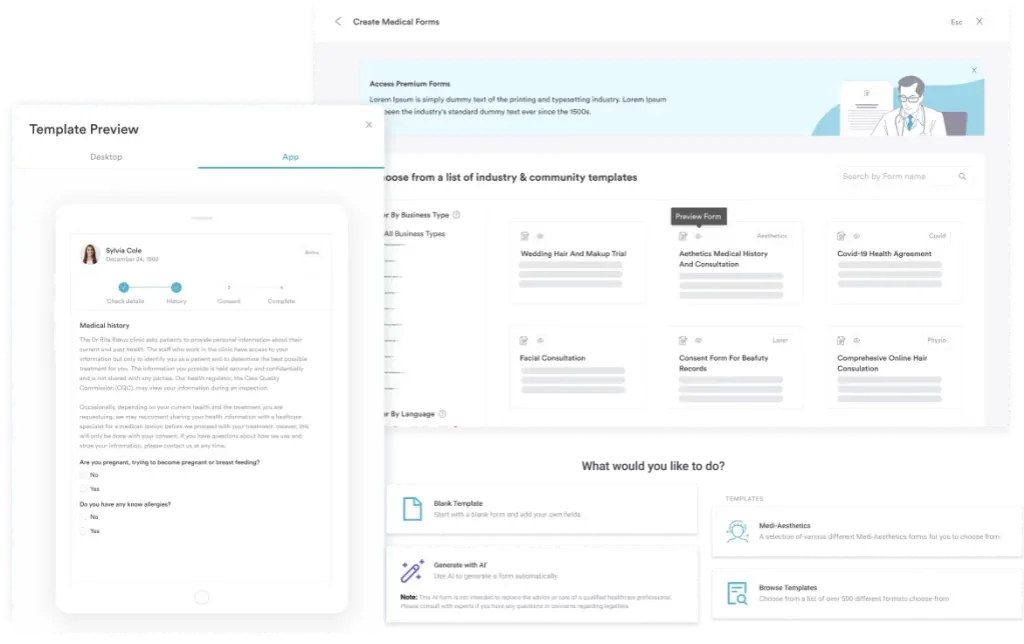
Practices that manage medical forms at their healthcare practice through integrated platforms can attach clinical notes and written orders directly to the billing entry. This reduces the chance of submitting an E0190 claim without the supporting documentation already on file.
Billing E0190 correctly requires coordinating the ordering physician, the DME supplier, and the claims submission workflow. Missing a single step is enough to generate a denial. The sequence below applies to Medicare billing; commercial payer steps may vary.
Connecting clinical documentation to billing entries through medical practice management software reduces the manual handoff between the written order and the submitted claim. Practices billing DME at scale benefit most from this integration.
HCPCS modifiers clarify the circumstances of delivery and affect both coverage determination and payment amount. The wrong modifier on an E0190 claim can trigger an automatic denial or an overpayment demand.
Under traditional Medicare fee-for-service, E0190 is not currently on CMS’s DMEPOS Prior Authorization Required list. However, Medicare Advantage plans and commercial payers may require prior authorization at their discretion. Always verify with the specific payer before dispensing the item.
CMS periodically updates the prior authorization required list for DME. Check the current list on CMS.gov or through your DME MAC’s website. A supplier that dispenses E0190 without required prior authorization in a Advantage plan risks full claim denial with no appeal pathway.
Medicaid coverage for HCPCS code E0190 varies significantly by state. Each state Medicaid agency sets its own DME coverage policies, fee schedule rates, and prior authorization requirements. Some states cover positioning cushions with minimal documentation; others exclude certain items or require prior authorization for all DME.
As a general rule, state Medicaid fee schedule rates for E0190 are lower than Medicare allowable amounts. Suppliers billing Medicaid should consult the applicable state Medicaid fee schedule and coverage policy directly. State Medicaid provider portals typically publish current fee schedules and prior authorization requirements by HCPCS code.
DME claims for positioning equipment have a higher denial rate than many other HCPCS categories. This is largely because the documentation burden is distributed across the ordering physician and the supplier. When either party falls short, the claim fails.
Appealing a denied E0190 claim is possible but requires a complete documentation package. The first level of appeal (redetermination) must be filed within 120 days of the denial date. Using HIPAA-compliant documentation workflows from the outset makes assembling that package faster and more reliable.
Choosing between E0190 and a more specific positioning or cushion code is one of the most common coding decisions in DME billing. The table below covers the most frequently referenced alternatives and helps distinguish when each code applies. For a broader view of procedure code reference guides across specialties, Pabau’s coding resource library covers multiple code sets.
The key rule: E0190 is for general positioning in bed or on a surface. Any cushion or positioning item used in a wheelchair has its own dedicated code in the E2600 series. Billing E0190 for a wheelchair cushion is a coding error that will be caught at claim edit or audit. Verify code selection using the AAPC HCPCS Level II code lookup or the PGM Billing HCPCS lookup tool. For a free programmatic code lookup, the NLM HCPCS Level II API offers direct access to CMS code data. A coding error surfaces as a cash flow problem weeks later, which is why the healthcare revenue cycle is measured end to end.
Pressure risk sometimes calls for a full bed surface instead of a positioning aid. E0196 covers a gel pressure mattress that replaces the bed mattress rather than lying on top of it.
Many practices track the written order, diagnosis code, and delivery confirmation for DME items like E0190 across separate paper files or disconnected systems. Coders then have to manually match each piece before submitting a claim. A missing signature or an unmatched diagnosis code often surfaces only after the payer denies the claim.
Practice management software like Pabau keeps the written order, the ICD-10 diagnosis, and the billing entry in one patient record. When a coder pulls up the claim, the diagnosis and modifier are already attached to the correct HCPCS code. Nothing has to be located separately before submission.
That connection is what cuts DME denial rework. The documentation a payer asks for during an audit is already stored against the claim, not scattered across paper files.

Pabau connects clinical notes directly to billing entries, so the written order, diagnosis, and HCPCS code are always aligned before submission. See how integrated claims management reduces rework for practices billing DME and specialist codes.

Most E0190 denials are preventable. The code itself is straightforward. The risk lives in missing documentation, wrong code selection, and missing modifiers. A written order that predates delivery, a supported ICD-10 diagnosis, and the correct NU or RR modifier are the three non-negotiable elements on every claim.
Keep the written order, the ICD-10 diagnosis, and the delivery confirmation attached to the claim before it goes out, and most denials never happen. Book a demo to see how Pabau keeps DME documentation and billing in sync for practices submitting E0190 and other DMEPOS codes.

Billing a surgical tray claim? Surgical tray billing guide explains why Medicare often excludes this code or bundles it into the global surgery payment.
Billing non-sterile glove supplies? Non-sterile gloves billing guide covers DME MAC verification for Medicare and the VA reimbursement rate per 100.
Billing another DME respiratory code? E0471 covers respiratory assist devices and follows the same DME MAC jurisdiction rules as E0190.
Coding a panniculitis-related diagnosis? L52 covers erythema nodosum, a condition sometimes paired with therapeutic positioning claims.
Billing a spinal orthosis instead? L0457 follows similar DME MAC documentation and proof-of-delivery rules.
HCPCS code E0190 describes a positioning cushion, pillow, or wedge of any shape or size, including all components and accessories. It is a Level II HCPCS code classified as Durable Medical Equipment (DME). DME suppliers use it to bill Medicare, Medicaid, and commercial payers for positioning aids that prevent pressure injuries or provide therapeutic support.
Bill E0190 by obtaining a written order from the treating physician before delivery, then verifying the patient’s DME benefit eligibility. Next, select a supported ICD-10-CM diagnosis code and append the correct modifier: NU for new purchase or RR for rental. Submit the claim to the correct DME MAC jurisdiction based on the patient’s permanent residence. Retain the written order, proof of delivery, and clinical notes for seven years.
Medicare Part B may cover E0190 when medical necessity is documented and the item is ordered by a treating physician for a covered clinical indication. Coverage is subject to DME MAC jurisdiction-specific LCD policies and supplier enrollment requirements. The supplier must be enrolled in DMEPOS and meet all accreditation standards for Medicare payment to apply.
Commonly paired ICD-10-CM codes include pressure ulcer codes (L89.xxx), paraplegia codes (G82.20), post-surgical positioning indications, and retinal detachment codes (H33.009) for post-vitrectomy face-down positioning. The correct code must reflect the patient’s documented diagnosis and functional limitation, not a generic code chosen to satisfy payer requirements.
The modifier NU (new equipment) applies when the item is sold outright, which is the most common scenario for positioning cushions. RR (rental) applies when the item is rented. UE (used durable medical equipment) applies to used items. Rental of low-cost items like E0190 is uncommon because CMS classifies inexpensive routinely purchased DME as eligible for outright purchase only.
Under traditional Medicare fee-for-service, E0190 is not currently listed on the CMS DMEPOS Prior Authorization Required list. However, Medicare Advantage plans and commercial payers may require prior authorization independently, so suppliers should verify payer-specific requirements before dispensing. Always check the current CMS prior authorization list, as it is updated periodically.



