CPT Code 51705: Change of cystostomy tube, simple
CPT Code 51705 at a glance CPT Code 51705 reports a simple change of a cystostom...

Last Updated: Oct 16, 2026
E0110 is the HCPCS Level II code for crutches, forearm, includes crutches of various materials, adjustable or fixed, pair, complete with tips and handgrips.
One unit of E0110 covers two crutches, while E0111 covers a single forearm crutch. Medicare claims need NU or RR, plus KX when the LCD criteria are met. A Standard Written Order replaced the Certificate of Medical Necessity in 2023, so no CMN is required.
Let Pabau's smart automation suggest the right codes, reduce claim denials, and keep your practice compliant—effortlessly.
Automate repetitive tasks and focus on what matters most—your patients.
Reduce coding errors and ensure compliance with the latest regulations.
Clean claims, fewer denials, and faster reimbursements.
Powerful insights and reporting to help your practice thrive.
HIPAA compliant SOC 2 certified GDPR-compliant Trusted by 4,000+ clinics worldwide

HCPCS Code E0110 covers one pair of forearm (Lofstrand or elbow) crutches, so one billing unit equals two crutches.
Medicare Part B covers E0110 as durable medical equipment when the records document ambulatory dysfunction that meets the Canes and Crutches LCD criteria.
Every E0110 claim needs NU (purchase) or RR (rental), plus KX when the supplier attests that the LCD criteria are met.
A Standard Written Order replaced the Certificate of Medical Necessity in 2023, so no DME MAC asks for a CMN on crutches.
Claims management software such as Pabau checks each claim for missing details before it’s sent, so E0110 claims go out complete the first time.
HCPCS Code E0110 is part of the CMS HCPCS Level II code set. Its official descriptor reads: Crutches, forearm, includes crutches of various materials, adjustable or fixed, pair, complete with tips and handgrips. The unit of service is one pair.
Tips and handgrips are included in the base allowance. Billing replacement tips (A4637) or handgrips (A4636) alongside a new pair is unbundling.
A forearm crutch has a cuff that wraps around the user’s forearm instead of a pad that rests under the armpit. That design separates it from an axillary (underarm) crutch. Lofstrand crutch, elbow crutch, and Canadian crutch are all names for the same device.
E0110 belongs to the E0100–E0159 walking aids range of DME supplier HCPCS codes, alongside canes, walkers, and walker attachments.
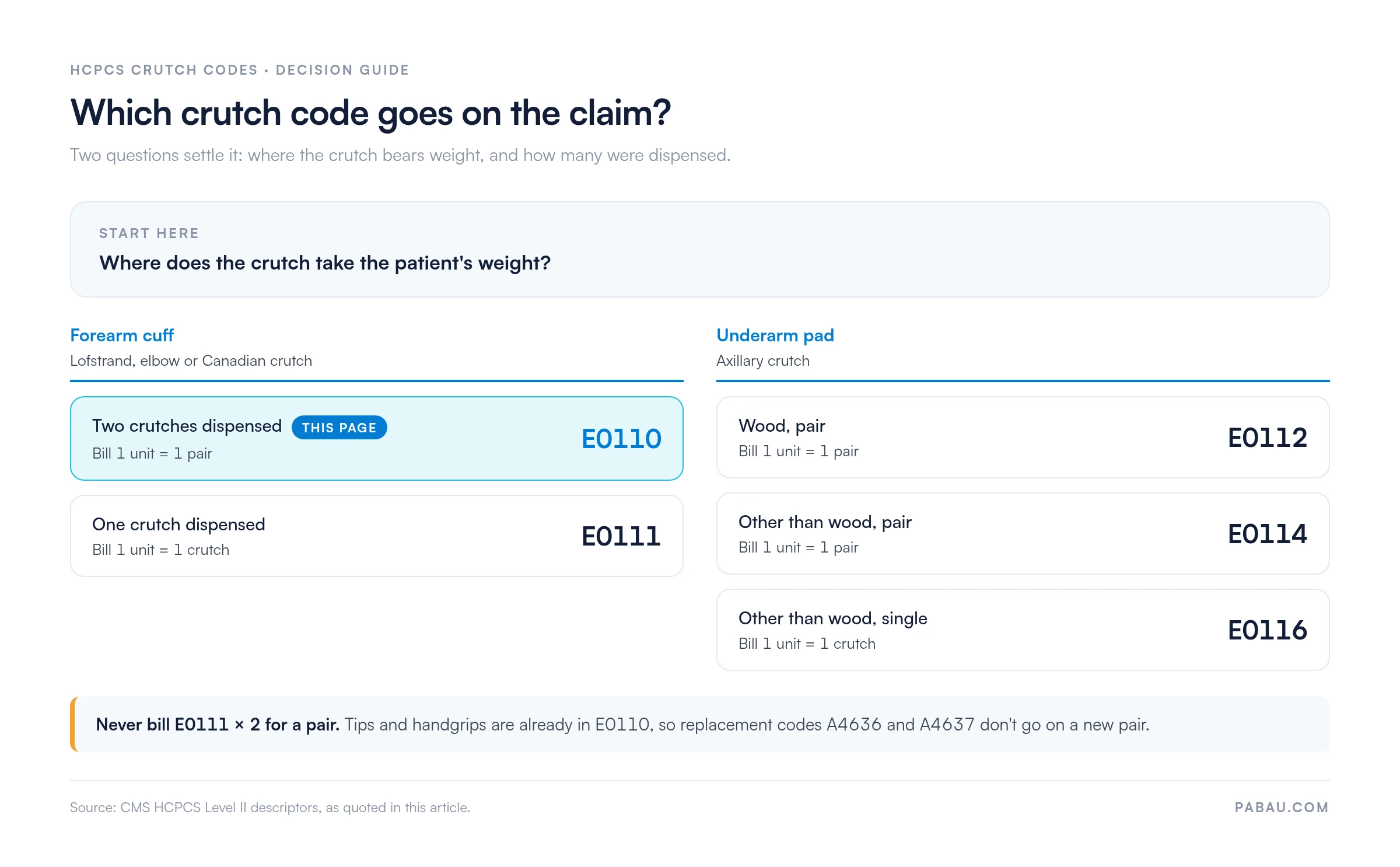
The practical rule: if a patient is given two forearm crutches, bill E0110 once. If one crutch is provided (for example, a patient with single-arm use), bill E0111 once. Billing E0111 twice to represent a pair is a common coding error that triggers medical review.
E0110 fits a patient whose ambulatory dysfunction calls for the added forearm support of a Lofstrand crutch. The device must also be medically necessary for safe walking. Forearm crutches are commonly ordered after surgery, for long-bone fractures, and for neuromuscular conditions that affect gait.
Medical necessity is judged against the Canes and Crutches Local Coverage Determination (LCD L33733), which every DME MAC applies. Conditions that commonly support E0110 claims include the following.
The ICD-10-CM code on the claim must reflect the patient’s specific diagnosis and, where possible, laterality. The table below lists commonly paired diagnosis codes. Check each one against the LCD before you dispense.
A diagnosis code that the LCD doesn’t support is one of the top denial triggers for E0110.
Billing E0110 under Medicare Part B starts with DMEPOS supplier enrollment, and each claim goes to the DME MAC for the patient’s home address. DME billing software that checks each claim for missing details cuts manual errors on E0110 submissions. These are the steps for submitting a clean claim.
Every E0110 claim sent to Medicare needs a modifier for the payment category, purchase or rental. When the supplier attests to the coverage criteria, KX goes on too. Missing modifiers are a primary cause of Medicare DME claim rejections.
Always append both NU (or RR) and KX on the same claim line. Without KX, the claim processes with no coverage attestation and often comes back as non-covered. Check your DME MAC’s billing guide for jurisdiction-specific modifier stacking rules.
Medicare Part B covers forearm crutches as durable medical equipment under Section 1861(s)(6) of the Social Security Act. Coverage follows the Canes and Crutches LCD in the beneficiary’s jurisdiction. Two contractors run the four DME MAC jurisdictions: Noridian handles A and D, and CGS handles B and C.
The LCD criteria are the same across jurisdictions, but each MAC publishes its own billing guidance. DME claims also follow different rules from the medical billing workflows used for professional services, and those rules shape E0110 reimbursement.
Key Medicare coverage rules for E0110:
Documentation decides whether a denied E0110 claim can be won on appeal, and the record must exist before the item is dispensed. Good medical billing compliance means assembling this checklist before submitting any DME claim.
The E0100–E0159 range covers canes, crutches, and walkers, and neighboring codes often differ by a word or two. The table below shows when to use E0110 instead of its closest neighbors. It includes the axillary crutch codes and the replacement codes for tips and handgrips.
The most important distinction for coders: if the device rests under the arm, it is an axillary crutch (E0112 through E0117). If it has a forearm cuff, it is a forearm crutch (E0110 or E0111). Mixing up the two is a routine source of claim rejections.
Check the current descriptor in the AAPC HCPCS code lookup when choosing between adjacent E-codes. The decision guide below maps both questions, cuff or underarm and pair or single, to the code that belongs on the claim.
E0110 claims have predictable denial patterns. Good denial management in healthcare deals with them in the ordering and documentation workflow, well before an appeal.
Medicare DME denials follow a five-level appeals process. When an E0110 claim was denied for missing paperwork, redetermination (Level 1) or reconsideration (Level 2) usually settles it.
For a denial based on missing chart notes, ask the ordering practitioner for an addended note. It should document the visit date, the diagnosis, and the clinical reason for forearm crutches. Attach it at Level 1.
Run a monthly audit of your E0110 claims against the KX modifier. Pull every E0110 claim from the previous 30 days and confirm each one carries NU or RR plus KX. Claims missing KX are still correctable via replacement claim submission before the timely filing deadline.
The E0110 denials in this guide start before the claim is sent: a missing KX modifier, two units for one pair, or an unsigned order. Catching them by hand means rereading each claim line against the LCD and the order.
Pabau, the practice management platform we build, scrubs each claim for missing or invalid details before it reaches the clearinghouse. A claim with a problem is flagged Needs action, and the Fix button takes your biller straight to the field. In the US, eligibility checks run through Claim.MD, so coverage questions get answered before the crutches are dispensed.
Once the DME MAC pays, electronic remittance advice (ERA) files settle against each invoice. An E0110 claim that’s still unpaid stands out on the claims dashboard, well inside the 120-day redetermination window.
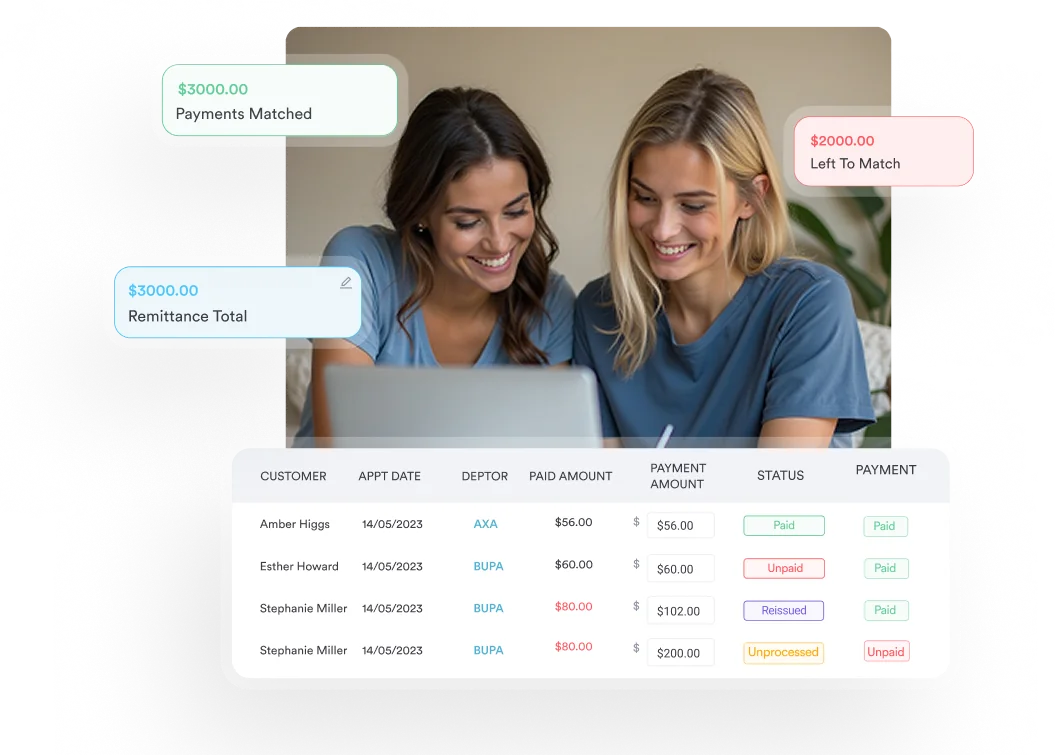

Pabau checks each claim for missing or invalid details before submission. It then tracks the claim to payment, so crutch claims stop coming back for paperwork.

Most E0110 problems come down to paperwork: a second unit, a missing KX, or an order that doesn’t match the claim. The clinical case for forearm crutches is usually the easy part.
So build the unit rule, the modifier pair, and the SWO check into your billing template, and appeals become rare. The setup takes a few minutes per code family and pays back on the first denial your team never has to work.
Book a demo to see how Pabau checks each DME claim for missing details before your team submits it.

Billing non-wood underarm crutches instead? HCPCS code E0114: Non-wood underarm crutches walks through the axillary pair code, its modifiers, and coverage.
HCPCS Code E0110 is the durable medical equipment code for a pair of forearm crutches, also called Lofstrand or elbow crutches. The pair includes tips and handgrips and suits patients whose ambulatory dysfunction needs forearm support on both sides.
E0110 covers a pair of forearm crutches, so one billing unit equals two crutches. E0111 covers a single forearm crutch. Bill E0110 once when two crutches are dispensed, and E0111 once when only one is provided.
Yes. Medicare Part B covers forearm crutches as durable medical equipment when the patient’s records document ambulatory dysfunction. The claim must also meet the Canes and Crutches LCD criteria for the patient’s DME MAC jurisdiction.
The main modifiers are NU for a new purchase, RR for a rental, and KX when the supplier attests the LCD criteria are met. GA shows an Advance Beneficiary Notice is on file. GZ means the item is expected to be denied and no ABN was obtained. Most claims carry NU and KX together.
The most common reasons are a missing KX modifier, a diagnosis the LCD doesn’t cover, and two units billed for one pair. Missing chart notes and an incomplete Standard Written Order also trigger denials. No claim needs a Certificate of Medical Necessity, because CMS retired CMNs on January 1, 2023.
E0110 covers forearm crutches, which use a forearm cuff and have no underarm pad. E0112 through E0117 cover axillary crutches, which rest under the patient’s arm. A forearm cuff points to E0110 or E0111, and an underarm pad points to a code from E0112 to E0117.
A standard rigid walker without wheels is billed under E0130. A folding wheeled walker is E0143, and E0149 is the heavy-duty wheeled walker with a higher weight capacity. Neither wheeled code depends on the number of wheels. Use a walker code when the patient needs a walker frame instead of crutches.