

HCPCS code E0198: Water pressure pad billing guide
HCPCS code E0198 is a water pad for a standard mattress HCPCS code E0198 is the ...

Last Updated: Oct 13, 2026
C1887 is the HCPCS Level II code for catheter, guiding (may include infusion/perfusion capability).
The pairing is where most C1887 lines come unstuck. The catheter went in and the procedure went fine. Then the claim bounces, because the note never named the device or the CPT companion code never made it onto the bill.
So start with the descriptor itself, which covers more ground than most billers expect.
Let Pabau's smart automation suggest the right codes, reduce claim denials, and keep your practice compliant—effortlessly.
Automate repetitive tasks and focus on what matters most—your patients.
Reduce coding errors and ensure compliance with the latest regulations.
Clean claims, fewer denials, and faster reimbursements.
Powerful insights and reporting to help your practice thrive.
HIPAA compliant SOC 2 certified GDPR-compliant Trusted by 4,000+ clinics worldwide

HCPCS code C1887 reports a guiding catheter, and the descriptor allows for infusion or perfusion capability.
The code belongs on hospital outpatient and ambulatory surgical center facility claims, never on a physician office claim.
Medicare packages C1887 into the payment for the primary procedure, so the line rarely adds money on its own.
Most C1887 denials trace back to a missing CPT companion code or a procedure note that never names the catheter.
Practice management software like Pabau keeps procedure records and claim submission in one place, so billers work from the clinical note.
C1887 covers a guiding catheter used in a hospital outpatient department or an ambulatory surgical center. The parenthetical in the descriptor, “may include infusion/perfusion capability”, is permissive rather than required. One code applies whether or not your catheter has that extra function. The CARC denial code list is short enough to learn, and most rework traces to a handful of entries.
C-codes sit inside HCPCS Level II, and CMS maintains them for facility device reporting. They don’t appear on physician office claims or Part B professional claims.
If your practice bills professional services only, C1887 will never reach your worklist. The CMS HCPCS overview sets out how the series is maintained.
A guiding catheter earns C1887 whenever it supports a separately billed procedure in one of those two settings. The catheter creates the path. Balloons, stents, wires and microcatheters all travel down it to reach the target vessel.
The code describes the device, not the work. The CPT code on the claim carries the procedure itself.
Nothing about the code is procedure-specific. Whatever the guiding catheter is doing, in a hospital outpatient department or an ASC, C1887 is the line that reports it.
Usually nothing extra. Medicare packages device C-codes into the Ambulatory Payment Classification, or APC, that pays for the primary procedure. The cost of the catheter already sits inside that payment.
C1887 did once carry device pass-through status, and that expired at the end of 2002. It has been a packaged line ever since. Anyone expecting a separate dollar amount against it is reading the wrong payment rule.
Because CMS builds next year’s rates from this year’s claims. Every packaged C-code line feeds the cost data behind APC weights. Leave the device off and you understate what the procedure really costs your facility.
There’s a practical reason too. Payer audits compare the procedure note against the billed lines. A note describing a guiding catheter with no matching device line invites a question you don’t want.
Rates also move every year and vary by wage index, so no fixed figure belongs in an article like this one. The CMS hospital outpatient regulations page carries the current final rule and its addenda.
Fewer than you’d think. C1887 is a supply line, so most of the modifier work on a cath lab claim happens on the procedure codes around it. Check each payer’s facility billing guide before you attach anything.
That last row trips people up. CMS retired -FB and -FC on hospital outpatient claims on January 1, 2014. Device credits moved to value code FD, paired with condition code 49, 50 or 53. ASCs kept the modifiers, so the same credit gets reported two different ways depending on the setting.
Commercial payers and Medicaid managed care plans write their own rules here, and they don’t have to match Medicare. Keep each contract’s modifier requirements somewhere your billers can find them in seconds. A shared drive nobody opens doesn’t count.
Some temporary HCPCS series run in the opposite direction. The S-series code S0800 for LASIK is excluded by Medicare as elective refractive surgery, so it goes to commercial and vision plans.
Pull the cath lab supply log for one busy day and set it next to the claims that went out. Count the guiding catheters opened, then count the C1887 units billed. If those two numbers don’t match, the problem sits upstream of billing, in how the device gets recorded during the case.
Two things. A guiding catheter was used, and it was used for the procedure you billed. Every item below serves one of those jobs.
Device records also have to survive an audit years later.
Run this over any claim carrying a device line. It takes about a minute, and it catches most of what would otherwise come back.
Four turn up again and again.
A device line with no procedure. The CPT code got dropped, or it’s sitting in coding review while the rest of the claim goes out. That line will not process on its own.
One unit for three catheters. Cath lab teams often open more than one guiding catheter during a case. The claim has to say so, and the supply record has to back it up.
A note that just says “catheter”. Generic wording leaves the coder guessing between C1887 and a neighboring code. Guessing is how the wrong C-code lands on a claim.
The wrong form for the setting. An ASC claim built like a hospital outpatient claim comes back before anyone reads the codes. Storing device records centrally.
Guiding catheters sit in a wider family of cardiovascular device C-codes, and picking the wrong one is an easy mistake on a busy day. These are the codes that most often appear on the same claim.
Two more sit close by. C1876 covers a non-coated stent with its delivery system.
Verify descriptors before you lean on any crosswalk. The AAPC HCPCS lookup is quick for a single code, and CMS reissues the HCPCS file on a quarterly update cycle.
Build a one-page device matrix for your cath lab or IR suite. List each device you stock, its C-code, and the CPT codes it usually accompanies. Review it every January against the new OPPS Addendum B, before the first claim of the year goes out.
Most C1887 problems start long before billing sees the claim. The catheter detail lives on a paper log in the lab. The note gets dictated later, and the biller rebuilds the device line from memory.
Pabau is an all-in-one practice management system, and the part that matters here is where the record sits. What the team recorded during the case is what the coder reads afterward. No retyping, no second log to reconcile.
From there, claims management handles the submission side. It checks the insurer fields on a claim before it goes out, then tracks what comes back. A rejection lands as a task on someone’s list, rather than a surprise at month end.
The same setup works well outside the cath lab. Teams in IV therapy practices and longevity practices wrestle with the same consumable records, even though C-codes stay in the hospital outpatient and ASC lanes.
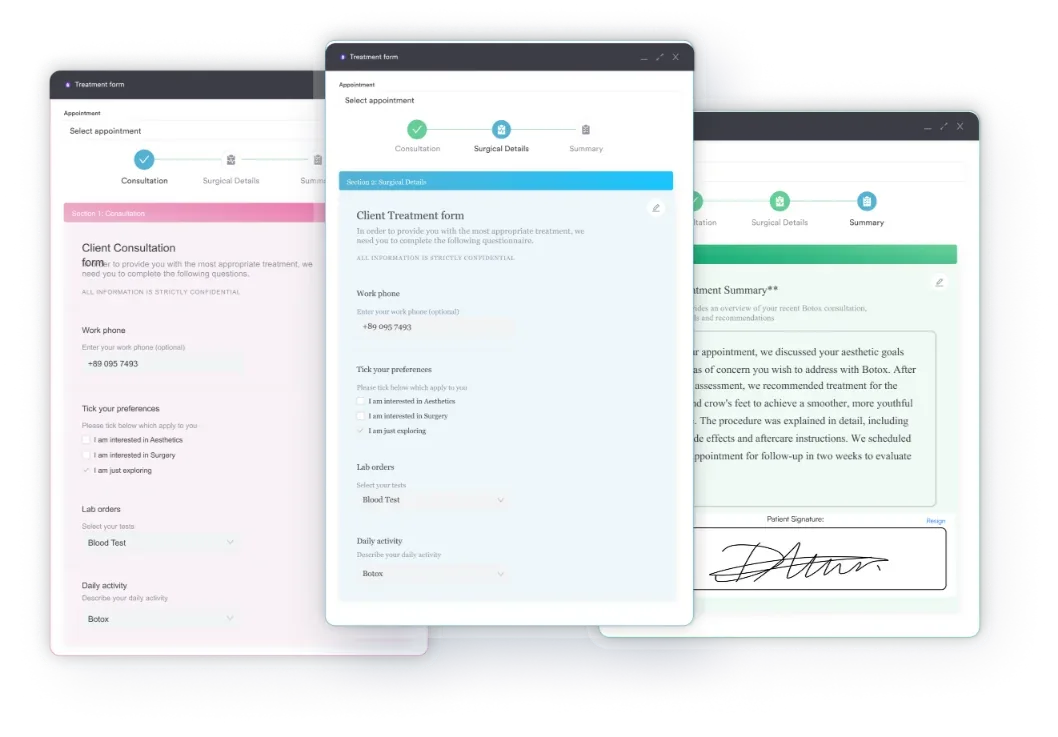

Pabau captures procedure and device detail on digital forms during the case, then carries it through to claim submission. Your billers work from the clinical record instead of a paper log.

C1887 is a small line on a big claim, and it behaves like one. On its own it adds no money. Left unsupported, it can still hold up everything else on the claim.
The fix is unglamorous. Capture the device detail while the case is still open. Keep the unit count honest, and send the claim on the form that setting actually uses. Do that consistently and the denial pile shrinks without anyone chasing it.
If your billing team is still rebuilding device lines from paper logs, that’s the part worth changing first. Book a demo to see how Pabau keeps procedure records and claim submission in one place for outpatient practices.

Billing the laser version of an angioplasty catheter? C1885 walks through where that code sits next to the non-laser option.
Working outside the cath lab? C1758 covers ureteral catheter reporting, with the same facility-claim rules in play.
Reporting an implantable cardiac generator? C1824 explains how a high-cost device code behaves under OPPS.
Billing the vascular imaging that comes before the intervention? 93970 covers bilateral duplex scanning of extremity veins.
Need another packaged device code worked through end to end? C1830 applies the same documentation logic to a powered biopsy needle.
Medicare doesn’t mandate one. Most hospital chargemasters map guiding catheters to a supply revenue code, commonly 0272 for sterile supply. The mapping is a chargemaster decision, so confirm it against your MAC’s billing guide before anyone changes it.
No. Medicare’s outpatient prior authorization program applies to a defined list of service categories, and guiding catheters are not on it. Any authorization requirement follows the procedure code, not the device line.
Not all of them. C-codes were built for Medicare facility reporting, so commercial contracts vary widely on whether the line is recognized, ignored or rejected. Check the payer’s facility billing guide before you assume it will process.
No. The Physician Fee Schedule prices professional services, and C1887 is a facility device line. Payment for it comes through OPPS or the ASC payment system, where it is normally packaged into the primary procedure.



