HCPCS Code J1110: Dihydroergotamine mesylate injection billing guide
HCPCS Code J1110: Official descriptor and drug overview HCPCS Code J1110 is the ...

Last Updated: Oct 29, 2026
C1842 is the HCPCS Level II code for a retinal prosthesis, including all internal and external components, reported as an add-on to C1841. It described the Argus II retinal prosthesis, used to treat severe retinitis pigmentosa.
CMS created C1842 on January 1, 2017, for ambulatory surgical center claims and terminated it on December 31, 2022. CMS lists no replacement code, so C1842 applies only to dates of service in that window.
Let Pabau's smart automation suggest the right codes, reduce claim denials, and keep your practice compliant—effortlessly.
Automate repetitive tasks and focus on what matters most—your patients.
Reduce coding errors and ensure compliance with the latest regulations.
Clean claims, fewer denials, and faster reimbursements.
Powerful insights and reporting to help your practice thrive.
HIPAA compliant SOC 2 certified GDPR-compliant Trusted by 4,000+ clinics worldwide

HCPCS Code C1842 reported the Argus II retinal prosthesis as an add-on to C1841, the primary retinal prosthesis code.
CMS terminated C1842 with a last valid date of service of December 31, 2022, and its HCPCS file names no replacement code.
CMS created C1842 in 2017 to fix an ambulatory surgical center claims issue and told hospital outpatient departments not to report it.
Under OPPS, C1842 carried status indicator E1 back to January 1, 2017, so Medicare did not pay it on hospital outpatient claims.
Today the code matters only for reopenings, appeals, audits and records requests on 2017 to 2022 dates of service.
HCPCS Code C1842 is a deleted Level II C-code for a retinal prosthesis, including all internal and external components, reported as an add-on to C1841. CMS calls it the Argus retinal prosthesis add-on code, after the Argus II Retinal Prosthesis System it was built for.
The official descriptor reads: Retinal prosthesis, includes all internal and external components; add-on to C1841. An add-on code never stands alone. C1842 only appeared on a claim alongside C1841, which described the same device, and the implantation procedure, CPT 0100T.
C-codes sit in the HCPCS Level II code set and normally serve the Medicare Outpatient Prospective Payment System (OPPS). C1842 was an exception, because CMS built it for ambulatory surgical center (ASC) claims rather than hospital claims.
Every fact in this table comes from CMS transmittals and the CMS HCPCS quarterly files.
The Argus II treats severe to profound retinitis pigmentosa, an inherited retinal disease that destroys the light-sensing cells of the retina. The FDA approved it in 2013 under humanitarian device exemption H110002.
The approved patient group is narrow. It covers adults aged 25 or older with bare light perception or no light perception in both eyes, who once had useful form vision. The surgeon implants the device in one eye, usually the worse-seeing one.
The system pairs an implanted electrode array on the retina with external parts the patient wears, including glasses carrying a small camera. That split explains the descriptor wording, which bundles internal and external components into one code.
On the diagnosis side, retinitis pigmentosa codes to ICD-10-CM H35.52, pigmentary retinal dystrophy. That is the diagnosis a reviewer expects to see next to the C1841 and C1842 lines on an Argus II claim.
No. The CMS HCPCS file records a termination date of December 31, 2022, for C1842, with the deletion effective January 1, 2023. C1841 carries the same termination date. The October 2026 HCPCS quarterly file still shows both codes with that end date.
CMS lists no cross-reference code for either one. The HCPCS file uses that field to point a deleted code at its successor, and it is blank here. No successor exists because the device left the market, so there is no current code to move these services to.
The withdrawal came first. In its July 2022 ASC update, CMS stated that the Argus II device was no longer available in the marketplace. It added that neither hospital outpatient providers nor ASCs were still performing the implantation.
Check the date of service before you touch a C1842 line. A service on or after January 1, 2023, cannot carry C1842 or C1841. A 2017 to 2022 service can, but only on an ASC claim for C1842.
CMS announced C1842 in Transmittal 3685, dated December 22, 2016. It took effect on January 1, 2017, with status indicator N. CMS said the code existed to resolve a claims processing issue for ASCs.
The same transmittal stated that hospital outpatient departments should not report C1842 on institutional claims. The code missed the CY 2017 annual HCPCS file. Medicare contractors added it by hand, following the January 2017 code editor update.
Transmittal 3728, dated March 3, 2017, then changed the OPPS status indicator from N to E1. E1 means Medicare does not pay the item on any outpatient bill type. CMS made that change retroactive to January 1, 2017.
Together, the two transmittals split the code by setting. An ASC claim reported C1841 and C1842 together, alongside the 0100T procedure line. A hospital outpatient claim left C1842 off, as Transmittal 3685 directed. The chart below maps how a C1842 line was treated by setting and date of service.
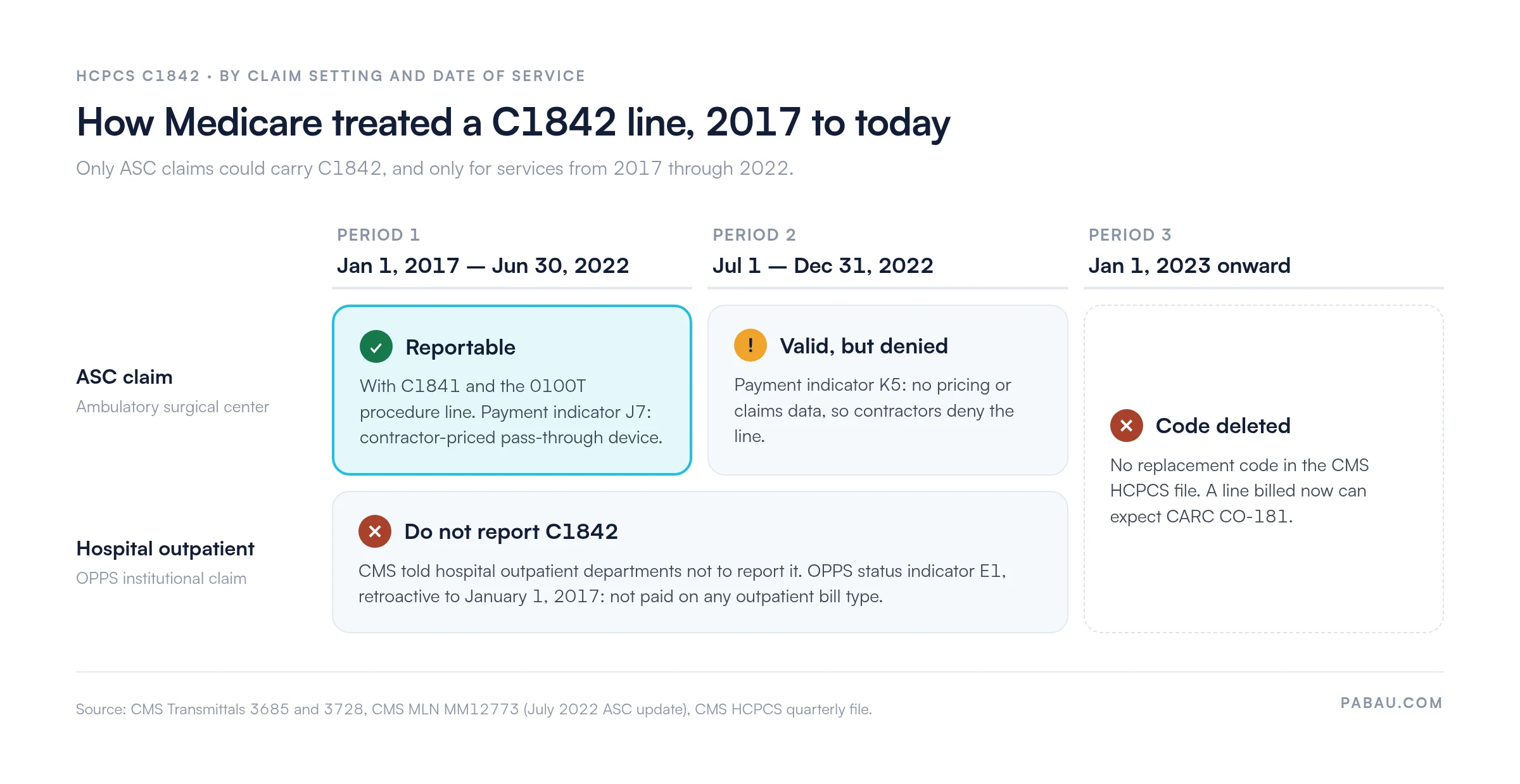
Medicare paid C1842 through the ASC payment system, not OPPS. Its ASC payment indicator was J7 by April 2022. J7 marks a pass-through device paid separately when it is integral to a surgical procedure on the ASC list. The Medicare contractor sets its price.
From July 1, 2022, CMS moved 0100T, C1841 and C1842 to payment indicator K5. K5 covers items for which pricing information and claims data are not available, and contractors deny those lines.
Because each Medicare contractor priced J7 lines itself, CMS never published one national rate for C1842. Treat any single dollar figure for the code with caution, and check the remittance or the contractor record for the claim in question.
C1841 and C1842 describe the same device, so the codes are a pair rather than alternatives. C1840 sits next to them numerically but describes a different ophthalmic implant.
If an operative note describes a telescopic lens implant, the device code is C1840. A retinal prosthesis never codes to C1840.
Medicare requires claims within 12 months of the date of service, so original C1842 claims are long past the filing window. The code now surfaces in reopenings, appeals, payer audits and records requests on 2017 to 2022 ASC services.
Sound medical billing compliance on those files rests on five elements in the record:
CMS instructions for C1842 name no required modifier. One modifier can still appear on these files. GX means a notice of liability was issued voluntarily under payer policy, so it only belongs where the ASC gave that notice.
The remittance advice explains each denied line with a claim adjustment reason code (CARC). These are the codes most likely to appear against C1842, with their official meaning.
A K5 line denied on or after July 1, 2022, reflects CMS policy rather than a coding error. Strong denial management starts with that distinction, because an appeal cannot change a payment indicator.
Commercial plans and Medicare Advantage plans set their own retinal prosthesis policies, and some required prior authorization for the implant. Several have since been retired or updated to note the deleted codes.
For any 2017 to 2022 claim, pull the archived policy version that applied on the date of service. A current policy will often say only that the codes were deleted, which does not settle an older claim.
An audit or appeal on a retired code turns on finding years-old paperwork quickly. Practices often split the operative note, consent forms and remittance across separate systems, so one request becomes a search through each of them.
Pabau, the practice management platform we build, keeps the clinical record, signed forms and invoices on one patient file. In the US, its claims management submits claims through Claim.MD and tracks their status, using data already on that record.
Pabau does not choose codes for you. Your coders still select every code. What changes is the retrieval, because the device note, the claim and its outcome sit together when a reviewer asks for them.

Pabau keeps clinical notes, signed forms and claim status on one patient record, so your team can answer an audit or appeal quickly.

Treat C1842 as a closed code. Use it only to read, correct or defend 2017 to 2022 ASC claims, and always beside C1841 and 0100T. For any later service, no Medicare code replaces it.
The work that remains is evidence. A file that ties the Argus II device, the operated eye and the diagnosis to one claim holds up. A file split across systems is far harder to defend. Book a demo to see how Pabau keeps device notes and claim records together for review.

Billing a different ophthalmic implant? HCPCS Code C1839 covers the iris prosthesis code and the procedure codes it is billed with.
Coding a telescopic lens instead? HCPCS Code C1840 explains the telescopic intraocular lens code that sits next to C1842.
Decoding a remittance line? Denial codes in medical billing maps common reason codes to their causes and fixes.
Want fewer resubmissions? What is a clean claim shows what a payer needs to process a claim on the first pass.
HCPCS Code C1842 described a retinal prosthesis, including all internal and external components, reported as an add-on to C1841. It was created for the Argus II Retinal Prosthesis System, which treats severe retinitis pigmentosa.
No. CMS terminated C1842 with a last valid date of service of December 31, 2022, and deleted it effective January 1, 2023. C1841 was terminated on the same date.
No code replaced it. The CMS HCPCS file lists no cross-reference code for C1842 or C1841. The Argus II device is no longer available, and the implant is no longer performed.
No. CMS created C1842 for ambulatory surgical center claims and told hospital outpatient departments not to report it. Its OPPS status indicator was E1, so Medicare did not pay it on outpatient bills.
Both codes describe the same retinal prosthesis. C1841 is the primary code, and C1842 is its add-on, which ASCs reported on the same claim as C1841 and the 0100T implantation procedure.
Retinitis pigmentosa codes to ICD-10-CM H35.52, pigmentary retinal dystrophy. The record should also document the severe visual loss that met the device criteria.