

HCPCS code E0198: Water pressure pad billing guide
HCPCS code E0198 is a water pad for a standard mattress HCPCS code E0198 is the ...

Last Updated: Oct 13, 2026
C1823 is the HCPCS Level II device code for a complete transvenous phrenic nerve stimulator system. It describes the remedē System, used for moderate to severe central sleep apnea. Its official descriptor is "Generator, neurostimulator (implantable), nonrechargeable, with transvenous sensing and stimulation leads."
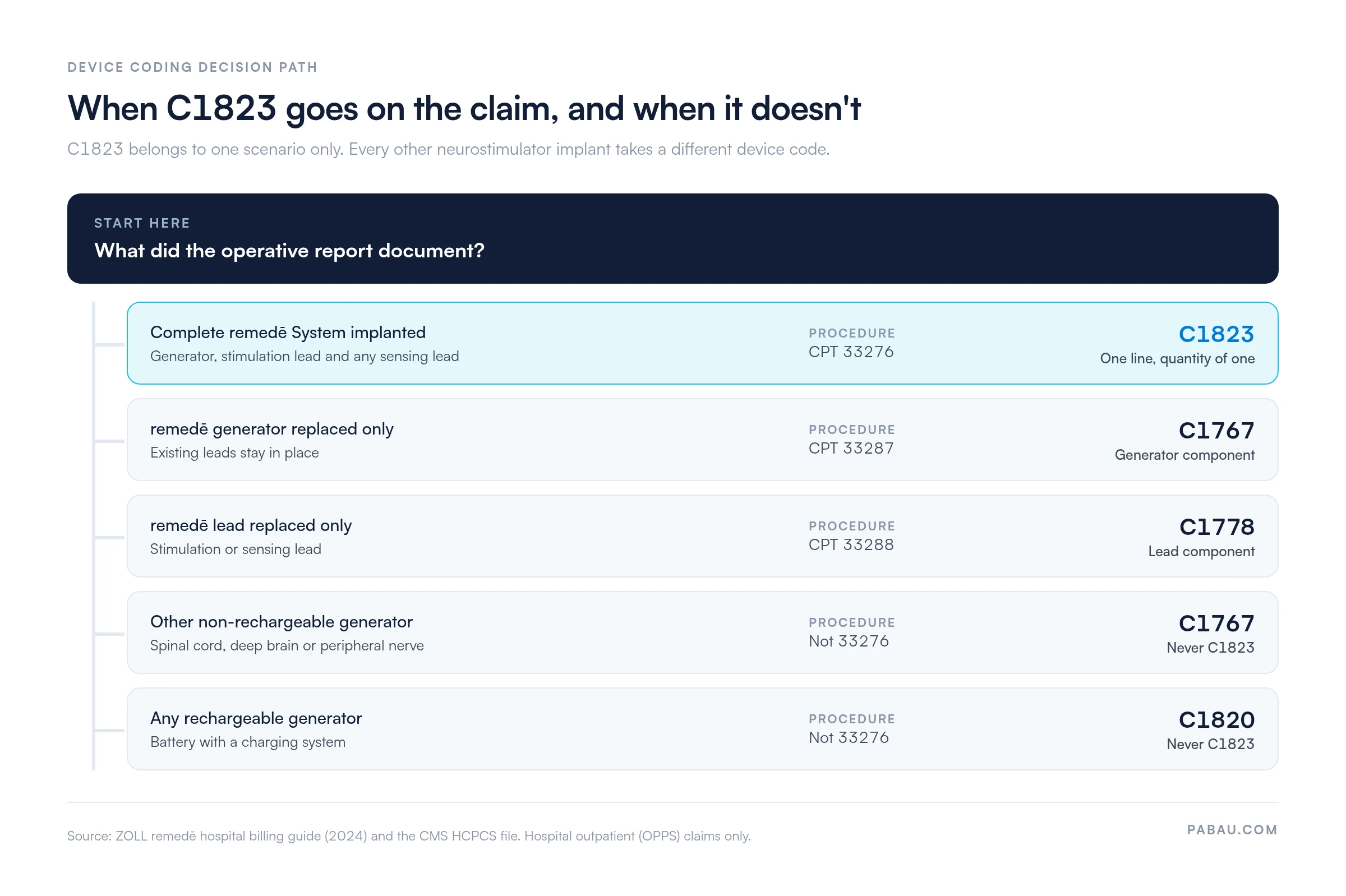
Hospitals report it on outpatient claims only with CPT 33276, on one line with a quantity of one. Other non-rechargeable neurostimulator generators belong to C1767, and their leads to C1778.
Let Pabau's smart automation suggest the right codes, reduce claim denials, and keep your practice compliant—effortlessly.
Automate repetitive tasks and focus on what matters most—your patients.
Reduce coding errors and ensure compliance with the latest regulations.
Clean claims, fewer denials, and faster reimbursements.
Powerful insights and reporting to help your practice thrive.
HIPAA compliant SOC 2 certified GDPR-compliant Trusted by 4,000+ clinics worldwide

HCPCS code C1823 reports the complete remedē transvenous phrenic nerve stimulator system for central sleep apnea, on one line with a quantity of one.
Bill C1823 only with CPT 33276, the complete-system insertion code that replaced Category III code 0424T on January 1, 2024.
C1823 is not a generic generator code, so other non-rechargeable neurostimulator generators go to C1767 and their leads to C1778.
Separate Medicare payment for C1823 ended on December 31, 2022, so the device cost is now packaged into the procedure payment.
Central sleep apnea codes such as G47.31 support the claim, and several commercial payers still class the therapy as investigational.
HCPCS code C1823 is the CMS device code for a complete transvenous phrenic nerve stimulator system, used to treat moderate to severe central sleep apnea. Its official descriptor is “Generator, neurostimulator (implantable), nonrechargeable, with transvenous sensing and stimulation leads.” CMS created it as a new pass-through device category effective January 1, 2019, in the January 2019 OPPS update transmittal.
The descriptor reads like a general generator code, but the “transvenous sensing and stimulation leads” clause ties C1823 to one therapy. Non-rechargeable spinal cord, deep brain, and peripheral nerve stimulator generators are reported with C1767 instead. Their permanent leads go to C1778, and any rechargeable generator is C1820.
C1823 covers one device, the remedē System, a transvenous phrenic nerve stimulator made by ZOLL Respicardia. The FDA approved it on October 6, 2017, for moderate to severe central sleep apnea in adults.
Central sleep apnea happens when the brain stops signaling the breathing muscles during sleep. The remedē System stimulates the phrenic nerve in the chest, which drives the diaphragm and restores the breathing signal. The system has up to three implanted parts, and C1823 reports all of them together.
Because one code describes the whole system, C1823 belongs to a complete implant, most often in a new patient. A generator replacement or a lead revision on an existing system is coded by component, as the sections below explain.
The costliest error on this code is treating it as a catch-all neurostimulator generator code. The table sets C1823 against its most common lookalikes, using descriptors from the ZOLL remedē hospital billing guide and the HCPCS file.
Two checks settle most cases. First, confirm the claim carries CPT 33276, because C1823 is wrong on any other procedure. Second, confirm the operative report names a remedē System, since a non-rechargeable spinal cord stimulator is C1767 however similar the descriptors look. The decision path below maps each implant scenario to its device code.
C1823 belongs to the C-series of HCPCS Level II codes, which CMS created for hospital outpatient billing. Hospitals report it under the Outpatient Prospective Payment System (OPPS) on the UB-04 or the 837I electronic claim. The device charge goes in revenue code 0278.
Ambulatory surgery centers (ASCs) can perform the implant, but they do not report C1823. Medicare pays 33276 in an ASC as a device-intensive procedure, so the device cost is already inside the procedure rate. CMS states that ASCs do not report packaged codes.
The implanting physician bills 33276 on the professional claim without the device code, because the facility buys and supplies the device. An inpatient implant is coded with ICD-10-PCS, such as 0JH60DZ for the generator, and paid through MS-DRGs 040 to 042.
Medicare has no National Coverage Determination for the remedē System, and coverage is decided case by case on documented medical necessity. ZOLL advises checking your Medicare Administrative Contractor (MAC) for any Local Coverage Determination before scheduling.
Traditional Medicare does not require prior authorization for the procedure. Medicare Advantage plans are run by commercial payers and may require it, so check the plan first.
C1823 entered the OPPS on January 1, 2019, with status indicator H, which marks a pass-through device, and its own pass-through APC, 2993. CMS also set a device offset of $20,626.59. That amount reflects the device cost already built into APC 5464, the 2019 procedure APC for the implant code 0424T.
Pass-through status was due to expire on December 31, 2021. In the CY 2022 OPPS final rule, CMS used its equitable adjustment authority to extend separate payment for four more quarters, through December 31, 2022.
Since then, the device cost has been packaged into the payment for the implant procedure. Packaged codes carry status indicator N, meaning no separate line-item payment. Report C1823 anyway, because CMS uses device charges to set future rates for 33276.
For CY 2024, CMS placed 33276 in New Technology APC 1580, status indicator S, with a national average payment of $45,000.50. APC assignments change every year, so check the current Addendum B before quoting a rate.
C1823 pairs with a single procedure code. CPT 33276 reports insertion of a complete phrenic nerve stimulator system, and ZOLL states that C1823 should only be used on claims with 33276. Category I codes 33276 to 33288 replaced Category III codes 0424T to 0436T on January 1, 2024.
ZOLL suggests reporting the procedure charges for 33276 in revenue code 0481, the cardiac catheterization lab. Claims for 2024 or later dates of service that still carry 0424T fail, because that code no longer exists.
The diagnosis must be central sleep apnea, because that is the only FDA-approved indication for the remedē System. The ZOLL billing guide lists the following ICD-10-CM codes.
Obstructive sleep apnea (G47.33) does not support C1823. Hypoglossal nerve stimulators for obstructive sleep apnea use CPT 64582 and different device coding, so confirm the operative report names the phrenic nerve.
Payers review a C1823 claim against the clinical record, and a missing document is the quickest route to a denial or a recoupment. Maintaining medical billing compliance for a device this costly starts with a pre-submission file check.
Ask the implant team to log every remedē component, including a sensing lead from another manufacturer, on one implant record. Billing can then build the single C1823 charge without chasing lead invoices after the procedure.
Commercial coverage varies more than Medicare coverage. Some plans review each case for medical necessity, while others class phrenic nerve stimulation for central sleep apnea as investigational.
Clinical guidance can support an authorization request. The American Academy of Sleep Medicine 2025 guideline gives transvenous phrenic nerve stimulation a conditional recommendation. It applies to adults with primary central sleep apnea, or central sleep apnea due to heart failure, who have failed other therapies.
ZOLL also runs the remedē Patient Access Program, which helps with prior authorizations and appeals. When a plan still classes the therapy as investigational, get a signed patient liability agreement before the procedure.
C1823 is reported on the hospital’s UB-04 alongside the implant procedure. Understanding the full medical billing workflow helps coders see where a device claim this costly is most likely to stall.
Most C1823 denials come from treating it like any other generator code. Knowing your payer’s denial management strategies before the claim goes out works better than appealing afterward.
Run three checks on every remedē claim before it goes out. Confirm 33276 is on the claim and C1823 sits on one line with a quantity of one. Then confirm the diagnosis is central sleep apnea.
The hospital files the C1823 claim, but much of its evidence starts in the sleep medicine or cardiology practice. The sleep study, the failed positive airway pressure trial, and the authorization paperwork often live in separate systems. The hospital billing team then chases them by email.
Pabau, the practice management platform we build, keeps that evidence on one patient record. Sleep study reports, treatment notes, and signed consent forms sit together, so the practice can send a complete file when the hospital or payer asks.
After the implant, ZOLL recommends follow-up every three to six months to check the battery and therapy settings. Pabau’s scheduling and automated reminders keep those visits booked, and its streamlined claims management handles the practice’s own programming and interrogation claims.

Pabau keeps sleep studies, consent forms, and follow-up visits on one patient record. Your practice can answer hospital and payer documentation requests without digging through separate systems.

C1823 rewards coders who read the descriptor to the end. The transvenous lead clause limits it to one system and one procedure code, and most C1823 errors trace back to ignoring that limit.
The coding fixes are simple and correctable on a resubmitted claim. Payer coverage is harder, because an investigational policy needs an authorization or an appeal before the implant. Start that work as soon as the sleep study confirms central sleep apnea. Book a demo to see how Pabau keeps sleep studies, authorizations, and follow-up visits on one patient record.

Want to reduce claim denials across your outpatient department? Denial management in healthcare covers the core strategies for reducing first-pass denial rates on complex claims.
Need a reference for denial reason codes? Denial codes in medical billing explains CARC and RARC codes that accompany rejected C-code device claims.
Building a compliant billing operation? Medical billing compliance outlines the documentation and audit requirements relevant to high-value outpatient device claims.
Coding a spinal cord or peripheral nerve generator instead? HCPCS code C1767 covers the non-rechargeable neurostimulator generators that C1823 excludes.
HCPCS code C1823 covers the complete remedē transvenous phrenic nerve stimulator system for central sleep apnea. That includes the non-rechargeable generator, the stimulation lead, and any sensing lead, reported together on one line.
No. C1823 describes a generator with transvenous sensing and stimulation leads, which fits only the remedē System. Non-rechargeable spinal cord, deep brain, and peripheral nerve generators use C1767, and rechargeable ones use C1820.
CPT 33276, insertion of a complete phrenic nerve stimulator system. ZOLL states that C1823 should only appear on claims carrying 33276. Before January 1, 2024, the pairing was Category III code 0424T, which has since been deleted.
No. CMS set a medically unlikely edit of one unit for C1823. Combine the generator, the stimulation lead, and any sensing lead into a single charge line with a quantity of one.
Not anymore. C1823 had pass-through status from January 1, 2019, and CMS extended separate payment through December 31, 2022. The device cost is now packaged into the procedure payment, but hospitals still report the code.
Central sleep apnea codes support it, chiefly G47.31 for primary central sleep apnea and G47.37 for central sleep apnea in conditions classified elsewhere. The ZOLL billing guide also lists G47.32 for high altitude periodic breathing.
No. An ASC can perform the implant, but Medicare pays 33276 there as a device-intensive procedure with the device cost packaged into the rate. ASCs do not report packaged device codes, so C1823 belongs on hospital outpatient claims.



