HCPCS code J3471: Hyaluronidase ovine injection billing guide
HCPCS code J3471: Descriptor, code type, and quick-reference data HCPCS code J34...

Last Updated: Oct 14, 2026
C1819 is the HCPCS Level II code for surgical tissue localization and excision device (implantable).
Denials on C1819 claims trace back to four causes. Two of them are billing errors, either the wrong care setting or a device cost CMS already packages into the procedure payment. The other two are documentation errors, a missing implant record or a diagnosis code that does not support medical necessity.
Let Pabau's smart automation suggest the right codes, reduce claim denials, and keep your practice compliant—effortlessly.
Automate repetitive tasks and focus on what matters most—your patients.
Reduce coding errors and ensure compliance with the latest regulations.
Clean claims, fewer denials, and faster reimbursements.
Powerful insights and reporting to help your practice thrive.
HIPAA compliant SOC 2 certified GDPR-compliant Trusted by 4,000+ clinics worldwide

HCPCS code C1819 covers single-use implantable tissue localization devices placed before surgical excision, distinct from reusable guidance instruments or wire localizers.
C1819 is restricted to hospital outpatient departments and ASCs under OPPS and the ASC payment system. Physician offices cannot bill this code.
CMS packaging rules may bundle the device cost into the procedure payment. Verify the current OPPS addendum before assuming separate reimbursement.
The operative report is the element most often missing from denied C1819 claims, so it belongs in the charge capture check.
Practice management software like Pabau tracks device-code claims, flags packaging status changes, and keeps the documentation checklist in one place.
HCPCS code C1819 carries the official descriptor: Surgical tissue localization and excision device (implantable).
It sits within HCPCS Level II, the code set maintained by the Centers for Medicare and Medicaid Services (CMS). HCPCS Level II captures supplies, devices, and services not described by CPT codes. C-series codes like C1819 are temporary outpatient codes created for the Hospital Outpatient Prospective Payment System (OPPS) and the ASC payment system.
The reference table below summarizes the classification attributes coders need when setting up the code in a chargemaster or submitting a claim.
C1819 covers single-use implantable devices placed inside the body before surgical excision. They mark or guide removal of a tissue target, most commonly a breast lesion. The device remains in the patient temporarily and is removed or retrieved during surgery. It is not a permanent implant.
Device categories that typically fall under C1819 include radar-reflector localizers, magnetic seed localizers, and radioactive seed localizers used for pre-surgical lesion marking. Radiology places these percutaneously before the operative procedure, and they serve as the target for the surgeon during excision.
Not every localizer maps to C1819. The code applies when the device is implantable or insertable and is used specifically for tissue localization and excision guidance. Non-implantable guidance tools, such as certain external ultrasound guidance systems, and reusable instruments do not qualify.
C1819 covers implantable tissue localization devices used for excision guidance. C1820 is a separate HCPCS code that describes a surgical tissue localization and excision device that is not implantable. The distinction is device construction. If the localization device stays inside the body until it is retrieved during surgery, use C1819. If the device is placed externally or does not meet the implantable definition, verify whether C1820 or another adjacent code applies.
When in doubt, review the device manufacturer’s specifications first. Then confirm the device category in the current CMS HCPCS code file or via the AAPC HCPCS code lookup.
C1819 is restricted to facility claims from hospital outpatient departments, billed under OPPS, and ambulatory surgery centers, billed under the ASC payment system. Physician offices, independent practices, and freestanding imaging centers cannot bill this code on a professional claim.
The C-series restriction exists because C-codes were created for the OPPS framework. Submitting a C-code on a CMS-1500 from a physician office will generate an edit error and denial. Before submission, confirm that the claim form, the billing NPI, and the facility taxonomy match the outpatient setting.
Three checks decide whether a C1819 line will pay, and two of them are settled before the claim form is chosen.
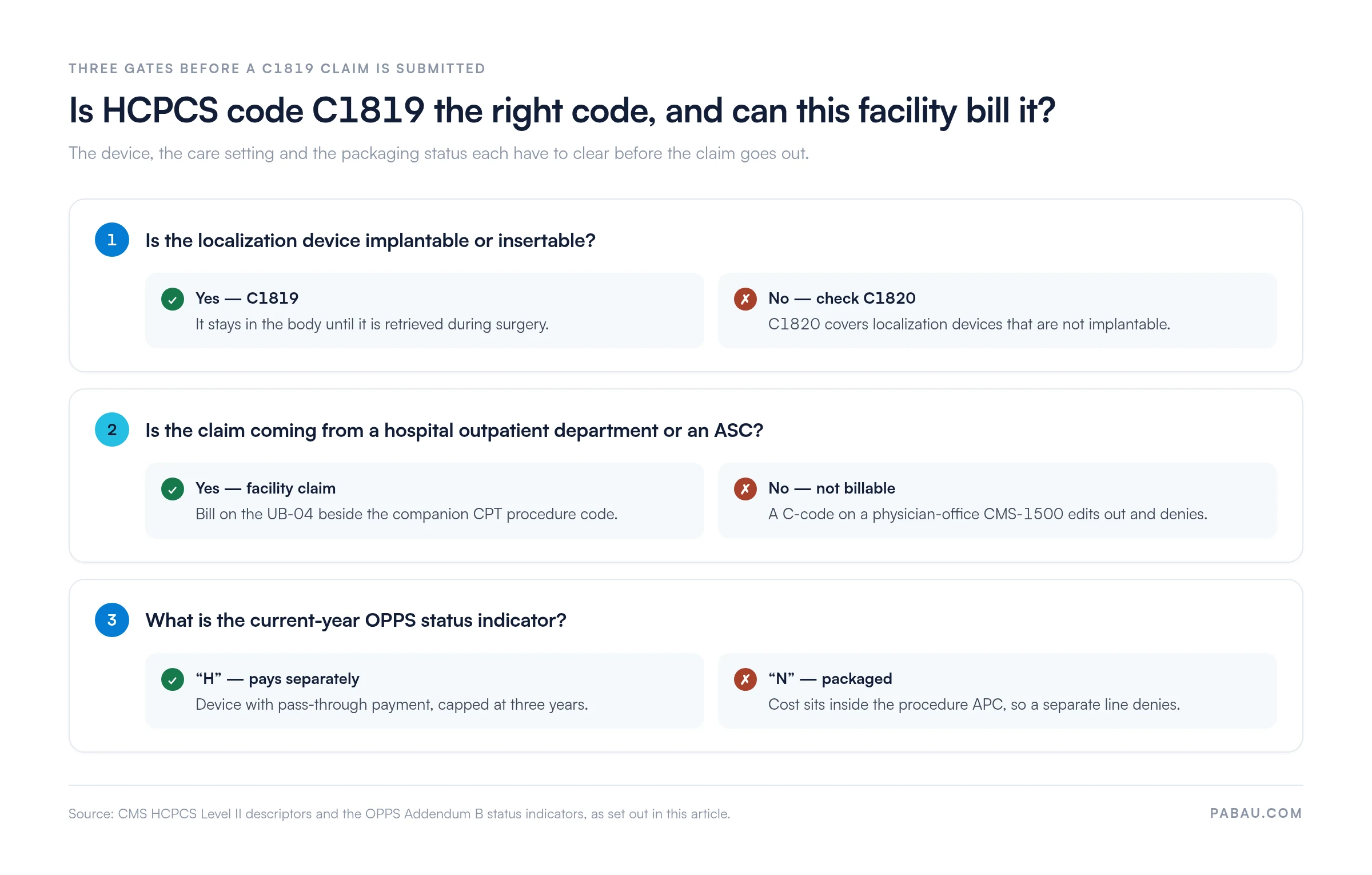
Medicare reimburses C1819 under OPPS through the APC (Ambulatory Payment Classification) assigned to the companion procedure, unless C1819 qualifies for separate pass-through payment. Pass-through status for device C-codes is temporary and lasts a maximum of three years from the date CMS grants it. After it expires, the device cost is packaged into the procedure APC payment.
Two practical steps come before billing:
Commercial and Medicaid payer coverage for C1819 varies. Some plans follow Medicare OPPS logic. Others have separate medical policies that govern device code reimbursement or require prior authorization. Always verify individual payer policy before assuming commercial coverage mirrors Medicare rates.
C1819 is a device code and does not describe a procedure on its own. It is always billed alongside a companion CPT procedure code on the same facility claim. The CPT code identifies what the surgeon did, and C1819 identifies the implantable device used to accomplish it.
Common companion CPT codes include:
Sequence the device code (C1819) after the primary procedure CPT code on the claim. Payers expect the procedure to drive medical necessity and the device code to follow as a supply item. Proper sequencing reduces the chance of an edit rejecting the claim before adjudication. Coordinate with your coding and OR supply chain teams to capture the device unit cost and lot number at implantation.
Payers adjudicating C1819 claims expect an ICD-10-CM diagnosis code that supports the medical necessity of surgical localization and excision. Breast neoplasm codes are the most common pairing, because most C1819 claims arise from breast lesion localization performed before lumpectomy or excisional biopsy.
Specificity matters. Code to the highest level of specificity the clinical documentation supports. If the operative report and pathology documents identify laterality and site, the diagnosis code must reflect that. Using an unspecified code when the record supports a specific one is an audit flag for Medicare and commercial payers alike.
Complete documentation separates a clean C1819 claim from a denial or a post-payment audit finding. The medical record must support every element of the claim. The device was implantable, it was used for surgical tissue localization and excision guidance, and it was implanted during the billed encounter.
The following elements must appear in the medical record to support a C1819 claim. Meeting clean claim standards for device codes takes radiology, OR nursing, and coding working together, since each group captures a different part of the record.
Build a C1819 charge capture checklist that radiology, OR nursing, and coders each complete before claim submission. Radiology confirms device placement documentation, OR nursing confirms the implant log sticker, and coders confirm the operative report names the device. A missing document caught at charge capture costs minutes to fix. The same document caught at denial costs weeks.
Medicare does not require prior authorization for HCPCS code C1819 as a standalone device code under standard OPPS billing. The companion surgical procedure, such as a partial mastectomy, may still require authorization from the Medicare Advantage plan or commercial payer. Authorization for the procedure generally covers the device when it is integral to that procedure.
Commercial and Medicaid managed care payers are another matter. Many have separate medical policies for tissue localization devices. Some plans require the facility to confirm which device technology is being used, and that the device meets their coverage criteria before the placement date. Check prior-authorization requirements for both the device and the companion excision procedure at scheduling.
Requirements change frequently. Build a process for verifying payer-specific authorization requirements each time a new device technology joins your facility’s supply chain.
C1819 denials cluster around four root causes. Each one is preventable once the coding and clinical teams coordinate on charge capture.
Implantable device billing under HCPCS code C1819 depends on departments that do not always communicate automatically. Three habits carry most of the weight for outpatient facilities billing C-codes: chargemaster accuracy, an OR-to-coding handoff, and annual OPPS verification.
Chargemaster accuracy: Confirm that C1819 is mapped to the correct revenue code in the chargemaster, and that the charge description reflects only implantable localization devices. A catch-all device charge that maps several device types to C1819 creates upcoding exposure. Keep the chargemaster device codes current each year, once the OPPS final rule is published.
OR-to-coding handoff: Establish a formal process where OR nursing captures device brand, model, and UDI at the time of implantation. That information then routes to the coding team before claim submission. Coders should not be reconstructing device details from a partial operative note.
Annual OPPS verification: CMS targets around November 1 for the OPPS final rule, which takes effect the following January 1. Recent years have slipped to mid or late November. Packaging status for C-codes can change with it. Build an annual review into the chargemaster update cycle, so C1819’s payment status is verified before the first claim of the new calendar year. Claims management software with payer rule tracking reduces the manual effort of monitoring these changes.
Run a quarterly internal audit of C1819 claims from the prior three months. Pull a sample of ten claims and trace each one back to the radiology report, operative report, and implant log. If an element is missing from more than two of them, the cause is the process rather than a one-off error. Fix the process before a payer finds it in an audit.
Most facilities track a device claim across three systems. The radiology report sits in imaging, the implant log sits with OR nursing, and the charge sits in the chargemaster. Coders reconcile the three by hand, often after the claim has already gone out.
Pabau, our practice management software, keeps the encounter, the clinical documentation, and the claim in one record. Coders can see whether the operative report names the device before the charge is released, rather than after a payer sends it back.
Claim status and denial reasons sit in the same place. A packaging change that starts denying C1819 lines shows up as a pattern instead of a run of one-off write-offs. Billing teams get the evidence to fix the chargemaster mapping once, instead of appealing claim by claim.

Pabau’s claims management tools track device-code claims, monitor packaging status changes, and surface missing documentation before submission. ASC and hospital outpatient teams get fewer denials and a cleaner C-code workflow.

Two of the three checks on a C1819 claim can be settled long before the patient is in the room. The device either meets the implantable definition or it does not. The facility either bills under OPPS or the ASC payment system, or it cannot bill the code at all. The third check, packaging status, moves with each OPPS final rule, so it belongs in the annual chargemaster review rather than in a coder’s memory.
What decides most C1819 denials is the operative report, and no billing rule fixes that from the coding desk. Get the OR to name the device and log the UDI at the time of implantation, and the rest of the claim follows. Book a demo to see how Pabau keeps device documentation and claim status in one record for outpatient and ASC billing teams.

Need device documentation that holds up to an audit? Medical billing compliance sets out the laws and violations that shape how practices document and bill implantable devices.
Want fewer denials on implantable device claims? Denial management in healthcare walks through the five-step process for finding, appealing, and preventing denied claims.
Curious how a device charge travels from the OR to the remittance? Revenue cycle management covers the seven steps from charge capture through payment posting.
HCPCS code C1819 covers implantable surgical tissue localization and excision devices. These are single-use devices placed inside the body before surgery to mark and guide removal of a tissue target, most commonly a breast lesion. The code applies in hospital outpatient departments and ambulatory surgery centers only.
Yes, Medicare reimburses C1819 under OPPS. Whether it pays separately or is packaged into the companion procedure’s APC payment depends on the current-year status indicator in the CMS OPPS addendum. Verify the status indicator each year, because packaging rules change with the OPPS final rule.
C1819 covers implantable or insertable tissue localization devices placed inside the body before surgery. C1820 covers tissue localization devices that are not implantable. The determining factor is whether the device meets the implantable definition, based on its construction and placement method.
Required documentation includes the radiology report confirming device placement and the operative report naming the device. The OR implant log must carry the device UDI and lot number. A signed physician order and a pathology report confirming excision of the tissue target are also required.
Yes, ASCs may bill C1819 when the companion surgical procedure is on the CMS-approved ASC covered procedures list. The ASC payment indicator for C1819 in the current ASC payment rates file decides whether reimbursement is separate, packaged, or not covered in that setting.
Four denial reasons come up most often. The first two are billing errors, an ineligible care setting or a device cost already packaged into the procedure APC payment. The other two are documentation errors, missing implant documentation in the operative report or an ICD-10 code that does not establish medical necessity.
Medicare fee-for-service does not require prior authorization for C1819 itself, but the companion surgical procedure may require authorization from a Medicare Advantage or commercial plan. Commercial and Medicaid managed care payers vary, so verify each payer’s tissue localization device policy before the procedure date.