HCPCS code J3471: Hyaluronidase ovine injection billing guide
HCPCS code J3471: Descriptor, code type, and quick-reference data HCPCS code J34...

Last Updated: Oct 14, 2026
C1783 is the HCPCS Level II code for ocular implant, aqueous drainage assist device.
The category covers the stent-based and tube-based implants placed during glaucoma surgery to lower intraocular pressure.
The code is active for 2026 and is reported separately from the surgical CPT code. It applies in hospital outpatient departments (HOPDs) and ambulatory surgical centers (ASCs). Payment is usually packaged into the Ambulatory Payment Classification (APC) for the procedure itself.
Let Pabau's smart automation suggest the right codes, reduce claim denials, and keep your practice compliant—effortlessly.
Automate repetitive tasks and focus on what matters most—your patients.
Reduce coding errors and ensure compliance with the latest regulations.
Clean claims, fewer denials, and faster reimbursements.
Powerful insights and reporting to help your practice thrive.
HIPAA compliant SOC 2 certified GDPR-compliant Trusted by 4,000+ clinics worldwide

HCPCS Code C1783 covers ocular implants that assist aqueous drainage, from micro-stents used in MIGS to traditional tube-shunt systems.
C1783 is billed in HOPD and ASC settings alongside a surgical CPT code. Payment is usually packaged within the APC for the glaucoma procedure.
Documentation must include the operative note, the implant sticker or manufacturer invoice, and a diagnosis that supports medically necessary glaucoma surgery.
Five pre-submission checks close the five denials that device-heavy ophthalmology claims attract most often.
Pabau’s claims management tools support accurate HCPCS Level II supply code entry, so ophthalmic billing teams see fewer denials on device cases.
HCPCS Code C1783 is an active HCPCS Level II supply code maintained by the Centers for Medicare and Medicaid Services (CMS). It describes an ocular implant that functions as an aqueous drainage assist device.
The code covers implantable devices placed surgically in the eye to create or enhance a drainage pathway for aqueous humor. That pathway lowers intraocular pressure (IOP) in patients with glaucoma. It sits within the C-series of HCPCS codes, reserved for outpatient facility device and supply reporting under the hospital Outpatient Prospective Payment System (OPPS).
The table below summarizes the key attributes of the code as they apply for the 2026 billing year.
Aqueous drainage assist devices treat glaucoma by creating a controlled pathway through which aqueous humor exits the anterior chamber of the eye, reducing IOP. Chronically elevated IOP is the primary modifiable risk factor for glaucomatous optic nerve damage. When topical medications and laser treatments fail to reach target pressure, surgical implantation of a drainage device is indicated.
The device category covered by C1783 spans a range of implant designs. It runs from micro-scale stents used in minimally invasive glaucoma surgery (MIGS) to larger tube-shunt systems. Assigning the code to the wrong implant puts a high-cost device charge on the claim under the wrong descriptor, and payers catch that on review.
Common device categories that have been reported under C1783 include:
Note: the Alcon CyPass Micro-Stent was withdrawn from the market in 2018 and is no longer a billable device. Coders should verify each device’s current FDA-approval status before assigning C1783.
HCPCS Code C1783 applies exclusively in outpatient facility settings. Physician offices and inpatient hospital stays do not use C-series supply codes, and those settings bill devices through different mechanisms. The two applicable settings carry different payment structures under Medicare.
Under the OPPS, CMS assigns most C-series device codes to an APC group tied to the primary surgical procedure. In practice, the facility fee for the glaucoma surgery already includes an assumption of device cost.
Whether C1783 receives separate payment or is fully packaged can shift year to year as CMS recalibrates APC weights. Coders should pull the current year’s OPPS Addendum B and confirm the active payment indicator before billing.
Medicare payment for HCPCS Code C1783 under the OPPS is tied to the APC assigned to the surgical procedure. There is no standalone device fee schedule rate. Because aqueous drainage device costs are usually packaged into the procedure APC, facilities do not always receive a discrete line-item payment for the device.
For ASC settings, CMS maintains a separate ASC payment system with its own payment indicators. Some device-intensive glaucoma procedures carry a device-offset payment or a separately payable status for the device. The specific payment indicator for C1783 in ASC settings can be confirmed in the annual CMS ASC Addendum AA and Addendum BB files.
Key reimbursement principles to apply when billing C1783:
For current 2026 payment figures, reference the official CMS OPPS Addendum B directly. Published third-party rates can lag behind mid-year CMS corrections. Remittance advice on paid and adjusted C1783 claims gives billing teams a practical benchmark for what each payer actually pays.
Pull the CMS OPPS Addendum B each October when the new payment year takes effect and flag any change in C1783’s status indicator. A shift from packaged to separately payable, or the reverse, causes systematic underpayments or overbilling that compounds across every glaucoma case until someone catches it.
Correct billing for HCPCS Code C1783 rests on three checks. Pair it with the right surgical CPT code, report accurate units, and supply documentation that proves both medical necessity and device identity. Missing any one of them is the most common reason a C1783 claim is denied or returned to the provider.
Report one unit of C1783 per device implanted. For bilateral glaucoma surgery in the same operative session, report two units with the appropriate modifier to distinguish eyes. Some payers prefer two separate line items instead. Verify bilateral rules against current National Correct Coding Initiative (NCCI) edits before submitting, since bundling edits between C1783 and companion CPT codes can apply.
The diagnosis on the claim has to carry the same specificity as the chart. Where the operative note records glaucoma without naming a type, the claim falls back to H40.9. Many payers read that as thin support for a drainage implant.
Each item on that list closes a specific denial. The pairing below maps the five pre-submission checks against the five rejections C1783 claims attract most often.
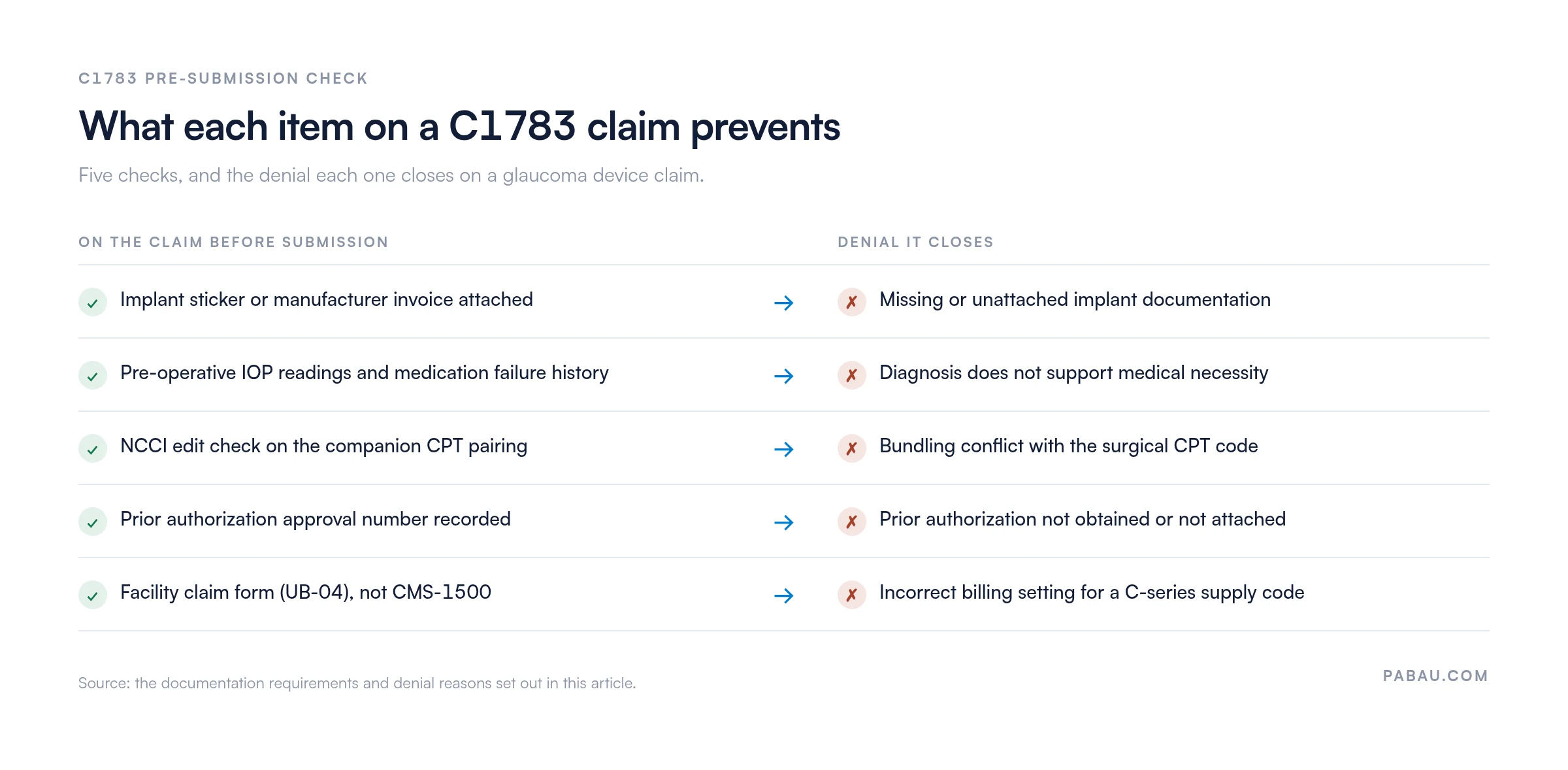
Flag missing sticker documentation before the claim leaves the billing department. That one check heads off most of the denial codes that device claims attract. For a MIGS case, that means the operative note, the device label, and the diagnosis codes. All three carry the same date of service on one UB-04 transaction.
Device claims also need a current mapping of which implant each manufacturer assigns to which HCPCS code. Manufacturers update their reimbursement guides when CMS issues a new code or reclassifies an existing one. A mapping built two years ago will be out of date.
Build a pre-submission checklist for glaucoma device cases. Check the CPT code, C1783 on the claim, the implant sticker, IOP documentation in the chart, and the prior auth number. Running that check before every case closes the three most common denial pathways for C1783 claims in a single workflow step.
HCPCS Code C1783 is never billed in isolation. It always accompanies a surgical CPT code that describes the operative procedure. The CPT code drives the APC assignment and the bulk of the facility payment, while C1783 reports the device itself. The codes below are the ones commonly paired with C1783 in glaucoma surgery billing.
Verify that the CPT-to-C1783 pairing you are billing does not trigger an NCCI edit before submission. The AAPC Codify HCPCS code lookup tool includes crosswalk data and edit indicators that help coders confirm valid code combinations.
Medicare covers aqueous drainage devices as part of medically necessary glaucoma surgery when IOP cannot be controlled by medications or laser treatment. Coverage is governed nationally by Medicare’s OPPS packaging rules. Locally, it follows the Local Coverage Determinations (LCDs) for glaucoma surgery issued by Medicare Administrative Contractors (MACs).
Commercial payer coverage for HCPCS Code C1783 varies widely across plans. The variables that decide it are:
Build a payer-by-payer coverage matrix for the glaucoma implants your surgeons use most often. It prevents last-minute auth failures and lets the scheduling team flag cases that need extra lead time. The NLM HCPCS Level II API gives programmatic access to code descriptions, which helps when that matrix is built as an internal tool.
C1783 is an established HCPCS Level II code that has stayed active across multiple coding years. Aqueous drainage devices remain in sustained clinical use in glaucoma surgery. CMS reviews C-series device codes annually as part of the OPPS rulemaking cycle. That review can change APC assignment and packaging status without changing the code descriptor.
Device-category codes like C1783 are occasionally supplemented when CMS decides a novel device type warrants its own descriptor. The annual CMS HCPCS update files are the reliable place to catch those additions before they reach a claim.
HCPCS Code C1783 sits where clinical documentation, device tracking, and claims accuracy meet. Manual handoffs between those three create most of the risk on a glaucoma device claim. The implant label lives in the operating room, and the claim is built somewhere else.
Practice management software like Pabau closes that distance. Pabau’s claims management software supports HCPCS Level II supply code entry alongside CPT procedure codes. Billing staff can build glaucoma surgery claim templates that pull C1783 automatically when the surgical CPT code is selected. The device line stops depending on someone remembering to add it.
Capturing device identity on the superbill at the point of service means the label data is already on file when the claim is built. Denials that trace back to missing device documentation stop reaching the payer at all.
Some practices run multiple surgeons across several procedure locations. A centralized system that flags missing implant stickers before submission closes the most common denial pathway on C1783 cases. No separate billing QA step is needed for every encounter.

Pabau’s claims management tools link HCPCS supply codes to surgical CPT codes for ophthalmic billing teams. They also flag missing documentation before submission and track remittance on device cases.

The work that decides whether a C1783 claim gets paid happens before anyone submits it. APC packaging status, NCCI edits, prior authorization, and device-specific coverage policies all land on the same glaucoma claim. Every one of them can be checked in advance.
Run the five checks above on every device case, and reconcile the status indicator each October when the new OPPS payment year starts. The trade-off is a few minutes per case against a denial that takes weeks to work back through appeals.
Pabau’s claims management tools pair C1783 with the right surgical CPT code and flag missing device documentation before the claim goes out. Book a demo to see how supply code billing works for an ophthalmology practice in Pabau.

Need to understand how claim denials are categorized? Denial codes in medical billing breaks down the CARC and RARC codes that turn up on remittances for device-intensive surgical claims.
New to facility billing workflows? What is medical billing covers the steps from encounter to payment that every supply code sits inside.
Want fewer first-pass rejections on surgical claims? Clean claim submission sets out what a payer needs on the first attempt, including the attachments device claims require.
Already working a backlog of denied device claims? Denial management in healthcare explains how to triage rejections by root cause instead of by date received.
Reconciling what Medicare actually paid? Electronic remittance advice shows how to read an ERA and spot underpayments on packaged device lines.
HCPCS Code C1783 is an active Level II supply code that describes an ocular implant functioning as an aqueous drainage assist device. It is used in outpatient glaucoma surgery to report the device cost separately from the surgical CPT code. It applies in hospital outpatient departments and ambulatory surgical centers billing under Medicare’s OPPS or the ASC payment system.
The most common pairings are 66183 (anterior segment aqueous drainage device, external approach) and 66179 (aqueous shunt to an extraocular equatorial plate reservoir). Two more apply by approach. Use 0449T for the internal approach into the subconjunctival space, and 66174 for viscodilation of Schlemm’s canal when a device is retained. For combined cataract and MIGS cases, 66989 or 66991 may accompany C1783.
Yes, C1783 is reportable in ASC settings, but the payment structure differs from HOPDs. CMS ASC payment indicators determine whether the device receives a separate payment or a device-offset payment tied to the companion CPT code. Check the current CMS ASC Addendum AA and Addendum BB files to confirm the specific payment indicator for the code year you are billing.
An aqueous drainage assist device is a surgically implanted ophthalmic device. It creates or enlarges a pathway for aqueous humor to drain from the anterior chamber of the eye, which reduces intraocular pressure. Examples include trabecular micro-bypass stents such as the iStent inject and subconjunctival gel stents such as the XEN Gel Stent. Tube-shunt systems such as the Ahmed Glaucoma Valve also qualify.
C1783 describes an aqueous drainage assist device, covering implants designed to lower IOP by creating a drainage pathway. Other C-series ocular implant codes cover different device functions, such as a new technology intraocular lens (C1780) or an integrated keratoprosthesis (C1818). Coders must match the specific device to the correct code descriptor. Billing C1783 for an IOL, or the reverse, is a coding error that can trigger an audit.
C1783 payment under Medicare OPPS is usually packaged within the APC for the glaucoma procedure. It is not paid as a separate line item, so there may be no discrete fee schedule rate for the device. Rates and packaging status can change annually with each OPPS final rule. Consult the official CMS OPPS Addendum B for the current 2026 APC assignment and payment indicator.