CPT code 93503: Swan-Ganz catheter billing and modifiers
CPT code 93503: Official descriptor and procedure overview In the AMA CPT code s...

Last Updated: Oct 23, 2026
A4660 is the HCPCS Level II code for a sphygmomanometer/blood pressure apparatus with cuff and stethoscope. It is billed as one item covering the gauge, the cuff and the stethoscope together.
The code sits in the dialysis supply range, next to A4663 (blood pressure cuff only) and A4670 (automatic blood pressure monitor). Medicare treats it as an ESRD supply that DME suppliers can't bill.
Let Pabau's smart automation suggest the right codes, reduce claim denials, and keep your practice compliant—effortlessly.
Automate repetitive tasks and focus on what matters most—your patients.
Reduce coding errors and ensure compliance with the latest regulations.
Clean claims, fewer denials, and faster reimbursements.
Powerful insights and reporting to help your practice thrive.
HIPAA compliant SOC 2 certified GDPR-compliant Trusted by 4,000+ clinics worldwide

A4660 describes a complete manual blood pressure kit: the sphygmomanometer, its cuff and a stethoscope, billed as one item.
Bill a cuff supplied on its own as A4663 and an automatic monitor as A4670, never as A4660.
CMS lists A4660 as a home dialysis supply that DME suppliers can’t bill to Medicare, because the ESRD PPS bundle includes it.
Commercial and Medicaid rules differ, so check the payer’s own dialysis policy before you bill A4660 outside the Medicare bundle.
Pabau keeps the order, treatment notes and invoice in one patient record, so billing staff can see what was dispensed before they code it.
HCPCS Code A4660 is the Level II code for a sphygmomanometer/blood pressure apparatus with cuff and stethoscope. The Centers for Medicare and Medicaid Services (CMS) maintains it within the A-series of medical and surgical supplies.
The code describes the whole manual apparatus as one line item. It sits in the dialysis equipment and supplies range, so it mostly appears on home dialysis claims.
The last two fields matter most for billing. Coverage code D sends you to the payer’s coverage instructions, and pricing indicator 00 means Part B sets no separate fee. The AAPC A4660 entry lists the same range.
A4660 covers one item: a manual blood pressure apparatus supplied together with its cuff and a stethoscope. The kit is the billable unit, so its parts are never billed as separate A4660 lines.
A replacement cuff for a patient’s existing device is not A4660. A cuff supplied without a gauge or stethoscope is coded A4663.
Under Medicare, A4660 is a home dialysis supply. CMS places it among the “DME ESRD supply HCPCS not payable to DME suppliers” in its ESRD PPS consolidated billing list.
Since the ESRD prospective payment system (PPS) began in 2011, home dialysis supplies are generally included in the dialysis facility’s bundled payment. A DME supplier therefore can’t bill A4660 to Medicare for a patient on dialysis.
Coverage code D means special coverage instructions apply. Check the ESRD chapter of the Medicare Benefit Policy Manual and your MAC’s guidance for the current rules. Before you bill, confirm these points:
Commercial payers follow their own policies. Aetna’s dialysis clinical policy bulletin (0541) lists A4660, A4663 and A4670 as covered when its selection criteria are met. Staying current with medical billing compliance requirements matters, because payer policies change.
Medicare rarely pays A4660 separately, so prior authorization seldom comes up for Part B claims. Commercial payers and Medicaid plans set their own rules, so confirm with each payer before dispensing.
No national list of accepted diagnoses applies to A4660. The supporting diagnosis normally documents the patient’s kidney failure and dialysis status, because dialysis is the coverage context.
Confirm the diagnosis rules with each payer before filing. When a dialysis patient needs the kit for an unrelated condition, document that condition and see the AY modifier below.
Three codes in the HCPCS code library describe blood pressure equipment in the dialysis supply range. The physical item dispensed decides which one applies, whatever the diagnosis.
The decision rule is short. A complete manual kit is A4660, a cuff on its own is A4663, and an automatic monitor is A4670. All three appear on the CMS list of ESRD supplies not payable to DME suppliers.
The chart below pairs that rule with the second check, which settles who can bill the kit.
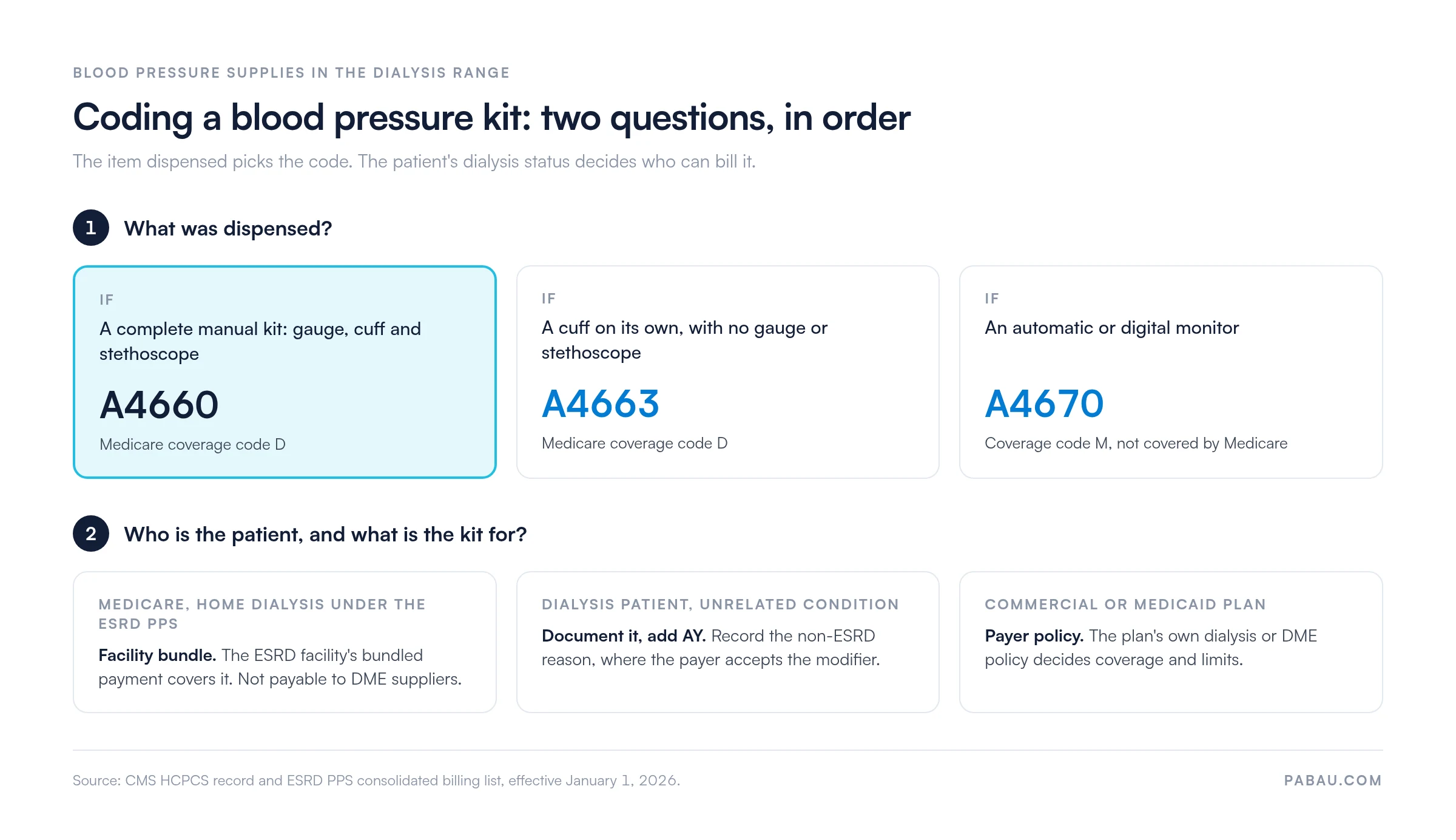
No modifier is required on every A4660 claim. Modifiers come into play when the item falls outside the dialysis bundle or when coverage is in doubt.
Use AY only when the medical record supports a non-ESRD purpose. Check your MAC’s guidance before you append any of these modifiers, because the rules vary by claim type.
Before you code a blood pressure kit, check three facts in order. Was a complete kit dispensed, or only a cuff? Is the patient on dialysis under the ESRD PPS? Is the kit for ESRD treatment or for an unrelated condition?
Who bills A4660 depends on the payer and the patient’s dialysis status. Understanding the medical billing workflow for supplies helps you route each claim to the right entity.
Physician practices that order home blood pressure monitoring do not normally bill A4660 themselves. The claim belongs to the facility or supplier that furnishes the kit.
CMS publishes no national fee for A4660. Its pricing indicator is 00, which means Medicare Part B does not price it separately.
Replacement intervals and quantity limits come from each payer’s policy rather than from the HCPCS record. Check that policy before you dispense a second kit to the same patient.
For other payers, confirm the allowed amount in their fee schedule or through the AAPC HCPCS code lookup. A rate quoted here would go stale, so always check the current figure.
The denial reasons below follow from the code’s descriptor and its payment status. Each one pairs with a prevention step. Strong denial management in healthcare starts with catching these errors before submission.
Work through this checklist in the order a biller reviews a claim. It keeps questions between the billing team and the ordering practice to a minimum.
Run this checklist before every transmission. Submitting a clean claim the first time spares you a denial, an appeal and a resubmission.
Before you dispense a second kit, check the patient’s claims history for an earlier A4660 or A4663. A payer that limits replacements will deny the duplicate, and an appeal takes longer than the check.
Dialysis and nephrology teams often keep orders in one system, supply notes in another and invoices in a spreadsheet. That split makes it hard to show which item a patient received.
Pabau, the all-in-one practice management system we build, keeps the patient record, treatment notes and invoicing in one place. Your billing staff can read the order and the dispensing note before choosing between A4660, A4663 and A4670.
The same record feeds Pabau’s claims software for billers, so the invoice and the notes behind it stay linked when you submit.
The outcome is fewer coding questions sent back to clinicians. When a payer asks for documentation, the order, the note and the invoice are already in the same record.

Pabau keeps orders, treatment notes and invoices with the patient record, so your team codes each blood pressure kit from what was dispensed. See it in action.

Code the item that went home with the patient, then check who is allowed to bill it. Run those two checks in that order and the denials in the table above rarely reach a payer.
For a Medicare dialysis patient, a DME claim for the kit won’t be paid, so catch it before dispensing rather than at the appeal. Outside that bundle, read the payer’s policy first, because it sets coverage, modifiers and replacement limits.
Keep the order, the dispensing note and the invoice in one record, and each of those decisions becomes easy to check. Book a demo to see how Pabau keeps that record together for your team.

Need a broader overview of DME billing compliance? Medical billing compliance covers the documentation and payer-policy requirements that apply across the DMEPOS supply code set.
Struggling with claim rejections before they become denials? Submitting a clean claim walks through the pre-submission validation steps that prevent the most common HCPCS code errors at the clearinghouse.
Want to understand how denial workflows are managed at scale? Denial management in healthcare explains how to build a systematic appeals and prevention process for DME and procedure code denials.
Dispensed an automatic monitor instead of a manual kit? HCPCS code A4670 covers the automatic blood pressure monitor and why Medicare doesn’t cover it.
Billing other home dialysis supplies? HCPCS code A4913 explains the catch-all code for dialysis supplies with no specific HCPCS code.
HCPCS Code A4660 covers a complete sphygmomanometer/blood pressure apparatus with its cuff and a stethoscope. It does not cover a cuff supplied on its own, which is A4663, or an automatic monitor, which is A4670.
A4660 is the complete manual kit with cuff and stethoscope, while A4663 is a blood pressure cuff only. Use A4663 when you supply a cuff without the gauge or stethoscope, such as a replacement cuff.
No national list of accepted diagnoses applies to A4660. Claims usually document end stage renal disease (N18.6) and dialysis status (Z99.2), but each payer sets its own rules.
No modifier is required on every A4660 claim. AY may apply when a dialysis patient needs the kit for an unrelated condition, and GA applies when you issued an ABN before dispensing.
The HCPCS record for A4660 sets no frequency limit. Any replacement interval comes from the payer’s own policy, so check it before you dispense a second kit to the same patient.
Medicare rarely pays A4660 separately, so prior authorization seldom comes up for Part B claims. Commercial payers and Medicaid plans set their own rules, so confirm with each payer before dispensing.
Not for a patient on dialysis, as a rule. CMS lists A4660 among ESRD supplies not payable to DME suppliers, because the dialysis facility’s bundled payment includes them.