CPT Code 28005: Foot bone cortex incision
CPT Code 28005: Definition and clinical scope CPT Code 28005 is the Current Proc...

Last Updated: Oct 22, 2026
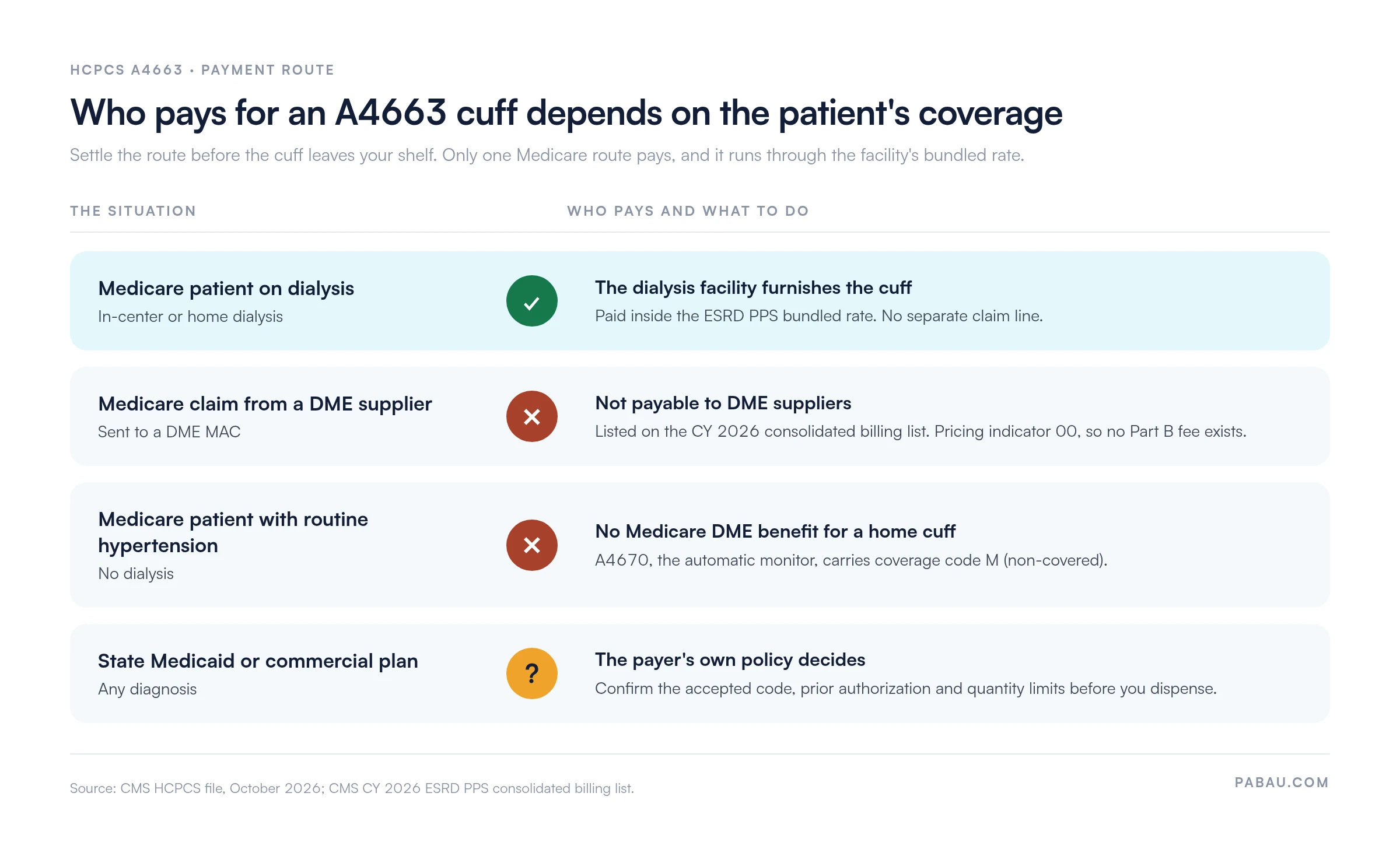
A4663 is the HCPCS Level II code for a blood pressure cuff only, which CMS labels a dialysis blood pressure cuff. It is an end-stage renal disease (ESRD) supply, so Medicare pays for it inside the dialysis facility's bundled payment rather than as a separate claim.
The CMS consolidated billing list marks A4663 as not payable to DME suppliers, and the HCPCS file shows no separate Part B price. Medicare has no home blood pressure cuff benefit for routine hypertension, so other payers decide coverage under their own policies.
Let Pabau's smart automation suggest the right codes, reduce claim denials, and keep your practice compliant—effortlessly.
Automate repetitive tasks and focus on what matters most—your patients.
Reduce coding errors and ensure compliance with the latest regulations.
Clean claims, fewer denials, and faster reimbursements.
Powerful insights and reporting to help your practice thrive.
HIPAA compliant SOC 2 certified GDPR-compliant Trusted by 4,000+ clinics worldwide

HCPCS Code A4663 describes a blood pressure cuff only, which the CMS short descriptor calls a dialysis blood pressure cuff.
The CY 2026 ESRD PPS consolidated billing list places A4663 among supplies that are not payable to DME suppliers.
Medicare pays for the cuff inside the dialysis facility’s bundled ESRD payment, and the HCPCS file shows no separate Part B price.
Medicare has no DME benefit for a home blood pressure cuff or monitor for routine hypertension, and it lists A4670 as non-covered.
State Medicaid programs and commercial plans set their own rules, so confirm the accepted code and coverage before you dispense.
HCPCS Code A4663 is the code for a blood pressure cuff only, and CMS labels it a dialysis blood pressure cuff in its short descriptor. It sits in the A-series of HCPCS Level II codes, which CMS maintains for supplies, equipment and services that CPT does not describe.
The code is an end-stage renal disease (ESRD) supply. Medicare pays for it as part of a dialysis facility’s bundled payment, not as a separate claim line. The reference data below comes from the October 2026 CMS HCPCS file.
A4663 reports the inflatable cuff on its own, without a gauge, a stethoscope or an electronic monitor. The HCPCS file classes it as an ESRD supply, so the code describes a cuff used in dialysis care.
Two neighboring codes describe the larger pieces of equipment, and neither one should be reported as A4663:
All three codes appear on the same CMS consolidated billing list, so swapping one for another does not create a Medicare payment path.
Since January 1, 2011, Medicare has paid dialysis facilities a single bundled rate under the ESRD prospective payment system (PPS). That rate covers renal dialysis drugs, laboratory tests, supplies and services, for in-center and home dialysis patients alike.
Consolidated billing makes the facility responsible for those items, so no other supplier bills Medicare for them separately. CMS publishes the affected codes each year. The CY 2026 ESRD PPS consolidated billing list places A4663 among supplies not payable to DME suppliers.
In practice, that leaves three consequences for anyone handling the code:
The HCPCS file adds a Medicare processing note that points to special coverage instructions (coverage code D).
Before you dispense a cuff, check the patient record for dialysis status. If a facility provides their dialysis, the cuff belongs to that facility’s ESRD bundle.
Medicare has no DME benefit that pays for a home blood pressure cuff or monitor for routine hypertension. A claim that sends A4663 to a DME MAC with a hypertension diagnosis and a physician order still has no coverage policy behind it.
Medicare does pay for blood pressure monitoring in other forms. Medicare’s ambulatory blood pressure monitoring coverage (NCD 20.19) pays for a once-a-year monitoring test to diagnose suspected white coat or masked hypertension. It does not pay a supplier for a cuff the patient keeps. Self-measured blood pressure monitoring is billed by the practitioner under CPT codes 99473 and 99474, which pay for training and for reviewing readings.
The self-measured monitoring codes do not reimburse a supplier for the device either. Modifiers such as NU or KX do not change that. A modifier cannot create coverage for a code CMS has not priced for Part B.
Because A4663 is a dialysis supply, the diagnoses that explain it come from kidney failure and dialysis dependence. The facility record usually carries ICD-10-CM codes such as these:
These codes document why the patient needs blood pressure checks around dialysis. They do not turn the cuff into a separately payable Medicare item.
Outside Medicare, coverage depends on each payer’s own policy. State Medicaid programs publish their own DME fee schedules and coverage rules, and some cover home blood pressure equipment for hypertension. A plan may accept A4663 for a replacement cuff, A4660 for a manual kit, A4670 for an automatic monitor, or none of them.
A short benefit check prevents most of the rework on these claims:
The related codes share the same ESRD listing, but their Medicare coverage codes differ. The HCPCS file assigns each one a code that tells you how Medicare treats it.
HCPCS Code A4670 is the code a non-Medicare payer may accept for an automatic home monitor, but only where its own policy says so. For a Medicare patient, coverage code M means Medicare does not cover the device. Settle who pays with the patient before the monitor is dispensed.
Most A4663 problems start with the same mistake, which is treating the code as a Medicare home-monitoring supply. The chart below routes the cuff by coverage, and the fixes after it follow from the ESRD rules above.
Recording the payer check on every supply line supports medical billing compliance. Pre-bill checks for clean claim submission then catch coding slips before the claim leaves the practice.
Supply claims like A4663 go wrong when the payer, the patient’s dialysis status and the code sit in three different places. Your team then pieces the story together only after a denial arrives.
Pabau, the practice management and billing software we make, keeps patient records, insurance details and invoices together. Its claims management software pulls the data already in the record into a pre-filled claim. It then submits the claim and tracks its status for US payers through Claim.MD.
Your billing team still chooses the code and any modifiers. Pabau keeps the evidence behind that choice in one place, so a payer query on a supply line gets answered from the record.
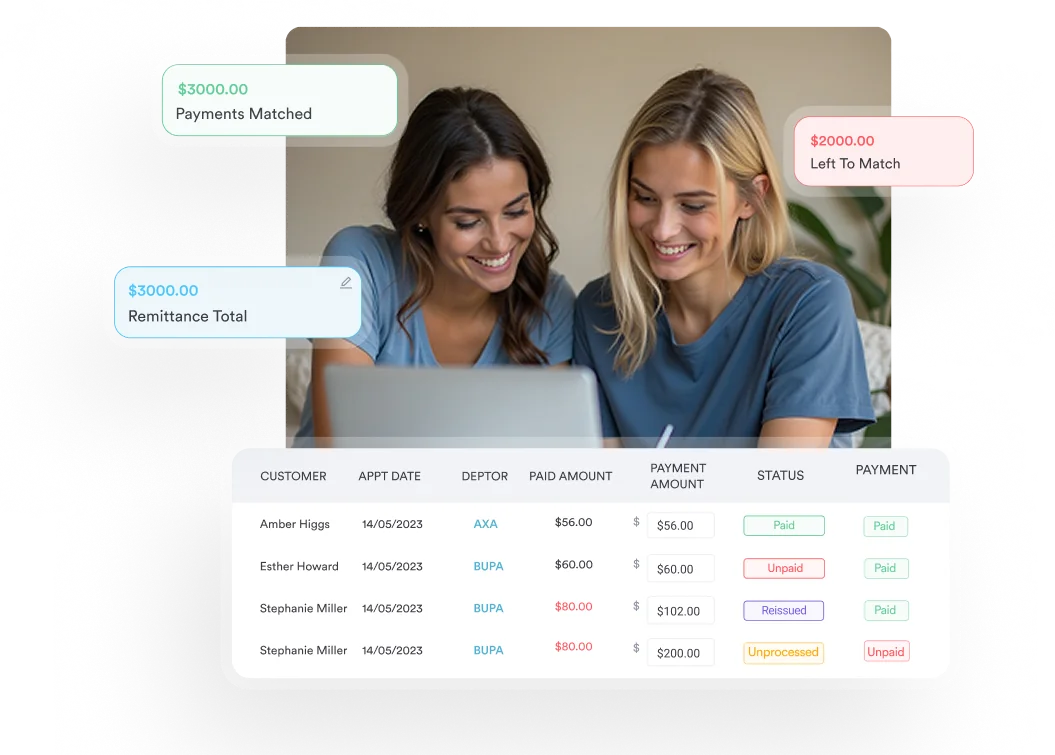

Pabau pulls the details already in your patient records into pre-filled claims, then submits and tracks them. Supply-claim queries get answered from one place.

Treat A4663 as a dialysis code first. Before a cuff leaves your shelf, confirm whether the patient is on dialysis and who pays for that care. The answer decides whether the item belongs to a facility’s bundle or to a separate payer claim.
If you supply home blood pressure equipment to patients with hypertension, take coverage from the payer’s own policy, not from Medicare. A written benefit check costs one phone call, while a recouped supply claim costs hours of staff time.
Book a demo to see how Pabau keeps records, invoices and claims together for supply billing.

Billing the automatic monitor instead? HCPCS Code A4670 covers the automatic blood pressure monitor code and how payers treat it.
Need to understand the broader billing landscape? What is medical billing walks through the full revenue cycle from claim creation to payment posting.
Seeing repeated denials on supply claims? Denial management in healthcare covers systematic approaches to reducing rejection rates across payers.
Want to improve claim accuracy at the source? Medical billing compliance explains the documentation standards that keep claims clean from day one.
HCPCS Code A4663 describes a blood pressure cuff only. The CMS short descriptor calls it a dialysis blood pressure cuff, and the HCPCS file classes it as an ESRD supply.
No. CMS lists A4663 on its ESRD PPS consolidated billing list as a supply not payable to DME suppliers. Medicare pays for it inside the dialysis facility’s bundled payment, and the HCPCS file shows no separate Part B price.
A4663 is the cuff only, while A4670 is an automatic blood pressure monitor. Both appear on the ESRD consolidated billing list. The HCPCS file gives A4670 coverage code M, which means Medicare does not cover it.
No. Medicare has no DME benefit for a home blood pressure cuff or monitor used for routine hypertension. Its ambulatory blood pressure monitoring coverage (NCD 20.19) pays for a once-a-year monitoring test to diagnose suspected white coat or masked hypertension. It does not pay a supplier for a cuff the patient keeps.
Yes, if that payer’s own policy covers it. Coverage, the accepted code and any prior authorization vary by state Medicaid program and by plan, so confirm in writing before you dispense.