



HCPCS code E0198: Water pressure pad billing guide
HCPCS code E0198 is a water pad for a standard mattress HCPCS code E0198 is the ...

Last Updated: Oct 13, 2026

CPT Code 99201 was a new patient office visit code, and the AMA deleted it effective January 1, 2021.
The 2021 E&M overhaul dropped history and exam as required documentation factors, so code selection now rests on MDM or total time.
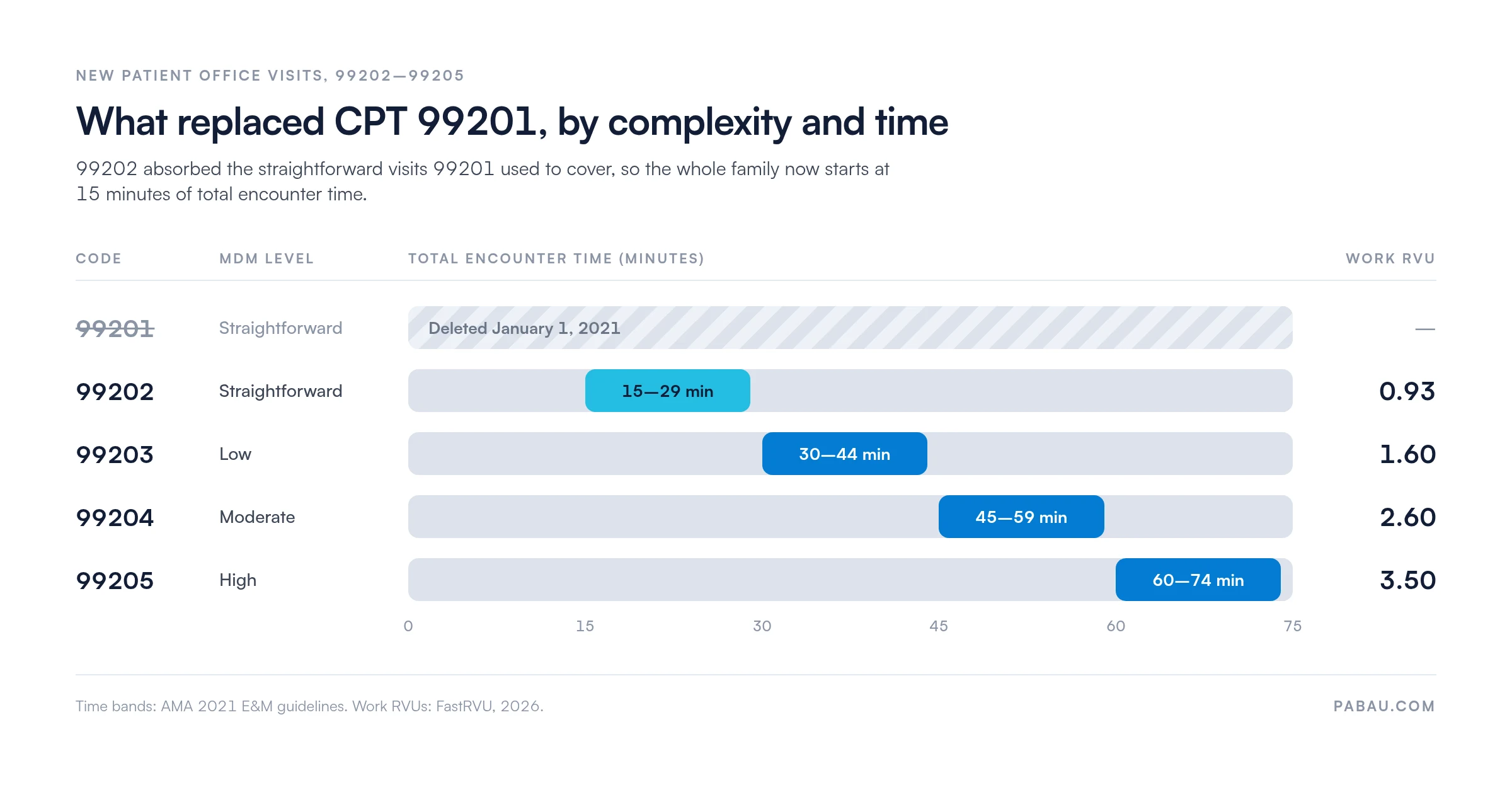
CPT 99202 is the direct replacement for straightforward new patient visits, and 99203 through 99205 cover higher complexity.
Work RVUs run from 0.93 for 99202 to 3.50 for 99205, so the level you document changes what the visit is worth.
Pabau’s claims tools carry the documented MDM level and total time into the claim, which keeps coding errors out of submission.
CPT Code 99201 was the lowest-level office or other outpatient visit code for new patients, and it is no longer billable.
The American Medical Association (AMA) deleted it on January 1, 2021, in the largest overhaul of office-based evaluation and management (E&M) codes in decades. Coders still meet it in legacy systems, old charge sheets, and practice management platforms that were never updated after the change.
This reference covers what CPT Code 99201 described, why the AMA deleted it, and how the replacement codes 99202 through 99205 work. It also shows how MDM and total encounter time now drive code selection for new patient office visits.
CPT Code 99201 was the lowest-level new patient office or other outpatient visit code in the E&M code family. The 1995 and 1997 E&M documentation guidelines governed it, and billing it required three documentation elements. A coder needed a problem-focused history, a problem-focused examination, and straightforward medical decision making (MDM). All three had to be met before the code could be submitted.
The code was valid from the original 1992 CPT code release through December 31, 2020. Any claim carrying 99201 for a date of service on or after January 1, 2021 will be denied. That holds for Medicare, Medicaid, and most commercial insurers. There is no grace period and no equivalent crosswalk that makes 99201 acceptable under a different format.
One core problem drove the 2021 E&M overhaul. The old documentation framework created heavy administrative burden without improving patient care. Clinicians spent more time documenting history elements and physical exam components to satisfy billing requirements than they spent on clinical reasoning. The CPT Editorial Panel worked with the Centers for Medicare and Medicaid Services (CMS) and restructured the entire office-based E&M code family.
Three specific changes drove 99201’s deletion:
The AMA announced the deletion through its CPT Editorial Panel process, and published formal notice ahead of the January 1, 2021 effective date. Practices that never updated their charge masters, EHR templates, or billing software met a wave of denials in early 2021. Each one needed a corrected claim.
Audit your EHR and billing software charge master for any active CPT Code 99201 line items. A platform updated in 2021 can still hold 99201 in custom templates, macro sets, or legacy encounter types built before the transition. One audit query prevents recurring denials.
CPT 99202 is the direct replacement for CPT Code 99201. It is the lowest-level active new patient office visit code. It applies when MDM complexity is straightforward, or when total encounter time reaches 15 to 29 minutes. The full replacement family runs from 99202 through 99205 and covers straightforward through high complexity.
These codes differ from the pre-2021 system in one important way. None of them requires a set number of history elements or exam components. A clinician who documents thorough reasoning for a complex case can bill 99205 with a brief exam section. The MDM or time threshold still has to be met and recorded.
The chart below lines the four replacement codes up against their time bands and their work RVUs, with 99201’s old slot marked for reference.
Medical decision making is the primary driver for selecting among 99202 through 99205. The AMA defines MDM using three elements. A clinician must meet or exceed two of the three to qualify for a given code level.
Meeting two of three MDM elements at a given level qualifies for that code. Take a visit with one minor self-limited problem, which is minimal complexity. If it also requires a review of external records and lab orders, the data element reaches limited, and the visit qualifies for 99203. Clinicians should document which MDM elements support the selected level, not just the code itself.
When total encounter time more clearly reflects visit intensity than MDM, clinicians may use time-based billing instead. This is a significant departure from the pre-2021 framework, where time billing was only an option when counseling or coordination of care dominated the visit.
Under the 2021 AMA guidelines, total encounter time includes both face-to-face and non-face-to-face work performed on the date of service. This covers pre-visit chart review, ordering tests, writing notes, and coordinating care, not just the time spent in the room with the patient. The time thresholds in the table above must be met or exceeded to bill at that level.
Selecting the correct replacement for CPT Code 99201 comes down to a consistent workflow. Practices that standardize the six steps below see fewer downcoded claims and fewer audit flags.
Some practices default to 99202 for every new patient, whatever the complexity. That habit undercodes the visit and leaves reimbursement on the table. Overcoding without documentation support carries the opposite problem, since it invites an audit and a recoupment.
Medicare payment for 99202 through 99205 varies by year and by geographic location. The CMS Physician Fee Schedule lookup tool publishes current-year payment rates by locality. Approximate work RVU values are listed below for reference. A work RVU is not a payment amount on its own, so check the CMS tool before you build any reimbursement projection.
The work RVU figures above are approximate, and they come from the FastRVU 2026 RVU lookup tool. Medicare turns a work RVU into a payment by applying the annual conversion factor, the practice expense and malpractice RVUs, and locality adjustments. Use the CMS Physician Fee Schedule for precise current-year amounts. Checking those amounts against your remittance advice shows what Medicare paid per code.
Run a quarterly comparison between the codes you submitted and the complexity your notes support. A steady lean toward 99202 where the documentation would carry 99203 or 99204 is systematic undercoding. At 0.93 work RVUs against 1.60, it compounds fast.
The 2021 E&M changes shifted the compliance burden from documentation volume to documentation precision. A practice with no structured way to capture MDM or total time carries more exposure to both undercoding and audit. Software that connects the note to the claim removes most of that exposure.
Practice management software like Pabau keeps the encounter note and the claim on one record. Pabau’s claims tools for billers carry the documented MDM level and total encounter time through to submission, so nobody retypes a code between systems. For US practices, Pabau submits electronically through Claim.MD, its clearinghouse partner, in the CMS-1500 and 837P formats.
Eligibility checks, claim status, and remittance responses all sit against the same encounter. A biller sees the code, the note behind it, and the payer’s answer without switching screens. That shortens the path from a documented E&M visit to a paid claim, and it keeps 99201 out of the charge master.

Pabau keeps the MDM level and total encounter time attached to the claim it supports, so E&M codes leave the practice accurate the first time. Claim status and payer responses land in the same record.

Treat 99201 as a maintenance problem rather than a coding question. Delete it from the charge master, the encounter templates, and the macros, and the denials stop at the source instead of at the payer.
From there the work is judgment rather than compliance. Pick MDM or total time for each visit, apply it consistently, and document which one drove the level. Practices that hold that discipline bill 99203 and 99204 when the visit earns it, instead of defaulting to 99202 and absorbing the difference.
Book a demo to see how Pabau keeps E&M documentation and claim submission on one record for your practice.

Need a clearinghouse for E&M claim submission? Medical claims clearinghouse guide explains how clearinghouses validate and route claims to payers electronically.
Seeing recurring denials on your E&M claims? Claim.MD clearinghouse overview covers how Pabau’s integration handles eligibility, claim scrubbing, and remittance.
Want to understand how payer reimbursement flows back to your practice? Best medical billing software for US practices compares platforms supporting E&M workflows and clearinghouse connectivity.
CPT Code 99201 was the lowest-level new patient office or other outpatient visit code in the AMA E&M code family. It required a problem-focused history, a problem-focused examination, and straightforward medical decision making. The AMA deleted it effective January 1, 2021, so it cannot be billed for any later date of service.
The AMA deleted CPT Code 99201 because it was functionally redundant with 99202, since both required straightforward MDM. The 2021 E&M overhaul eliminated problem-focused history and examination as standalone billing factors, making the distinction between 99201 and 99202 meaningless under the new framework.
CPT 99202 replaced CPT Code 99201 as the lowest-level new patient office visit code. It applies when MDM is straightforward or total encounter time is 15 to 29 minutes. The full new patient E&M code family now runs from 99202 (straightforward) through 99205 (high complexity).
No. CPT 99201 has been invalid for billing since January 1, 2021. Claims submitted with this code for any date of service from 2021 onward will be denied by all payers, including Medicare and commercial insurers. There is no workaround or modifier that reactivates it.
Straightforward MDM means the visit involves minimal problems (one self-limited or minor problem), minimal or no data review, and minimal risk of complications. Under the 2021 AMA guidelines, meeting two of three MDM elements at the straightforward level qualifies a new patient visit for CPT 99202.
Yes. The 2021 E&M guidelines allow time-based billing for new patient office visits, 99202 through 99205. Total encounter time counts both face-to-face and non-face-to-face work performed on the date of service. The clinician must document that total and confirm it meets the code’s threshold.



